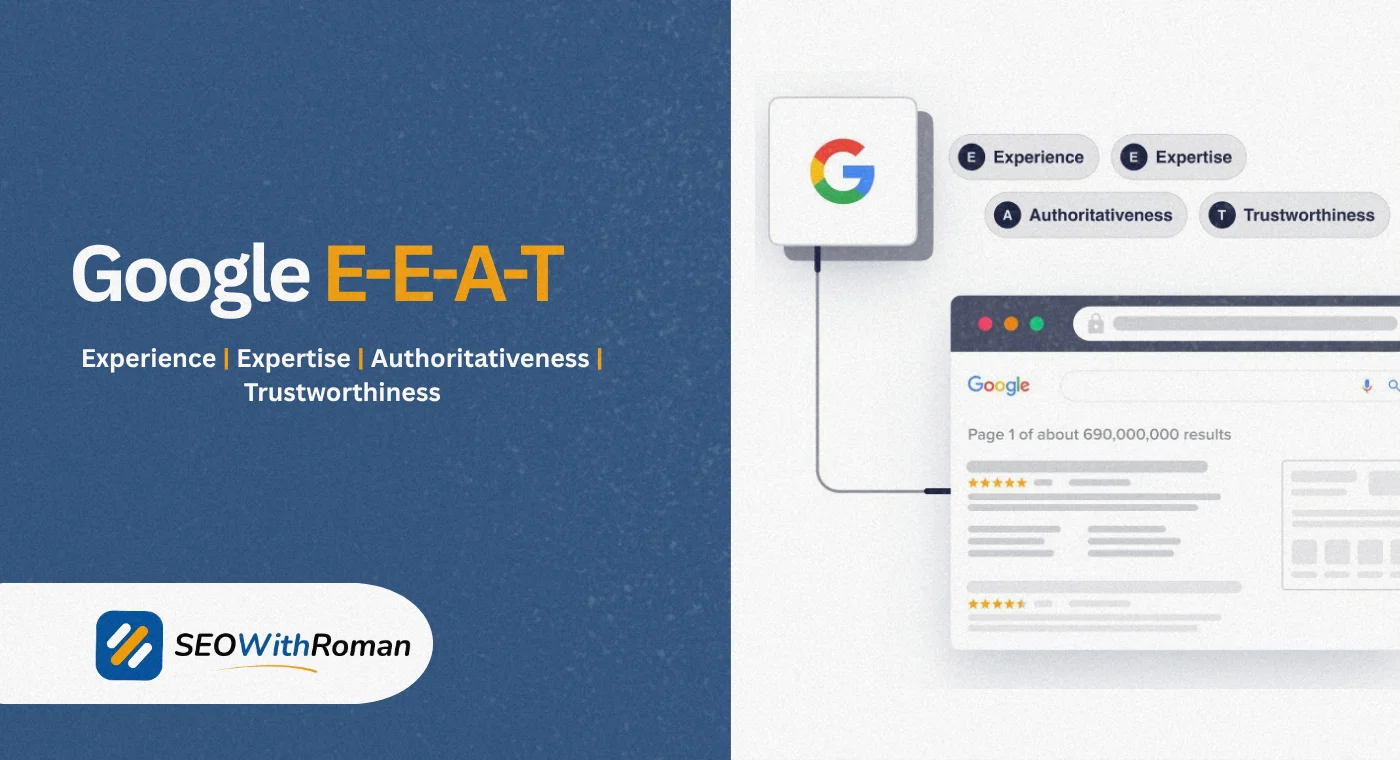
- Google E-E-A-T stands for Experience, Expertise, Authoritativeness, and Trustworthiness and was updated from E-A-T in December 2022
- E-E-A-T is not a direct ranking factor but it directly influences how Google's algorithms evaluate and rank your content
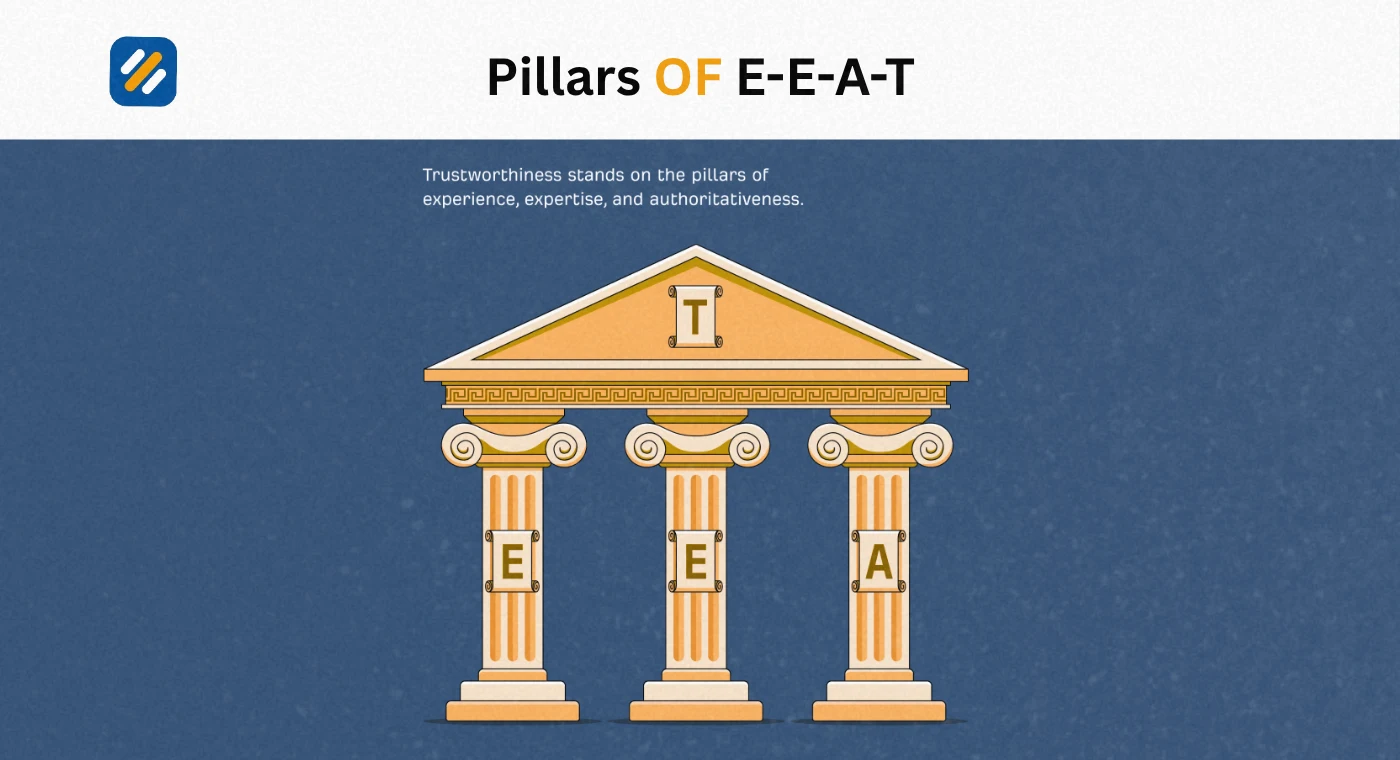
- Trustworthiness is the most important element in E-E-A-T because even highly expert content scores low if it cannot be trusted
- YMYL content, meaning Your Money or Your Life topics, is held to the highest E-E-A-T standard because poor content in these areas can cause real harm
- Personal brand websites have a significant E-E-A-T advantage because your name, experience, and real client work are all verifiable trust signals
1 What Is Google E-E-A-T and Why Every Website Owner Needs to Understand It
If you have been doing SEO for more than five minutes, you have probably heard the term E-E-A-T mentioned in the context of Google rankings. But most explanations either oversimplify it to the point of being useless or make it sound so complicated that beginners give up trying to understand it entirely.
Let me explain it the way I explain it to clients after six years of working on real websites across multiple industries.
Google E-E-A-T stands for Experience, Expertise, Authoritativeness, and Trustworthiness. It is a quality framework that Google's human reviewers, called Quality Raters, use to assess whether a piece of content genuinely deserves to rank in search results. These Quality Raters do not directly control rankings. Instead, their assessments are used to train and improve Google's ranking algorithms over time.
Google's former Vice President of Search, Ben Gomes, explained it clearly: "You can view the rater guidelines as where we want the search algorithm to go. They don't tell you how the algorithm is ranking results, but they fundamentally show what the algorithm should do."
In other words, E-E-A-T is Google's written definition of what good content looks like. If you understand it, you understand exactly what Google is trying to reward when it ranks pages.
The framework matters most in 2026 because the internet is flooded with AI-generated, thin, and unverifiable content. Google's entire business depends on surfacing trustworthy answers. E-E-A-T is the measuring stick it uses to separate content worth showing from content worth ignoring.
2 What Does E-E-A-T Stand For | Breaking Down Each Element
Each letter in E-E-A-T represents a distinct quality signal. Understanding each one individually is the first step to improving them on your own website.
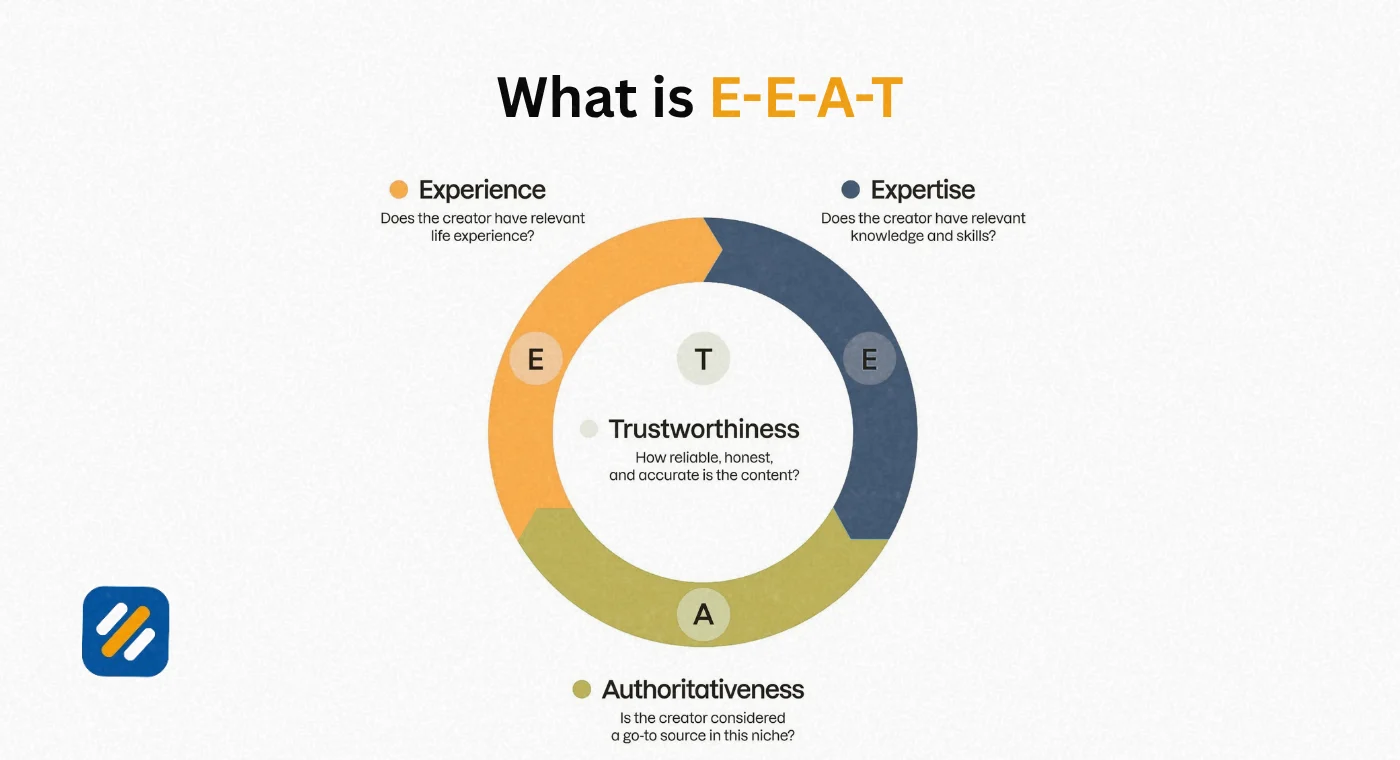
The First E: Experience
Experience was added to the framework in December 2022, upgrading what was previously known as E-A-T to E-E-A-T. This addition was significant because it shifted the framework from rewarding credentials alone to rewarding first-hand, real-world knowledge.
Experience means the content creator has personally done, used, visited, or lived through the thing they are writing about. A product review carries far more weight when the reviewer has actually purchased and used the product. A travel guide is more valuable when the writer has personally visited the destination. A guide to fixing a WordPress error is more trustworthy when the author has actually fixed it themselves.
For SEOWithRoman.com, this is one of the strongest natural advantages available. Every SEO guide published here comes from someone who has been doing this work daily for six years across real client websites. That is a genuine experience signal that an anonymous blog or an AI-only publication cannot replicate.
The Second E: Expertise
Expertise refers to your depth of knowledge, skills, and qualifications in your subject area. It is related to but distinct from experience. You can have experience without formal expertise, and you can have formal expertise without hands-on experience. The strongest content demonstrates both.
For YMYL content, meaning topics related to health, finance, law, and safety, Google expects formal or professional expertise. A medical article should ideally be written or reviewed by a qualified doctor. A financial guide should be authored by a qualified financial advisor.
For non-YMYL content like SEO tutorials, marketing guides, cooking recipes, or fitness advice, demonstrated practical expertise is sufficient. You do not need a formal qualification. You need to show genuine depth of knowledge through the specificity, accuracy, and insight of what you write.
The A: Authoritativeness
Authoritativeness is about reputation. Not just your personal reputation, but the reputation of your website and your content as perceived by others in your field.
Google measures authoritativeness primarily through backlinks from respected websites, mentions in reputable publications, citations in research, expert endorsements, and recognition from industry peers. A website that other experts link to and reference is considered more authoritative than a website that publishes equally good content but has not yet earned external recognition.
Authoritativeness builds over time. It cannot be faked through manipulation and it cannot be earned overnight. It is the compound interest of consistently producing content that others find genuinely valuable enough to reference.
The T: Trustworthiness
Trustworthiness is the most important element in the entire E-E-A-T framework. Google's own guidelines state clearly that untrustworthy pages have low E-E-A-T regardless of how experienced, expert, or authoritative they appear to be.
Trust operates on multiple levels. At the technical level, trust means your website uses HTTPS, has a clear privacy policy, and does not engage in deceptive practices. At the content level, trust means your information is accurate, verifiable, and updated when facts change. At the business level, trust means your contact information is visible, your brand is consistent across platforms, and you respond to feedback and reviews honestly.
For a personal brand website, trustworthiness is also built through transparency. Showing your real name, your real photo, your real professional history, and your real client work all contribute to the trust signals Google and its Quality Raters look for.
3 E-E-A-T vs E-A-T | What Changed and Why It Matters for Your SEO
Before December 2022, Google's quality framework was called E-A-T, standing for Expertise, Authoritativeness, and Trustworthiness. The addition of the first E for Experience was not a minor update. It represented a fundamental shift in how Google evaluates content quality.
Under the original E-A-T framework, credentials and reputation were the dominant signals. A medical article written by a doctor ranked better than one written by a patient advocate, even if the patient advocate had lived through the condition being discussed.
The addition of Experience changed this dynamic. Google recognised that first-hand lived experience is a form of authority that credentials alone cannot always replicate. A person who has spent five years managing their own type 2 diabetes brings a form of experiential insight that a doctor who has never had the condition cannot easily provide.
| Framework | When Introduced | Key Focus | What It Added |
|---|---|---|---|
| E-A-T | 2014, via Quality Rater Guidelines | Expertise, Authority, Trust | Foundation quality framework for content evaluation |
| E-E-A-T | December 2022 | Experience added as primary signal | First-hand experience as a standalone quality dimension |
For content creators and website owners, the practical impact of this change is significant. It means that personal experience, real examples, original observations, and genuine first-hand knowledge are now explicitly valued quality signals in Google's framework, not just nice-to-haves.
4 What Is YMYL and Why It Changes How Strictly E-E-A-T Is Applied
Not all content is evaluated with the same E-E-A-T intensity. Google applies its highest E-E-A-T standards to what it calls YMYL content.
YMYL stands for Your Money or Your Life. These are topics where inaccurate, misleading, or low quality content could directly harm the reader's financial situation, health, safety, or general wellbeing.
Google's Quality Rater Guidelines identify these as YMYL topic areas
| YMYL Category | Examples | E-E-A-T Requirement |
|---|---|---|
| Health and Safety | Medical advice, medications, mental health, emergency procedures | Highest, formal expertise often required |
| Financial Security | Investment advice, tax guidance, loans, insurance | Highest, professional credentials expected |
| Legal | Legal rights, contracts, court procedures, immigration | Highest, legal expertise expected |
| News and Current Events | Breaking news, political events, crisis information | High, sourcing and accuracy critical |
| Civics and Government | Voting, government policies, public services | High, accuracy and neutrality required |
| Shopping | Product safety, consumer rights, financial transactions | Medium to high |
| Groups of People | Content about race, religion, gender, nationality | High, potential for real-world harm |
For a website like SEOWithRoman.com, most content falls outside YMYL categories. SEO tutorials, keyword research guides, and WordPress tips are not YMYL content. This means Google does not require formal credentials to rank this content. Demonstrated practical expertise and genuine experience are sufficient.
However, understanding YMYL is still important because it helps you calibrate how much E-E-A-T investment any given piece of content requires.
5 Is E-E-A-T a Google Ranking Factor
This is one of the most debated questions in the SEO community. Let me give you the clearest possible answer.
E-E-A-T is not a direct ranking factor. There is no E-E-A-T score that Google assigns to your website. There is no slider in Google's algorithm that says your E-E-A-T is 7.4 out of 10.
What E-E-A-T is, is a framework that informs how Google's ranking algorithms are designed and evaluated. Quality Raters assess search results using E-E-A-T criteria and their feedback is used to train and refine the algorithms over time. The algorithms then apply ranking signals that serve the same purpose as E-E-A-T, rewarding content that is trustworthy, authoritative, and genuinely useful.
The practical implication is this. Improving your E-E-A-T does improve your rankings. Not because there is an E-E-A-T dial being turned up, but because the actions you take to improve E-E-A-T, writing better content, earning stronger backlinks, demonstrating real expertise, and building genuine trust, directly improve the ranking signals that Google's algorithms do measure.
Google's John Mueller confirmed this indirectly when he stated that Google looks at E-E-A-T for every single query, not just YMYL searches. This means every page on every website is being evaluated through this lens to some degree.
6 How E-E-A-T Affects SEO in Practice | What Google Actually Rewards
Understanding E-E-A-T theory is one thing. Seeing how it plays out in actual search rankings is where the real learning happens.
Here is what consistently happens to websites that have strong E-E-A-T signals versus those that do not
Websites with strong E-E-A-T:
- Recover faster after Google algorithm updates because their authority is genuine and not dependent on manipulation
- Rank for competitive keywords even without the highest number of backlinks because content quality compensates for lower link quantity
- Appear in Google's AI Overviews and featured snippets more frequently because their content is considered reliable enough to surface directly
- Build compounding organic traffic because readers share, link to, and return to content they genuinely trust
Websites with weak E-E-A-T:
- Experience significant ranking drops during Google's Helpful Content updates, Core Updates, and Quality Rater-informed algorithm changes
- Struggle to rank competitively even with strong keyword optimisation because the content is thin, generic, or unverifiable
- Rarely appear in AI-generated answers because AI systems including Google's AI Overviews and ChatGPT prioritise content from authoritative, trusted sources
- Plateau at moderate traffic levels because they cannot build the topical authority needed to compete for high-value keywords
The pattern is clear. In 2026, with AI-generated content flooding every niche, E-E-A-T signals are becoming the most important differentiator between websites that grow and websites that stagnate.
7 E-E-A-T Signals | The Complete List of What Google Actually Looks For
Most E-E-A-T guides tell you to "build trust" and "demonstrate expertise" without getting specific about what that actually means in practice. Here is the complete breakdown of real E-E-A-T signals across all four dimensions:
Experience Signals:
- First-person language describing personal actions, decisions, and observations
- Original photos, screenshots, or videos showing real use of the product or topic
- Specific details that only someone with direct experience would know
- Client examples, case studies, or real project outcomes referenced in content
- Personal opinions and informed perspectives rather than neutral restating of facts
Expertise Signals:
- Author bio with verifiable credentials, years of experience, and professional background
- Depth of topic coverage that goes beyond surface-level explanation
- Precise, practitioner-level language that reflects genuine familiarity with the subject
- Content reviewed or contributed to by recognised experts in the field
- Citations of credible research, data, and industry sources
Authoritativeness Signals:
- Backlinks from respected websites in your industry
- Brand mentions and citations in reputable publications
- Guest articles published on authoritative websites in your niche
- Wikipedia mentions or references to your content
- Industry awards, recognitions, or expert endorsements
- Social proof through followers, engagement, and community recognition
Trustworthiness Signals:
- HTTPS encryption and valid SSL certificate
- Clear privacy policy, disclaimer, and terms of service pages
- Visible contact information including email and ideally a phone number
- Accurate, up-to-date information with correction notices when facts change
- Transparent author attribution with real names and bios
- Consistent brand identity across your website and all social platforms
- Positive reviews and honest responses to negative reviews
8 How to Improve E-E-A-T on Your Website | 10 Actionable Strategies
Here is the practical implementation guide. Every strategy below directly addresses one or more E-E-A-T signals and can be applied to any website regardless of size or industry.
Strategy 1: Build a detailed author bio page
Your author bio is one of the most direct E-E-A-T signals available. It should include your full name, professional title, years of experience, specific industries or clients you have worked with, and any relevant credentials or publications. Link every article on your website to your author bio page.
Strategy 2: Add first-hand experience to every article
Before publishing any piece of content, ask yourself: what do I know about this topic from personal experience that nobody else has written about? Add at least one specific example, real client situation, or personal observation that only you could write. This is what separates your content from AI-generated alternatives.
Strategy 3: Cite credible sources throughout your content
Every specific statistic, research finding, or claim should link to its original source. Healthline, Wikipedia, government websites, peer-reviewed publications, and official industry reports are all strong source signals. Linking to credible sources tells Google and readers that your claims are verifiable.
Strategy 4: Add schema markup for author information
Structured data in the form of Person schema and Article schema helps Google understand who wrote your content and what credentials they hold. On WordPress, Rank Math makes this straightforward. Configure your author details in Rank Math's schema settings and it will automatically apply the correct structured data to every article you publish.
Strategy 5: Earn backlinks from industry-relevant websites
Focus your outreach on websites that are already trusted in your niche. A single backlink from a well-regarded industry publication carries more E-E-A-T weight than a hundred links from unrelated directories. Write genuinely useful content that others want to reference and reach out to relevant website owners with specific, personalised link requests.
Strategy 6: Publish original data and research
Original research, surveys, case studies, and data studies are among the most powerful E-E-A-T builders available. When you publish something that others cite, your authoritativeness compounds. Even a small original survey within your own audience produces data that no other website has.
Strategy 7: Keep your content updated
Outdated information signals low trustworthiness. Add a "Last Updated" date to every article and review your most important pages at least once per year. When significant changes occur in your industry, update the relevant articles immediately and note the update date clearly.
Strategy 8: Build a complete Trust page structure
Every website needs these trust pages in place before it can claim strong E-E-A-T: About page with real person information, Contact page with real contact options, Privacy Policy, and Disclaimer. These are not optional formalities. They are direct trust signals that Google's Quality Raters look for explicitly.
Strategy 9: Get expert reviews or contributions
If you publish content on topics where formal expertise matters, consider having a recognised expert review or contribute to specific articles. Adding a "Reviewed by [Expert Name, Credentials]" note with a link to their bio page significantly strengthens the expertise and trust signals on that piece of content.
Strategy 10: Be consistent across all platforms
Your brand identity, professional history, and content claims should be consistent across your website, LinkedIn profile, Google Business Profile, and any other platform where you have a presence. Conflicting information between platforms weakens trust signals significantly.
9 E-E-A-T for Personal Brand Websites | Why Your Name Is Your Biggest Advantage
This is the part of the E-E-A-T conversation that most guides written for large corporations completely miss. For a personal brand website, E-E-A-T is not a challenge to overcome. It is a structural advantage that anonymous sites and faceless content farms can never replicate.
When your name is in the domain, when your photo is on every page, when your many years of real client experience is the foundation of every article, you are already doing what large websites have to engineer through contributor networks, editorial policies, and expert review processes.
Google's Quality Raters are instructed to look for signs that a real person with real expertise stands behind the content. On a personal brand website, that answer is immediately obvious. There is a named author with a verifiable professional history. Every article comes from someone with genuine skin in the game because their professional reputation is literally attached to every word they publish.
The key is making those E-E-A-T signals visible rather than leaving them implied. Your About page should clearly state your experience, your client work, and the specific results you have achieved. Your author bio should appear on every article. Your LinkedIn profile should be linked and consistent with what your website says about you.
When all of that is in place, a personal brand website competes with E-E-A-T signals that most corporate blogs spend years and significant budget trying to build artificially.
10 E-E-A-T and Google's AI Overviews | How This Framework Shapes What AI Recommends
This is the most forward-looking aspect of E-E-A-T that almost no competitor article covers adequately, and it is critically important for anyone publishing content in 2026.
Google's AI Overviews, the AI-generated answer summaries that now appear at the top of many search results, pull information from content that Google has already assessed as trustworthy and authoritative. In other words, strong E-E-A-T signals are one of the primary factors that determine whether your content gets cited in AI-generated answers.
The same logic applies to other AI systems. ChatGPT, Perplexity, and other AI assistants are increasingly trained on or referencing web content that meets quality thresholds similar to what E-E-A-T describes. Content from websites with weak trust signals, thin content, and no verifiable authorship is systematically underrepresented in AI answers.
This creates a new dimension to E-E-A-T strategy in 2026. You are not just optimising to rank in traditional search results. You are optimising to be cited by AI systems as a trustworthy source. The websites that get cited in AI Overviews consistently are the ones with the strongest E-E-A-T signals, the clearest author attribution, the most verifiable claims, and the deepest topical coverage.
The content strategy that wins in traditional SEO and the content strategy that wins in AI search are increasingly the same strategy. That is the E-E-A-T framework applied consistently and comprehensively.
11 Common E-E-A-T Mistakes That Are Silently Hurting Your Rankings
After auditing dozens of websites across multiple industries, the same E-E-A-T weaknesses appear repeatedly. Here are the most common mistakes and exactly how to fix each one:
Mistake 1: Anonymous content with no author attribution
Publishing articles without an identified author removes one of the most important E-E-A-T signals available. Every article needs a named author with a linked bio page. Fix this by adding author boxes to every published article and creating a detailed author bio page that links to your LinkedIn profile and showcases your real professional background.
Mistake 2: About pages that say nothing specific
Generic about pages that say "we are passionate about helping businesses grow" tell Google and readers nothing about who you actually are. Fix this by rewriting your About page to include specific years of experience, specific industries worked in, specific client results achieved, and specific credentials held.
Mistake 3: Making claims without sources
Stating facts without citing where they come from undermines trustworthiness immediately. Fix this by linking every specific statistic and research finding to its original source. Use government websites, peer-reviewed publications, and official industry reports as preferred citation sources.
Mistake 4: No HTTPS or visible trust pages
A website without SSL encryption or without a visible privacy policy is a red flag to Quality Raters regardless of how good the content is. Fix this by ensuring your SSL certificate is active and your Privacy Policy, Disclaimer, and Contact pages are accessible from every page on your site.
Mistake 5: Inconsistent brand information across platforms
If your LinkedIn says you have eight years of experience but your website says five, or if your bio photo is different across platforms, these inconsistencies undermine trust signals. Fix this by auditing all your online profiles and making sure your professional information is identical and accurate everywhere your name appears.
12 3 Expert Tips to Strengthen Your E-E-A-T Faster Than Your Competitors
These are the three actions that produce the fastest, most measurable improvement in E-E-A-T signals based on real website work across multiple industries.
Expert Tip 1: Use Your Real Client Work as Content Evidence
The fastest way to demonstrate genuine experience is to reference specific real work you have done, without violating any confidentiality agreements. "I applied this technique to a client website in the healthcare sector and rankings for their primary keyword moved from position 22 to position 6 within 90 days" is an E-E-A-T signal that no AI-generated competitor article can replicate. Add at least one specific real work reference to every article you publish and watch how differently readers engage with the content.
Expert Tip 2: Build Your Topical Authority Before Chasing Backlinks
Most beginners focus on getting backlinks before they have established topical authority. Google's algorithms assess whether your website comprehensively covers a subject area, not just whether individual pages have links. Publish at least 15 to 20 articles covering all major aspects of your core topic before actively pursuing backlinks. When you do start outreach, your site will be a genuinely authoritative resource worth linking to rather than a thin site asking for favours.
Expert Tip 3: Treat Every Article Update as an E-E-A-T Signal
Updating existing content is one of the highest-ROI E-E-A-T activities available, and most website owners never do it systematically. Set a calendar reminder every six months to review your ten most important articles. Add new data, update any statistics that have changed, add fresh examples from your recent work, and update the "Last Updated" date visibly at the top of the article. Google tracks content freshness as a quality signal and readers trust regularly maintained content far more than articles that have not been touched in two years.
13 Conclusion
Google E-E-A-T is not a mysterious algorithm you need to decode or a secret formula reserved for large corporations with editorial teams and massive link budgets. It is Google's written definition of what good, trustworthy, useful content looks like.
Experience means your content comes from someone who has actually done the thing they are writing about. Expertise means you genuinely understand your subject at a level that serves your reader's real needs. Authoritativeness means others in your field recognise and reference your work. Trustworthiness means everything about your website, your content, and your brand can be verified and relied upon.
For a personal brand website built on many years of real SEO work with real clients across real industries, every single one of those signals is already present. The job is not to create E-E-A-T from scratch. It is to make the E-E-A-T you already have visible to Google and to the readers who will decide whether your website is worth trusting.
Start with your About page. Make it specific, professional, and human. Then add your author bio to every article. Then cite your sources. Then add one real personal example to every piece you publish.
Do that consistently and your E-E-A-T will compound in the same way your rankings and traffic compound over time.
Have a question about building E-E-A-T for your specific website? Drop it in the comments below and I will answer it personally.
Join 1,000+ business owners and bloggers who get one actionable SEO tip every week — straight to their inbox. Free forever.
Get Free Weekly Tips →