- Topics and keywords are not the same thing. Topics define what your content covers. Keywords define how people search for it
- Modern Google rewards topical authority over individual keyword targeting. Covering a topic deeply beats chasing a single keyword
- There are 16 types of SEO keywords and understanding each one changes how you plan and structure your content
- Semantic SEO and topic clustering are now the dominant strategy for ranking in 2026, replacing old-school keyword-first thinking
- The right keyword research tool saves you months of guessing by showing you exactly what your audience searches for and how competitive each term is
1 What Are Topics and Keywords and Why Most Beginners Confuse Them
If you have ever sat down to write a blog post and asked yourself “should I be writing about a topic or targeting a keyword,” you are asking exactly the right question. Most beginners treat these two things as interchangeable. They are not, and understanding the difference is what separates websites that rank from websites that guess.
A keyword is the exact phrase a person types into Google. “How to do keyword research for free” is a keyword. It is specific, measurable, and has a defined monthly search volume you can look up in a tool.
A topic is the broader subject that keyword belongs to. “Keyword research” is a topic. It contains dozens, sometimes hundreds, of individual keywords that all relate to the same core subject.
Here is the distinction that changes everything for your SEO strategy. When you target only a keyword, you write one article for one search phrase. When you target a topic, you build a cluster of content that covers every angle of that subject. Google rewards the second approach far more heavily in 2026 because it signals genuine expertise rather than individual page optimisation.
Think of it this way. A keyword is a single question. A topic is the entire conversation around that question. The websites that dominate page one today are the ones having the full conversation, not just answering one question at a time.
2 Topics vs Keywords in SEO | How Each One Works Differently
Understanding how topics and keywords function inside Google’s ranking system helps you make better decisions before you write a single word.
How keywords work in classic SEO:
In traditional keyword-focused SEO, the process is linear. You find a keyword with decent search volume and low competition, write a single article targeting that keyword, optimise the title tag, meta description, and body content around that exact phrase, and hope Google ranks it.
This approach still works for individual articles. But it has a ceiling. Each article competes in isolation. There is no compounding benefit from one article to the next unless they are connected by topic.
How topics work in modern semantic SEO:
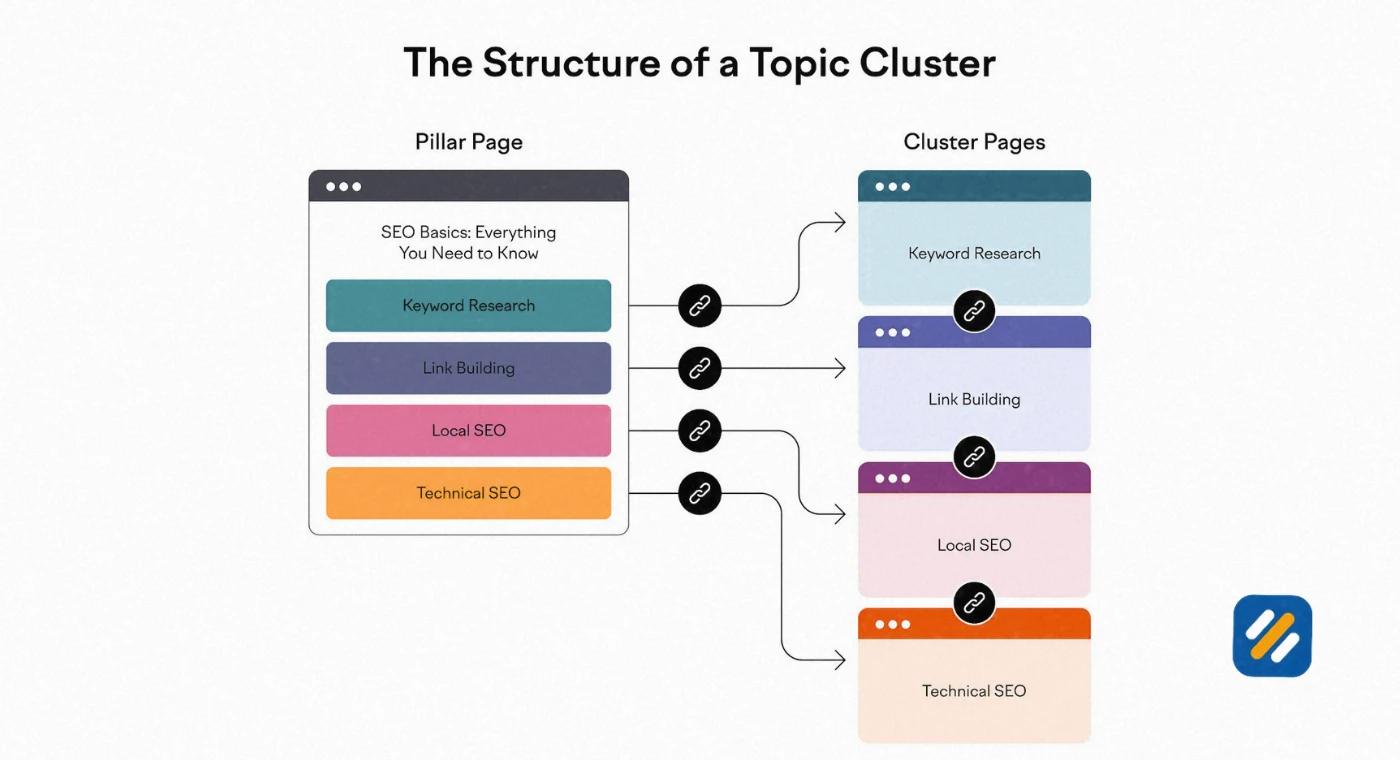
Topic-based SEO starts with a broader subject and builds outward. You identify a core topic, map every question and subtopic related to it, create individual articles for each subtopic, and connect them all with internal links pointing back to a central pillar page.
Google reads this structure as topical authority. When your website has fifteen interconnected articles all covering different angles of keyword research, Google understands that your site is a genuine authority on that subject. This authority lifts all fifteen pages simultaneously, not just the one you optimised hardest.
| Factor | Keyword Focused SEO | Topic Focused SEO |
|---|---|---|
| Core unit | Single keyword phrase | Broad subject with many subtopics |
| Content structure | One article per keyword | Pillar page plus cluster articles |
| Google signal | Page level relevance | Site level topical authority |
| Traffic growth | Linear, one page at a time | Compounding, entire cluster rises together |
| Best for | Quick wins on low competition terms | Long term authority and sustainable rankings |
| Keyword difficulty | Targets specific KD scores | Covers low to medium KD across the whole topic |
| Internal linking | Optional | Essential, connects the entire cluster |
| 2026 effectiveness | Still works for isolated articles | Dominant strategy for competitive niches |
3 The 16 Types of SEO Keywords Every Content Creator Must Know
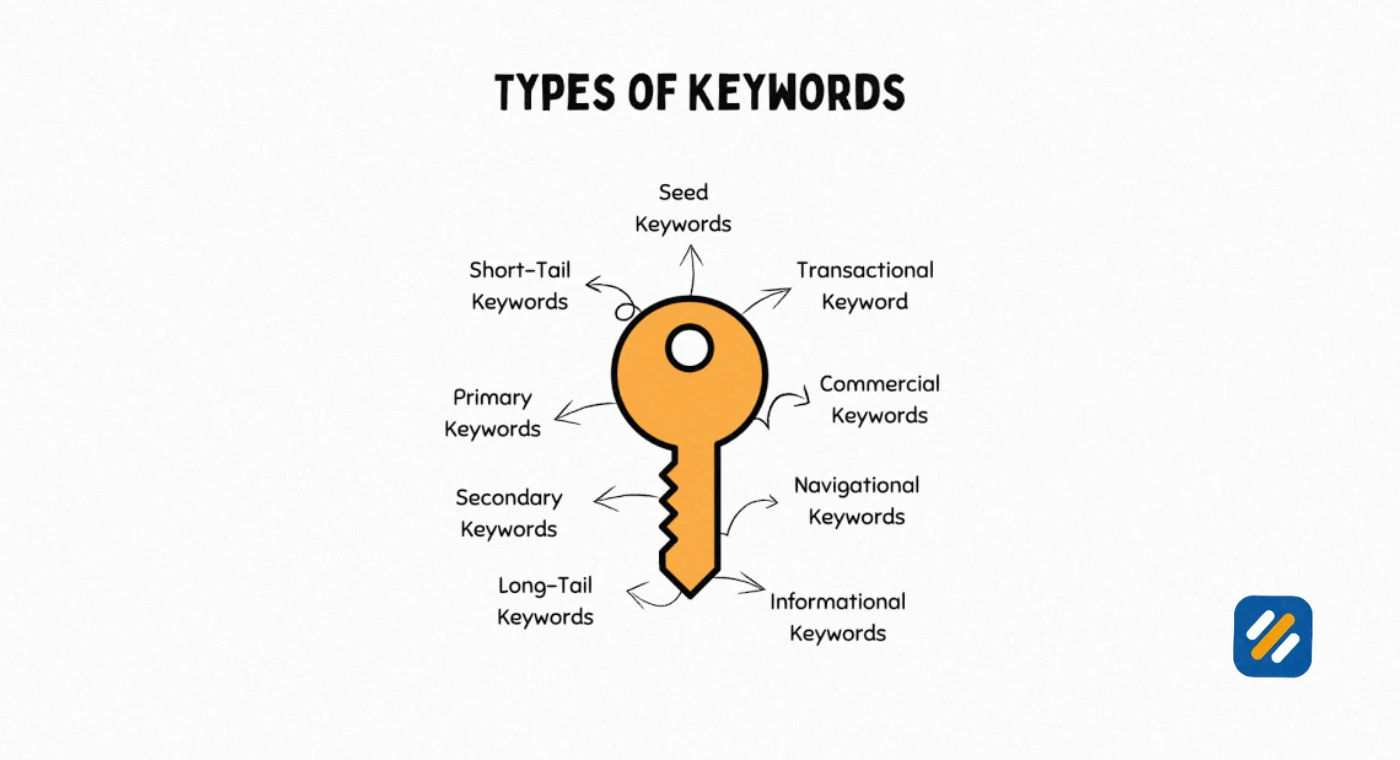
One of the most important things I teach beginners in SEO is that not all keywords are equal. There are 16 distinct types of SEO keywords and each one serves a different purpose in your content strategy.
1. Primary Keywords
The main keyword your page is built around. It appears in your title tag, first paragraph, one H2, and meta description. Every page has exactly one primary keyword.
2. Secondary Keywords
Supporting keywords that relate to your primary keyword. They appear naturally in your body content and subheadings. A page targeting “keyword research” might use “how to find keywords” and “keyword difficulty” as secondary keywords.
3. Long Tail Keywords
Phrases of three or more words with lower search volume but higher purchase or conversion intent. “How to do keyword research for free for a new website” is a long tail keyword. These are the fastest ranking opportunity for new websites because competition is significantly lower.
4. Short Tail Keywords
Single word or two-word phrases with massive search volume and extreme competition. “SEO” and “keyword research” are short tail keywords. New websites should avoid targeting these until they have significant domain authority.
5. Semantic Keywords
Words and phrases that are conceptually related to your primary keyword without being direct variations. For an article about “keyword research,” semantic keywords include “search intent,” “search volume,” “SERP,” and “ranking factors.” Google uses semantic keywords to understand the full context of your content.
6. LSI Keywords (Latent Semantic Indexing)
Terms that frequently co-occur with your primary keyword across the web. Google uses LSI signals to verify that your content genuinely covers a topic rather than just mentioning a keyword repeatedly.
7. Focus Keywords
The single most important keyword for a specific piece of content, used in tools like Rank Math to guide optimisation. Every article has one focus keyword.
8. Trending Keywords
Keywords experiencing a sudden spike in search volume due to current events, news, or seasonal interest. These offer fast traffic opportunities but usually decline quickly.
9. Evergreen Keywords
Keywords with stable search volume year-round that do not spike or decline seasonally. “What is SEO” is an evergreen keyword. These are the foundation of a sustainable content strategy.
10. Geo-Targeted Keywords
Keywords that include a location signal. “SEO specialist in London” and “best plumber near me” are geo-targeted keywords. Essential for local businesses targeting specific cities or regions.
11. Branded Keywords
Keywords that include a specific brand name. “Ahrefs keyword research” or “SEOWithRoman guide” are branded keywords. These indicate high purchase intent and direct brand recognition.
12. Informational Keywords
Keywords from users who want to learn something. They typically begin with “what,” “how,” “why,” or “when.” Most blog content targets informational keywords.
13. Navigational Keywords
Keywords from users trying to reach a specific website or page. “Gmail login” and “Ahrefs free tool” are navigational keywords. Difficult to rank for unless the brand is yours.
14. Transactional Keywords
Keywords from users ready to take action. “Buy SEO course online” and “hire SEO specialist” are transactional keywords. These carry the highest conversion value of any keyword type.
15. Commercial Investigation Keywords
Keywords from users comparing options before making a decision. “Best keyword research tools 2026” and “Ahrefs vs SEMrush” are commercial investigation keywords. These are high-value targets for affiliate content.
16. Additional Keywords
Topic-related phrases that naturally belong in comprehensive content but were not specifically targeted. These are discovered after publishing through Google Search Console’s Queries report and can be added during content updates to expand a page’s ranking footprint.
4 What Are the Top 10 Keywords on Google Right Now
The most searched keywords on Google globally tend to stay consistent year over year because they reflect everyday human behaviour, not trending topics. Here are the top categories and what they tell us about how people use search:
| Rank | Keyword Type | Example | Monthly Searches | What It Tells Us |
|---|---|---|---|---|
| 1 | Navigational brand | YouTube | 1.2 billion+ | People use Google to navigate to other sites |
| 2 | Navigational brand | 900 million+ | Social platforms dominate top searches | |
| 3 | Navigational brand | 800 million+ | People search Google to find Google | |
| 4 | Navigational brand | Gmail | 500 million+ | Email access drives massive search volume |
| 5 | Informational | Weather | 400 million+ | Utility searches are some of the highest volume |
| 6 | Navigational brand | Amazon | 350 million+ | Ecommerce navigation through search |
| 7 | Informational | News | 300 million+ | People use Google as their news aggregator |
| 8 | Navigational brand | 280 million+ | Social media navigation | |
| 9 | Navigational brand | 250 million+ | Messaging app access | |
| 10 | Navigational brand | Netflix | 200 million+ | Entertainment platform navigation |
What this data tells you as a content creator is important. The highest volume keywords in the world are almost all navigational. They are dominated by brands with hundreds of millions of users and cannot be competed with by any blog or small business website.
Your opportunity lies in the informational and commercial investigation keywords that sit below these giants. A keyword with 5,000 monthly searches and a difficulty score under 25 is infinitely more valuable to your website than a keyword with 5 million searches and a difficulty score of 95.
5 What Are Trending Keywords and How to Find Them Before Your Competitors Do
Trending keywords are search terms experiencing rapid growth in volume over a short period. They represent windows of opportunity that open and close quickly. The websites that publish on trending keywords early capture traffic that latecomers never see.
There are three types of trending keywords worth understanding:
Seasonal trends are predictable. “Christmas gift ideas” spikes every November and December. “Tax return help” spikes every January through April. These can be planned months in advance because the pattern repeats every year.
News-driven trends are unpredictable but fast-moving. A product launch, a Google algorithm update, or a major industry event can create thousands of new searches overnight. Speed is everything with these keywords.
Emerging topic trends grow steadily over months as a new technology, strategy, or concept gains mainstream awareness. “AI SEO tools” and “GEO optimisation” are examples of keywords that grew from near zero to significant search volume over twelve to eighteen months.
How to find trending keywords before your competitors:
Google Trends is your most powerful free tool for this. Set your time range to “Past 90 days” and look at the Rising section under Related Queries for any seed topic. These are the search terms growing fastest right now, often before any keyword research tool has updated its database with accurate volume data.
Combine Google Trends with Reddit, LinkedIn, and industry newsletters. When a topic starts appearing frequently in professional conversations, the search volume usually follows within four to six weeks. Publishing content before the volume peaks positions your article to capture the traffic surge rather than chase it after the fact.
6 Topic Clustering and Semantic SEO | The Strategy That Replaced Keyword Stuffing
If you have been in SEO for more than a few years you remember the era of keyword density. Write your keyword once every 100 words. Add it to every heading. Make sure it appears in the first sentence and the last sentence. This approach worked in 2010. By 2026 it actively hurts your rankings.
Google’s understanding of content has evolved dramatically. It no longer looks at keywords in isolation. It reads your entire page and evaluates whether the content genuinely covers a topic comprehensively. This is the foundation of semantic SEO.
How to build a topic cluster for semantic SEO:
Step 1: Choose your pillar topic. This is the broad subject your website has authority on. For SEOWithRoman.com, one pillar topic is “keyword research.”
Step 2: Create a pillar page. This is a comprehensive, long-form guide covering the entire topic at a high level. It does not go deep on any one subtopic but it links to dedicated articles for every subtopic it mentions.
Step 3: Create cluster articles. Each cluster article covers one specific subtopic in full depth. “How to find long tail keywords,” “What is keyword difficulty,” and “How to use Google Keyword Planner” are all cluster articles under the keyword research pillar.
Step 4: Connect everything with internal links. Every cluster article links back to the pillar page. The pillar page links out to every cluster article. This creates a web of topical authority that Google reads as comprehensive expertise on the subject.
Step 5: Use semantic keywords throughout. Each article naturally uses related terms, synonyms, and contextually relevant phrases. You are not repeating the same keyword. You are building a complete semantic picture of the topic.
The result is that all pages in the cluster tend to rise together in rankings. Google sees the interconnected web of content and assigns topical authority to your entire domain for that subject, not just to individual pages.
7 How to Find the Right Keywords and Topics for Your Website
The most common mistake beginners make is writing content first and thinking about keywords second. The correct order is always keyword and topic research first, content second.
Here is the process I use for every new website I work on:
Step 1: Start with your main topic
Write down the core subject your website covers. For an SEO blog, that is “SEO.” For a plumbing business, it is “plumbing services.” This is your seed topic.
Step 2: Expand into subtopics using Google
Type your seed topic into Google and read every autocomplete suggestion, every People Also Ask question, and every related search at the bottom of the results page. These are real questions your audience is already asking.
Step 3: Validate search volume and difficulty
Take your subtopic list into a keyword research tool and check monthly search volume and keyword difficulty for each one. For a new website, focus exclusively on keywords with a difficulty score under 25. For an established site with domain authority, you can target up to difficulty 50.
Step 4: Group keywords by topic
Cluster your validated keywords into topic groups. All keywords about “finding keywords” belong in one cluster. All keywords about “keyword difficulty” belong in another. Each cluster becomes one article or one section of a pillar page.
Step 5: Identify your primary and secondary keywords
For each article, choose one primary keyword with the strongest combination of search volume and low difficulty. Choose two to three secondary keywords that are closely related and can be placed naturally in subheadings and body content.
8 Which Tools to Use for Finding Keywords and Topics
The right tool depends on your budget, your website’s stage, and what specific data you need. Here is an honest breakdown:
| Tool | Best For | Cost | Strength |
|---|---|---|---|
| Google Keyword Planner | Volume ranges, ad competition signals | Free | Direct Google data, unlimited searches |
| Ahrefs Keywords Explorer | Keyword difficulty, traffic potential, competitor gaps | Paid, free version available | Most accurate KD scores in the industry |
| SEMrush Keyword Magic | Topic clusters, keyword variations, intent filtering | Paid, 10 free searches/day | Best for semantic keyword discovery |
| Google Search Console | Finding keywords you already rank for | Free | Real performance data from your own site |
| Google Trends | Trending keywords, seasonal patterns, topic momentum | Free | Only tool showing real-time interest growth |
| Ahrefs Free Generator | Long tail suggestions for any seed keyword | Free | Good starting point with no account needed |
| ChatGPT and Claude AI | Natural language keyword angles, question variations | Free tier available | Surfaces how real people phrase questions |
| Perplexity AI | Conversational queries matching AI search behaviour | Free | Shows what AI search surfaces for your topic |
| AnswerThePublic | Question-based keywords, preposition variations | Free limited | Visual keyword mapping around a seed topic |
| Rank Math Content AI | Semantic keyword suggestions inside WordPress editor | Paid add-on | Integrates directly into your writing workflow |
For a brand new website with zero budget, start with Google Keyword Planner, Google Search Console, Google Trends, and Ahrefs free generator. These four tools together give you everything you need to build a keyword strategy for your first fifty articles without spending a single dollar.
9 Keywords Examples | What Good Keywords Actually Look Like in Practice
One of the most useful exercises in SEO is studying real keyword examples to understand what makes one keyword better than another for a specific website and stage of growth.
Here are SEO keywords examples across different difficulty levels and intent types:
Beginner website, Month 1 to 3 | Target these:
- “how to check keyword difficulty for free” (KD 8, 300 monthly searches)
- “what is a focus keyword in Rank Math” (KD 5, 200 monthly searches)
- “long tail keywords examples for beginners” (KD 12, 500 monthly searches)
Growing website, Month 4 to 8 | Target these:
- “best free keyword research tools 2026” (KD 22, 2,400 monthly searches)
- “how to find keywords your competitors rank for” (KD 18, 1,900 monthly searches)
- “what is search intent in SEO” (KD 25, 3,100 monthly searches)
Established website, Month 9 onwards | Target these:
- “keyword research guide” (KD 45, 12,000 monthly searches)
- “how to do SEO for beginners” (KD 38, 8,500 monthly searches)
- “best SEO tools 2026” (KD 52, 22,000 monthly searches)
The pattern is consistent. Start with low difficulty, specific, long tail keywords that large sites consider too small to target. Build domain authority through consistent publishing. Gradually move into higher difficulty terms as your site earns trust with Google.
10 3 Expert Tips on Topics vs Keywords That Most SEO Guides Never Tell You
Tip 1: One Topic Per Page, Not One Keyword Per Page
Stop thinking about what keyword a page targets and start thinking about what topic it owns completely. A page that fully covers one topic from every angle will naturally rank for dozens of keyword variations without you having to target each one separately.
Tip 2: Use Google Search Console to Discover Topics You Are Already Ranking For
Open your GSC Performance report and look at the Queries tab filtered to pages with positions 5 to 20. The keywords appearing there reveal which topics Google is already connecting your content to. These are your highest priority pages to update and strengthen because Google has already decided you are relevant, you just need to earn the click.
Tip 3: Choose Fewer Keywords and Cover Them More Deeply
Most beginners target too many keywords with too little content depth per article. One 1,500 word article that thoroughly covers a single topic will consistently outrank five 500 word articles that each touch the same topic superficially. Depth beats volume every time in modern Google.
11 Conclusion
The topics vs keywords debate is not really a debate at all. In 2026 the answer is clear. You need both, but in the right relationship to each other.
Keywords are the bridge between your content and your audience. They tell you exactly what people are searching for and how competitive each term is. Topics are the architecture that gives your entire website structure, authority, and the kind of depth Google rewards with consistent long-term rankings.
Start with a topic you have genuine expertise in. Map the keywords that live inside that topic. Build your content cluster one article at a time. Connect everything with internal links. Update your best performing pages every six months.
Do that consistently and your website will not just rank for the keywords you targeted. It will rank for dozens of related keywords you never even thought to target because Google understands you are the authority on the entire topic.
Have a question about how to build your own topic cluster or choose the right keywords for your niche? Leave a comment below and I will answer it personally.
Join 1,000+ business owners and bloggers who get one actionable SEO tip every week — straight to their inbox. Free forever.
Get Free Weekly Tips →