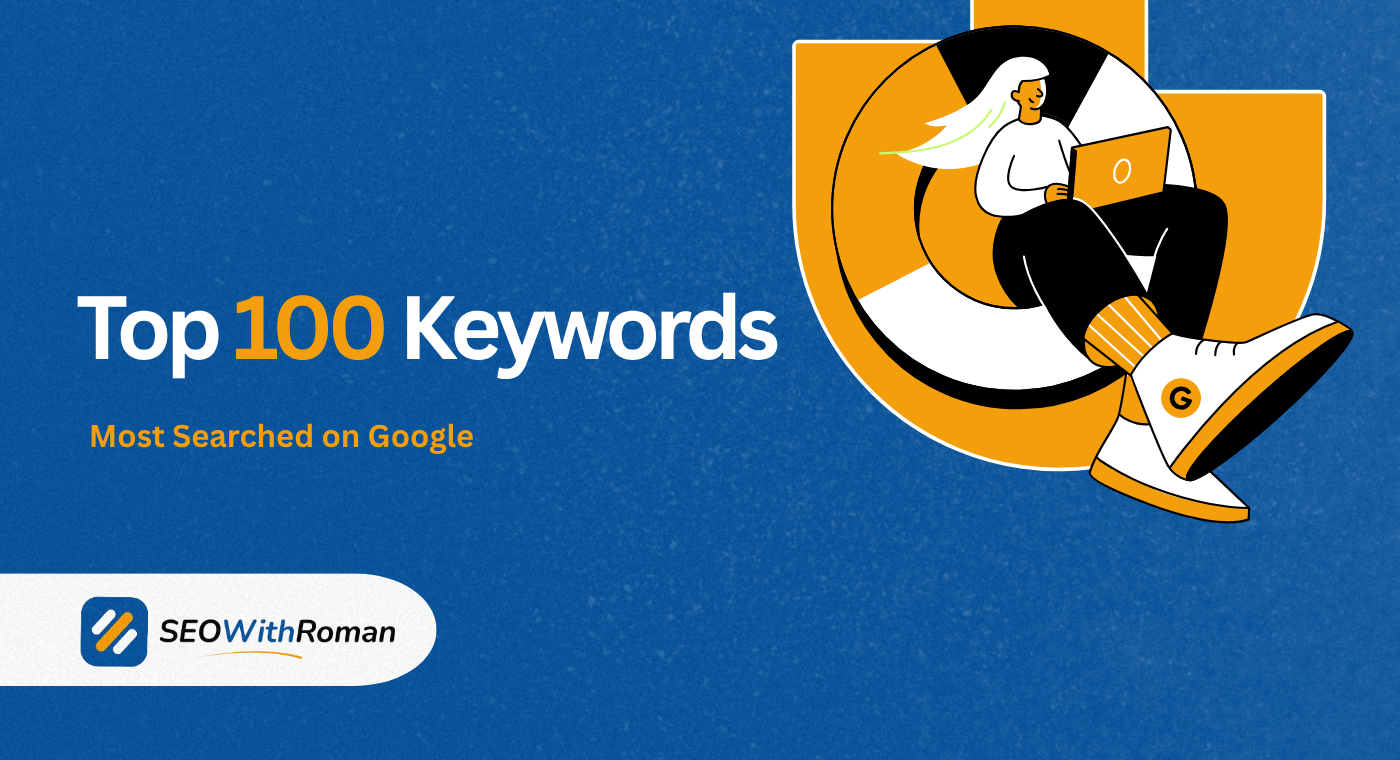
- 8YouTube is the single most searched keyword on Google globally with over 1.3 billion monthly searches
- The vast majority of top 100 keywords on Google are navigational, meaning people use Google to find specific websites rather than discover new ones
- Understanding search intent behind high-volume keywords is more valuable for SEO than chasing the keywords themselves
- ChatGPT has become one of the fastest-rising keywords in Google history with 7,600% growth in five years
- Small businesses and bloggers cannot rank for the top 100 keywords but can use this data to find adjacent low-competition opportunities
1 Why the Top 100 Most Searched Keywords on Google Tell You More Than You Think
Every month, billions of people open Google and type something into the search bar. Some are looking for a product. Some need directions. Some want answers to questions keeping them up at night. And some just want to find a website they have visited a hundred times but cannot remember the exact URL for.
The top 100 keywords on Google are a window into human behaviour at a scale nothing else can match. They show what people actually care about, not what marketers think they care about. Not what brands wish they cared about. What they genuinely, repeatedly, consistently type into the world's most used search engine.
I have spent many years doing keyword research across dozens of industries and markets. The single most useful exercise I have ever done for understanding search demand is studying what the highest volume keywords in the world actually are and more importantly why those specific keywords dominate the list.
In this article I break down the top 100 most searched keywords on Google in the US and globally, what the data tells you about search intent, and most importantly what you as a small business owner or blogger can actually do with this information.
2 Top 100 Most Searched Keywords on Google in the United States
The following data is sourced from Semrush keyword research data representing average monthly search volumes in the United States. All search volumes are monthly averages.
| Rank | Keyword | Monthly Search Volume (US) | Primary Search Intent |
|---|---|---|---|
| 1 | YouTube | 185 million | Navigational |
| 2 | Amazon | 124 million | Navigational |
| 3 | 101 million | Navigational | |
| 4 | 83.1 million | Navigational | |
| 5 | Gmail | 55.6 million | Navigational |
| 6 | Wordle | 55.6 million | Informational |
| 7 | ChatGPT | 45.5 million | Navigational / Commercial |
| 8 | Google Translate | 45.5 million | Informational |
| 9 | Walmart | 45.5 million | Navigational |
| 10 | Weather | 37.2 million | Informational |
| 11 | News | 37.2 million | Informational |
| 12 | Translate | 30.4 million | Informational |
| 13 | Food Near Me | 30.4 million | Transactional |
| 14 | Home Depot | 30.4 million | Navigational |
| 15 | Yahoo | 30.4 million | Navigational |
| 16 | Yahoo Mail | 30.4 million | Navigational |
| 17 | NFL | 30.4 million | Informational |
| 18 | NBA | 24.9 million | Informational |
| 19 | eBay | 24.9 million | Navigational |
| 20 | Target | 24.9 million | Navigational |
| 21 | Amazon Prime | 24.9 million | Navigational |
| 22 | Calculator | 24.9 million | Informational |
| 23 | 20.4 million | Navigational | |
| 24 | ESPN | 20.4 million | Navigational |
| 25 | Fox News | 20.4 million | Navigational |
| 26 | CNN | 20.4 million | Navigational |
| 27 | Twitter / X | 20.4 million | Navigational |
| 28 | Google Flights | 20.4 million | Transactional |
| 29 | Costco | 20.4 million | Navigational |
| 30 | Canva | 20.4 million | Navigational |
| 31 | Lowes | 16.6 million | Navigational |
| 32 | Zillow | 16.6 million | Navigational |
| 33 | NFL Scores | 16.6 million | Informational |
| 34 | USPS Tracking | 16.6 million | Transactional |
| 35 | Restaurants Near Me | 13.6 million | Transactional |
| 36 | Google Maps | 13.6 million | Navigational |
| 37 | Indeed | 13.6 million | Navigational |
| 38 | Netflix | 13.6 million | Navigational |
| 39 | Walgreens | 13.6 million | Navigational |
| 40 | Best Buy | 13.6 million | Commercial |
| 41 | Spotify | 13.6 million | Navigational |
| 42 | USPS | 13.6 million | Navigational |
| 43 | Roblox | 11.1 million | Navigational |
| 44 | Dow Jones | 11.1 million | Informational |
| 45 | Wells Fargo | 11.1 million | Navigational |
| 46 | English to Spanish | 11.1 million | Informational |
| 47 | Spanish to English | 11.1 million | Informational |
| 48 | Solitaire | 11.1 million | Informational |
| 49 | Shein | 9.1 million | Navigational |
| 50 | Google Docs | 9.1 million | Navigational |
| 51 | Capital One | 9.1 million | Navigational |
| 52 | Craigslist | 9.1 million | Navigational |
| 53 | Etsy | 9.1 million | Navigational |
| 54 | Facebook Marketplace | 9.1 million | Navigational |
| 55 | Bank of America | 9.1 million | Navigational |
| 56 | MLB | 9.1 million | Navigational |
| 57 | Speed Test | 9.1 million | Informational |
| 58 | 9.1 million | Navigational | |
| 59 | American Airlines | 9.1 million | Informational |
| 60 | Airbnb | 9.1 million | Navigational |
| 61 | TikTok | 9.1 million | Navigational |
| 62 | FedEx Tracking | 9.1 million | Transactional |
| 63 | Kahoot | 7.5 million | Navigational |
| 64 | 7.5 million | Navigational | |
| 65 | Dominos | 7.5 million | Navigational |
| 66 | Donald Trump | 7.5 million | Informational |
| 67 | AOL Mail | 7.5 million | Navigational |
| 68 | Real Madrid | 7.5 million | Informational |
| 69 | Gmail Login | 7.5 million | Navigational |
| 70 | AutoZone | 7.5 million | Navigational |
| 71 | Old Navy | 7.5 million | Navigational |
| 72 | Outlook | 6.1 million | Navigational |
| 73 | Premier League | 6.1 million | Informational |
| 74 | Dollar Tree | 6.1 million | Navigational |
| 75 | IKEA | 6.1 million | Navigational |
| 76 | McDonald's | 6.1 million | Navigational |
| 77 | Pizza Hut | 6.1 million | Navigational |
| 78 | Starbucks | 6.1 million | Navigational |
| 79 | Taco Bell | 6.1 million | Navigational |
| 80 | PayPal | 6.1 million | Navigational |
| 81 | Twitch | 6.1 million | Navigational |
| 82 | Nvidia Stock | 6.1 million | Informational |
| 83 | Cool Math Games | 6.1 million | Navigational |
| 84 | Google Drive | 5.0 million | Navigational |
| 85 | DuckDuckGo | 5.0 million | Navigational |
| 86 | Daily Mail | 5.0 million | Navigational |
| 87 | Temu | 5.0 million | Navigational |
| 88 | Taylor Swift | 5.0 million | Informational |
| 89 | Connections | 13.6 million | Informational |
| 90 | Harbor Freight | 7.5 million | Navigational |
| 91 | Blooket | 16.6 million | Navigational |
| 92 | Eight Sleep | 24.9 million | Navigational |
| 93 | MSN | 9.1 million | Navigational |
| 94 | Election Results | 20.4 million | Informational |
| 95 | StreamEast | 13.6 million | Informational |
| 96 | CVS | 11.1 million | Navigational |
| 97 | Traductor | 11.1 million | Navigational |
| 98 | Ebay | 24.9 million | Navigational |
| 99 | Google Scholar | 37.7 million | Navigational |
| 100 | Poki | 6.1 million | Navigational |
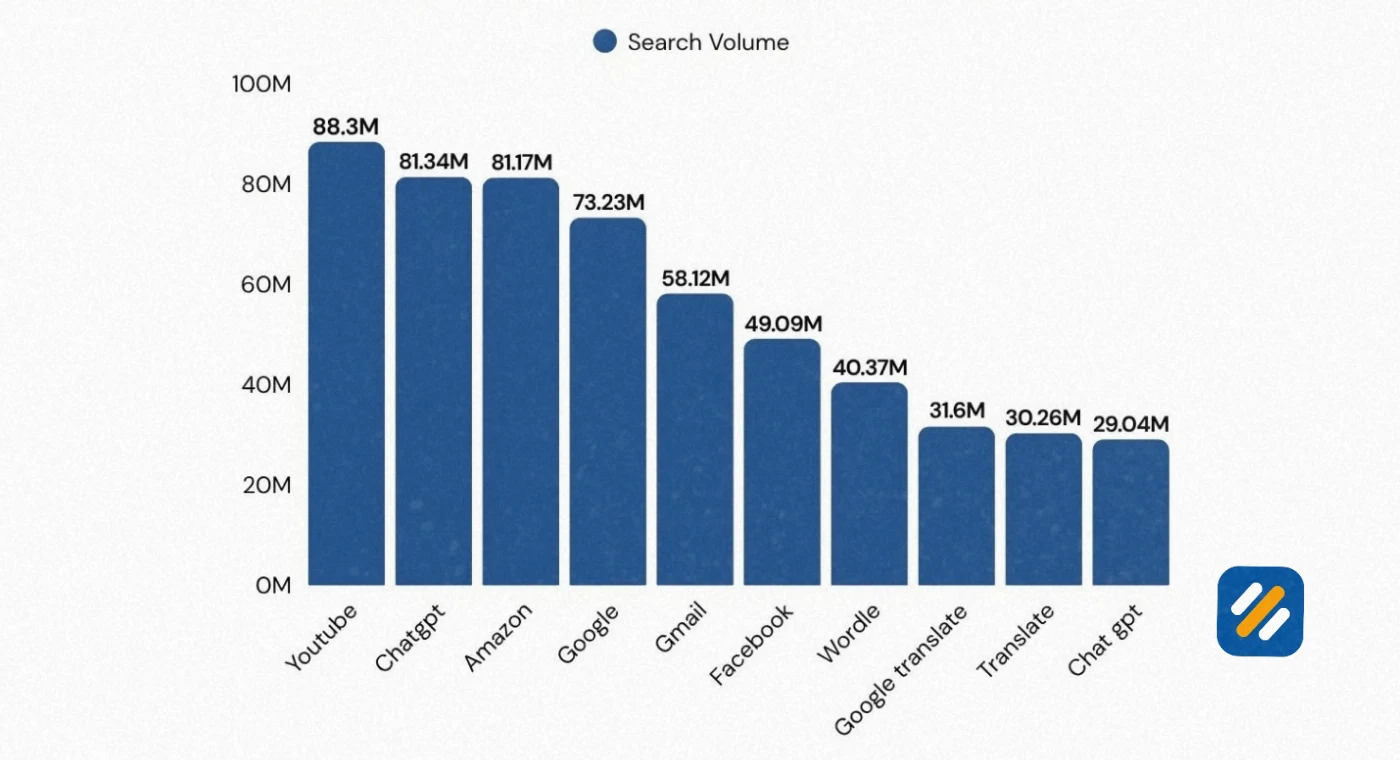
3 Top 100 Most Searched Keywords on Google Globally
The global picture looks different from the US list in several important ways. Translation-related keywords dominate globally because Google is used in every language. Sports like cricket, football, and the Premier League appear prominently reflecting search demand across Asia, South America, and Europe.
| Rank | Keyword | Monthly Search Volume (Global) | Search Intent |
|---|---|---|---|
| 1 | YouTube | 1.3 billion | Navigational |
| 2 | 589.6 million | Navigational | |
| 3 | WhatsApp Web | 476.1 million | Navigational |
| 4 | 411.8 million | Navigational | |
| 5 | Translate | 383.6 million | Informational |
| 6 | Gmail | 364.1 million | Navigational |
| 7 | 359.1 million | Navigational | |
| 8 | Amazon | 345.8 million | Navigational |
| 9 | Google Translate | 298.9 million | Informational |
| 10 | Weather | 290.5 million | Informational |
| 11 | Cricbuzz | 257.7 million | Navigational |
| 12 | ChatGPT | 213.1 million | Navigational / Commercial |
| 13 | 141.3 million | Navigational | |
| 14 | Canva | 163.7 million | Navigational |
| 15 | Twitter / X | 116.3 million | Navigational |
| 16 | 105.5 million | Navigational | |
| 17 | Yahoo | 104.8 million | Navigational |
| 18 | TikTok | 101.3 million | Navigational |
| 19 | Netflix | 93 million | Navigational |
| 20 | NBA | 88.3 million | Informational |
| 21 | Hotmail | 85.9 million | Informational |
| 22 | IPL | 81.9 million | Informational |
| 23 | Roblox | 81.7 million | Navigational |
| 24 | Real Madrid | 81.6 million | Informational |
| 25 | Speed Test | 81.3 million | Informational |
| 26 | Wordle | 94.3 million | Informational |
| 27 | Yahoo Mail | 95.2 million | Navigational |
| 28 | Google Maps | 128.3 million | Navigational |
| 29 | News | 70.1 million | Informational |
| 30 | Flipkart | 69.3 million | Navigational |
| 31 | BBC News | 65.2 million | Navigational |
| 32 | Restaurants Near Me | 64.3 million | Transactional |
| 33 | Premier League | 63.7 million | Informational |
| 34 | Yandex | 63 million | Navigational |
| 35 | eBay | 60.5 million | Navigational |
| 36 | Spotify | 59.8 million | Navigational |
| 37 | Outlook | 56.5 million | Navigational |
| 38 | Walmart | 56.5 million | Navigational |
| 39 | Calculator | 53.1 million | Informational |
| 40 | Facebook Login | 53.1 million | Navigational |
| 41 | Hotels | 52.7 million | Transactional |
| 42 | 51.7 million | Navigational | |
| 43 | Live Score | 50.5 million | Navigational |
| 44 | Serie A | 49.3 million | Informational |
| 45 | DuckDuckGo | 49.1 million | Navigational |
| 46 | IKEA | 48.9 million | Navigational |
| 47 | Google Flights | 43.3 million | Transactional |
| 48 | Champions League | 43.1 million | Informational |
| 49 | Airbnb | 41.9 million | Navigational |
| 50 | Twitch | 40.1 million | Navigational |
| 51 | Temu | 39.9 million | Navigational |
| 52 | Amazon Prime | 39.4 million | Navigational |
| 53 | Indeed | 38.7 million | Navigational |
| 54 | Telegram | 38.2 million | Navigational |
| 55 | Google Scholar | 37.7 million | Navigational |
| 56 | Food Near Me | 36.7 million | Transactional |
| 57 | Cricket | 36.5 million | Informational |
| 58 | Home Depot | 36.4 million | Navigational |
| 59 | Gmail Login | 34.5 million | Navigational |
| 60 | Flashscore | 34 million | Navigational |
| 61 | Discord | 31.9 million | Navigational |
| 62 | Costco | 30.3 million | Navigational |
| 63 | NFL | 45.9 million | Informational |
| 64 | CNN | 28.7 million | Navigational |
| 65 | Instagram Login | 79.6 million | Navigational |
| 66 | Shein | 43.9 million | Navigational |
| 67 | Google Drive | 5 million (US only) | Navigational |
| 68 | Betano | 56.6 million | Navigational |
| 69 | PayPal | 6.1 million | Navigational |
| 70 | Poki | 96 million | Navigational |
| 71 | Taylor Swift | 5 million | Informational |
| 72 | Fox News | 20.4 million | Navigational |
| 73 | ESPN | 20.4 million | Navigational |
| 74 | Lowes | 16.6 million | Navigational |
| 75 | Zillow | 16.6 million | Navigational |
| 76 | Target | 24.9 million | Navigational |
| 77 | Etsy | 9.1 million | Navigational |
| 78 | Dollar Tree | 6.1 million | Navigational |
| 79 | McDonald's | 6.1 million | Navigational |
| 80 | Pizza Hut | 6.1 million | Navigational |
| 81 | Starbucks | 6.1 million | Navigational |
| 82 | Taco Bell | 6.1 million | Navigational |
| 83 | AutoZone | 7.5 million | Navigational |
| 84 | Harbor Freight | 7.5 million | Navigational |
| 85 | Old Navy | 7.5 million | Navigational |
| 86 | MSN | 9.1 million | Navigational |
| 87 | AOL Mail | 7.5 million | Navigational |
| 88 | Kahoot | 7.5 million | Navigational |
| 89 | Bank of America | 9.1 million | Navigational |
| 90 | Capital One | 9.1 million | Navigational |
| 91 | American Airlines | 9.1 million | Informational |
| 92 | Wells Fargo | 11.1 million | Navigational |
| 93 | USPS Tracking | 16.6 million | Transactional |
| 94 | FedEx Tracking | 9.1 million | Transactional |
| 95 | Nvidia Stock | 6.1 million | Informational |
| 96 | Donald Trump | 7.5 million | Informational |
| 97 | Cool Math Games | 6.1 million | Navigational |
| 98 | Blooket | 16.6 million | Navigational |
| 99 | Eight Sleep | 24.9 million | Navigational |
| 100 | StreamEast | 13.6 million | Informational |
4 What Is Search Intent and Why It Matters More Than Search Volume
Looking at these two tables, one pattern stands out immediately. Almost every single keyword in the top 100 is navigational. People are not searching for information. They are using Google as a shortcut to reach websites they already know exist.
This tells you something critically important about how people actually use Google versus how most SEO beginners think they use it.
Search intent is the reason behind a search query. It answers one question: what does this person actually want right now?
There are four types of search intent you need to understand
Navigational intent means the searcher wants to find a specific website or page. "YouTube," "Gmail," and "Amazon" are all navigational. The person already knows the destination. Google is just the road.
Informational intent means the searcher wants to learn something. "Weather," "how to do keyword research," and "what is SEO" are informational. The person wants an answer, an explanation, or a guide.
Commercial intent means the searcher is researching before making a decision. "Best SEO tools," "ChatGPT vs Claude," and "Canva alternatives" are commercial. The person is comparing options before committing.
Transactional intent means the searcher is ready to take action right now. "Food near me," "Google Flights," and "USPS tracking" are transactional. The person wants to buy, book, order, or complete a task immediately.
| Intent Type | Example Keywords from Top 100 | What Content Serves This | SEO Opportunity for Blogs |
|---|---|---|---|
| Navigational | YouTube, Gmail, Amazon, Netflix | Brand pages, login pages | None, these are destination searches |
| Informational | Weather, News, NFL Scores, Calculator | Guides, explainers, data articles | High, this is where bloggers win |
| Commercial | ChatGPT, Canva, Best Buy | Comparison articles, reviews | Medium, requires domain authority |
| Transactional | Food Near Me, Google Flights, USPS Tracking | Local pages, booking tools | Low, dominated by large platforms |
5 The 5 Fastest Growing Keywords From the Top 100 List in 2026
Not all high-volume keywords are equal. Some have been at the top for years and are completely stable. Others have grown explosively in a short time, which signals a broader shift in how people search, what they trust, and what they rely on.
These five keywords from the top 100 show the most significant growth trajectories and reveal important trends for anyone building a content strategy
ChatGPT: 7,600% growth in five years
No keyword in recent history has grown faster than ChatGPT. From zero to 45.5 million monthly US searches and 213 million global searches, it represents the fastest mainstream adoption of a technology product in search history. For SEO content creators, this signals that AI-related informational content carries enormous search demand right now.
Canva: 555% growth in five years
Canva's rise reflects a broader trend of non-technical users seeking professional-quality design tools. Its growth has not peaked despite already reaching 20 million US monthly searches. The lesson for content creators: tools that democratise professional skills attract sustained, growing search demand.
TikTok: 85% growth in five years
TikTok's search growth reflects its transition from a niche app to a mainstream platform. Crucially, it maintained strong growth even through its US regulatory challenges in early 2025, showing that genuine user loyalty sustains search volume even through turbulent periods.
Telegram: 121% growth in five years
Privacy-focused communication tools have grown steadily as users seek alternatives to mainstream platforms. Telegram's growth trajectory shows no signs of slowing, particularly as data privacy concerns continue to drive users toward encrypted alternatives.
Discord: 18% growth continuing from a 2020 explosion
Discord's growth story started during the pandemic when remote communities needed voice and text coordination. The platform has since expanded far beyond gaming into professional communities, creator spaces, and brand communities. Its sustained search volume makes it one of the most resilient platform searches in the top 100.
6 What the Top 100 Keywords Reveal About How People Really Use Google
After studying this data for years and running keyword research across dozens of industries, six clear patterns emerge from the top 100 most searched keywords on Google.
Pattern 1: Google is mostly a navigation tool, not a discovery tool
Over 70% of the top 100 US searches are navigational. People use Google to find websites they already know about, not to discover new ones. This means the most searched terms are permanently dominated by established brands with massive user bases. A new competitor will never rank for "YouTube" or "Amazon."
Pattern 2: Translation drives global search demand more than anything else
Translate, Google Translate, Traductor, and multiple language-pair searches collectively represent billions of monthly searches globally. Language access is one of the most fundamental human needs on the internet and it drives more search volume than any single entertainment platform outside YouTube.
Pattern 3: Sports search volume is massively underrepresented in US-only data
When you look at US-only data, sports searches seem moderate. The global data tells a completely different story. Cricket alone generates hundreds of millions of monthly searches. Real Madrid, Champions League, Premier League, IPL, and Serie A all represent enormous global audiences that US-centric keyword research completely misses.
Pattern 4: AI tools have permanently entered the top tier of search demand
ChatGPT becoming one of the top 10 most searched terms in the US within three years of its launch is unprecedented. No technology product has ever achieved this level of search demand this quickly. For anyone in the SEO or digital marketing space, this confirms that AI-related content will remain one of the highest-demand topic areas for the foreseeable future.
Pattern 5: "Near me" searches represent pure transactional gold for local businesses
"Food near me" and "restaurants near me" generate over 30 million and 13 million US monthly searches respectively. These are among the very few high-volume keywords where a small local business can actually compete and win, through Google Business Profile optimisation and local SEO, not through competing for the organic keyword itself.
Pattern 6: Financial services searches signal trust-based navigation
Wells Fargo, Bank of America, Capital One, and PayPal all appear in the top 100. These represent people navigating directly to financial institutions they already use. The lesson for any brand in a trust-sensitive industry is that search volume correlates with trust, not just popularity.
7 How Small Businesses and Bloggers Can Use Top 100 Keyword Data Strategically
Here is the single most important thing I want you to take from this article. You cannot rank for any of the top 100 most searched keywords on Google. Not a single one. And you should not try.
But that does not mean this data is useless for you. It is actually some of the most valuable data you can study as a small business owner or content creator, because it shows you exactly where the demand is and lets you find the adjacent, uncontested opportunities sitting right next to it.
Here is how to use the top 100 keyword list strategically
Identify the category, not the keyword: "ChatGPT" gets 45 million US monthly searches. You cannot rank for "ChatGPT." But "how to use ChatGPT for keyword research," "ChatGPT prompts for small business owners," and "ChatGPT vs Claude for content writing" are all informational variations with genuine search volume and far lower competition.
Use popular navigational searches to find content opportunities: YouTube gets 185 million monthly searches. Every one of those searches is a person who uses YouTube. That means questions like "how to grow a YouTube channel," "YouTube SEO for beginners," and "best YouTube video length for SEO" all have proven audiences behind them.
Study commercial and transactional patterns for your niche: "Restaurants near me" gets 13 million monthly searches. A local restaurant cannot rank for that keyword. But "best Pakistani restaurant in Manchester" or "authentic curry house Leeds" are specific enough to compete for and specific enough to convert when someone finds them.
Track trending keywords for content timing: ChatGPT, Canva, and Telegram all showed massive growth before they reached the top 100. The keywords growing fastest right now at lower volumes are tomorrow's top 100 entries. Use Google Trends alongside this data to find what is trending upward before everyone else does.
8 How to Find Keywords Similar to the Top 100 That You Can Actually Rank For
This is where the real SEO strategy begins. The top 100 keywords show you what the world is interested in. Your job is to find the version of those interests that a website at your current authority level can actually compete for.
Here is the exact process I use
Step 1: Pick a category from the top 100 that relates to your niche. If you run an SEO blog, ChatGPT and Canva are both relevant categories. If you run a local food business, "restaurants near me" and "food near me" define your audience.
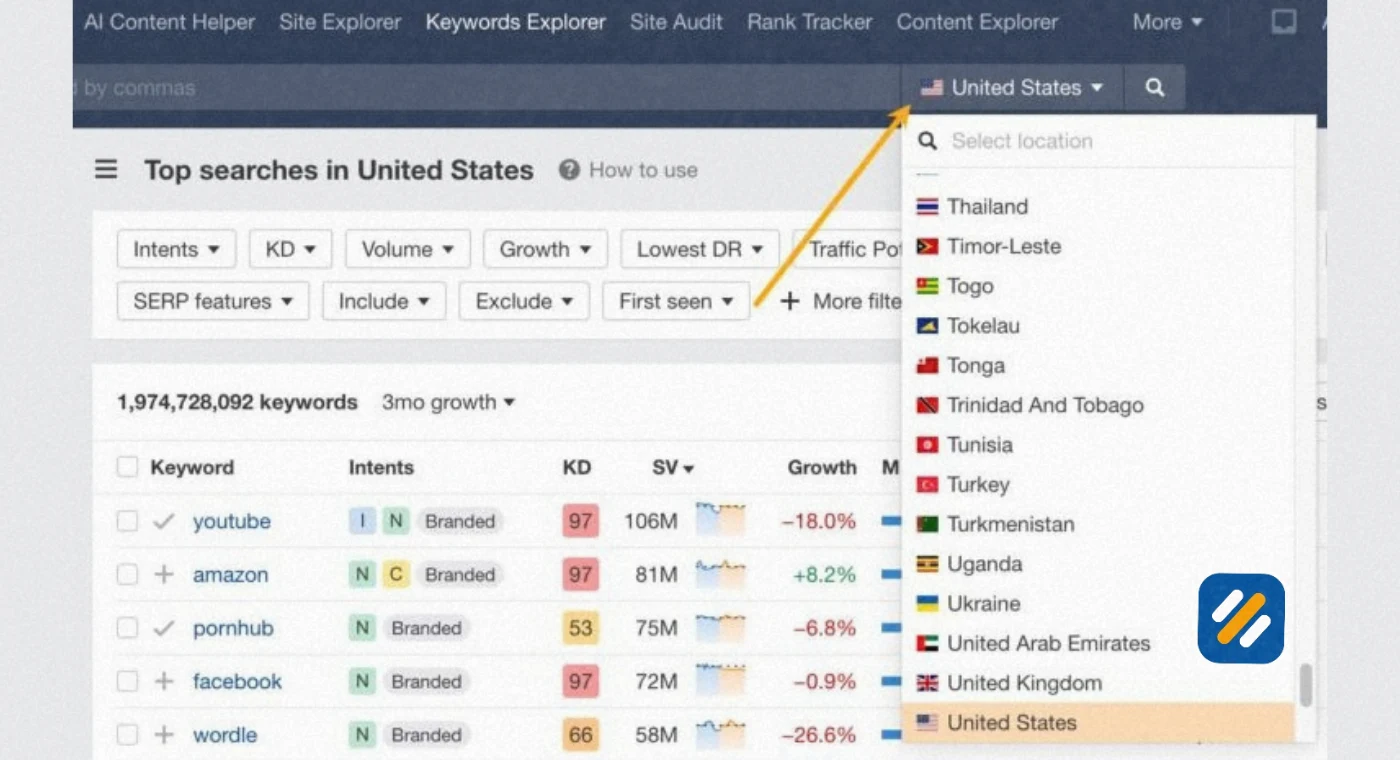
Step 2: Take that navigational keyword into a free keyword research tool. Enter "ChatGPT" into Ahrefs free keyword generator or Google Keyword Planner. Look at the "related keywords" and "questions" sections. These show you what people also want to know in that category.
Step 3: Filter by keyword difficulty under 30. Any keyword with a difficulty score under 30 is potentially rankable for a website with moderate authority. Between 15 and 30 is the sweet spot for growing websites in their first 12 months.
Step 4: Match the keyword to a search intent your content can serve. Informational keywords are the easiest to compete for through blog content. Commercial keywords require established authority. Transactional keywords require specific landing pages or local presence.
Step 5: Validate monthly search volume. Anything above 100 monthly searches in your target country is worth writing about. The best beginner targets are keywords between 200 and 2,000 monthly searches with difficulty under 20. These are the keywords that build your first traffic foundation.
9 3 Expert Tips for Using Top Keyword Data to Build a Smarter Content Strategy
Tip 1: Use Navigational Searches to Identify Your Audience's Existing Tools
Every navigational keyword in the top 100 represents a tool or platform your audience already uses. If you are targeting small business owners, they use Canva, Gmail, LinkedIn, and PayPal. Write content that helps them use those tools better and you are writing for an audience with proven, confirmed demand.
Tip 2: Never Target a Top 100 Keyword Directly. Target the Question Behind It
Instead of trying to rank for "weather," rank for "how to check weather forecast accuracy for outdoor events." Instead of "calculator," rank for "how to calculate profit margin for small businesses." The top 100 keywords tell you the topic. Your job is to find the question within that topic that you can own.
Tip 3: Update Your Keyword Strategy Quarterly Using Google Trends
The top 100 keywords change. ChatGPT did not exist in this list three years ago. Temu was not in the top 100 two years ago. Check Google Trends quarterly for keywords showing upward momentum in your niche. Publishing content on a keyword while it is growing is ten times more effective than trying to break into a keyword that has been saturated for years.
10 Conclusion
The top 100 keywords on Google are fascinating for what they reveal about human priorities at scale. We navigate more than we discover. We translate more than we create. We search for sports, entertainment, and the tools we rely on every single day.
But for a small business owner or a blogger building organic traffic from scratch, the real lesson from this data is simpler than it looks. The most searched keywords in the world are permanently out of reach. The keywords sitting adjacent to them, the questions behind them, the problems they represent, those are where your opportunity lives.
Study this list not as a target but as a map. It shows you where the people are. Your job is to build something genuinely useful for those people in the corner of the internet that you can actually own.
That is how organic traffic compounds. Not by chasing what everyone searches for. By becoming the best answer to the question those searches eventually lead to.
Have a question about keyword research strategy for your specific niche? Drop a comment below and I will answer it personally.
Join 1,000+ business owners and bloggers who get one actionable SEO tip every week — straight to their inbox. Free forever.
Get Free Weekly Tips →