- A doorway page is a low-value webpage created to rank for specific keywords while redirecting users somewhere else entirely
- Google explicitly prohibits doorway pages in its Search Essentials guidelines and actively penalises websites using them
- There are three types of doorway pages: black, grey, and white, each carrying different levels of SEO risk
- Doorway pages damage user experience, waste crawl budget, dilute domain authority, and can result in complete removal from Google’s index
- The safe and sustainable alternative to doorway pages is creating genuinely unique, user-focused landing pages for each topic or location you want to target
1 What Is a Doorway Page and Why Does It Exist in SEO
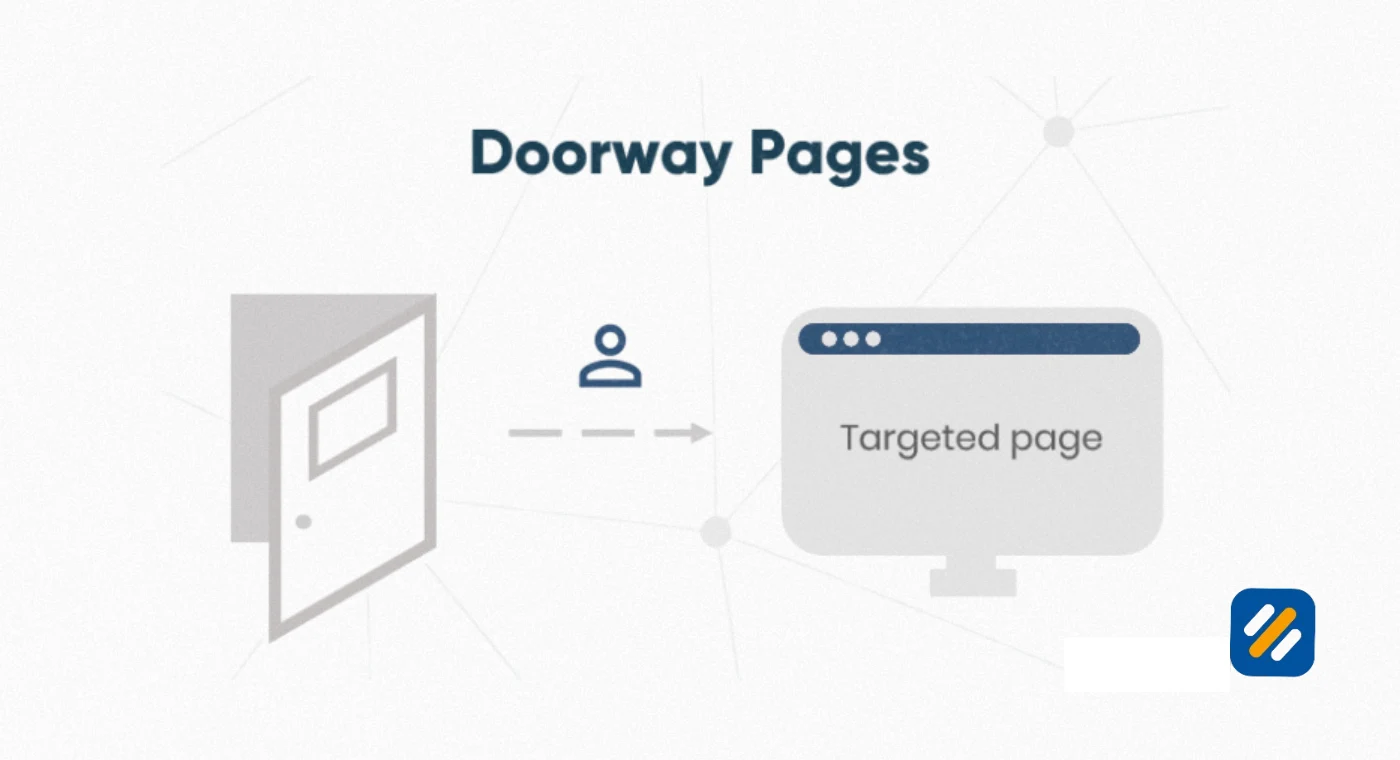
A doorway page is a webpage created to rank for specific keywords in Google while sending visitors to a completely different page. It is also called a bridge page or gateway page and is considered a Black Hat SEO technique.
For Google, doorway pages are web spam. They provide no real value to the searcher and exist only to manipulate search rankings. In some cases, doorway pages redirect users to harmful websites, including phishing pages or malware. That is why Google has been actively updating its spam detection algorithms to identify and penalise doorway pages since 2015.
In my many years of doing SEO audits for clients across multiple industries, I have seen businesses inherit doorway page penalties from previous agencies without even knowing these pages existed on their sites. Cleaning up the damage takes months. Understanding what doorway pages are before you accidentally create them is far easier.
2 What Does Doorway Mean in a Digital Context
The word “doorway” in SEO comes directly from the concept of an entry point. Just as a physical doorway is a passage between two spaces, a doorway page in SEO is designed to be a passage between a search result and a final destination.
The term has been part of SEO vocabulary since the late 1990s when early search engines were far easier to manipulate. Website owners discovered they could create hundreds of simple pages, each stuffed with a slightly different keyword variation, and rank them all simultaneously. Each page acted as a separate doorway into their main website, multiplying their search visibility without improving their actual content quality at all.
Google caught on quickly. By the mid-2000s, doorway pages were flagged as a violation of Google’s Webmaster Guidelines, which later became the Search Essentials. The practice has been officially prohibited for over a decade, yet it still appears regularly on websites that either inherited the tactic from old SEO campaigns or misunderstood the difference between doorway pages and legitimate location or service pages.
3 What Is a Landing Page in SEO and How Is It Different From a Doorway Page
This is one of the most common points of confusion in SEO, and it is important to get this distinction completely clear before building any new pages on your website.
Both landing pages and doorway pages are created to attract traffic for specific keywords. That is where the similarity ends.
| Feature | Doorway Page | Legitimate Landing Page |
|---|---|---|
| Primary purpose | Rank for a keyword, then redirect the user | Serve a specific user need and convert them |
| Content quality | Thin, duplicated, or auto-generated | Original, valuable, and genuinely useful |
| User experience | Frustrating, user is redirected away | Satisfying, user finds what they came for |
| Google’s view | Explicitly prohibited, penalty risk | Encouraged, rewarded with rankings |
| Redirect behaviour | Often uses automatic redirect to another page | No redirect, this page is the destination |
| Unique value | Little to none | Each page has distinct, meaningful content |
| Conversion focus | None, page is not meant to be the destination | Clear call to action, designed to convert |
| Long term SEO impact | Penalty, deindexing, loss of rankings | Stable, compounding authority over time |
A legitimate landing page for a plumbing business in Manchester is a page that explains the specific services available in Manchester, includes local phone numbers, shows real customer reviews from Manchester clients, and gives the visitor a reason to call. That page serves a genuine local searcher.
A doorway page for the same business is a page that says “Plumber Manchester” repeatedly with thin filler text and then automatically redirects the visitor to the same generic homepage they would have found anyway. The Manchester page adds no unique value. It exists only to intercept the local search query.
4 The 3 Types of Doorway Pages in SEO | Black, Grey, and White
Not all doorway pages are created equal. SEO professionals classify them into three categories based on how aggressively they manipulate search engines and how much risk they carry.
Black Doorway Pages
Black doorway pages are the most aggressive and most dangerous type. They are created purely for search engine manipulation and typically use automatic redirects to send users to a completely different page the moment they arrive. The visitor never sees the doorway page content at all. Only Google’s crawler does.
Black doorway pages are often created using automated doorway generators, software that produces hundreds or thousands of near-identical pages with slightly different keyword variations. They are frequently hosted on free hosting platforms to protect the main domain if Google issues a penalty.
These are a clear violation of Google’s Search Essentials and carry the highest penalty risk, including complete removal from Google’s index.
Grey Doorway Pages
Grey doorway pages do not use automatic redirects. Instead, they contain some real content alongside links back to the main website they are built to promote. The content exists not to help the visitor but to earn link equity for the primary domain.
Grey doorway pages sit in a risk zone that many SEO professionals mistakenly consider safe. They are not explicitly using the most obvious manipulation tactics but they still violate the spirit of Google’s guidelines by existing primarily to manipulate rankings rather than serve users.
White Doorway Pages
White doorway pages are the most legitimate variation and some SEO experts argue they are not truly doorway pages at all. These pages contain original, meaningful content and include links to the main website presented transparently, like advertising or recommendations. The visitor can choose whether to follow the link.
White doorway pages are the closest thing to an ethical version of this tactic and are generally not considered Black Hat SEO. However, creating large numbers of them still risks triggering Google’s pattern detection algorithms if they appear designed to manipulate rankings rather than genuinely inform users.
5 Real Doorway Pages Examples | What They Actually Look Like
Understanding doorway pages in theory is useful. Seeing what they look like in practice makes the concept impossible to misapply.
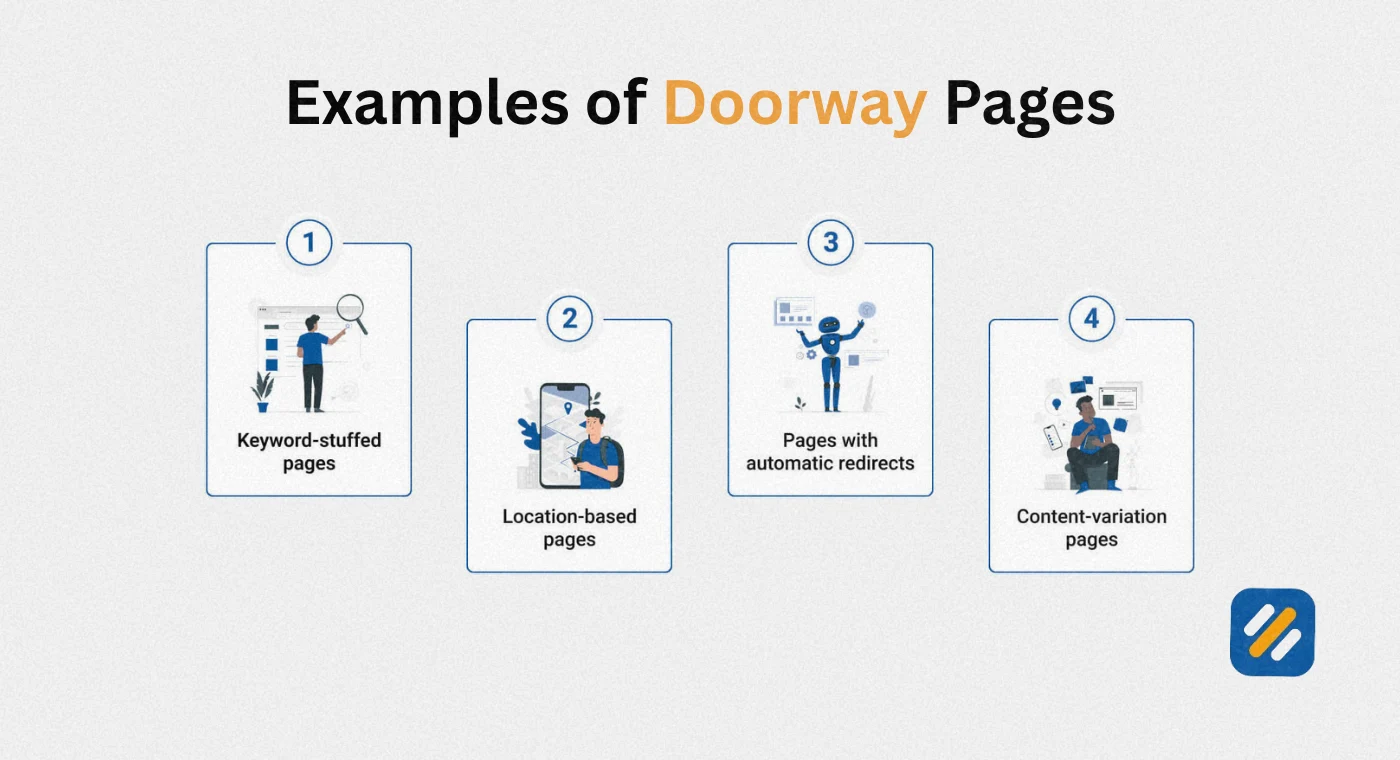
Example 1: Location-based keyword clusters
A national cleaning company creates 50 separate pages titled “Cleaning Services in [City Name]” for every major UK city. Every page has the same content with only the city name swapped out. None of the pages contain any information specific to that city. They all link back to the same booking form. This is a classic doorway page cluster.
Example 2: Keyword variation pages
A software company creates separate pages for “project management software,” “project management tool,” “project management app,” and “project management platform.” Each page is essentially the same article with the target term swapped throughout. No unique value exists between the pages. These are doorway pages disguised as content.
Example 3: Affiliate gateway pages
A blogger creates thin product review pages that rank for specific product keywords and immediately redirect visitors to an affiliate link without providing any original review content. The page is simply a gateway to a commission, not a resource for the reader.
Example 4: Auto-generated doorway networks
An SEO agency creates a network of 300 separate domain names, each targeting a niche keyword variation, all redirecting to one client website. Every domain is a doorway. This is one of the most severe violations and typically results in manual action from Google’s spam team.
6 How Google Detects and Penalises Doorway Pages
Google has been detecting doorway pages algorithmically since 2015 when it released a specific update targeting gateway pages. The detection methods have become significantly more sophisticated since then.
Here is how Google identifies doorway pages in 2026
Content similarity analysis: Google compares pages across your domain for duplicate or near-duplicate content patterns. Pages that are 80 to 90 percent identical with only minor variable substitutions are flagged automatically.
User behaviour signals: When users consistently bounce immediately from a page, spend zero seconds on it, or are redirected before they can interact, Google’s systems interpret this as a strong signal that the page is not serving any real user need.
Redirect pattern detection: Automatic redirects, especially JavaScript redirects that trigger immediately on page load, are a classic doorway page signal. Google’s crawlers now follow these redirects and compare the crawled content to the destination content.
Site structure analysis: Large clusters of pages targeting minor keyword variations with no meaningful differentiation between them trigger pattern detection. A site with 200 location pages that are all identical except for the city name will almost certainly be flagged.
Manual review: Google employs human quality raters who apply the Search Quality Evaluator Guidelines to flag sites for manual review. Doorway page patterns that survive algorithmic detection are often caught by manual reviewers.
The consequences of being caught range from ranking drops for the affected pages to a site-wide manual penalty that removes the entire domain from Google’s search results until the issue is resolved and a reconsideration request is filed and approved.
7 Google’s Official Doorway Pages Policy Explained
Google Search Central’s doorway pages policy is one of the clearest prohibitions in the entire Search Essentials document. Understanding exactly what Google says helps you make informed decisions about your own page architecture.
Google defines doorway pages as pages created to rank for specific search queries and then funnel users to one destination. The key questions Google’s guidelines suggest asking about any page are:
| Google’s Test Question | What It Reveals |
|---|---|
| Are the pages designed for search engines or for users? | Doorway pages answer: search engines. Good pages answer: users |
| Do the pages provide original content or value beyond what the destination page offers? | Doorway pages provide none. Good pages provide unique, distinct value |
| Are these pages part of a cluster designed to maximise search engine coverage? | Doorway pages are almost always created in clusters |
| Would a user feel deceived landing on this page expecting specific content? | Doorway pages almost always deceive the user’s intent |
| Does the page exist as an intermediate step rather than a final destination? | Doorway pages by definition are not the final destination |
If the honest answer to any of these questions points toward manipulation rather than user value, the page is likely a doorway page by Google’s definition regardless of what you call it internally.
Google’s Search Central documentation also makes clear that this policy applies regardless of whether the redirect is automatic or the funnelling happens through links rather than redirects. The intent and the user experience are what matter, not the technical mechanism.
8 How to Find Doorway Pages on Your Own Website
Many website owners discover they have doorway pages on their sites not because they created them intentionally but because a previous SEO agency used tactics they did not fully understand or disclose. Here is how to audit your site for doorway pages:
Step 1: Run a full site crawl with Screaming Frog free version. Export all URLs and look for pages that share near-identical title tags with only one variable changing, like a city name or keyword variation. These patterns are the first signal of a doorway page cluster.
Step 2: Check your Google Search Console coverage report. A sudden spike in indexed pages, particularly pages you did not create deliberately, often indicates an automated doorway page generation problem, sometimes caused by a compromised plugin or CMS vulnerability.
Step 3: Search Google for site:yourdomain.com and browse the results. If you see pages appearing that you do not recognise or pages that look identical except for one swapped variable, you have doorway pages.
Step 4: Check your analytics for zero-engagement pages. Pages with 100 percent bounce rates, zero time on page, and no conversions across hundreds of sessions are strong candidates for doorway pages. Real content pages always generate some engagement from at least a portion of visitors.
Step 5: Review your redirect log. Any internal pages that immediately redirect visitors to a different URL without displaying content are doorway pages by definition. Audit your redirect map and investigate any redirects that send users to a different domain or a generic destination page.
9 What to Do Instead | Building Legitimate Pages That Google Rewards
Every scenario where someone considers creating doorway pages has a legitimate, sustainable alternative. Here is what to build instead:
For location targeting: Create genuinely unique location pages. Each city or region page should include location-specific case studies, local contact details, testimonials from clients in that area, knowledge of local regulations or conditions relevant to your service, and content that only makes sense in that specific local context. A Manchester plumbing page and a Birmingham plumbing page should be meaningfully different, not interchangeable.
For keyword variation targeting: Use a single comprehensive page that naturally covers multiple related keyword variations through topical depth. One authoritative guide on “project management software” can rank for “project management tool,” “project management app,” and dozens of related terms without creating separate thin pages for each.
For affiliate content: Write genuine, detailed product reviews based on real use and testing. Comparison guides, pros and cons breakdowns, and original photography or screenshots all add value that justifies the page’s existence beyond its affiliate links.
For service variations: Create service pages that are genuinely distinct in content because the services themselves are distinct. “Commercial cleaning” and “residential cleaning” deserve separate pages because the audience, the process, and the considerations are different. “Cleaning service” and “cleaning services” do not deserve separate pages because the difference is only grammatical.
10 3 Expert Tips to Protect Your Website From Doorway Page Penalties
Tip 1: Apply the “user first” test to every new page before publishing
Before any new page goes live, ask one question: if a real user landed on this page from Google, would they find what they were looking for and feel their search was satisfied? If the honest answer is no, the page should not be published until it genuinely serves that user. This single habit eliminates the risk of accidentally creating doorway pages more effectively than any technical checklist.
Tip 2: Audit location and service page clusters every six months
Location pages and service variation pages are the most common place doorway pages accidentally appear on legitimate business websites. Run a content similarity check across all location or service pages twice per year. If you cannot clearly articulate what makes each page unique and valuable for its specific audience, consolidate the thin ones into stronger, more comprehensive pages.
Tip 3: Never let an agency create pages without explaining their purpose
In six years of auditing client sites, doorway page penalties are almost always inherited from previous SEO work rather than created intentionally by the business owner. Before any new pages are created by an agency or freelancer, ask for a clear explanation of what unique value each page provides to the specific user who lands on it. If the answer is primarily about rankings rather than user value, push back before the pages go live.
11 Conclusion
Doorway pages represent one of the clearest examples of short-term thinking in SEO. They can generate fast rankings. They can intercept significant search traffic. And they will almost certainly cause serious damage to your website’s long-term rankings, authority, and credibility the moment Google’s algorithms or manual reviewers catch up.
The businesses that rank consistently on page one are not the ones creating the most pages. They are the ones creating the most useful pages. One genuinely valuable page that fully serves a user’s need will always outperform ten thin doorway pages in the long run, and it will never put your entire domain at risk.
Build pages for people. Let Google find them because they deserve to be found.
Have a question about whether a page on your site might be considered a doorway page? Drop a comment below and I will give you an honest answer based on real SEO experience.
Join 1,000+ business owners and bloggers who get one actionable SEO tip every week — straight to their inbox. Free forever.
Get Free Weekly Tips →