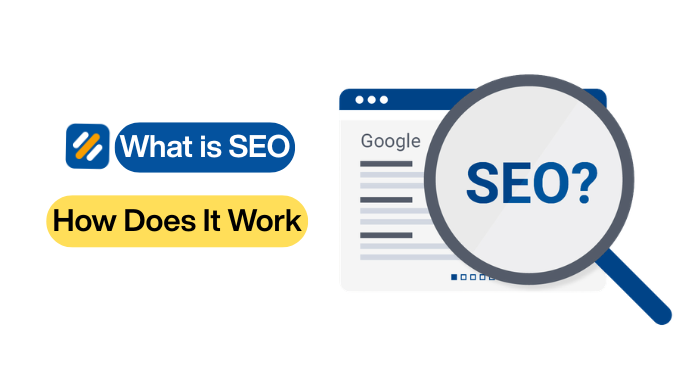
- SEO stands for Search Engine Optimization and it helps your website appear on Google organically without paying for ads.
- Google uses over 200 ranking factors but three matter most for beginners: relevance, authority, and experience
- On-page SEO, off-page SEO, and technical SEO are the three pillars every website needs
- A brand new website can start seeing results within 3 to 6 months with consistent effort
- You do not need to hire an agency to do SEO. Most beginner SEO is learnable and free to implement
1 What Is SEO and Why Should You Care About It
Let me start with the most honest explanation you will find anywhere.
SEO stands for Search Engine Optimization. It is the process of making changes to your website so that Google ranks it higher when someone searches for something related to your business.
That is it. No magic. No secret algorithm. Just a set of actions that make Google more likely to show your website to the right people.
Here is why this matters for you specifically. When someone in the US or UK types "plumber near me" or "best accounting software for small business" into Google, they click one of the first three results almost every time. Studies from Backlinko show that the first result on Google gets 27.6% of all clicks. The second gets 15.8%. By position 10, you are getting less than 2.5%.
If your website is not on page one, it is effectively invisible.
SEO is how you get to page one. And unlike paid ads, the traffic you earn from SEO does not stop the moment you stop paying. It compounds over time.
2 How Does Google Actually Decide What to Rank
Most beginners think Google ranking is mysterious or random. It is neither.
Google's job is to give searchers the most useful, trustworthy answer as fast as possible. Every ranking decision it makes serves that one goal.
To decide which pages deserve to rank, Google sends out automated programs called crawlers (also called spiders or bots). These crawlers visit billions of pages across the internet, read the content, and report back to Google's index. Think of the index as a massive library containing a copy of every webpage Google has found.
When someone searches, Google does not search the live internet. It searches this index in fractions of a second and decides which pages best match the search query.
Here is what Google looks at when making that decision:
Relevance: Does your page actually answer what the person searched for? This is determined by the words you use, how you structure your content, and whether your topic matches the search intent.
Authority: Does the internet trust your website? Google measures this partly through backlinks, which are links from other websites pointing to yours. A backlink from a respected website tells Google your content is worth recommending.
Experience: Does your page load fast? Is it easy to read on a phone? Does the user stay on your page or immediately go back to the search results? Google tracks all of this.
Freshness: For certain topics like news or "best tools in 2026" searches, Google prefers recently updated content. For evergreen topics, freshness matters less.
3 The Three Pillars of SEO Every Beginner Must Know
SEO is not one single thing. It breaks down into three areas. You need all three to rank consistently.
On-Page SEO
On-page SEO covers everything you do on your actual webpage to make it relevant to a search query. This includes:
- Keyword research for primary and secondary keywords
- Writing a clear title tag that contains your target keyword
- Writing a meta description that convinces people to click
- Using your keyword naturally in the first paragraph and in at least one heading
- Structuring your content with H1, H2, and H3 headings so it is easy to scan
- Adding internal links to other relevant pages on your site
- Slug, permalink, URL optimization
- Optimising your images with descriptive alt text
On-page SEO is entirely in your control and it is where every beginner should start.
Off-Page SEO
Off-page SEO refers to actions taken outside your website that influence your rankings. The most important off-page signal is backlinks.
Important Point: When a reputable website links to your content, it passes what SEO professionals call "link equity" or "link juice" to your page.
Google interprets this as a vote of confidence. The more high-quality backlinks you earn, the more Google trusts your website overall.
For beginners, the most practical way to build do-follow backlinks is to write content so genuinely useful that other websites want to reference it, or to write guest posts for other blogs in your industry.
Technical SEO
Technical SEO ensures Google can find, crawl, and understand your website without obstacles. It covers things like:
- Making sure your site loads in under 3 seconds
- Adding schema markup for getting result in rich snippet
- Optimized robot. txt file
- Use canonical tags for duplicate content
- Having a clean URL structure
- Setting up a sitemap so Google can easily discover all your pages
- Ensuring your site works properly on mobile devices
- Fixing broken links and redirect errors
- Optimized core web vitals
- Optimized page speed
You do not need to master technical SEO on day one. But ignoring it completely will cap how far your on-page and off-page work can take you.
4 On-Page vs Off-Page vs Technical SEO at a Glance
| SEO Type | What It Covers | Your Control Level | Where to Start |
|---|---|---|---|
| On-Page SEO | Title tags, headings, content, internal links, meta descriptions | Full control | Start here first |
| Off-Page SEO | Backlinks, brand mentions, guest posts | Partial control | After publishing 20+ articles |
| Technical SEO | Site speed, mobile usability, crawlability, sitemaps | Full control (with help) | Fix basics before publishing |
| Local SEO | Google Business Profile, local citations, map rankings | Full control | Only if you serve a local area |
| E-E-A-T Signals | Author bio, credentials, real experience shown in content | Full control | Add from day one |
5 3 SEO Techniques Every Beginner Must Know Before They Start Optimising
SEO is not one-size-fits-all. The approach you choose from day one decides whether your website grows steadily or gets wiped out by a Google update.
White Hat SEO follows every Google guideline. Rankings are earned through genuine content, real backlinks, and honest optimisation. Slower to start but rock solid long term.
Black Hat SEO manipulates Google using tactics like keyword stuffing, paid link schemes, and cloaking. Rankings appear fast but a single Google penalty can erase your entire website from search results overnight.
Grey Hat SEO borrows from both. Not explicitly banned but not clean either. Rankings built here are always one algorithm update away from disappearing.
The choice is simple. White hat SEO is the only technique that builds something real. Every shortcut in SEO will be a reason for penalising your website.
6 What Is E-E-A-T and Why Google Cares About Your Credibility
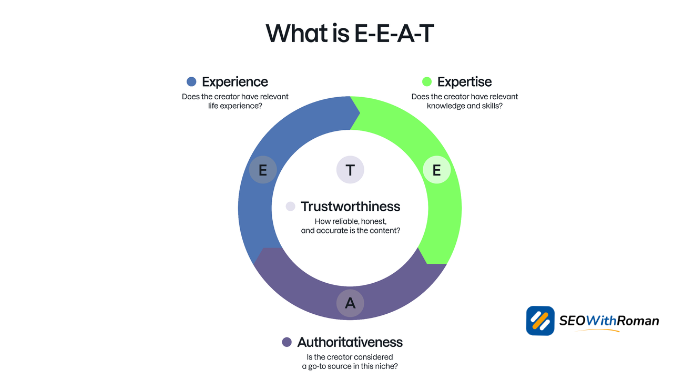
Google introduced a quality framework called E-E-A-T, which stands for Experience, Expertise, Authoritativeness, and Trustworthiness. It was updated in 2022 to add the first E for Experience.
This is not a direct ranking factor in the sense that you cannot add an "E-E-A-T score" to your page. Instead, it is a set of signals Google uses to evaluate whether your content deserves to rank for important or sensitive topics.
Here is what each part means in plain language:
Experience means you have first-hand, real-world knowledge of what you are writing about. A guide on SEO written by an actual SEO specialist is more valuable than the same guide written by someone who just read about it.
Expertise means you have skills and knowledge in your field. Showing your qualifications, your track record, and the depth of your knowledge in your content all contribute here.
Authoritativeness means others in your industry recognise your knowledge. Backlinks from respected websites, mentions in publications, and having your content cited by others all build authority.
Trustworthiness means your website is safe, honest, and transparent. Having an SSL certificate, a clear privacy policy, accurate information, and an author bio all support trust.
For a personal brand blog like SEOWithRoman.com, E-E-A-T is a significant advantage. Your name, your ten years of experience, and your real client examples are E-E-A-T signals that an anonymous website can never replicate.
7 How Long Does SEO Take to Work
This is the question I get asked the most. And the honest answer is: it depends, but here is what the data shows.
| Website Stage | Expected Timeline | What Drives Results |
|---|---|---|
| Brand new website, 0 content | Month 1 to 3: Near zero traffic | Building foundation, publishing first articles |
| New website, 20 to 30 articles | Month 3 to 5: First rankings appear | Long-tail keywords start ranking |
| Growing site, 50+ articles | Month 5 to 8: Consistent traffic begins | Topical authority starts forming |
| Established site, 80 to 100 articles | Month 8 to 14: Compounding growth | Strong domain authority, higher competition keywords possible |
| Authority site, 100+ articles, backlinks | Month 14 onwards: Significant passive traffic | Brand searches, referral traffic, repeat visitors |
The most important thing to understand about SEO timelines is that the results are not linear. You will often feel like nothing is happening for the first three months. Then traffic will start appearing. Then it will grow faster and faster as your domain authority builds.
Ahrefs published research showing that the average page that ranks in the top 10 is over two years old. This does not mean you need two years to rank. It means consistency compounds. The blogs that win are the ones that keep publishing when early results are slow.
8 Can You Do SEO Yourself Without Hiring an Agency
Yes. Absolutely.
In fact, for small business websites and personal blogs, doing your own SEO is often more effective than hiring an agency. Here is why.
Most agencies that work with small businesses are managing dozens of clients at once. Your website gets a few hours of attention per month. When you do it yourself, you are the only client.
More importantly, you know your business, your customers, and your industry better than any agency ever will. That knowledge translates directly into better content.
Here is what you can realistically do yourself for free:
- Keyword research using Ahrefs free keyword generator or Google Search Console
- On-page optimisation using Rank Math free plugin on WordPress
- Technical SEO basics using Google Search Console and PageSpeed Insights
- Content creation using your own knowledge and experience
- Internal linking as you build out your content library
The main thing you cannot easily do yourself is earning high-authority backlinks at scale. That is the one area where professional outreach eventually helps. But for the first 12 months of a new website, focusing on publishing quality content consistently will take you further than chasing backlinks.
9 Three SEO Mistakes Beginners Make in the First 90 Days
I have worked with dozens of small business owners who started SEO on their own. The same three mistakes come up every time.
Targeting keywords that are too competitive: A brand new website cannot rank for "best SEO tools" or "what is SEO." These keywords have massive competition from websites with thousands of backlinks. Start with long-tail keywords under a difficulty score of 20.
Writing content for Google instead of people: Stuffing your articles with keywords, writing shallow 500-word posts, and copying what competitors wrote will not work. Google's algorithms in 2026 are sophisticated enough to detect content written purely for rankings rather than readers.
Expecting results in 30 days: This creates frustration and leads people to abandon SEO entirely right before the results would have started showing. Set a 6-month minimum before you judge whether your SEO is working.
10 Conclusion
SEO is not complicated once you understand the three things it is built on: helping Google find you, proving your content is relevant, and showing that your website is trustworthy.
You do not need an agency. You do not need expensive tools. You need a clear understanding of how Google works, a plan for the keywords you want to target, and the consistency to keep publishing useful content every week.
Every article you publish is a permanent asset. It works for you 24 hours a day, 7 days a week, without you paying for clicks.
Start with one article. Optimise it properly. Publish it. Then do it again next week.
That is how SEO works. And that is how this blog was built.
Note: If you found this guide useful, leave a comment below and let me know what SEO topic you want me to cover next.
Join 1,000+ business owners and bloggers who get one actionable SEO tip every week — straight to their inbox. Free forever.
Get Free Weekly Tips →