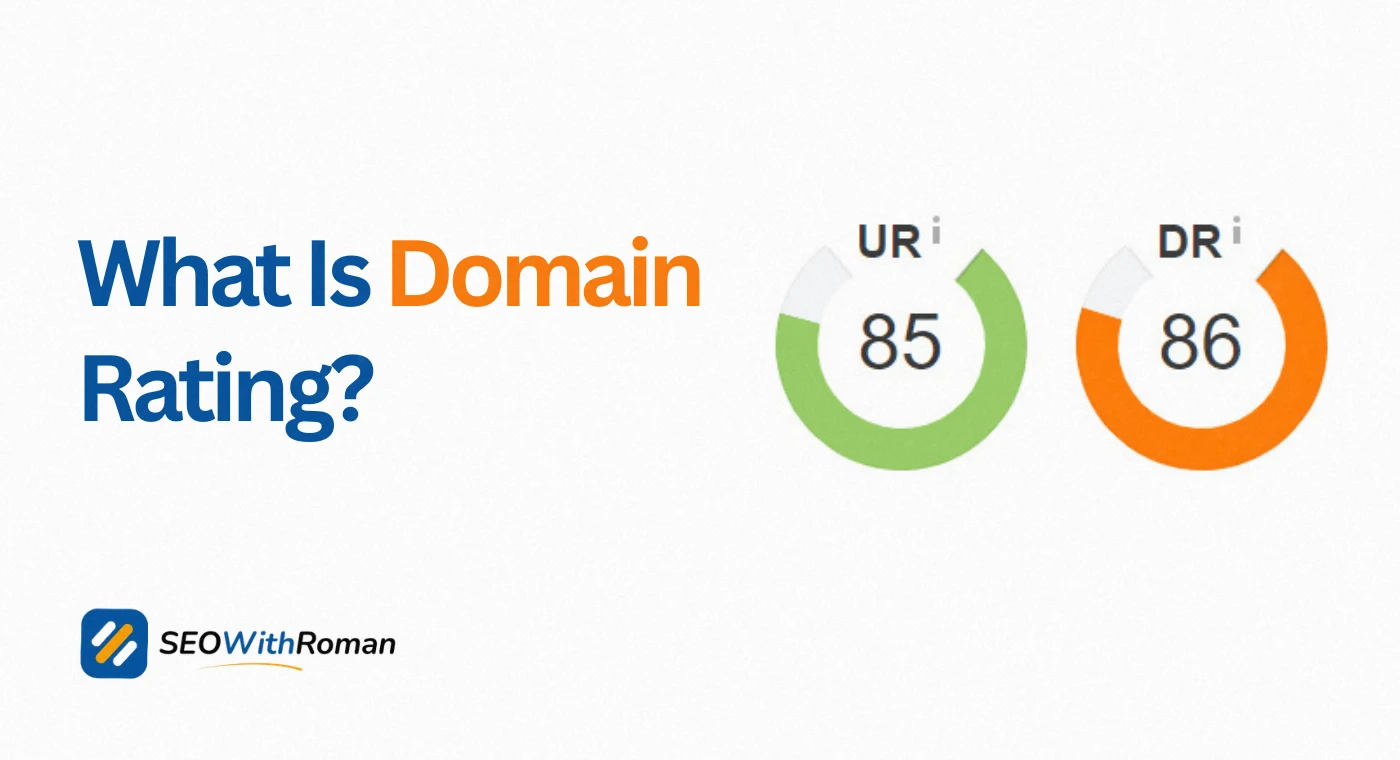
- Domain Rating is a metric created by Ahrefs that measures the strength of a website’s backlink profile on a scale of 0 to 100
- DR is a relative metric, meaning your score is always measured against every other website in Ahrefs database
- A good domain rating depends entirely on your niche and competitors, not on a fixed number
- DR does not directly affect Google rankings but strongly correlates with ranking ability because it reflects backlink strength
- The fastest way to improve your domain rating is to earn backlinks from high DR websites that link to fewer total domains
1 What Is Domain Rating and Why Every Website Owner Needs to Understand It
If you have ever wondered why some websites rank on Google for almost every keyword they target while others with equally good content stay stuck on page three, domain rating is a big part of the answer.
Domain Rating, commonly written as DR, is a metric developed by Ahrefs that measures the strength of a website’s overall backlink profile. It runs on a scale from 0 to 100. The higher the number, the stronger the website’s backlink authority relative to every other website in the Ahrefs database.
Think of it this way. Two websites can publish articles on the same keyword with the same on-page optimisation. The one with a higher domain rating will almost always outrank the other because Google trusts it more. That trust is built almost entirely through the quantity and quality of websites linking back to it.
After many years of doing SEO for clients across multiple industries, I can tell you that domain rating is the single metric I look at first when assessing why a competitor is outranking my client. It tells me immediately how much authority gap we are dealing with and how aggressive the link building strategy needs to be.
Domain rating is not a Google metric. Google does not use Ahrefs DR as a ranking factor. But it is one of the most accurate third-party proxies for what Google’s own internal authority signals look like. Websites with high DR almost always have the kind of backlink profiles that Google rewards.
2 How Domain Rating Is Actually Calculated
Most guides explain what domain rating is without explaining how it works. Understanding the calculation changes how you think about building yours.
Ahrefs calculates domain rating using a process that considers two things simultaneously: the quantity of unique domains linking to your website and the quality of those linking domains.
Here is where it gets interesting. A high DR website linking to your site transfers more authority than a low DR website. But the amount it transfers depends on how many other websites it links to. A DR 70 website that links to five domains passes far more authority to each of those five sites than a DR 90 website that links to ten thousand domains.
This is the key insight most beginners miss. One backlink from a high DR website that links to very few other websites is worth more than fifty backlinks from high DR websites that link to everyone.
The final DR score is then scaled across the 0 to 100 range logarithmically. This means moving from DR 20 to DR 30 is significantly easier than moving from DR 70 to DR 80. The higher you go, the harder each point becomes to earn.
DR is also a relative metric. This means if large websites suddenly gain enormous numbers of backlinks, your DR can drop even if you did not lose a single backlink. You did not get weaker. The competition got stronger and pushed the scale.
3 Domain Rating vs Domain Authority | Understanding the Difference
This is one of the most common points of confusion in SEO and it is worth addressing directly.
| Metric | Created By | Scale | What It Measures | Updates |
|---|---|---|---|---|
| Domain Rating (DR) | Ahrefs | 0 to 100 | Backlink profile strength across entire domain | Frequent, near real time |
| Domain Authority (DA) | Moz | 0 to 100 | Predicted ranking ability based on backlinks | Less frequent |
| URL Rating (UR) | Ahrefs | 0 to 100 | Backlink strength of a single page, not the whole domain | Frequent |
| Trust Flow | Majestic | 0 to 100 | Quality of backlinks based on trusted seed sites | Periodic |
| Citation Flow | Majestic | 0 to 100 | Quantity of backlinks regardless of quality | Periodic |
Domain Rating and Domain Authority measure similar things using different methodologies and different link databases. Neither is a Google metric. Both are useful proxies for understanding backlink authority.
In practice, I use Ahrefs DR as my primary reference when doing competitor analysis because Ahrefs has the largest and most frequently updated backlink database available. When checking website authority quickly, I also cross reference with Moz DA for a second opinion on sites I am considering for link building outreach.
4 What Is a Good Domain Rating Score
This is the question I get asked most often and the honest answer surprises most beginners.
There is no universally good domain rating score. A DR of 30 can be excellent for a local plumber’s website competing in a small geographic market. That same DR of 30 would be weak for an ecommerce store competing against Amazon, eBay, and major retailers with DRs above 80.
Domain rating only matters in context. The only comparison that is relevant is your DR versus the DR of the websites ranking above you for your target keywords.
That said, here is a practical reference guide based on six years of working across different website types and industries
| DR Score Range | What It Generally Indicates | Typical Website Type |
|---|---|---|
| 0 to 10 | Brand new or very few backlinks | New websites, just launched blogs |
| 11 to 20 | Early link building stage | Small blogs, local business sites |
| 21 to 35 | Growing authority | Active content sites, small niche blogs |
| 36 to 50 | Solid mid-level authority | Established blogs, regional businesses |
| 51 to 65 | Strong authority | Industry publications, large service sites |
| 66 to 80 | Very high authority | Major news outlets, large ecommerce stores |
| 81 to 100 | Exceptional authority | Wikipedia, BBC, major global brands |
To answer the specific question “is 75 a good SEO score” — a DR of 75 is genuinely strong and puts a website in the top tier of most niches. Very few small businesses or personal blogs ever reach DR 75. If your website is at DR 75, you have built a serious backlink profile and you should be able to compete for high difficulty keywords in most industries.
5 How to Check Your Domain Rating for Free
You do not need a paid Ahrefs subscription to check your domain rating or your competitors. Here are the best free methods:
Ahrefs Website Authority Checker
Ahrefs offers a completely free DR checker tool at ahrefs.com/website-authority-checker. Enter any domain and it instantly shows you the DR score, the number of referring domains, and the total backlinks. No account required. This is the most accurate free DR checker available because it uses the same data as the full paid tool.
Ahrefs Free Webmaster Tools
If you want to check your own website’s DR along with more detailed data including which pages have the most backlinks and which referring domains are linking to you, sign up for Ahrefs Free Webmaster Tools. It is free for website owners who verify their domain and gives you significantly more data than the public authority checker.
Moz Link Explorer
Moz’s free version at moz.com/domain-analysis shows Domain Authority, Page Authority, and linking domain data for any website. You get ten free searches per month without an account. This is useful for a second opinion on a website’s authority when you are deciding whether to pursue a link building opportunity.
SEMrush Authority Score
SEMrush has its own equivalent metric called Authority Score. The free version gives you limited lookups but enough for occasional competitor checks. It uses a different methodology than Ahrefs DR but the results are broadly comparable for most websites.
6 The 7 Types of Domains and How They Affect Your Domain Rating
Understanding the types of domains helps you make smarter decisions about which websites are worth getting backlinks from and how different domain structures affect your overall domain strength.
| Domain Type | Example | How It Affects DR |
|---|---|---|
| Root Domain | example.com | Your main domain, where all DR accumulates |
| Subdomain | blog.example.com | Treated as a separate entity by Ahrefs, has its own DR |
| Country Code TLD | example.co.uk | Standard domain, DR builds normally |
| Generic TLD | example.io or example.app | Standard domain, DR builds normally |
| Expired Domain | Purchased old domain with existing backlinks | Inherits previous DR if backlinks are still live |
| Exact Match Domain | keywords.com | No automatic DR advantage, must earn backlinks normally |
| Branded Domain | seowithroman.com | Best for long term authority and E-E-A-T, builds DR through content and outreach |
The most important insight from this table is about subdomains. If your blog lives on blog.yourwebsite.com rather than yourwebsite.com/blog, Ahrefs treats it as a completely separate domain with its own DR. This means all the link equity your blog earns does not flow back to your main domain. For most small websites, keeping your blog on a subdirectory rather than a subdomain is the right decision for domain rating purposes.
7 Why Domain Rating Matters for SEO and How It Connects to Google Rankings
Domain rating does not directly influence Google rankings. Google does not use Ahrefs data. But DR matters enormously for SEO for one simple reason: it accurately reflects the kind of backlink profile that Google does use as a ranking signal.
Google’s PageRank algorithm, which is the foundation of how Google evaluates backlinks, works on a very similar principle to how Ahrefs calculates DR. Websites with more high-quality backlinks from trusted sources rank better because those backlinks are votes of confidence from other websites.
When your DR is high it means
- Many trusted websites are linking to your content
- Google is more likely to trust your entire domain
- New content you publish ranks faster because your domain already has authority
- You can compete for higher difficulty keywords that low DR websites cannot rank for
- Your pages start appearing in featured snippets and AI Overviews more frequently
In practical terms, I have seen websites with DR 40 to 50 consistently outrank websites with technically better content at DR 15 to 20. The authority advantage overrides the content quality advantage when the gap is large enough.
The goal for SEOWithRoman.com and any personal brand SEO blog is to build DR steadily through quality content that earns natural backlinks and strategic outreach to relevant websites in the SEO niche.
8 How to Improve Your Domain Rating | Strategies That Actually Work
Improving your domain rating comes down to one core activity: earning backlinks from high DR websites that link to fewer total domains. Everything else is supporting that goal.
Here are the strategies that consistently deliver DR growth
Publish linkable assets first: Free tools, original research, comprehensive guides, and unique data studies earn backlinks naturally because other websites want to reference them. A free SEO checklist or original data study about SEO results for small businesses will earn links that a standard how-to article never will.
Guest posting on relevant high DR websites: Writing guest articles for established websites in your niche is the most reliable way to earn high DR backlinks at scale. Focus on websites with DR above 40 that are topically relevant to your content. A backlink from an SEO blog with DR 50 is worth far more than ten backlinks from unrelated websites with DR 60.
Broken link building: Find high DR websites in your niche that have broken outbound links. Use Ahrefs or Check My Links browser extension to identify them. Then contact the website owner and suggest your relevant content as a replacement. This works because you are solving a real problem for the website owner rather than just asking for a favour.
Digital PR and brand mentions: Getting your website or your name mentioned in online publications, interviews, or industry roundups builds high authority backlinks that are difficult to replicate through outreach alone. Publishing original research or expert opinions on trending topics in your industry is the most scalable way to earn PR backlinks.
Internal linking to consolidate authority: While internal links do not directly increase your DR, they distribute the link equity your site already has more efficiently. Pages with strong backlink profiles should internally link to pages you want to rank better. This is free and takes effect immediately.
9 3 Expert Tips to Improve Domain Rating Faster
Tip 1: Chase Referring Domains, Not Total Backlinks
Ahrefs DR is driven by unique referring domains, not raw backlink count. One hundred backlinks from the same website count far less than ten backlinks from ten different high DR websites. Always prioritise diversifying your referring domain count over accumulating more links from sources you already have.
Tip 2: Check How Many Sites a Linking Domain Links To Before Pursuing It
Before investing time in outreach for a backlink from any website, check how many total outbound links that domain has in Ahrefs. A DR 60 website linking to five thousand other sites will contribute almost nothing to your DR. A DR 40 website linking to only fifty sites will move your DR noticeably. Quality of the linking domain’s link distribution matters as much as its DR score.
Tip 3: Protect Your DR by Disavowing Toxic Backlinks
Spammy or manipulative backlinks from low quality websites can dilute your DR and raise red flags with Google. Check your backlink profile in Ahrefs or Google Search Console every three months. If you find backlinks from irrelevant, low quality, or clearly spammy websites, submit a disavow file in Google Search Console to tell Google to ignore those links.
10 Conclusion
Domain rating is one of the most useful metrics in SEO because it gives you an instant snapshot of how much backlink authority your website has built and how that compares to your competitors. It is not a Google ranking factor directly but it is one of the best proxies available for predicting ranking ability.
The path to improving your DR is straightforward even if it is not quick. Publish content worth linking to. Build relationships with websites in your niche. Earn backlinks from high DR websites that link selectively. Repeat consistently over time.
A website with DR 40 and 60 well-optimised articles will outperform a website with DR 10 and 200 thin articles in almost every competitive keyword scenario. Build your authority deliberately and your rankings will follow.
Have a question about your domain rating or how to start building backlinks for a new website? Drop a comment below and I will answer it personally.
Join 1,000+ business owners and bloggers who get one actionable SEO tip every week — straight to their inbox. Free forever.
Get Free Weekly Tips →