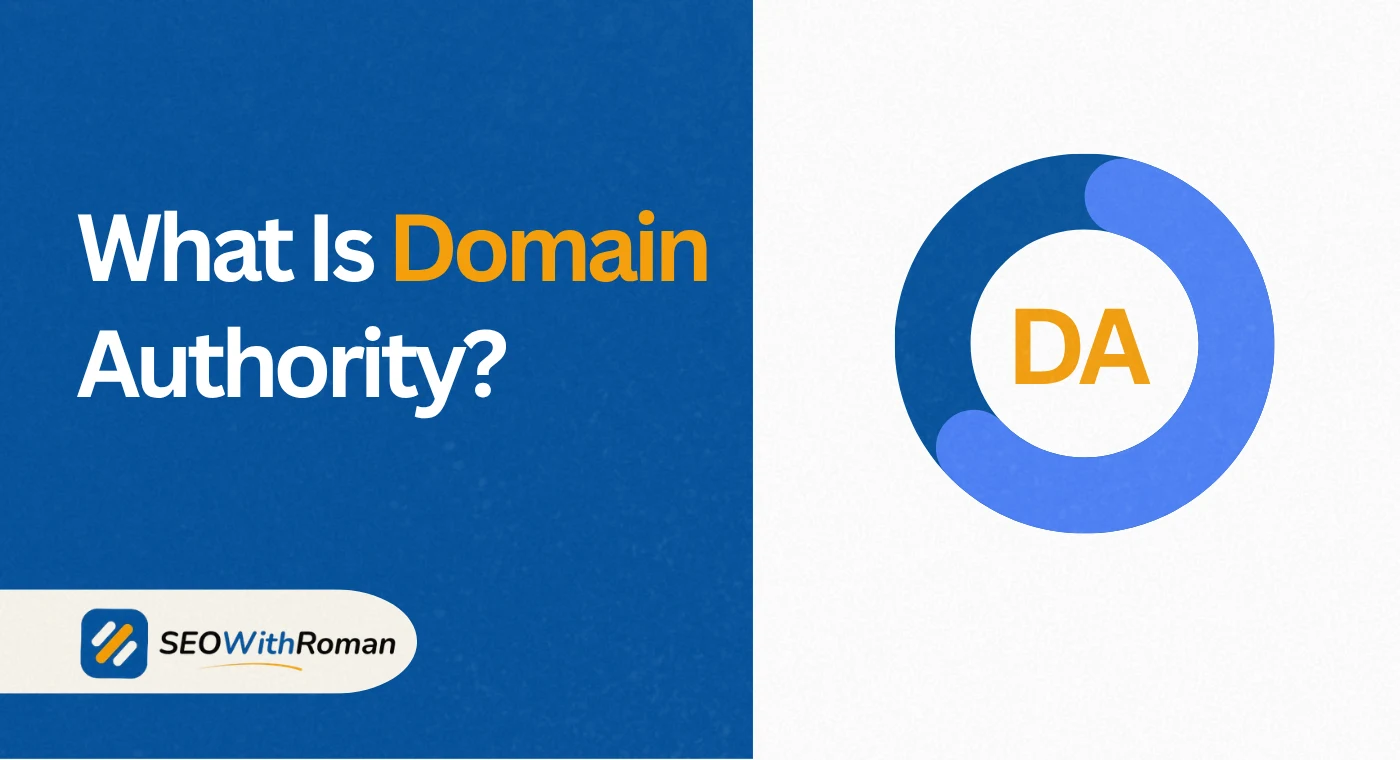
- Domain Authority is a third party score from 1 to 100 created by Moz that predicts how likely a website is to rank on Google compared to competitors
- Google does not use Domain Authority as a direct ranking factor, but a high DA reflects the same qualities Google rewards
- A DA score of 30 to 50 is good for a small business or new blog, and anything above 60 is considered strong
- You can check your domain authority for free using Moz Link Explorer, Ahrefs Website Authority Checker, or SEMrush Authority Score tool
- The single most effective way to increase domain authority is earning high quality backlinks from relevant, trusted websites in your niche
1 What Is Domain Authority and Why Every Website Owner Should Understand It
If you have been doing SEO for more than a week, you have probably heard someone mention Domain Authority. But most explanations either oversimplify it to the point of being useless or make it sound more complicated than it actually is.
Let me give you the clear, honest version
Domain Authority, commonly shortened to DA, is a website scoring metric originally created by Moz. It runs on a scale from 1 to 100. The higher your score, the more likely your website is to rank on Google compared to competitors in your space.
A brand new website starts with a DA of 1. Wikipedia sits at 93. A well-established small business blog with a few years of consistent content and some quality backlinks might sit between 30 and 45.
Here is the most important thing most beginners get wrong about DA. Google does not use Domain Authority as a ranking factor. Moz built this metric independently to estimate ranking potential. It is not part of Google’s algorithm.
What DA actually measures is a combination of factors that also happen to influence Google rankings, specifically the quality and quantity of backlinks pointing to your website. So a high DA and strong Google rankings tend to go together, but one does not directly cause the other.
Think of Domain Authority like a credit score for your website. Your bank does not use the credit bureau’s exact score to make lending decisions, but the score reflects your financial behaviour accurately enough to be a reliable indicator of creditworthiness. DA works the same way for SEO.
In many years of doing SEO for clients, I use DA as a competitive benchmarking tool, not as a goal in itself. The question is never “how do I raise my DA?” The question is “how do I build the kind of website authority that makes DA rise naturally?
2 Domain Authority vs Domain Rating vs Authority Score | Which One Should You Track
Here is something competitors rarely explain clearly. Domain Authority is not the only website authority metric in the SEO industry. Every major tool has built its own version, and they do not always agree.
| Metric Name | Tool That Created It | Scale | What It Measures | Best Used For |
|---|---|---|---|---|
| Domain Authority (DA) | Moz | 1 to 100 | Backlink profile quality and quantity | Benchmarking against competitors using Moz data |
| Domain Rating (DR) | Ahrefs | 1 to 100 | Strength of a website’s backlink profile | Evaluating link building progress in Ahrefs |
| Authority Score (AS) | SEMrush | 1 to 100 | Backlinks, organic traffic, and spam factors combined | Holistic site health assessment |
| URL Rating (UR) | Ahrefs | 1 to 100 | Strength of an individual page’s backlink profile | Evaluating page-level link equity |
| Page Authority (PA) | Moz | 1 to 100 | Individual page ranking potential | Identifying which pages need link building |
| Trust Flow | Majestic | 1 to 100 | Quality of links from trusted seed sites | Spam detection and link quality assessment |
None of these metrics is universally superior. Each tool uses slightly different data and different algorithms. A website might have a Moz DA of 35 and an Ahrefs DR of 42. Both are valid measurements from their respective databases.
My recommendation for beginners is to pick one tool and track that metric consistently. Comparing your DA in one tool to a competitor’s DR in another tool is comparing apples to oranges and will lead to wrong conclusions about your competitive position.
3 How Domain Authority Is Actually Calculated
Understanding how DA is calculated helps you make smarter decisions about where to focus your SEO efforts.
Moz calculates Domain Authority using a machine learning algorithm that factors in dozens of link-related signals. The core inputs are
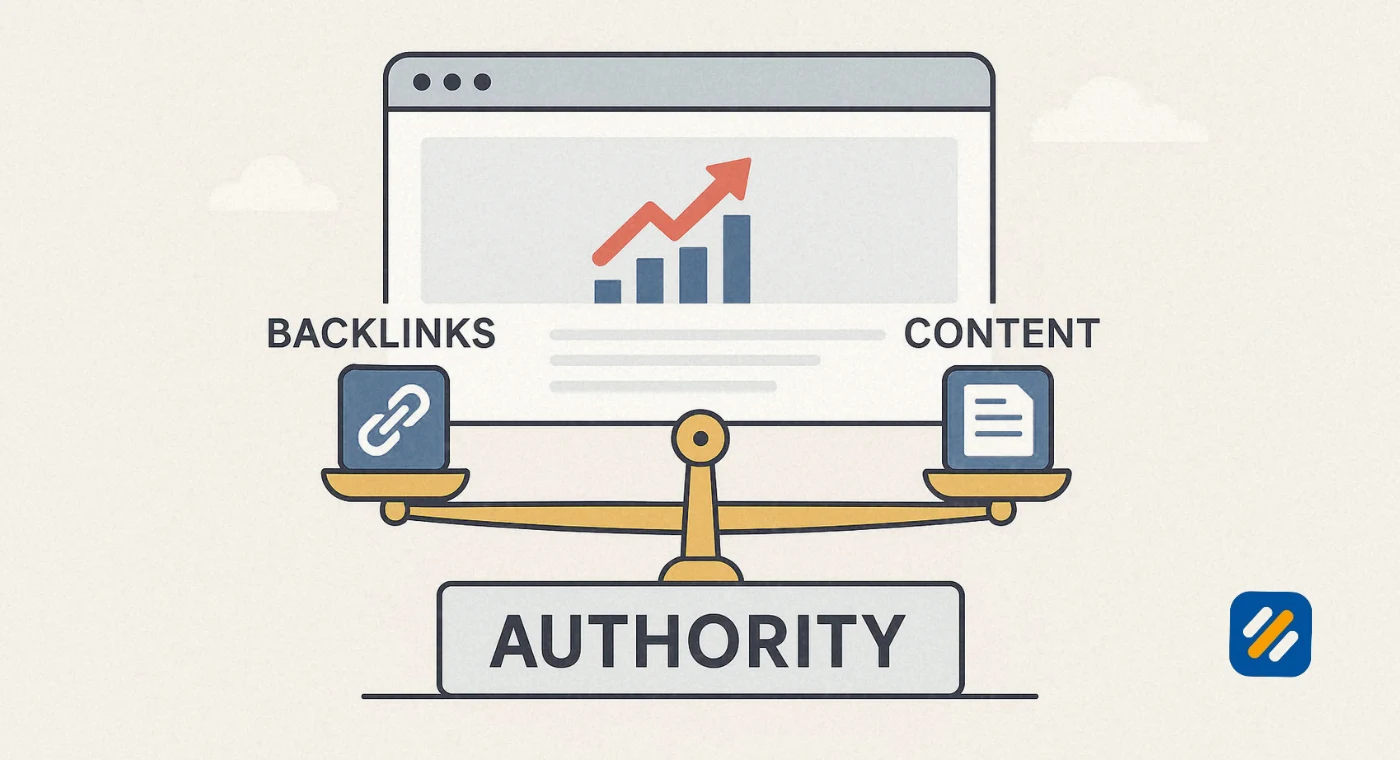
Linking root domains: This is the number of unique websites linking to your domain. One website linking to you ten times counts as one linking root domain, not ten backlinks. Diversity of referring domains matters more than raw backlink count.
Quality of linking domains; A single backlink from a DA 80 website like Forbes or the BBC carries more weight than fifty backlinks from DA 10 blogs nobody has heard of. Moz’s algorithm heavily weights the authority of the sites linking to you.
MozRank and MozTrust: These are Moz’s internal calculations of how link equity flows across the web. MozRank measures link popularity. MozTrust measures how close your backlinks are to trusted seed sites like government and university domains.
Spam signals: An unusually high proportion of low quality, irrelevant, or manipulative backlinks will suppress your DA score even if you have a large number of links overall.
One important technical point that confuses many beginners. Domain Authority is calculated on a logarithmic scale, not a linear one. This means going from DA 20 to DA 30 requires significantly less effort than going from DA 60 to DA 70. At higher DA levels, each additional point represents a substantial increase in the underlying link profile strength.
4 What Is a Good Domain Authority Score and Is 30 DA Good
This is one of the most common questions I get from small business owners starting their SEO journey. The honest answer is that a good DA score is entirely relative to your competitors and your niche.
Here is how to interpret DA scores in practical terms
| DA Score Range | What It Indicates | Typical Examples |
|---|---|---|
| 1 to 10 | Brand new or very weak site, minimal backlinks | New blogs, freshly launched business sites |
| 11 to 20 | Early stage, some backlinks starting to accumulate | Sites with 6 to 12 months of content and outreach |
| 21 to 30 | Growing authority, noticeable backlink profile building | Established niche blogs, local business sites |
| 31 to 50 | Solid authority, competitive in most local and niche markets | Active content sites, small to mid-size businesses |
| 51 to 60 | Strong authority, competitive across broader keywords | Well-established industry blogs and brands |
| 61 to 80 | High authority, ranking for competitive head terms | Major industry publications, national brands |
| 81 to 100 | Elite authority, extremely difficult to compete with | Wikipedia, BBC, Forbes, government sites |
So is a DA of 30 good? Yes, for most small businesses and personal brand blogs in a niche market, a DA of 30 is genuinely competitive. If your top competitors in a local or niche space have DA scores between 20 and 40, a DA of 30 puts you in the middle of the competitive pack, which is a strong position for a website that is still building.
Where a DA of 30 becomes a problem is when you are trying to rank against national or global competitors with DA scores above 60 or 70 for high-competition keywords. In that case, DA is one signal telling you that you need to focus on lower-competition long-tail keywords while you build your authority over time.
5 How to Check Domain Authority for Free | Every Tool Explained
You do not need a paid subscription to check your domain authority. Here are the best free options available right now:
Moz Link Explorer (moz.com/link-explorer)
This is the original DA checker and it is free to use. Enter your domain URL, and Moz shows your Domain Authority score, Page Authority of your homepage, number of linking root domains, and total inbound links. You get ten free searches per month without a paid account. This is the most accurate source for Moz DA data since it is the tool that created the metric.
Ahrefs Website Authority Checker (ahrefs.com/website-authority-checker)
Ahrefs offers a completely free Domain Rating checker with no account required. Enter any domain and instantly see the DR score, number of referring domains, and an estimate of organic traffic. This is my personal first choice for a quick competitive authority check because it requires zero sign-up.
SEMrush Authority Score (semrush.com/free-tools/website-authority-checker)
SEMrush’s free authority checker shows their own Authority Score alongside backlink data and organic traffic estimates. The Authority Score from SEMrush weighs organic traffic alongside link data, which sometimes gives a more complete picture of overall site health than pure backlink metrics.
MozBar Chrome Extension
This free browser extension from Moz shows the DA and PA scores of any website you visit directly in your browser bar. It is the fastest way to check competitor authority while browsing Google search results, which is useful when evaluating whether a keyword is realistic to compete for with your current DA.
How to Check DA, PA, and Spam Score Together:
For a complete picture of domain health, use Moz Link Explorer which shows DA, PA, and spam score in one dashboard. Enter your domain at moz.com/link-explorer. The spam score shows the percentage of sites with similar link profiles that have been penalised by Google. A spam score below 10% is healthy. Above 30% needs investigation.
6 Domain Authority vs Page Authority | Understanding the Difference
These two metrics are often confused but they measure completely different things and serve different strategic purposes.
Domain Authority (DA) measures the overall ranking potential of your entire website as a single entity. It reflects the cumulative backlink profile of every page on your domain combined. When you build one great piece of content that earns backlinks, it raises the DA of your entire website, which lifts the ranking potential of every other page on the site.
Page Authority (PA) measures the ranking potential of a single individual page. The homepage of most websites has the highest PA because it typically receives the most internal and external links. A deeply nested blog post might have a PA of 15 even on a website with a DA of 45.
Why does this matter in practice? Because when you are doing link building, you need to think about both dimensions. Building backlinks to your homepage raises DA and lifts the whole site. Building backlinks directly to a specific article raises that article’s PA and helps it rank faster for its target keyword.
Internal linking connects these two strategies. When your high-PA homepage links internally to a newer article, it passes some of that page authority down to the article, helping it rank before it has accumulated its own external backlinks.
7 How to Increase Domain Authority | The Strategies That Actually Move the Needle
Increasing Domain Authority is a long-term project. There is no quick fix and anyone promising to raise your DA in 30 days is either selling you low-quality links or misleading you about how the metric works.
Here is what consistently and genuinely raises Domain Authority over time
Earn backlinks from relevant, authoritative websites: This is the single highest-impact action you can take. One backlink from a DA 60 website in your niche is worth more than fifty backlinks from DA 10 directories. Focus your outreach on websites your target audience actually reads and trusts.
Create content that earns natural backlinks: Original research, comprehensive guides, free tools, and data-driven articles earn backlinks without outreach because other writers naturally cite them as sources. This is the most scalable long-term link building strategy available to a content-focused website.
Fix and reclaim lost backlinks: Use Ahrefs or Moz to identify backlinks pointing to 404 pages on your site. Set up 301 redirects to recover that lost link equity. Also check for unlinked brand mentions using Google Search Console and reach out to ask those sites to convert mentions into actual links.
Remove or disavow toxic backlinks: If your site has accumulated spammy backlinks from irrelevant or low-quality sites, these suppress your DA by raising your spam score. Use Moz’s spam score report or Google’s disavow tool to clean up your backlink profile.
Build a strong internal link structure: Internal links distribute page authority across your site. Every new article should link to at least two or three older articles. Your highest-authority pages should link to your most important content. This maximises the DA you already have before you earn a single new backlink.
Publish consistently and build topical authority: Google rewards websites that comprehensively cover a topic. Consistent publishing across your niche increases the number of pages available to earn backlinks and signals to Moz’s algorithm that your site is an active, growing resource.
8 Domain Authority and SEO | How These Two Connect in Real Rankings
Since Google does not use DA as a ranking factor, understanding the real connection between DA and your actual search rankings helps you use this metric more intelligently.
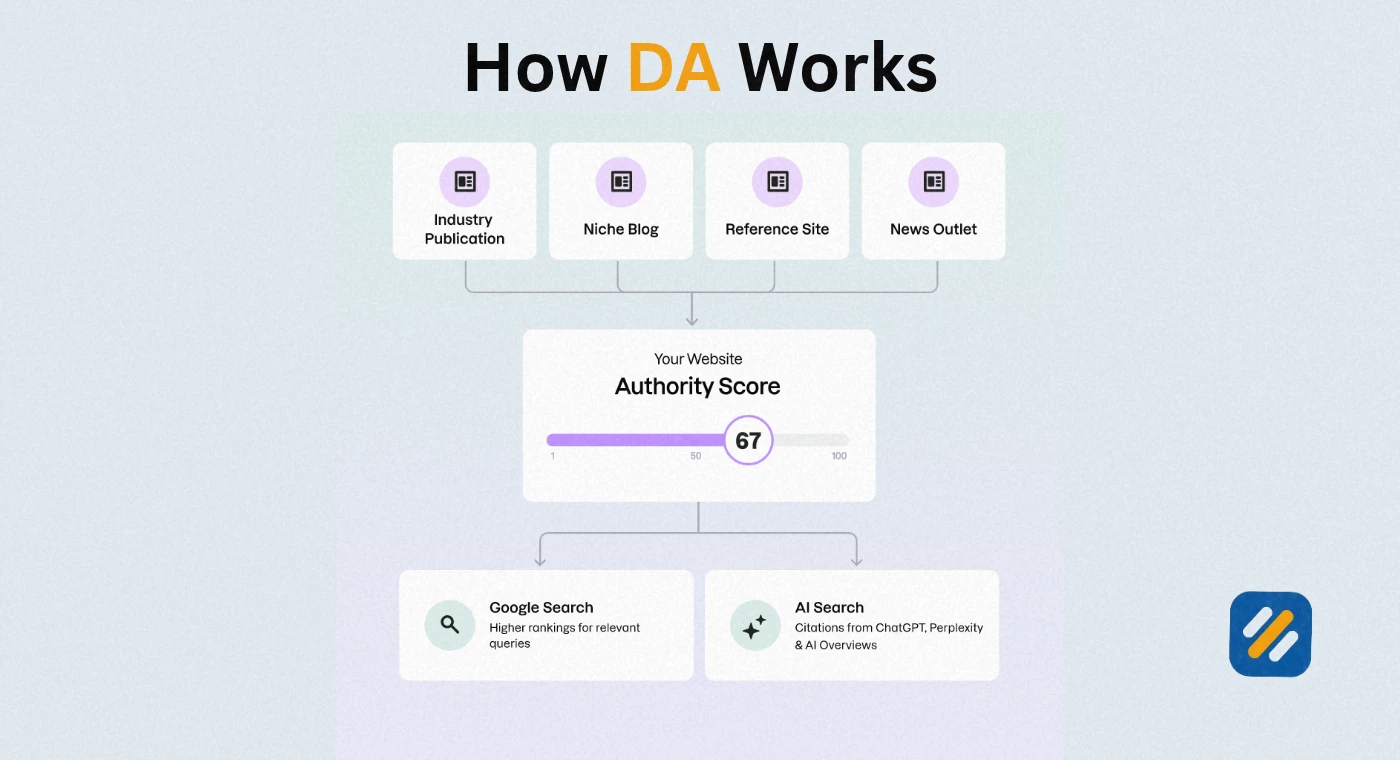
Domain Authority correlates with Google rankings because both are influenced by the same underlying factor: the quality and quantity of backlinks your website has earned. Google’s PageRank algorithm and Moz’s DA calculation both assign more weight to links from trusted, authoritative sources. They just measure it differently.
Here is what this means in practice for your SEO strategy
When you search a competitive keyword and check the DA of every page ranking on page one, you get a rough benchmark of the authority level your site needs to compete. If every page one result has a DA above 60 and your site is at DA 25, that keyword is not realistic to target right now. But if page one has sites ranging from DA 20 to DA 45, your site is in a competitive range.
This is called a DA-based SERP analysis and it is one of the most practical uses of domain authority in real SEO work. I use it with every new client website to identify which keywords are within reach now and which ones to target after six to twelve months of authority building.
9 3 Expert Tips on Domain Authority That Most Guides Never Tell You
Tip 1: Track DA Trends, Not Just the Current Number
A website at DA 35 that was DA 20 six months ago is growing fast and likely a more dangerous competitor than a site sitting at DA 40 that has not moved in a year. When evaluating competitors or your own progress, always look at the trend line in Ahrefs or Moz history, not just the current score.
Tip 2: New Websites Should Ignore DA for the First Six Months
In the first six months of a new website, DA is almost meaningless as a performance metric because all new sites start near DA 1 regardless of content quality. Focus entirely on publishing great content and earning your first twenty to thirty backlinks. DA will follow naturally once the foundation exists.
Tip 3: One High Quality Backlink Beats Fifty Low Quality Ones Every Time
A single backlink from a DA 70 industry publication can raise your DA more than fifty directory submissions or low-quality guest posts on unrelated blogs. Before any outreach campaign, spend time identifying five to ten genuinely authoritative websites in your niche that your audience trusts. One link from any of them is worth months of bulk outreach.
10 Conclusion
Domain Authority is one of the most useful competitive benchmarking tools in SEO when you understand what it measures and what it does not. It is not a Google ranking factor. It is not a score you should obsess over daily. It is a directional indicator that tells you whether your backlink profile is strong enough to compete for the keywords you want to rank for.
Check your DA against your top five competitors. Identify the gap. Then focus your energy on the things that close that gap: earning quality backlinks, publishing content worth linking to, and building the kind of website that other professionals in your industry want to reference and recommend.
DA rises as a result of doing good SEO. It is a symptom of authority, not the cause of it.
If you found this guide useful, drop a comment below and let me know your current DA score. I read every comment and will give you specific advice on the most realistic next step for your website.
Join 1,000+ business owners and bloggers who get one actionable SEO tip every week — straight to their inbox. Free forever.
Get Free Weekly Tips →