- What programmatic SEO actually is, explained in plain language with real company examples
- How programmatic SEO strategy differs from writing content one page at a time
- The exact keyword research process used to find patterns worth scaling
- How to build SEO page templates that avoid thin and duplicate content penalties
- A full step by step framework for launching your own programmatic SEO pages
- How indexation, internal linking, and structured data affect programmatic pages at scale
1 What Is Programmatic SEO
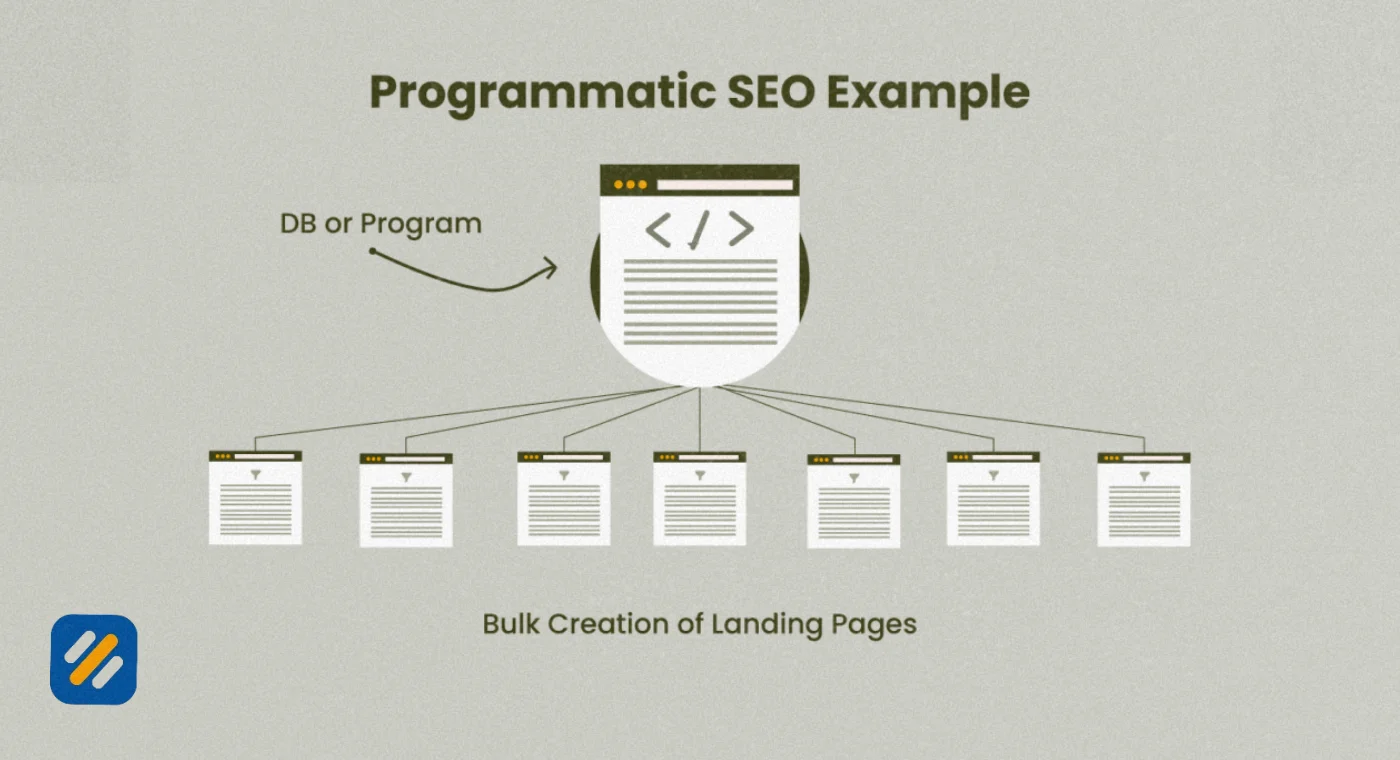
Programmatic SEO is the practice of using a database, a page template, and a repeatable keyword pattern to automatically generate hundreds or thousands of search optimized pages, instead of writing each page by hand one at a time. Rather than publishing one article at a time, you build a system that pulls structured data into a fixed layout and produces a unique page for every variation of that data.
Think of it this way. A normal blog writes one article about "SEO tools for small business." A programmatic SEO page builds one template, then feeds it a list of 500 cities, 300 job titles, or 5,000 software integrations, and out comes 500, 300, or 5,000 individual pages, each targeting its own specific search.
The name itself explains the concept. "Programmatic" means driven by a program or a set of rules rather than manual, one off effort. Applied to SEO, it means your content creation process runs on logic and data rather than a writer starting from a blank page every single time.
I have set this up for a SaaS client with a directory of 400 integrations. Writing 400 unique articles by hand would have taken a content team the better part of a year. Building one solid template and mapping it to a structured spreadsheet took under three weeks, and the pages started picking up long-tail rankings within the first month because each one matched an exact, specific search.
Simple example: Zapier's "connect [App A] to [App B]" pages are the textbook case. Search "connect Slack to Google Sheets" and Zapier has a dedicated page for that exact pairing, built from the same template used for every other app combination in their database. They did not write each page individually. They built the template once and let their integration data fill in the rest.
2 Programmatic SEO vs Traditional Content: What Actually Changes
Traditional content marketing and programmatic SEO are not competing strategies, they solve different problems. Traditional content is built for depth on a smaller number of topics. Programmatic SEO is built for coverage across a large number of near identical search variations.
| Factor | Traditional Content | Programmatic SEO |
|---|---|---|
| Creation method | Written by hand, one article at a time | Generated from a template plus a structured dataset |
| Best for | Complex, high value topics needing original analysis | Repeatable searches that follow a clear pattern |
| Scale | Dozens to hundreds of pages per year | Hundreds to millions of pages from one system |
| Keyword type | Broad and competitive head terms | Long-tail keywords with a shared modifier pattern |
| Main risk | Slow production, limited coverage | Thin or duplicate content if done poorly |
| Example | An in-depth guide on "how to choose accounting software" | 5,000 pages, one for each "[software] pricing" search |
Most mature websites end up using both. A pillar guide explains a concept in depth, while a programmatic SEO strategy underneath it captures every specific, long-tail version of that search that a single article could never realistically cover on its own.
3 How Programmatic SEO Actually Works, Step by Step
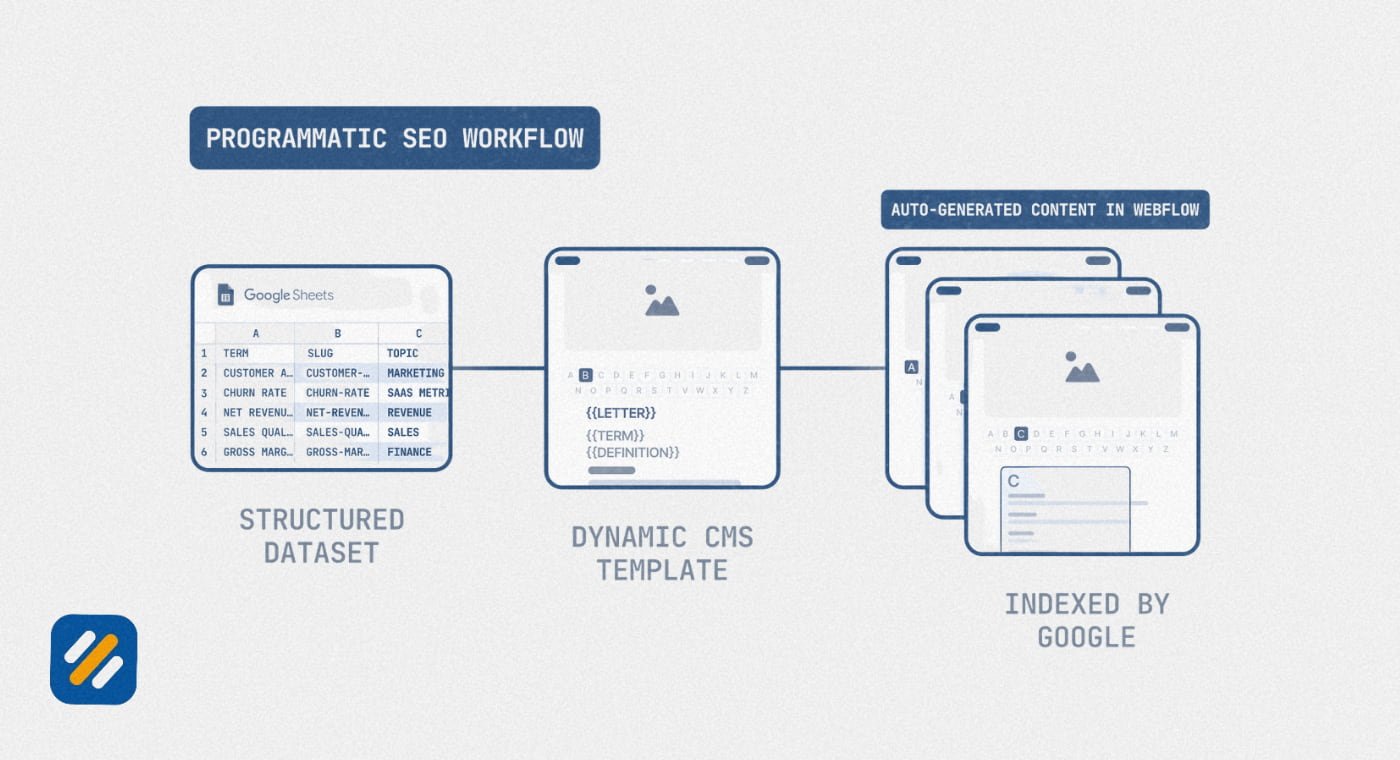
At its core, every working programmatic SEO program is built from three components working together. Skip any one of them and the whole system tends to fail.
A keyword pattern. A repeatable search structure such as "[city] cost of living," "[software A] vs [software B]," or "[currency A] to [currency B] exchange rate." This is the skeleton the entire system is built around.
A structured dataset. The actual data that makes each page different from the next. This might be your own product catalog, a public API, government data, or user submitted content.
A page template. A single layout that pulls the right data into the right place for every page, while including enough unique elements that no two pages read exactly the same.
When these three pieces are aligned, you get what looks like thousands of individually written pages, but is actually one well built system doing the repetitive work automatically.
4 Real Programmatic SEO Examples Worth Studying
Reading about the theory only gets you so far. Looking at real companies doing this well tells you far more about what separates a good programmatic SEO program from a spammy one.
| Company | Pattern | Data Source | Approx. Scale |
|---|---|---|---|
| Zapier | Connect [App A] to [App B] | Their own integration and workflow database | 25,000+ integration pages |
| Nomad List | Cost of living / best places to live in [city] | Cost of living, internet speed, and safety data combined into a "nomad score" | Over 1,000 city pages |
| Wise | [Currency A] to [Currency B] exchange rate | Live currency conversion rates | Thousands of currency pair pages |
| G2 | [Software A] vs [Software B] | Verified user ratings and reviews | Tens of thousands of comparison pages |
| Tripadvisor | Things to do / hotels in [location] | User reviews and business listings | Millions of location pages |
Notice the pattern. Every one of these programs runs on a dataset the company already owns or has reliable access to, not scraped or copied from competitors. That data is the actual moat. A competitor can copy your page template overnight, but they cannot copy your database of real user reviews, live exchange rates, or verified integrations without years of the same work.
Nomad List is a personal favorite example to point beginners toward because it was built by a solo founder rather than an enterprise team. It proves programmatic SEO content is achievable without a large engineering department, as long as the underlying dataset is genuinely useful and well organized.
5 Keyword Research for Programmatic SEO: Finding the Pattern
Programmatic SEO strategy starts with keyword research that looks different from normal keyword research. Instead of hunting for one great keyword, you are hunting for a keyword pattern with dozens or hundreds of valid variations, each with real search demand.
- Start with a head term related to your business, such as "project management software"
- Look for a repeatable modifier that naturally attaches to it, such as a city, an industry, a competitor name, or a price point
- Check search volume across several sample variations, not just one, to confirm the pattern has demand across the set, not only in a few outliers
- Study keyword patterns already ranking for competitors using a tool like Ahrefs or Semrush, filtering their organic pages by URL structure to spot templated pages
- Confirm search intent is consistent across the pattern. A pattern only works at scale if every variation shares the same underlying intent
A useful gut check: if you can write the search query with a blank in the middle, such as "best CRM for ___ industry," and that blank can realistically be filled with fifty or more real answers people search for, you likely have a workable programmatic SEO pattern.
6 Building the Template: The Page That Has to Work for Every Variation
The page template is where most programmatic SEO content either becomes genuinely useful or turns into the kind of thin, spammy page Google actively targets. Your template needs to answer the full search intent for every single variation it will ever generate, not just the one or two examples you tested it against.
- Include enough unique, data driven content per page that no two pages could pass as duplicates of each other
- Design for the edge cases, not just the average case. A city page template built only around large cities will look broken on a small town with limited data
- Add context beyond the raw number. A currency page that only shows one exchange rate is thinner than one that adds historical trend, conversion examples, and related currency pairs
- Build in genuine value elements such as calculators, comparison tables, or user reviews wherever the dataset supports them
- Keep the visual layout consistent so users instantly understand how to navigate any page in the set, even the first time they land on one
Pro Tip: Before generating a single page, mock up the template using your best case data and your worst case data side by side. If the worst case page still reads as useful and complete, your template is ready to scale. If it looks broken or embarrassingly thin, fix the template first.
7 Structured Data and Schema Markup for Programmatic Pages
Structured data plays an outsized role in programmatic SEO because it helps search engines understand a large volume of near identical pages quickly and accurately, without needing to interpret each one from scratch. Since every page in a programmatic set shares a template, applying schema markup once at the template level automatically covers every page it generates.
Product schema for pricing or comparison pages, so search engines understand availability and price ranges automatically
FAQ schema for pages that answer a recurring set of questions across every variation
LocalBusiness or Place schema for location based programmatic pages such as city or neighborhood guides
BreadcrumbList schema to help search engines and users understand where each page sits inside a very large site structure
AggregateRating schema for pages built around review or rating data, such as comparison pages
Applying structured data correctly across a template also improves how programmatic SEO pages show up in AI Overviews and other AI generated answers, since these systems rely heavily on clearly labeled, machine readable data when selecting which pages to summarize or cite.
8 Internal Linking for Programmatic Pages at Scale
Internal linking becomes a genuine engineering challenge once you are dealing with thousands of pages rather than dozens. Manually linking pages together is not realistic at this scale, so internal linking itself needs to be automated and rule based, just like the pages themselves.
- Link every page to its logical siblings automatically, such as a city page linking to nearby cities, or a currency page linking to related currency pairs
- Build category or hub pages that group programmatic pages by a shared attribute, such as region, industry, or price tier, and link down into the individual pages from there
- Route a portion of your site's overall link authority toward your programmatic section through your main navigation or footer, especially early on when the pages have no external backlinks yet
- Avoid orphan pages entirely. Every generated page should be reachable through at least one other page and one hub page, or search engines may struggle to find and crawl it at all
Strong internal linking does double duty. It helps search engines discover and crawl your programmatic SEO pages efficiently, and it distributes topical relevance across the entire set so pages support each other instead of competing for the same limited authority.
9 Indexation: The Silent Killer of Large Programmatic SEO Projects
Indexation is the single biggest technical risk in any programmatic SEO project, and it is the reason so many ambitious programmatic launches quietly fail. Google does not automatically index every page you publish, and it becomes noticeably more selective once it identifies a large batch of similarly structured pages arriving at once.
- Submit an XML sitemap specifically for your programmatic section, separate from your main site sitemap, so you can monitor its indexation rate on its own
- Launch in smaller batches rather than publishing your entire dataset on day one, so Google can evaluate quality on a subset before you scale further
- Monitor the indexed versus submitted ratio inside Google Search Console closely during the first few months. A ratio dropping below 50 percent is an early warning sign your template needs more unique value per page
- Noindex or consolidate any variation in your dataset that has genuinely low or zero search demand, since a page nobody searches for adds crawl cost without adding value
- Keep page load speed fast across the template, since slow, resource heavy templates make it harder for search engines to crawl a large page set efficiently
10 How to Do Programmatic SEO: A Step by Step Strategy
Here is the practical framework I use when planning a programmatic SEO strategy for a new project, from the initial idea through to the first indexed batch.
Identify a keyword pattern with real, repeatable demand. Confirm the pattern across multiple sample variations before committing engineering time to it.
Secure or build a genuine data source. Your own database, a reliable public API, or user generated content, never scraped or copied competitor content.
Design one template that handles both the best and worst case data. Test it against your most data rich and most data poor example before building anything else.
Add schema markup at the template level. This automatically applies structured data across every page the template produces.
Build automated internal linking rules. Sibling links, hub pages, and category pages should be generated by the system, not added by hand.
Launch in a controlled first batch. Publish a subset, monitor indexation and early rankings, then adjust the template before scaling further.
Track performance by segment, not just as one number. Break down rankings and traffic by category so you can spot which variations are working and which need a template fix.
11 Programmatic SEO Mistakes That Get Pages Deindexed
Google has taken direct action against low value, mass produced content, and programmatic SEO content sits squarely in the category it watches most closely. Avoiding the common mistakes below is what separates a program like Zapier's from a spam folder full of deindexed pages.
Do build every page around a genuinely useful, unique dataset rather than filling a template with generic filler text
Do treat programmatic SEO pages as a permanent content asset requiring ongoing maintenance, not a one time launch you can forget about
Don't generate pages for keyword variations with no real search demand, since this only adds thin, useless pages to your site
Don't use AI generated text to pad out pages that lack real underlying data, since Google's helpful content systems are specifically built to catch exactly this pattern
Don't ignore duplicate content warnings inside Google Search Console once your programmatic section grows, since unresolved duplication can suppress indexation across the entire batch, not just the affected pages
A quick gut check: Open ten random pages from your programmatic set and ask whether each one would still be useful if it were the only page on your entire website. If several of them fail that test, the template needs more genuine value before you scale it further.
12 Tools and Trusted Resources for Programmatic SEO
| Resource | What It Helps With | Link |
|---|---|---|
| Google Search Central | Official guidance on scaled content abuse and Google's helpful content systems | developers.google.com/search |
| Google Search Console | Tracks indexation rate, coverage issues, and crawl stats for large page sets | search.google.com/search-console |
| Schema.org | Full reference vocabulary for structured data used across programmatic templates | schema.org |
| Screaming Frog | Crawls large sites to check for template errors, duplicate titles, and broken internal links | screamingfrog.co.uk |
| Google Rich Results Test | Validates schema markup on a template before it is applied across thousands of pages | search.google.com/test/rich-results |
13 3 Expert Tips to Get Programmatic SEO Right the First Time
Tip 1: Start with fifty pages, not five thousand. Launch a small, controlled batch first and watch how Google Search Console responds to it over four to six weeks. This tells you whether your template and dataset are strong enough before you invest in scaling the full dataset.
Tip 2: Build one unique data point per page that nobody else has. Whether it is your own pricing data, a calculated score like Nomad List's nomad score, or verified user reviews, one genuinely unique element per page is often the difference between a page that ranks and one that gets ignored.
Tip 3: Treat your programmatic section like a product, not a content project. The best programmatic SEO programs are maintained continuously, with broken data fixed, low performing variations pruned, and templates improved based on real ranking data. Set a recurring review cycle rather than treating launch day as the finish line.
14 Conclusion
Programmatic SEO is not a shortcut and it is not a loophole. It is a genuine content strategy that trades manual, one at a time writing for a system built on real data, a solid template, and a keyword pattern with actual search demand behind it. Done well, it is exactly how companies like Zapier, Wise, and Nomad List built entire growth channels out of search traffic that traditional content alone could never have captured at that scale.
Done poorly, it produces exactly the kind of thin, repetitive pages that Google's spam systems are specifically designed to catch. The difference between the two outcomes rarely comes down to the size of the dataset. It comes down to whether every single page, even the smallest or least glamorous variation in the set, gives a real searcher a real reason to be there.
Start small, build one template that works even on your worst case data, and only scale once you have proof the system holds up under real search traffic and real indexation.
Have a question about programmatic SEO or how to structure your own dataset for it? Drop a comment below and I will answer it personally.
Join 1,000+ business owners and bloggers who get one actionable SEO tip every week — straight to their inbox. Free forever.
Get Free Weekly Tips →