- Search engine marketing uses both paid ads and organic SEO to drive traffic from search engines like Google
- Google Ads operates on a pay-per-click model meaning you only pay when someone actually clicks your ad
- Your Ad Rank is determined by your bid, quality score, and ad relevance, not just how much you spend
- SEM keyword research is the foundation of every successful paid search campaign
- SEM and SEO work best together. SEM gives you immediate traffic while SEO builds long-term free traffic
1 What Is Search Engine Marketing and Why Every Business Needs to Understand It
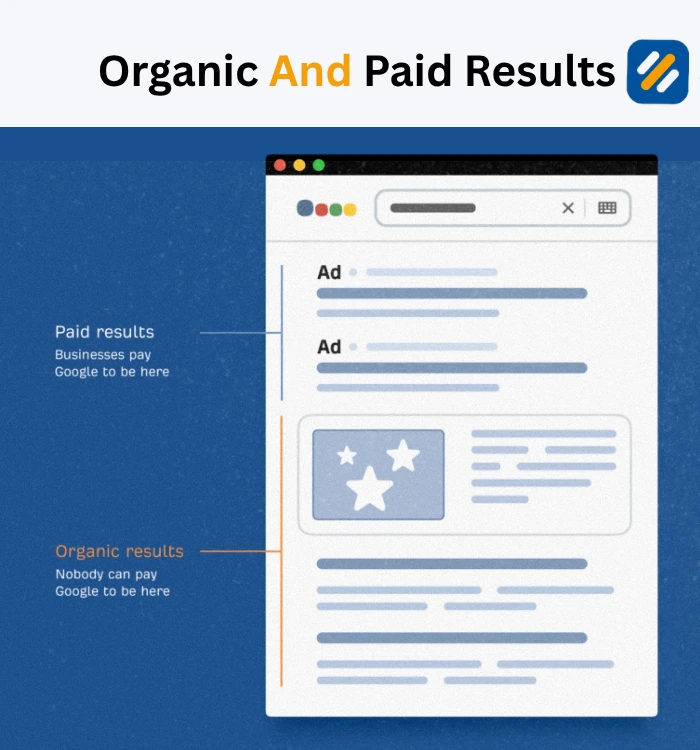
Every time you type something into Google, two types of results appear on the page. The listings at the top with a small "Sponsored" label are paid ads. Everything below those labels is organic. Search engine marketing covers both.
Search engine marketing, commonly referred to as SEM, is the practice of using search engines like Google to drive traffic to a website through a combination of paid advertising and organic optimisation. In practical terms, SEM is the umbrella that covers both Google Ads (paid search) and SEO (organic search) working together.
However, in most marketing conversations today, when someone says SEM they are specifically referring to paid search advertising through platforms like Google Ads. That is the definition this article focuses on, because it is where most beginners need the most guidance and where most of the budget decisions get made.
Here is why search engine marketing matters more in 2026 than it ever has before. 68% of all online experiences begin with a search engine, and Google holds over 92% of the global search engine market share. When your potential customers want something, their first instinct is to search for it. SEM puts your business in front of them at exactly that moment.
Unlike social media advertising where you are interrupting someone's feed, search engine advertising reaches people who are actively looking for what you offer. That difference in intent is what makes paid search one of the highest-converting digital marketing channels available.
2 SEM vs SEO | Understanding the Real Difference and When to Use Each
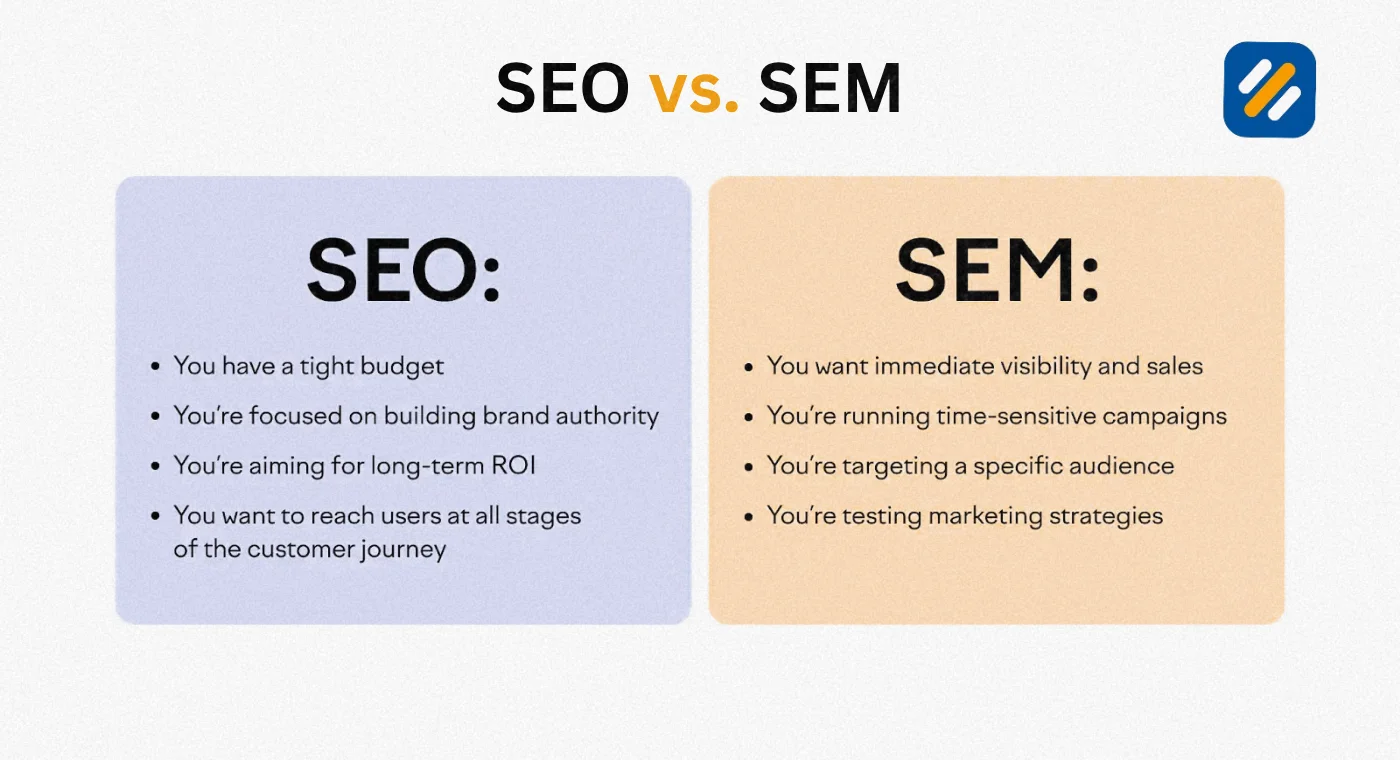
The most common confusion beginners have is treating SEM and SEO as competing strategies. They are not. They serve different purposes and work best when used together with a clear understanding of what each one does.
| Factor | SEM (Paid Search) | SEO (Organic Search) |
|---|---|---|
| Cost | Pay per click, ongoing budget required | Time investment, no cost per click |
| Speed to results | Immediate, ads go live within hours | 3 to 6 months minimum |
| Traffic when you stop | Stops immediately when budget runs out | Continues for months or years |
| Click through trust | Lower, users know it is an ad | Higher, organic results trusted more |
| Targeting precision | Extremely precise, keyword and audience | Keyword targeting only |
| Best use case | Product launches, promotions, fast visibility | Long term brand authority, passive traffic |
| Scalability | Scale by increasing budget instantly | Scale by publishing more content over time |
| Measurability | Immediate ROI tracking through Google Ads | Slower measurement, attribution complex |
The smartest search engine marketing strategy uses both. SEM captures buyers who are ready to purchase right now. SEO captures researchers who are not ready yet but will come back when they are. Together they cover the entire buyer journey from awareness to purchase.
For a small business or personal brand with a limited budget, I typically recommend starting with SEO to build long-term traffic while using a small SEM budget to test which keywords actually convert for your specific business before going all in on either channel.
3 How Google Ads Works | The Paid Search Advertising System Explained
Google Ads is the platform that powers search engine marketing on Google. Understanding how it works is essential before spending a single dollar on paid search advertising.
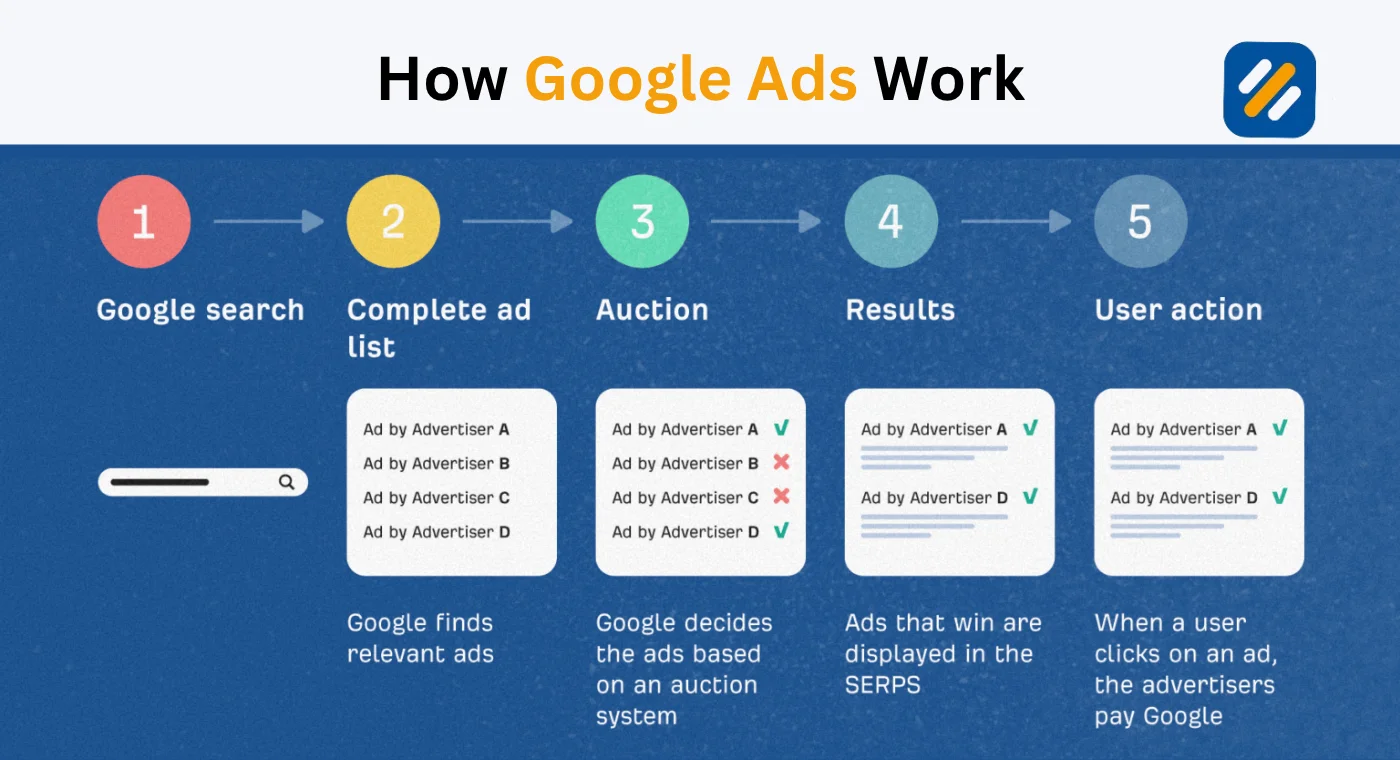
When an advertiser sets up a campaign in Google Ads, they choose target keywords and set a maximum bid, meaning the most they are willing to pay each time someone clicks their ad. When a user searches Google for a matching keyword, an automated auction runs in milliseconds to decide which ads to show and in what order.
This is the pay-per-click model. You do not pay to show your ad. You only pay when someone actually clicks it. This is what makes PPC advertising fundamentally different from traditional display advertising where you pay for impressions regardless of engagement.
Here is the full flow of how a Google Ads campaign works in practice:
Step 1: You choose keywords that match what your target customers search for. For example a solicitor in London might target "family lawyer London" or "divorce solicitor near me."
Step 2: You write ad copy that appears when those keywords are searched. The ad includes a headline, a description, and the destination URL.
Step 3: You set a daily budget and a maximum cost per click bid for each keyword.
Step 4: Every time someone searches your target keyword, Google runs an instant auction among all advertisers bidding on that term.
Step 5: Google determines your Ad Rank based on your bid, your quality score, and the expected impact of your ad extensions.
Step 6: The highest ranked ads appear at the top of the search results page. You are charged only when someone clicks.
4 Ad Rank and Quality Score: Why the Highest Bidder Does Not Always Win
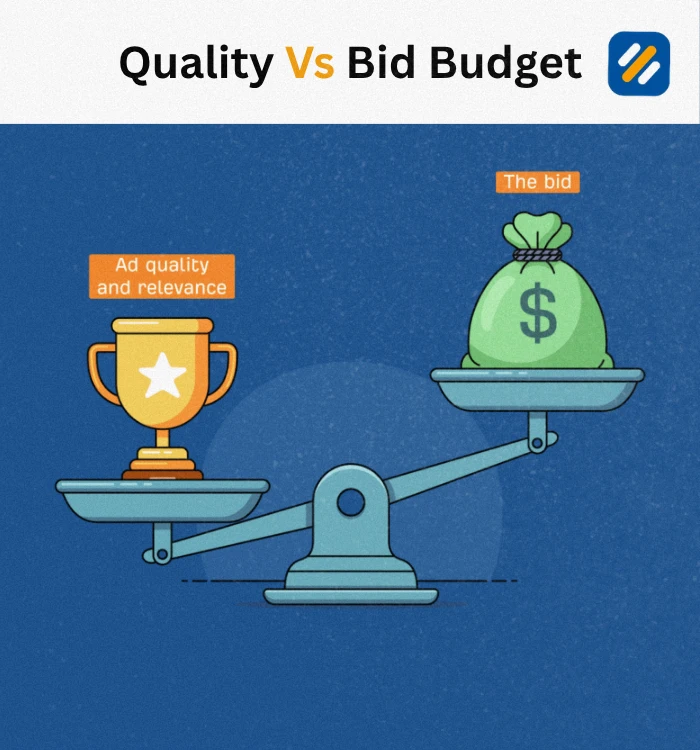
This is the part of search engine marketing that surprises most beginners. In Google's ad auction, spending more money does not guarantee the top position. A smaller advertiser with a more relevant, higher quality ad can outrank a bigger advertiser spending ten times more.
Google determines who wins the auction using Ad Rank, which is calculated from five factors:
Your bid: The maximum amount you are willing to pay per click. Higher bids give you a better chance at top positions but are not the only factor.
Quality Score: Google rates every ad on a scale of 1 to 10 based on three components: the expected click through rate of your ad, the relevance of your ad to the search query, and the quality and relevance of your landing page. A quality score of 8 to 10 means you pay less per click than competitors with lower quality scores for the same position.
Expected impact of ad extensions: Ad extensions are additional pieces of information you can add to your ad such as your phone number, site links, location, or reviews. Google rewards advertisers who use extensions effectively because they make ads more useful to searchers.
Ad Rank threshold: Google sets minimum quality thresholds for each position. Your ad must meet the threshold to appear in that position regardless of your bid.
Context of the search: The device being used, the location of the searcher, the time of day, and even the other ads competing in the same auction all influence Ad Rank dynamically for every single search.
The practical takeaway is powerful. If you write highly relevant ad copy, send users to a landing page that genuinely delivers what the ad promises, and use all available ad extensions, you will pay less per click and rank higher than competitors who simply throw more money at the same keywords.
5 SEM Keyword Research | How to Find the Right Keywords for Paid Search
SEM keyword research is different from SEO keyword research in one critical way. In paid search, every click costs money. That means choosing the wrong keywords does not just fail to bring traffic. It actively wastes your budget on clicks that will never convert.
There are four dimensions to evaluate every keyword before adding it to a paid search campaign
Search volume: How many times per month does this keyword get searched in your target location? High volume means more potential clicks but also more competition and higher cost per click.
Search intent: Is the person searching this keyword ready to buy, still researching, or just looking for information? For paid search, transactional and commercial intent keywords deliver the best return on investment. Someone searching "buy running shoes online" is closer to purchasing than someone searching "what are the best running shoes."
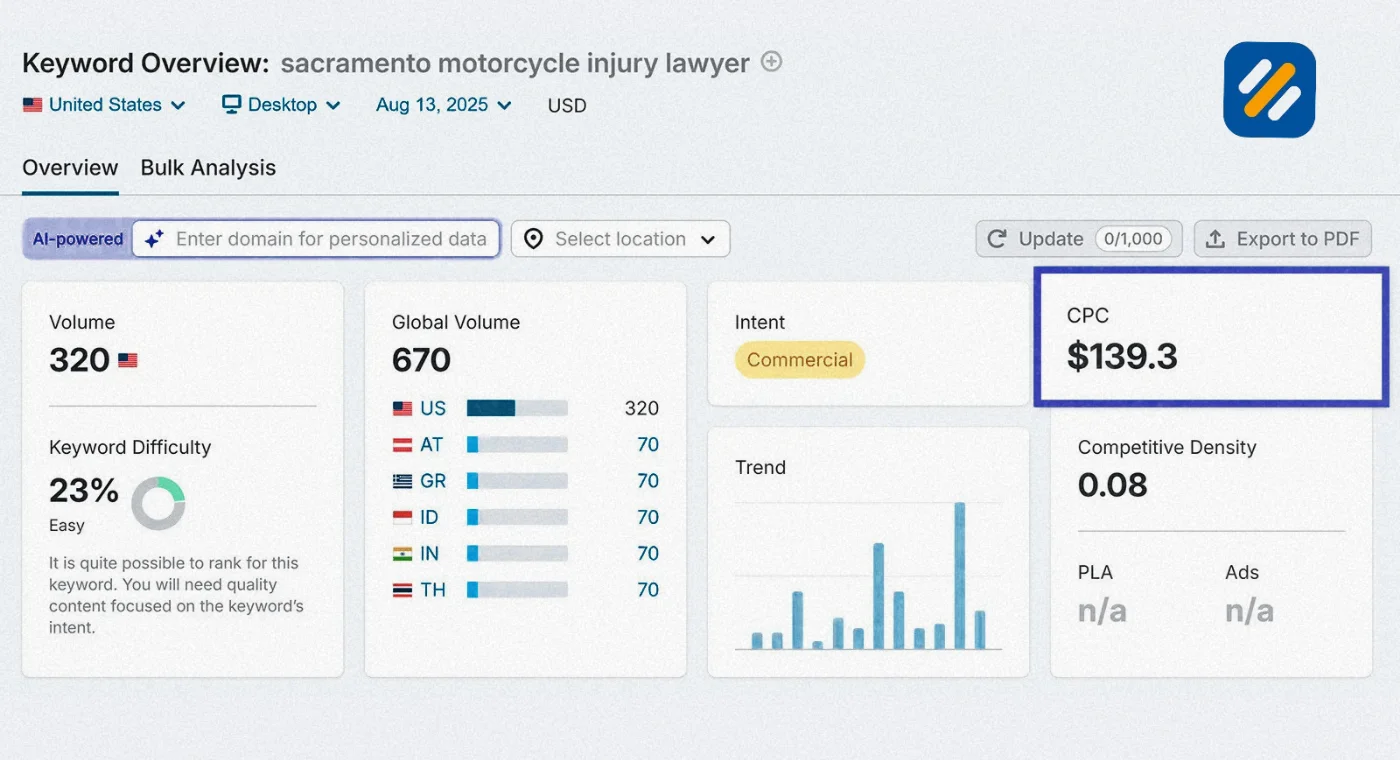
Cost per click: What does Google estimate each click will cost in your target market? High-value industries like legal, finance, and insurance can have CPC rates above $50 per click. Lower-competition niches may have CPCs under $1. Knowing this before launching a campaign helps you calculate whether a keyword can realistically be profitable.
Keyword match types: Google offers three match types that control how closely a search query must match your keyword to trigger your ad. Broad match shows your ad for loosely related queries. Phrase match shows your ad when the search contains your keyword phrase in order. Exact match shows your ad only when the search matches your keyword precisely. For beginners, starting with phrase match and exact match gives you control while broad match is explored carefully with negative keywords in place.
| Match Type | Your Keyword | Ad Shows For | Best Used When |
|---|---|---|---|
| Broad Match | running shoes | jogging footwear, trainers for gym, athletic wear | Large budget, discovery campaigns |
| Phrase Match | "running shoes" | best running shoes, buy running shoes online | Mid-stage campaigns with some data |
| Exact Match | [running shoes] | running shoes only | Tight budget, proven converting keyword |
| Negative Match | -free | Excludes any search containing "free" | Always, to filter out non-buyers |
6 How to Build Your First SEM Campaign Step by Step
Building a Google Ads campaign for the first time feels overwhelming because the platform has dozens of settings. Here is the sequence that actually matters for a first campaign:
Step 1: Define your goal before touching Google Ads.
Are you trying to generate leads, drive ecommerce sales, get phone calls, or build brand awareness? Your goal determines every other decision. A lead generation campaign for a service business is structured completely differently from a product sales campaign for an ecommerce store.
Step 2: Research your keywords using Google Keyword Planner.
Start with five to ten seed keywords that describe exactly what you sell. Use Google Keyword Planner to find related terms, see monthly search volumes, and get CPC estimates for your target location. Build a list of 20 to 30 target keywords grouped by theme.
Step 3: Organise keywords into tightly themed ad groups.
Do not put all your keywords into one ad group. Group them by theme so each group has its own tailored ad copy. Keywords about "SEO services London" go in one ad group. Keywords about "SEO audit for small business" go in another. Tighter groups produce higher quality scores.
Step 4: Write three to five ad variations per ad group.
Each ad needs a compelling headline that contains the target keyword, a description that highlights a specific benefit or unique selling point, and a clear call to action. Google automatically tests your variations and shows the best performing ones more frequently.
Step 5: Build or optimise your landing page.
The page your ad sends traffic to must match the promise of the ad exactly. If your ad says "Free SEO Audit for Small Businesses," the landing page must prominently offer that free audit immediately without the visitor having to scroll or search for it.
Step 6: Set your daily budget conservatively.
Start with a budget you are comfortable losing entirely while you gather data. A new campaign needs at least two to four weeks of data before you can make meaningful optimisation decisions. Do not start with your maximum budget on day one.
Step 7: Add negative keywords before launch.
Review Google's suggested searches for your keywords and add irrelevant terms as negative keywords. If you are selling premium SEO services, add "free," "cheap," "DIY," and "how to" as negative keywords to avoid wasting budget on searches from people who are not your customers.
7 Search Engine Marketing Techniques That Improve Campaign Performance
Once a campaign is live and gathering data, these are the techniques experienced SEM specialists use to improve performance over time:
Conversion tracking setup: If you are not tracking conversions, you are flying blind. Install Google Ads conversion tracking on your thank you page, contact form submission, or purchase confirmation page before your campaign goes live. Without it, you cannot tell which keywords are generating actual customers versus which ones are generating clicks that go nowhere.
Search term report analysis: Every week, review the actual search terms that triggered your ads. This report shows exactly what people typed before clicking. It always reveals new negative keywords to add and sometimes surfaces new keyword opportunities you had not considered.
Ad scheduling optimisation: Google Ads lets you increase or decrease bids based on day of week and time of day. After four to six weeks of data, analyse your conversion rate by hour and day. If your ads convert at three times the average rate between 8 PM and 10 PM on weekdays, increase your bids during those hours and decrease them during low-converting times.
Landing page testing: A 10% improvement in landing page conversion rate has the same financial impact as a 10% reduction in cost per click. Test one element at a time, headline, call to action, form length, or page layout, and let each test run long enough to reach statistical significance before drawing conclusions.
Competitor ad analysis: Use Google's Ad Preview and Diagnosis tool to see exactly what ads your competitors are running for your target keywords. Understanding their messaging helps you write ads that position your offer differently and give searchers a clear reason to choose you.
8 SEM vs SEO | Which One Should You Prioritise With a Limited Budget
This is the most practical question any small business owner or blogger asks about search engine marketing. Here is the honest answer based on real client experience.
If you need customers or leads within the next 30 days, SEM is the only viable option. SEO cannot deliver results in that timeframe for a new website. Paid search advertising can have your ads live within 24 hours of campaign setup.
If you have a budget of under $500 per month and are in a high-CPC industry like legal, insurance, or finance, SEM may not be financially viable on its own. A $500 monthly budget in a market where keywords cost $30 to $50 per click gives you only 10 to 16 clicks per day. That is rarely enough volume to generate consistent leads. In this case, focusing that budget on SEO content production gives you a better long-term return.
If you have a medium term horizon of six to twelve months and a product or service with clear commercial search intent, running SEM and SEO simultaneously is the most powerful combination. SEM generates immediate revenue that funds your SEO investment. SEO gradually reduces your dependence on paid advertising as organic rankings build.
The businesses that get the best results from search engine marketing are the ones that treat SEM data as SEO research. The keywords that convert best in your paid campaigns are exactly the keywords your organic content should be targeting. Your SEM campaign is essentially a paid research tool that tells you which topics your customers actually care enough about to pay for.
9 Search Engine Marketing Tools You Need in 2026
| Tool | Cost | Best Used For |
|---|---|---|
| Google Ads | Free to use, pay per click | Creating and managing all paid search campaigns |
| Google Keyword Planner | Free | Finding keywords, CPC estimates, search volume data |
| Google Analytics 4 | Free | Tracking conversions, user behaviour, campaign ROI |
| Google Search Console | Free | Monitoring organic search performance alongside SEM |
| SEMrush | Paid, free trial available | Competitor ad research, keyword gap analysis |
| Ahrefs | Paid, free tools available | Keyword research, competitor paid search analysis |
| Google Trends | Free | Identifying seasonal keyword trends before campaigns |
| Unbounce | Paid | Building and testing dedicated landing pages for ads |
| ChatGPT or Claude AI | Free tier available | Generating ad copy variations quickly at scale |
| Optmyzr | Paid | Automating SEM campaign optimisation and reporting |
10 3 Expert Tips to Run Smarter SEM Campaigns
Tip 1: Use Your SEM Data to Guide Your SEO Strategy
The keywords converting best in your paid campaigns are your highest-value organic targets. Before investing months in SEO content, run a small SEM campaign for two to four weeks to identify which keywords actually generate leads or sales. Then build your SEO content strategy around those proven converters.
Tip 2: Never Send Paid Traffic to Your Homepage
Your homepage is designed for general visitors, not buyers responding to a specific ad. Every Google Ads campaign should send traffic to a dedicated landing page built specifically for that keyword and ad. A relevant, focused landing page consistently converts at two to five times the rate of a generic homepage and directly improves your quality score, which reduces your cost per click.
Tip 3: Match Negative Keywords to Your Ad Budget, Not Just Your Campaign
Most beginners add negative keywords only when they spot wasted spend in their search term report. Experienced SEM managers build their negative keyword list before launch using common sense filters. If you sell premium services, add "free," "cheap," "template," and "DIY" as negatives from day one. This single pre-launch step can reduce wasted spend by 20 to 30% in the first month alone.
11 Conclusion
Search engine marketing is not just about running ads. It is about understanding how people search, what they are willing to click on, what makes them stay on a page, and what convinces them to take action. Every element of a successful SEM campaign, from keyword selection to ad copy to landing page design, is a decision about human behaviour.
The businesses that win at search engine marketing are not the ones with the biggest budgets. They are the ones who understand their customers deeply enough to put the right message in front of the right person at the exact moment they are searching for a solution.
Start with clear goals. Research your keywords before spending anything. Write ads for humans, not just for Google. Build landing pages that deliver on every promise your ad makes. Track every conversion from day one.
Do those five things and you will outperform the majority of paid search advertisers in any industry.
Have a question about starting your first SEM campaign? Drop it in the comments below and I will answer it personally.
Join 1,000+ business owners and bloggers who get one actionable SEO tip every week — straight to their inbox. Free forever.
Get Free Weekly Tips →