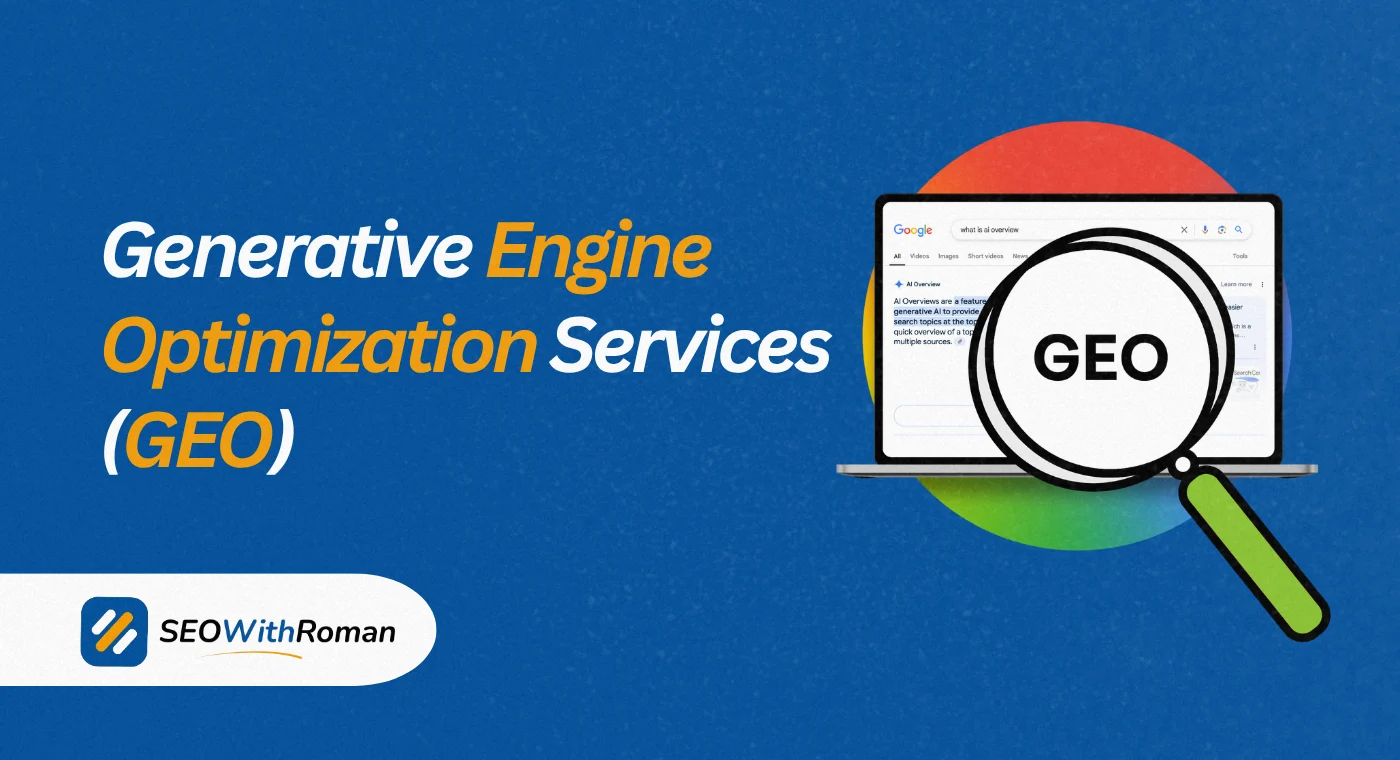
- Generative Engine Optimization (GEO) is the process of optimizing your content so AI tools like ChatGPT, Perplexity, and Google AI Overviews cite and recommend your brand
- Traditional SEO gets you ranked on Google. GEO gets you mentioned in AI-generated answers where a growing number of buyers now start their search
- GEO is not a replacement for SEO. It is a powerful layer that works on top of your existing SEO strategy
- The three pillars of GEO are conversational content, structured data, and authority signals across the web
- Brands that invest in GEO services now are building a competitive moat that will take competitors years to close
1 What Are Generative Engine Optimization Services and Why Every Business Needs Them Right Now
Something fundamental changed in how people find information online. And most businesses have not caught up yet.
For the past two decades, getting found online meant ranking on Google. You targeted keywords, built backlinks, optimised your pages, and climbed the search results. That model still works. But it is no longer the complete picture.
In 2026, a significant and growing percentage of people do not type a query into Google and click a blue link. They open ChatGPT and ask a question. They prompt Perplexity for a recommendation. They get an AI Overview at the top of Google before they even see the organic results. They ask Gemini to compare service providers in their industry.
These AI tools do not rank websites. They generate answers. And the brands they mention in those answers are the ones that will win the next decade of digital marketing.
Generative Engine Optimization services are the discipline of making sure your brand is one of those mentioned brands. It is the process of structuring your content, building your authority, and optimising your digital presence so that large language models understand who you are, trust what you say, and cite you when they answer questions your customers are asking.
In many years of doing SEO across multiple industries, I have never seen a shift this significant happen this fast. GEO is not a trend. It is the next evolution of search visibility, and the window to get ahead of competitors is open right now.
2 What Is Generative Engine Optimization | The Plain English Definition
Generative Engine Optimization, commonly called GEO, is the practice of optimising your website, content, and online presence so that AI-powered search engines and large language models surface your brand in their generated responses.
Traditional search engines like Google use algorithms to rank web pages based on relevance, authority, and technical signals. A user searches, sees a list of ranked pages, and clicks one.
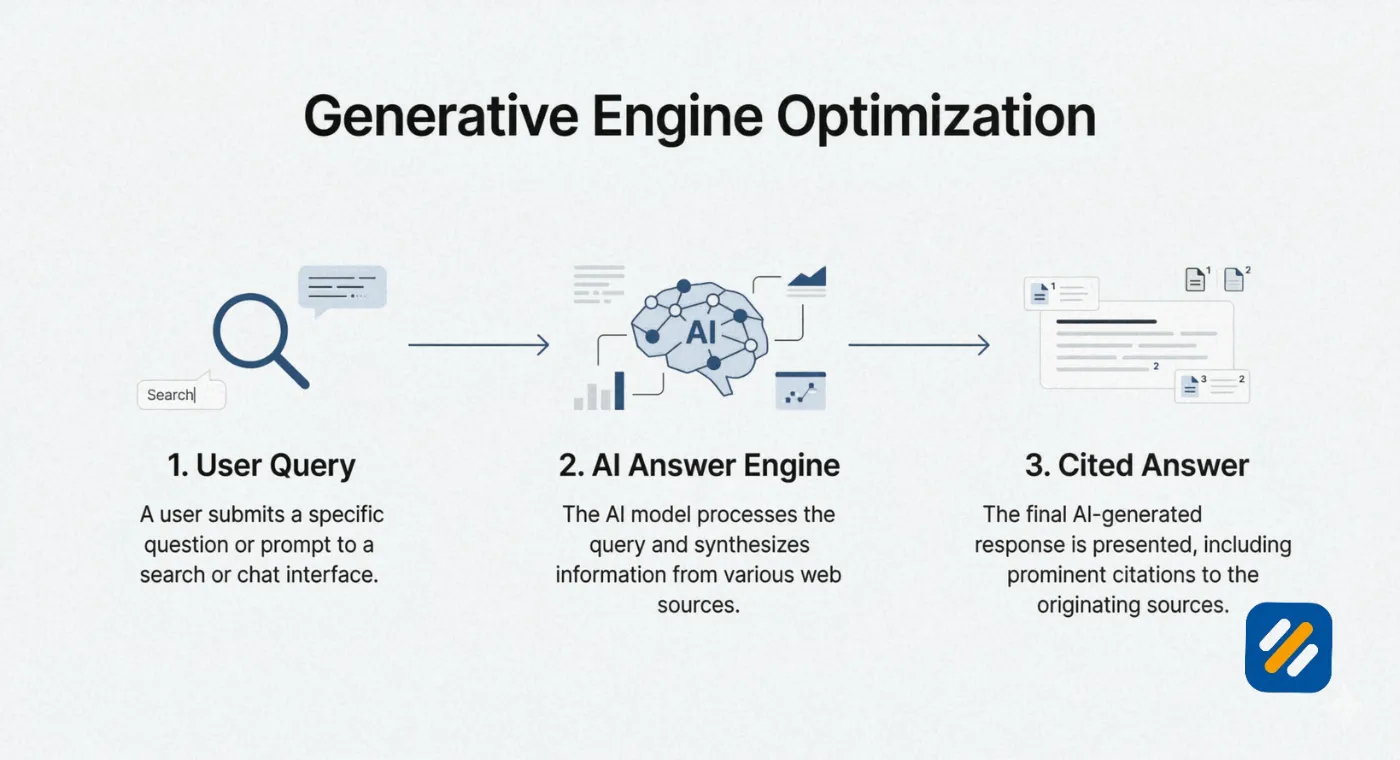
Generative AI engines work completely differently. When a user asks ChatGPT "what are the best GEO agencies for B2B brands" or prompts Perplexity "compare generative engine optimization services," the AI does not return a list of ranked websites. It generates a synthesised answer, pulling from its training data and live web content to construct a response that directly answers the question.
The brands that appear in those synthesised answers are not there by accident. They are there because their content is structured in a way that AI can understand, their authority is recognised across multiple digital sources, and their information is presented in a clear, factual, citable format.
That is what generative engine optimization services are designed to achieve
| Feature | Traditional SEO | Generative Engine Optimization (GEO) |
|---|---|---|
| Target platform | Google, Bing search results | ChatGPT, Perplexity, Gemini, AI Overviews |
| Goal | Rank in position 1 to 10 | Be cited or mentioned in AI generated answers |
| Primary signal | Backlinks and keyword relevance | Structured content, authority signals, brand mentions |
| User action | User clicks a ranked link | User reads an AI generated answer containing your brand |
| Content format | Keyword optimised pages | Conversational, structured, question-answer format |
| Timeline | 3 to 12 months for rankings | 4 to 16 weeks for citation improvements |
| Measurement | Rankings, organic traffic | AI citation share, brand mention frequency in LLM responses |
3 Is SEO Replaced by AI? The Honest Answer Every Business Owner Needs to Hear
This is the question I get asked most frequently in 2026. And the answer is more nuanced than the clickbait headlines suggest.
No. SEO is not dead. SEO is not replaced by AI. But SEO alone is no longer sufficient.
Here is the reality. Google still processes over 8.5 billion searches per day. Organic rankings still drive enormous amounts of traffic to websites. On-page optimisation, technical SEO, and backlink building still work and still matter. A business that abandons traditional SEO to focus exclusively on GEO would be making a serious strategic mistake.
What has changed is where buyers begin their journey. A growing segment of high-intent buyers, particularly in B2B, technology, and professional services, now start their research by prompting an AI tool rather than typing into a search bar. Studies from 2025 show that over 60% of knowledge workers now use AI tools daily for research and decision support. These users often never reach the organic search results at all.
The brands that win in this environment are not choosing between SEO and GEO. They are doing both simultaneously because they reinforce each other. Many of the signals that help you rank in Google, structured data, clear authoritative content, strong domain authority, also help AI tools understand and cite your brand.
Think of it this way. SEO gets you found when people search. GEO gets you recommended when people ask. You need both because different buyers use different tools at different stages of their journey.
4 The 3 Pillars of Effective Generative Engine Optimization Services
Every reputable GEO agency and service builds its work around three core pillars. Understanding these pillars helps you evaluate what you are buying and what results you should expect.
Pillar 1: Conversational Content Optimization
Large language models are trained on and retrieve content that is written in a clear, conversational, question-and-answer format. They are built to understand language the way humans speak, not the way traditional SEO content was written to rank.
Conversational content optimization means rewriting and restructuring your existing content so that it directly answers the specific questions your target audience asks AI tools. This includes:
- Identifying the exact prompts your ideal customer types into ChatGPT or Perplexity
- Restructuring content around those prompts in a direct question-and-answer format
- Adding FAQ sections that mirror how buyers phrase questions conversationally
- Writing clear, specific, factual statements that an LLM can lift and cite accurately
- Avoiding vague marketing language that AI models cannot extract meaningful information from
Pillar 2: Structured Data and Technical GEO
AI tools understand websites better when content is marked up with structured data that explicitly defines what each piece of information is. Schema markup is the technical foundation of GEO.
For generative engine optimization services, this means implementing
- Organization schema that clearly defines your brand name, industry, services, and credentials
- FAQ schema on key service and content pages
- Article schema with clear author information and publication dates
- Product and service schema where applicable
- Breadcrumb and site navigation schema to help AI understand your site structure
Pillar 3: Authority and Citation Building Across the Web
LLMs do not only read your website. They are trained on and retrieve from the entire web. A brand that is mentioned, cited, and referenced across multiple authoritative sources is a brand that AI tools are more likely to trust and recommend.
This pillar includes building brand mentions on industry publications, getting cited in relevant articles and resources, earning consistent positive reviews on third-party platforms, maintaining accurate and consistent brand information across the web, and building the kind of digital authority that AI tools recognise as genuine expertise.
5 The GEO Digital Marketing Process | What a Full Service Engagement Looks Like
Understanding the process behind generative engine optimization services helps you set realistic expectations and choose the right agency or approach for your business.
Here is the complete process that a well-executed GEO engagement follows
Phase 1: AI Visibility Audit
Before any optimization work begins, you need to know where your brand currently stands in AI-generated answers. This means testing dozens of relevant prompts across ChatGPT, Perplexity, Gemini, and Google AI Overviews and recording whether your brand appears, how it is described, and what competitors are being mentioned instead.
This audit reveals your current AI citation share, which is the percentage of relevant AI responses that include your brand, and identifies the specific content gaps and authority gaps that are preventing you from appearing.
Phase 2: Prompt and Theme Mapping
Every industry has a set of common prompts that buyers use when researching solutions. Mapping these prompts and identifying which themes your content currently addresses and which it misses is the strategic foundation of GEO.
For a B2B SEO agency, for example, the high-value prompts might be "what is the best SEO agency for B2b companies" or "how do I choose an SEO specialist for a B2B service business." If your content does not address these themes specifically, you will not appear in those answers.
Phase 3: Content Restructuring and Creation
Based on the prompt mapping, existing content is restructured for AI comprehension and new content is created to fill the identified gaps. This is where conversational optimization, FAQ development, and clear factual positioning happen.
Phase 4: Technical Implementation
Schema markup is implemented across the website. Brand information is standardised. Structured data is tested and validated to ensure AI tools can correctly extract and use the information.
Phase 5: Authority and Mention Building
A systematic outreach process builds brand mentions and citations across relevant publications, directories, and digital sources. This off-site authority building signals to AI tools that your brand is genuinely recognised in your industry.
Phase 6: Monitoring and Citation Share Reporting
GEO results are measured differently from traditional SEO. Instead of tracking keyword rankings, you track AI citation share, the frequency and context of brand mentions in AI-generated responses, and the sentiment of those mentions. Monthly reporting tracks progress and identifies new opportunities.
6 GEO vs SEO | Which AI Platforms Your Brand Needs to Appear On
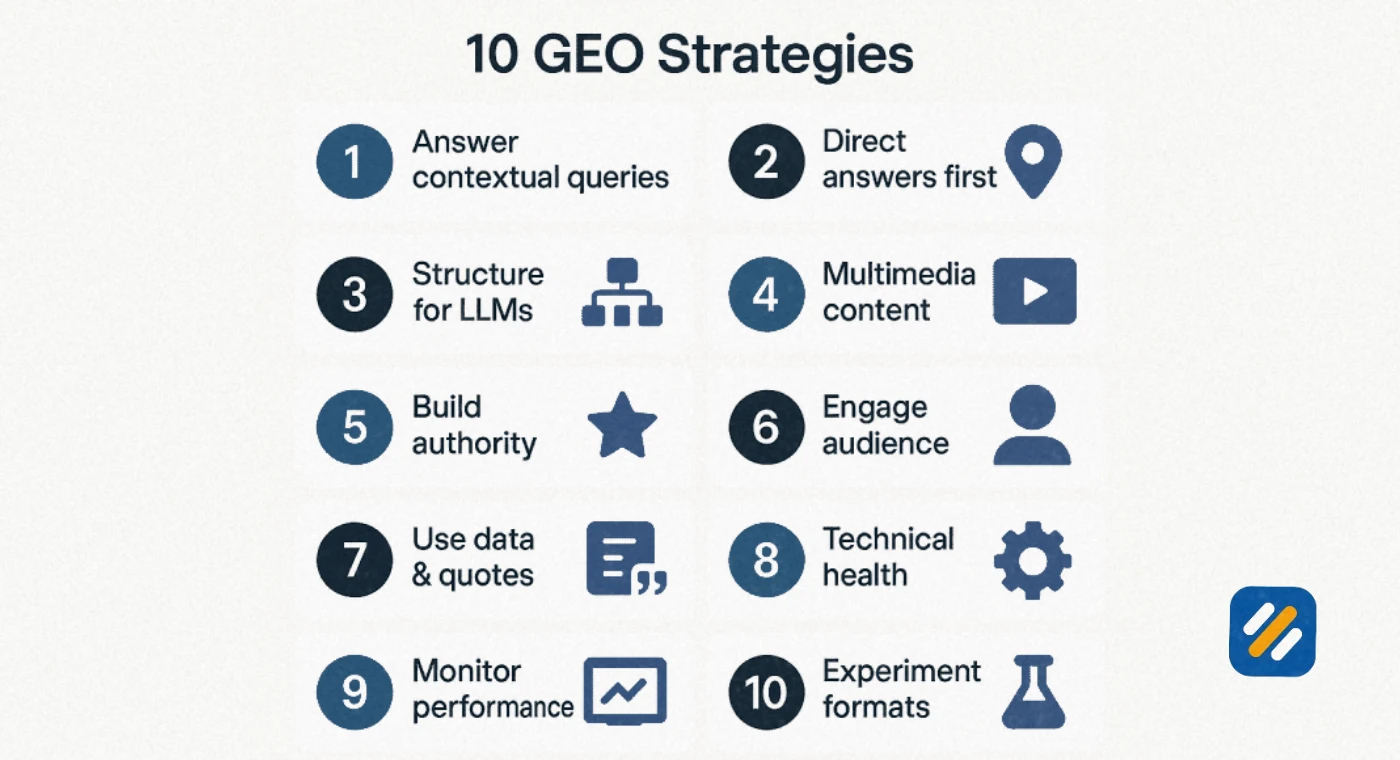
One of the most important strategic decisions in generative engine optimization is identifying which AI platforms matter most for your specific audience and industry.
| AI Platform | Monthly Active Users (2026) | Best For | GEO Priority |
|---|---|---|---|
| ChatGPT | Over 200 million | Research, recommendations, comparisons | Essential for all businesses |
| Google AI Overviews | Billions via Google Search | Top of funnel discovery, local business | Critical, appears in Google results |
| Perplexity AI | Over 15 million | Research-heavy, technical buyers | High priority for B2B and SaaS |
| Google Gemini | Over 100 million | Professional and enterprise users | High priority for enterprise brands |
| Microsoft Copilot | Over 70 million | Business and productivity users | High priority for B2B service brands |
| Claude AI | Growing rapidly | Writing, analysis, professional tasks | Medium priority, growing fast |
| Meta AI | Integrated across Facebook, Instagram | Consumer brands, lifestyle, ecommerce | High for B2C and consumer brands |
For most B2B service businesses, the highest priority platforms are ChatGPT, Google AI Overviews, and Perplexity, in that order. These three platforms collectively reach the highest concentration of business decision-makers actively researching solutions.
7 Who Needs Generative Engine Optimization Services
GEO is not only for large enterprises with massive marketing budgets. The opportunity is arguably larger for small and mid-size businesses because the competition for AI citation share in most niches is still relatively low.
Small business owners who want to appear when local buyers ask AI tools for recommendations in their area. "What is the best SEO consultant near me" is a prompt that local experts can win with the right GEO strategy.
B2B service companies whose buyers use AI tools to research vendors, compare services, and build shortlists before ever contacting a provider. Being cited in those research conversations is worth more than any paid ad.
Personal brand bloggers and consultants who want AI tools to recommend them when someone asks for expert advice in their niche. An SEO specialist who appears in ChatGPT responses when someone asks "who should I hire to help with SEO" is generating inbound leads at zero cost per click.
Ecommerce brands whose customers use AI tools to compare products, ask for recommendations, and research before buying. Appearing in those answers dramatically reduces the friction between awareness and purchase.
SaaS companies whose target users ask AI tools "what is the best tool for X" before ever visiting a review platform or running a search.
8 3 Expert Tips for Generative Engine Optimization That Most Agencies Will Not Tell You
Tip 1: Write for the Prompt, Not the Keyword
The most common GEO mistake is treating it like SEO with different keywords. LLMs respond to full questions and conversational prompts. Before writing any content for GEO, type the exact prompt your ideal customer would ask ChatGPT and read the current answer. That answer shows you exactly what structure, format, and information level the AI values for that topic.
Tip 2: Your Brand's Consistency Across the Web Is a GEO Ranking Signal
AI tools cross-reference information about your brand across multiple sources. If your business name, services, and positioning are described differently on your website, LinkedIn, industry directories, and third-party articles, AI tools get confused and are less likely to cite you confidently. Audit your brand consistency across every digital touchpoint before investing in any other GEO work.
Tip 3: Existing High-Ranking SEO Content Is Your Fastest GEO Win
Your pages that already rank on page one of Google are pages that AI tools are already reading and potentially citing. Restructuring these existing high-authority pages with conversational FAQ sections, clear structured data, and direct question-answer formatting gives you GEO visibility improvements in weeks rather than months, without needing to create new content from scratch.
9 How to Choose the Right Generative Engine Optimization Agency
The GEO services market is new and moving fast. That means there are genuine experts and there are agencies that have simply rebranded their existing SEO offerings with GEO terminology without changing their actual process.
Here is how to evaluate a GEO agency before committing
Ask for an AI visibility audit of your brand before signing anything: A legitimate GEO agency will test your current citation share across the major AI platforms and show you exactly where you appear and where you are missing. If they cannot do this, they are not doing real GEO work.
Ask how they measure results: SEO is measured in rankings and traffic. GEO is measured in AI citation share, brand mention frequency, and the context of those mentions. If an agency is measuring GEO success purely through traditional SEO metrics, they do not understand the discipline.
Ask specifically which AI platforms they optimize for: Different platforms require different approaches. ChatGPT optimization is not the same as Google AI Overviews optimization. An agency that treats all platforms identically is applying a template rather than a strategy.
Look for agencies that have case studies showing AI citation share improvements, not just traffic growth: Traffic growth can come from traditional SEO. AI citation share improvements are the specific proof point that validates genuine GEO work.
10 Conclusion
Search is not what it was two years ago. The buyers you are trying to reach are prompting AI tools, getting synthesised answers, and making shortlists before they ever visit a website. If your brand is not appearing in those answers, you are invisible to a fast-growing segment of your most valuable potential customers.
Generative engine optimization services are how you change that. Structured content that AI can understand. Technical markup that makes your brand information extractable. Authority signals that make AI tools trust and cite you. These are the building blocks of visibility in the AI-driven search landscape of 2026 and beyond.
The best time to invest in GEO was twelve months ago. The second best time is right now, before your competitors realise what they are missing.
Have a question about generative engine optimization services or want to know where your brand currently stands in AI search? Leave a comment below and I will give you my honest assessment.
Join 1,000+ business owners and bloggers who get one actionable SEO tip every week — straight to their inbox. Free forever.
Get Free Weekly Tips →