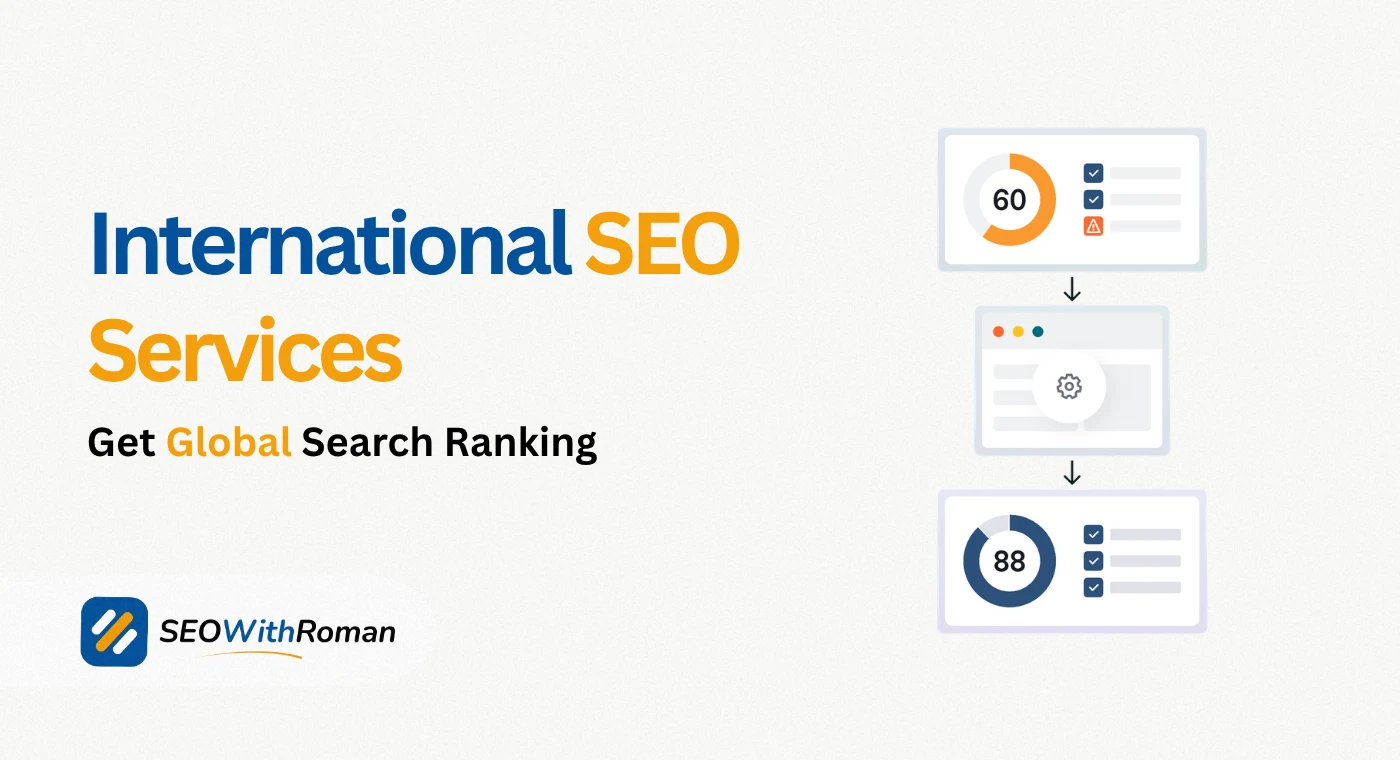
- International SEO services are the strategies, technical implementations, and content systems that help businesses rank in multiple countries and languages simultaneously
- The three international site structure options, ccTLDs, subfolders, and subdomains, each carry different implications for authority, geo-targeting, and operational complexity
- Hreflang implementation errors affect 75% of international websites and silently suppress rankings in target countries for months before anyone investigates
- Content localisation is not translation. It means rewriting content from scratch for each market's search intent, cultural context, and buying behaviour
- International SEO takes 4 to 9 months to show meaningful results in a new country market but the compounding organic traffic it builds has no ongoing cost per click
1 What Are International SEO Services and Why Every Global Business Needs Them
Most businesses make the same mistake when they decide to expand into a new country market. They translate their homepage, maybe translate a few service pages, and then wait for Google to send them international traffic. Months pass. Nothing happens. The frustration sets in.
The problem is not their product. It is not even their content. It is that they treated international expansion as a translation project instead of an SEO infrastructure project.
International SEO services are the specialised strategies, technical implementations, and content systems that help a business rank in search engines across multiple countries and languages at the same time. They go far beyond translation. They cover how your website is structured, how Google understands which country each page targets, how your content matches the search intent of buyers in each specific market, and how your domain builds authority in each country's search ecosystem independently.
In 2026, the stakes have never been higher. Google AI Overviews now appear for commercial queries across 40 languages. ChatGPT and Perplexity cite country-specific sources when answering buyer research questions. A business that gets international SEO right builds a compounding organic traffic engine across every market it enters. A business that ignores it remains invisible in foreign markets regardless of how much it spends on paid advertising.
After many years of working on SEO campaigns across B2B, BPO, healthcare, and ecommerce clients targeting US and UK markets simultaneously, I can tell you with certainty: international SEO is not complicated when you understand the system. But it is unforgiving when you skip the fundamentals.
2 International SEO vs Domestic SEO | Understanding the Real Difference
Before diving into strategy, you need to understand exactly what separates international SEO from standard domestic SEO. They share the same foundation but diverge significantly in execution.
| Factor | Domestic SEO | International SEO Services |
|---|---|---|
| Target market | One country, one language | Multiple countries, multiple languages |
| Keyword research | One market's search volume and intent | Country-segmented volume and intent per market |
| Site structure | Single domain structure | ccTLD, subfolder, or subdomain decision required |
| Content | One version per topic | Localised version per market per topic |
| Technical setup | Standard on-page and technical SEO | Hreflang, geo-targeting, international crawl budget |
| Link building | Backlinks from any relevant domain | Country-specific backlinks from market-relevant domains |
| Reporting | Single aggregate traffic report | Country-segmented performance per market |
| Timeline | 3 to 6 months for first results | 4 to 9 months per new country market |
| Complexity | Manageable for one person | Requires systematic multi-market coordination |
The most important distinction is this. In domestic SEO, you are competing in one ecosystem. In international SEO, you are building and managing multiple parallel ecosystems simultaneously, each with its own keyword landscape, competitive set, content requirements, and authority signals.
3 International Site Structure | ccTLDs vs Subfolders vs Subdomains
The single most consequential decision in any international SEO strategy is how you structure your website. This is a one-time architectural decision with permanent consequences and changing it later is one of the most disruptive migrations an SEO team can manage.
There are three options. Each has genuine trade-offs that depend on your budget, your market priorities, and your technical resources.
Option 1: Country Code Top Level Domains (ccTLDs)
A ccTLD uses a country-specific domain extension for each market. Your UK site becomes yourbrand.co.uk, your Australian site becomes yourbrand.com.au, your German site becomes yourbrand.de.
The geo-targeting signal from a ccTLD is the strongest available to Google. There is no ambiguity about which country a .co.uk domain serves. For brands with the budget and resources to build separate link profiles for each country domain, ccTLDs deliver the most authoritative geo-targeting signal.
The downside is significant. Each ccTLD is treated as a separate domain by Google. The domain authority you build on yourbrand.com.au does not transfer to yourbrand.co.uk. You are building separate authority from scratch in each market, which multiplies your link building workload and cost proportionally.
Option 2: Subfolders
A subfolder structure keeps everything under one main domain and organises country content into directories. Your UK content lives at yourbrand.com/uk/, your Australian content at yourbrand.com/au/.
This is the recommended starting structure for most businesses entering international markets. All domain authority is consolidated under one domain. Every backlink earned anywhere on the site benefits every country version. Google's geo-targeting signal from subfolders is strong when combined with correct hreflang implementation and Google Search Console property configuration.
The limitation is that Google relies more on hreflang and GSC settings to understand country targeting compared to ccTLDs, which means correct technical implementation becomes even more critical.
Option 3: Subdomains
A subdomain structure creates separate subdomains per country or language. UK content lives at uk.yourbrand.com, German content at de.yourbrand.com.
Subdomains sit between ccTLDs and subfolders in terms of complexity and authority consolidation. Google treats subdomains as somewhat separate from the main domain, meaning authority consolidation is partial rather than complete. Most SEO specialists, myself included, recommend subfolders over subdomains for new international site builds because subfolders provide better authority consolidation with similar geo-targeting effectiveness.
| Architecture | Example | Geo-Signal Strength | Authority Consolidation | Complexity | Best For |
|---|---|---|---|---|---|
| ccTLD | brand.co.uk | Strongest | Separate per domain | Highest | Large brands with per-market budget |
| Subfolder | brand.com/uk/ | Strong | Fully consolidated | Medium | Most businesses, recommended default |
| Subdomain | uk.brand.com | Moderate | Partially consolidated | Medium | Specific technical use cases |
4 International Keyword Research | The Foundation Most Agencies Get Wrong
International keyword research is not global keyword research. This distinction is where most agencies fail their international clients and where most businesses waste months targeting the wrong terms in new markets.
Global keyword research aggregates search volume across all countries and gives you one number. International keyword research pulls country-segmented data for each target market separately and analyses not just volume but search intent, competitive landscape, and SERP format in each country independently.
Here is why this matters in practice. The keyword "SEO agency" generates significant search volume in the United States. The same keyword in Australia generates a fraction of that volume. But more importantly, the businesses ranking for it in Australia are completely different from those ranking in the US, the user intent signals differ, and the content format Google rewards in Australian search results may differ from what it rewards in American results.
What genuine international keyword research covers
Country-specific volume analysis means pulling search data through Google Search Console segmented by country property, not relying on aggregated global volume from third-party tools that blend markets together.
Local intent verification means manually checking the live SERP in each target country using country-specific search tools or a VPN to see what format of content Google is actually ranking, not just which keywords have volume.
Dialect and vocabulary mapping is essential for English-language markets. UK searchers say "solicitor," US searchers say "attorney." UK shoppers search for "trainers," Australians search for "sneakers." These are the same products and services described with completely different words. A global keyword list that uses US English vocabulary will miss significant search volume in the UK and Australian markets.
Competitor gap analysis per market identifies which keywords your UK or Australian competitors rank for that your website has no content covering. This is where the fastest keyword wins in a new market are usually found.
Local search intent differences matter even within the same language. The keyword "accountant near me" triggers local pack results in every English-speaking market. But the types of accounting services most searched for, the price points expected, and the trust signals that convert visitors into leads differ meaningfully between London, Sydney, and Chicago.
5 Hreflang Implementation | The Most Misunderstood Technical Element in International SEO
If you ask most website owners whether their hreflang is correctly implemented, they will say yes. Research consistently shows that hreflang errors exist on approximately 75% of international websites. These errors silently suppress rankings in target countries for months before anyone connects the technical issue to the traffic problem.
Hreflang is an HTML attribute that tells Google which version of your content is intended for which country and language combination. When it is correct, Google serves the right page to the right searcher in the right country. When it breaks, Google makes its own decision about which page to serve where, and that decision is frequently wrong.
A correct hreflang implementation for a page targeting UK English looks like this in the HTML head: link rel alternate hreflang en-GB href https://yourdomain.com/uk/page-name
The attribute uses ISO 639-1 language codes combined with ISO 3166-1 alpha-2 country codes. en-GB targets English speakers in Great Britain. en-AU targets English speakers in Australia. en-US targets English speakers in the United States. Using en alone without a country code tells Google the page targets all English speakers globally, which can create unintended competition between your country-specific pages.
The most common hreflang errors and their consequences:
Missing reciprocal tags mean every page that has a hreflang pointing to another page must have that other page pointing back to it. A UK page pointing to a US page that does not point back to the UK page invalidates both tags. Google ignores unconfirmed hreflang relationships.
Incorrect language-country code combinations occur when pages use language codes alone without country codes, or use wrong country codes that do not match the page content. Using en-UK instead of en-GB is an extremely common error that silently breaks geo-targeting.
Hreflang tags in sitemaps rather than HTML, when implemented inconsistently with the page's canonical tag, create conflicting signals that Google resolves by ignoring the hreflang entirely.
Canonical conflicts happen when a hreflang tag points to a page but that page's canonical tag points somewhere else. Google follows the canonical and ignores the hreflang, meaning the geo-targeting is completely non-functional.
How to audit your hreflang implementation:
Use Screaming Frog to crawl your international site and export all hreflang tags. Run them through the hreflang checker at hreflang.ninja or Ahrefs Site Audit to identify missing reciprocal tags, incorrect codes, and canonical conflicts. Fix critical errors before any other international SEO work because broken hreflang undermines everything built on top of it.
6 Content Localisation vs Translation | The Difference That Decides Whether You Rank
This is the section of international SEO that most guides skim over and that most agencies implement incorrectly. Understanding the difference between translation and localisation is what separates international SEO campaigns that build real organic traffic from those that produce pages that nobody searches for and nobody clicks.
Translation converts your existing content into another language word for word. Localisation creates content from scratch for the target market's specific search intent, cultural context, buying behaviour, and vocabulary.
In English-language international SEO targeting UK, US, Australian, and Canadian markets, localisation does not even require translation. It requires rewriting.
What content localisation for international SEO actually involves
Dialect and spelling alignment is the most visible element. UK content uses optimisation, programme, colour, and solicitor. US content uses optimization, program, color, and attorney. Australian content follows UK spelling conventions in most cases but has its own vocabulary for products and services. A page using American spelling in a UK subfolder sends a subtle but real mismatch signal to both Google and the reader.
Market-specific examples and case studies build the local trust that generic content cannot. A UK audience trusts examples from recognisable UK brands and UK cities. Showing a case study from a Manchester-based business on your UK service page is more persuasive than a New York case study, even if both demonstrate the same outcome.
Local search intent matching means the same keyword can have different dominant intent in different markets. Informational in the US, transactional in the UK. The content format must match what Google is already rewarding in each country's SERP for that keyword.
Local regulatory and compliance references add trust and relevance signals specific to each market. UK content referencing GDPR, ICO compliance, and Companies House signals market familiarity. Australian content referencing the ACCC and Australian Consumer Law does the same. These references are not just trust signals for readers. They are topical relevance signals for Google that the content was written for and by people familiar with that specific market.
Pain point alignment requires understanding that while the underlying business challenge may be universal, how it manifests and what solutions are culturally accepted differ by market. UK business owners discussing SEO concerns use different language and reference different authorities than their US counterparts.
7 International Link Building | How to Build Geo-Authority in Each Target Market
A backlink from a UK-based publication carries geo-authority signals for Google UK rankings that a US-based backlink of equal domain authority does not. This is one of the most underappreciated mechanisms in international SEO and one of the clearest explanations for why technically sound international sites underperform in specific country markets.
International link building is the process of earning backlinks from domain-relevant, country-specific websites in each target market. It amplifies every other element of your international SEO strategy because it builds the geo-authority signals that tell Google your content belongs in each country's search results.
The international link building framework
Country-specific outreach identifies relevant publications, industry blogs, trade associations, and news sites in each target market and builds relationships with their editorial teams. A guest post on a genuine .co.uk domain with real UK readership does more for Google UK rankings than five generic .com posts.
Digital PR campaigns create original research, proprietary data studies, or newsworthy content assets that are relevant to each target market and generate editorial coverage with backlinks. A survey of 500 UK small business owners about their SEO challenges is a linkable UK-specific asset. The same survey conducted with US respondents serves the US market. These are separate content assets requiring separate outreach campaigns.
Competitor backlink gap analysis per market uses Ahrefs or Semrush to identify which UK or Australian domains link to your competitors but not to you. These are pre-qualified link opportunities in each market and closing this gap systematically is one of the highest-leverage link building activities available.
Local business association memberships and directory listings in each country earn relevant local citations and in some cases editorial backlinks that are impossible to replicate from outside the market. Chamber of Commerce listings, industry association directories, and local business press features all carry country-specific authority signals.
Realistic expectations: For a new country market entry, plan for a minimum of three to five new referring domains per month from country-relevant sites before meaningful geo-authority signals accumulate. International link building is slow work done correctly but it is the work that makes everything else in your international SEO strategy perform at its ceiling.
8 International Technical SEO | The Infrastructure Layer That Everything Depends On
Technical SEO at international scale has a complexity multiplier that domestic technical SEO does not face. An error affecting one page on a single-market site can affect hundreds of pages across dozens of country variants on an international site. The technical foundation must be right before content, links, or any other element can perform.
Crawl budget management for international sites
Google allocates a specific crawl budget to your website based on domain authority and site size. Large international sites with multiple country subfolders must manage this budget deliberately. Google should be crawling your highest-priority country pages most frequently. This requires log file analysis to understand current crawl patterns and sitemap architecture that prioritises key country pages.
Submit a dedicated XML sitemap per country property to the corresponding Google Search Console property. This is the correct approach for any international site with more than 500 pages across multiple markets and it gives Google clear crawl priority signals per country.
Page speed across geographies
A page that loads in under two seconds for a user in New York may load in over four seconds for a user in Sydney or Johannesburg because of server proximity. International sites need Content Delivery Network configuration evaluated from the perspective of users in each target country, not just the primary market.
Use Google's PageSpeed Insights with the location set to each target country to understand actual loading performance for users in those markets. Tools like WebPageTest allow you to run speed tests from specific cities in each target country to identify geographic performance gaps.
Duplicate content management across markets
Country variants of the same page, your UK and Australian service pages covering identical services in different markets, must be managed carefully to prevent them from competing with each other in global search results. Correct canonical tags combined with hreflang implementation are the technical tools that resolve this. The canonical tag on each country page should point to itself, not to the main global page, and the hreflang network must confirm the correct page for each country.
International schema markup
Structured data is how AI systems Google AI Overviews, ChatGPT, Perplexity understand your content and decide whether to cite it in responses to queries in each target market. In 2026, international schema implementation is not optional infrastructure. It is the technical layer that determines your content's eligibility for AI-generated search results across every country you target.
Every country-specific service page needs LocalBusiness schema with the correct country address format, local phone number, and areaServed property. Every blog post needs Article schema with accurate author attribution and dateModified properties. Every page with a FAQ section needs FAQPage schema with concise 40 to 60 word answers that AI systems can extract and cite.
9 International SEO Strategy | The Complete Implementation Roadmap
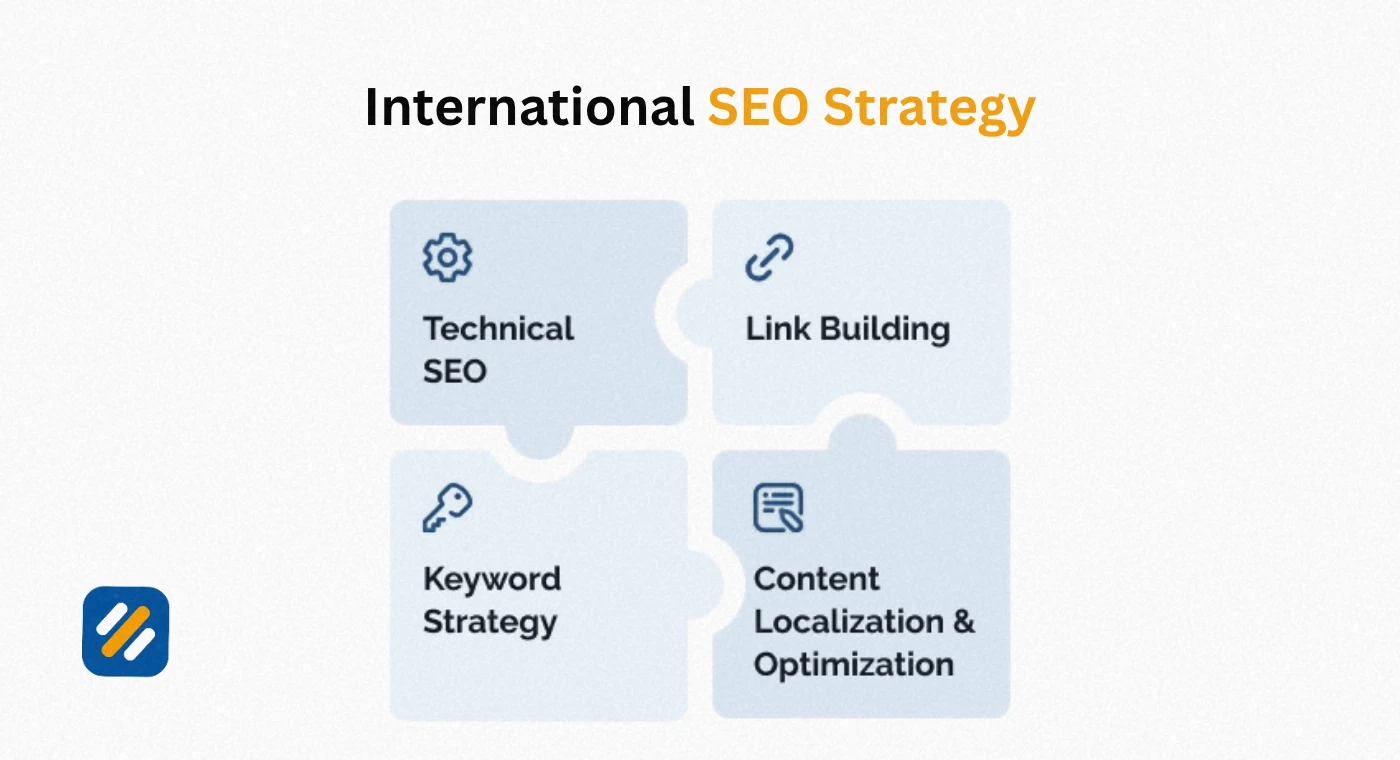
Here is the exact phased strategy I follow when building an international SEO campaign for a business entering new country markets
Phase 1: Technical Foundation (Month 1)
Audit the existing site structure and make the ccTLD versus subfolder versus subdomain decision based on budget, market priorities, and technical resources. Configure Google Search Console with separate properties for each country target. Implement or audit hreflang tags across all existing international pages. Submit country-specific XML sitemaps to each GSC property. Test page speed from each target country and configure CDN accordingly.
Phase 2: International Keyword Research (Month 1 to 2)
Pull country-segmented keyword data for every target market separately. Map search intent per country for primary commercial keywords. Build vocabulary and dialect reference documents for each English-speaking market. Identify competitor keyword gaps in each country using Ahrefs or Semrush filtered by country. Prioritise the 20 highest-opportunity keywords per market for initial content targeting.
Phase 3: Content Localisation (Month 2 to 4)
Create localised service pages for each country target using market-specific vocabulary, local examples, and country-appropriate trust signals. Build a blog content cluster for each country subfolder targeting low-difficulty informational keywords in each market. Implement schema markup on every page before publishing. Ensure every page passes a country-specific intent check before going live.
Phase 4: International Link Building (Month 3 onwards)
Begin outreach campaigns in each target market. Target three to five new referring domains per month per country market from genuinely country-relevant domains. Build digital PR assets with original data relevant to each market. Close competitor backlink gaps using country-filtered analysis from Ahrefs.
Phase 5: Monitoring and Optimisation (Ongoing)
Review Google Search Console data segmented by country property monthly. Monitor AI Overview appearances in each target market manually for top commercial keywords. Update underperforming country pages with additional depth, local examples, and stronger keyword targeting. Build internal links from blog content to service pages within each country subfolder.
10 How to Measure International SEO Performance | Country-Level Reporting That Actually Means Something
Aggregate traffic reports are the most common way international SEO agencies hide poor performance from their clients. When all country markets are blended into one total traffic number, strong performance in one country masks weak performance in another.
Country-segmented reporting is the only way to make intelligent investment decisions about international SEO.
| Metric | How to Measure It | What It Tells You |
|---|---|---|
| Organic traffic per country | GSC filtered by country property | Which markets are growing and which are stalling |
| Keyword rankings per country | Ahrefs or Semrush filtered by country | Position progress for target terms in each market |
| Click through rate per country | GSC Search Performance filtered by country | Whether titles and descriptions are compelling enough per market |
| AI Overview citation rate | Manual monthly testing in GSC Search Type | Whether your content is being surfaced in AI results per country |
| Backlinks by country domain | Ahrefs referring domains filtered by TLD | Whether you are building geo-authority in each market |
| Conversion rate per country | GA4 segmented by country | Which markets are converting organic traffic into leads or sales |
| Hreflang error count | GSC International Targeting report | Whether your geo-targeting signals are working correctly |
| Page speed per geography | PageSpeed Insights per country | Whether technical performance is equal across all markets |
Review these metrics monthly for each country market separately. When a market stalls, the segmented data tells you exactly which layer of the international SEO system needs attention, whether it is technical, content, or authority.
11 3 Expert Tips to Get Better Results From International SEO Services
These are the tips that go beyond what most international SEO guides cover and that I have found make the most meaningful difference in real campaign results.
Expert Tip 1: Fix Hreflang Before Everything Else
Before investing in content creation or link building for a new country market, run a complete hreflang audit. Broken hreflang means Google may be serving your homepage to UK searchers instead of your UK service page. Every piece of content you create and every backlink you earn while hreflang is broken is delivering partial results. One afternoon fixing hreflang errors can unlock rankings that have been suppressed for months.
Expert Tip 2: Build Country-Specific Content Clusters Before Targeting Competitive Keywords
Do not launch a new country subfolder with one or two localised pages and expect to rank for competitive commercial terms. Google rewards topical authority built through content depth. Launch each country market with a minimum of five to ten pieces of content covering the topic cluster around your primary service keyword. Each piece strengthens the others and builds the topical signal that lifts your commercial page rankings faster than any amount of link building on a thin content foundation.
Expert Tip 3: Monitor AI Overview Citations Per Country Separately
Google AI Overviews for the same keyword differ by country. The sources cited in a UK AI Overview for "international SEO agency" are different from those cited in an Australian AI Overview for the same term. Check your top ten commercial keywords manually in each target country monthly and document whether your content is being cited. If competitors are consistently cited and you are not, the gap is almost always answer-first content structure, missing FAQ schema, or insufficient original data in your country-specific pages.
12 Conclusion
International SEO services are not a single tactic. They are a system of interconnected disciplines, technical infrastructure, localised content, country-specific authority building, and market-level performance measurement, that work together to make a business visible in every market it enters.
The businesses winning international organic search in 2026 are not the ones with the biggest budgets. They are the ones who got the technical foundation right before building content, who localised rather than translated, who built country-specific backlinks rather than just chasing global domain authority, and who measure performance at the country level rather than hiding results in aggregated totals.
If your business is targeting the US and UK markets, or any combination of English-speaking countries, the international SEO system outlined in this guide gives you everything you need to build a compounding organic traffic engine in each market simultaneously.
Start with your site architecture decision. Audit your hreflang. Build localised content clusters. Earn country-relevant backlinks. Measure everything at the country level.
Do those five things consistently for twelve months and international organic search will become your most scalable customer acquisition channel in every market you enter.
Have a question about your specific international SEO situation? Drop a comment below and I will answer it personally.
Join 1,000+ business owners and bloggers who get one actionable SEO tip every week — straight to their inbox. Free forever.
Get Free Weekly Tips →