- Competitor keywords are the search terms your rivals rank for that you either do not rank for or rank lower for
- Finding competitor keywords is not just about copying what they do, it is about identifying the gaps where you can do it better
- SEO competitors and business competitors are two different groups and both need to be analysed separately
- Keyword gap analysis, SERP analysis, and LSI keyword research together give you a complete competitor keyword strategy
- Free tools including Ahrefs Webmaster Tools, Google Search Console, and Semrush free version are enough to start a full competitor keyword analysis today
1 What Are Competitor Keywords and Why They Are the Fastest Shortcut in SEO
When I start working on a new website, the first thing I do is not brainstorm topics. The first thing I do is look at exactly what keywords the top competing websites are already ranking for.
This is the most underused shortcut in SEO. Your competitors have already done the hard work of proving which keywords drive real traffic in your niche. They have published the content, earned the rankings, and validated the search demand. Your job is not to start from zero. Your job is to study what is already working and build something better.
Competitor keywords are the search terms your rivals appear for in Google's organic results that you either do not rank for at all or rank significantly lower for. Finding these keywords gives you a ready-made content roadmap built on real market data rather than guesswork.
In many years of doing SEO across B2B, ecommerce, and service businesses, competitor keyword research has consistently produced the fastest ranking results for new websites. It removes the uncertainty from content planning and replaces it with evidence.
There are three types of competitor keywords worth understanding before you start your analysis
Ranking keywords your competitors own completely which are terms where a competitor ranks in positions one to three and you have no presence at all. These require the most effort to target but often represent the highest traffic opportunity.
Keywords where competitors outrank you which are terms where you both appear but they sit above you. These are often quicker wins because you already have some authority and relevance established.
Emerging keywords competitors are testing which are terms where a competitor has recently published content and is not yet ranking strongly. Targeting these early gives you a chance to establish authority before competition intensifies.
2 SEO Competitors vs Business Competitors | Understanding the Difference That Changes Everything
Most beginners make one critical mistake when starting competitor keyword research. They only analyse their direct business competitors and miss the websites that are actually stealing their search traffic.
Your business competitors are companies that sell similar products or services to the same audience you serve. Your SEO competitors are the websites that appear in Google search results for the keywords your potential customers are searching for. These two groups overlap but they are never identical.
Here is a real example. A small accounting firm in Manchester might consider other accounting firms their business competitors. But when their potential clients search "how to file a self assessment tax return" on Google, the pages ranking on page one are not other accounting firms. They are HMRC's own guidance pages, financial media sites, and large accounting software companies. Those are the SEO competitors for that keyword.
If the accounting firm only studied other local accounting firms, they would miss the actual content gap they need to fill.
| Type | Definition | How to Find Them | Priority |
|---|---|---|---|
| SEO Competitors | Websites ranking for your target keywords regardless of industry | Google your target keywords and note which domains appear most frequently | Highest for content strategy |
| Business Competitors | Companies selling similar products or services to the same audience | Industry knowledge, Google Ads competitors, trade directories | Highest for positioning strategy |
| Indirect Competitors | Websites covering adjacent topics your audience also reads | Related keyword searches, People Also Ask results | Medium for content gap analysis |
| Emerging Competitors | New websites recently gaining rankings in your niche | Ahrefs new competitors report, GSC position changes | Medium for early monitoring |
The most effective competitor keyword strategy analyses both groups. Business competitors show you the commercial keywords and positioning language that converts. SEO competitors show you the informational keywords and content formats that attract your audience at every stage of the buying journey.

3 Primary Keywords, Secondary Keywords, and LSI Keywords | What Each One Means in Competitor Analysis
Before diving into how to find competitor keywords, you need to understand the three layers of keywords that make up a complete competitor keyword analysis. Most guides only cover the surface layer and miss the deeper opportunities.
Primary Competitor Keywords
These are the main search terms your competitors have built entire pages around. The keyword appears in their title tag, H1 heading, meta description, URL, and throughout the body content. It is the single most important keyword that page is designed to rank for.
When you identify a primary competitor keyword that you have not targeted, you need to create a dedicated page or article targeting that exact keyword at the same depth or better than your competitor's page.
Secondary Competitor Keywords
These are supporting keywords that appear alongside the primary keyword on a competitor's ranking page. They are related terms that the page ranks for in addition to its main target. Google often ranks a single page for dozens of secondary keywords because the content naturally covers related language that matches multiple search queries.
When you create content targeting a competitor's primary keyword, you can steal their secondary keyword rankings at the same time by ensuring your content covers the same topic breadth and uses natural language that addresses the related terms.
LSI Keywords in Competitor Content
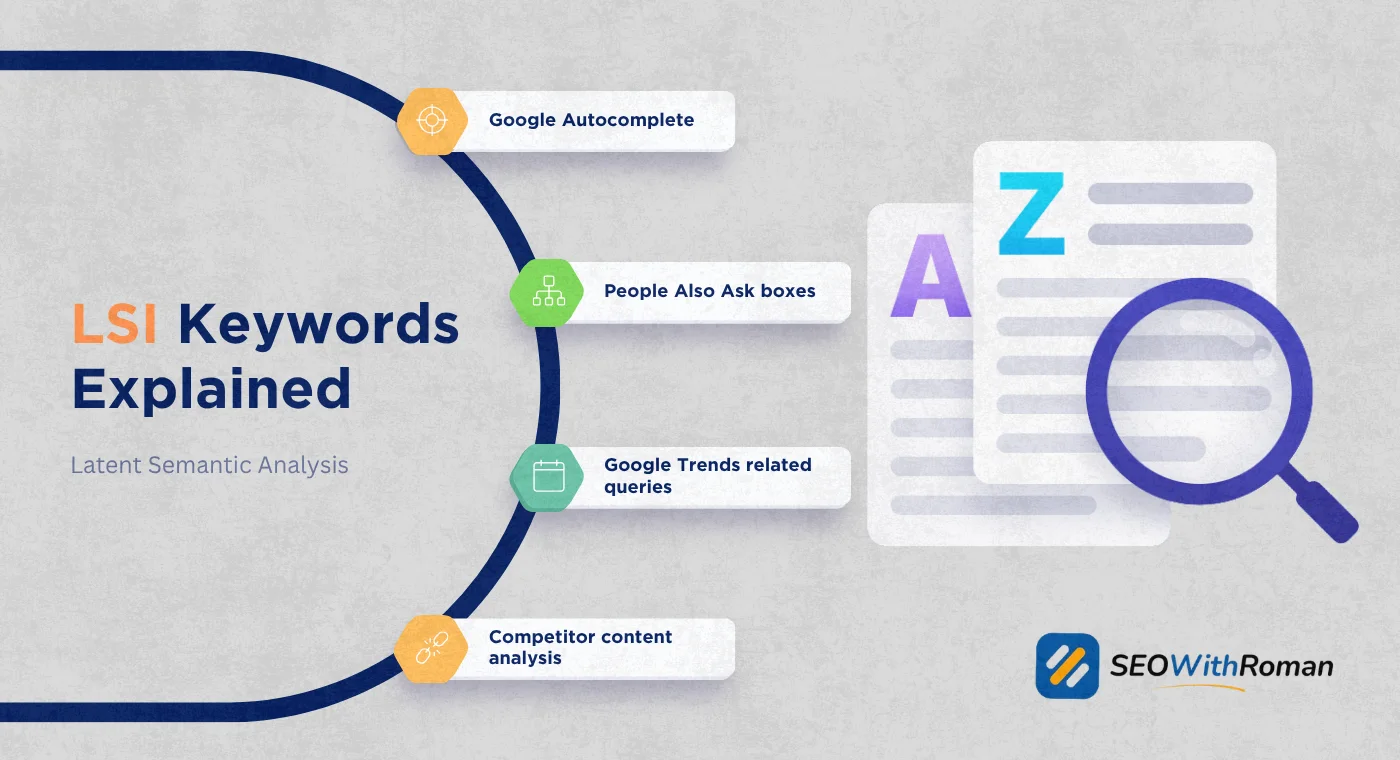
LSI stands for Latent Semantic Indexing and refers to the conceptually related words and phrases that appear in the context of a topic. When Google reads a page about "keyword research," it expects to see related terms like "search volume," "keyword difficulty," "search intent," "SERP analysis," and "organic traffic" nearby. Their presence confirms to Google that the page genuinely covers the topic in depth.
When you analyse a competitor's top-ranking page, the LSI keywords are the terms that appear repeatedly throughout their content that are not the primary keyword but clearly belong to the same semantic topic cluster.
Finding and including the LSI keywords your competitors use is one of the most effective ways to match their topical relevance and compete for the same rankings.
4 How to Find Competitor Keywords Step by Step | The Complete Process
Here is the exact competitor keyword research process I use when starting an SEO campaign for a new website or when a client wants to grow organic traffic faster.
Step 1: Identify your actual SEO competitors
Open Google and search for three to five of your most important target keywords. Note which domains appear most frequently across the results pages. The websites that appear consistently across multiple keyword searches are your primary SEO competitors.
For a more data-driven approach, enter your own domain into Ahrefs free Webmaster Tools or the free version of Semrush's Domain Overview. Both tools show you a competitive positioning map that identifies which domains share the most keyword overlap with your website.
Create a list of four to six competitor domains before moving to the next step. Include a mix of direct business competitors and the SEO competitors you identified from your manual Google searches.
Step 2: Analyse each competitor's organic keyword profile
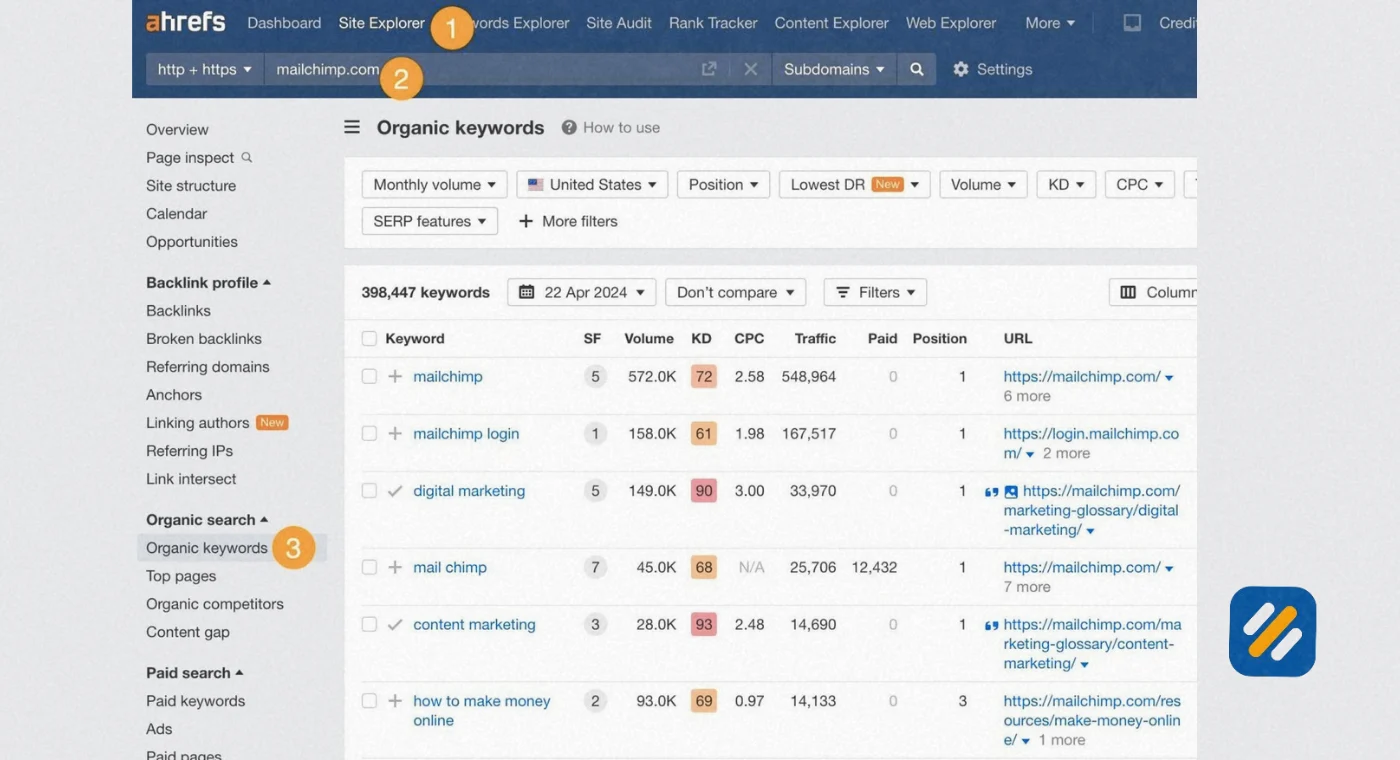
Enter each competitor domain into a keyword research tool. In Ahrefs, use Site Explorer then Organic Keywords. In Semrush, use Domain Overview then Organic Research. In the free version of either tool you have limited searches, so prioritise your top two or three competitors.
Filter the results to show only keywords where the competitor ranks in positions one to ten. These are confirmed rankings that are already driving traffic. Sort by estimated monthly traffic to identify which keywords are sending the most visitors to your competitor's website.
Look for keywords in this list that you have not yet created content for. Each one is a potential content opportunity.
Step 3: Run a keyword gap analysis
Keyword gap analysis is where the real strategic value of competitor keyword research appears. Instead of analysing competitors one at a time, you compare your domain directly against multiple competitors to see exactly which keywords they all rank for that you do not.
In Semrush's free version, use the Keyword Gap tool. Enter your domain and up to two competitor domains. Click the Missing tab to see keywords that all your competitors rank for but you do not appear for at all. These are your highest-priority content gaps because multiple competitors have validated the keyword's relevance to your niche.
The Weak tab shows keywords where all your competitors outrank you. Since you already have some presence for these terms, improving the existing page is often faster than creating new content.
Step 4: Filter for realistic opportunities
Not every competitor keyword is worth targeting. A brand new website cannot compete for keywords with a difficulty score of 70 when competitors ranking for them have thousands of backlinks built over years.
Filter your competitor keyword list by these three criteria
Search volume above 100 monthly searches in your target region. Keywords below this threshold will rarely drive meaningful traffic even if you rank number one.
Keyword difficulty under 30 for a new website or under 50 for an established website with existing domain authority. Chasing high difficulty keywords before your domain is ready wastes content resources.
Search intent that matches what your website offers. A product page cannot rank for informational how-to keywords. A blog post cannot rank for transactional keywords with strong commercial intent. Match your content type to what Google is already showing for each keyword.
Step 5: Analyse the top-ranking pages for each priority keyword
Before writing a single word, open Google and search each priority competitor keyword. Read the top three ranking pages carefully. Note their content format, their approximate word count, their heading structure, the questions they answer, and the data or examples they use.
This SERP analysis tells you exactly what Google considers the best possible answer to that search query right now. Your content needs to match this format and exceed the depth and usefulness of what is already ranking.
5 Competitor Keyword Research Tools | Free and Paid Options Compared
You do not need to spend hundreds of dollars per month on tools to do effective competitor keyword research. Here is a complete comparison of every tool worth using at every budget level:
| Tool | Cost | Best For | Key Feature for Competitor KW Research | Searches Per Day Free |
|---|---|---|---|---|
| Google Search Console | Free | Finding keywords you already rank for to compare against competitors | Performance report shows your ranking keywords with position data | Unlimited |
| Ahrefs Free Webmaster Tools | Free | Competitor discovery and backlink analysis | Competitive positioning map shows keyword overlap | Limited |
| Semrush Free Version | Free | Keyword gap analysis and competitor organic keyword snapshots | Keyword Gap tool compares your domain against competitors | 10 per day |
| Ahrefs Paid | From $129/month | Full competitor keyword database with traffic estimates | Site Explorer shows every keyword a competitor ranks for with full metrics | Unlimited |
| Semrush Paid | From $139/month | Most comprehensive competitor keyword and gap analysis | Organic Research plus Keyword Gap with full data | Unlimited |
| Moz Free | Free | Domain authority comparisons and basic keyword research | Link Explorer shows domain authority to assess competitor strength | 10 per day |
| Ubersuggest Free | Free | Basic competitor keyword overview with limited data | Traffic analyser shows estimated competitor organic keywords | 3 per day |
| Google Keyword Planner | Free | Validating search volume for competitor keywords you have identified | Search volume ranges for any keyword list | Unlimited |
For a new website with zero budget, combining Google Search Console, Ahrefs free Webmaster Tools, and Semrush's ten free daily searches gives you enough data to identify your top competitor keyword opportunities and build a six-month content plan.
6 Keyword Gap Analysis | How to Find the Exact Keywords Your Competitors Rank For That You Don't
Keyword gap analysis is the most strategically valuable part of competitor keyword research. Rather than hunting through a competitor's full keyword list one by one, a keyword gap analysis shows you exactly where the opportunities are in one focused report.
Here is how to run a complete competitor keyword gap analysis using free and paid methods
Method 1: Manual keyword gap analysis using Google
Search for your target keyword on Google. Look at the top ten results. For each competing page, note the domain and manually check whether you have similar content targeting the same keyword. Any keyword where competitors appear but you have no relevant page is a gap.
This method is slow but it requires zero tools and gives you firsthand insight into the quality and depth of content you need to create.
Method 2: Keyword gap analysis using Semrush free
Enter your domain and two competitor domains into Semrush's Keyword Gap tool. Click Missing to see keywords all competitors rank for that you do not. Export this list and filter by search volume and keyword difficulty to find your highest priority gaps.
Method 3: Content gap analysis using Ahrefs
In Ahrefs Site Explorer, enter a competitor domain and click Content Gap. Enter your domain as the comparison. Ahrefs shows you keywords that rank on the competitor's site but not on yours, with full search volume and difficulty data.
What to do with your keyword gap list
| Gap Type | What It Means | Recommended Action |
|---|---|---|
| Missing keyword, no existing content | You have never covered this topic | Create a new dedicated page or article |
| Missing keyword, existing related content | You have a relevant page but it is not optimised for this term | Update and optimise the existing page |
| Weak keyword, ranking position 11 to 20 | You rank but not on page one | Improve content depth, add internal links, update with fresh data |
| Weak keyword, ranking position 5 to 10 | Close to page one, high priority quick win | Add missing subtopics, improve title tag, earn one or two backlinks |
| Competitor ranking, low search volume | Keyword confirmed relevant but limited traffic potential | Lower priority, address after high volume gaps |
7 How to Analyse What Makes a Competitor's Page Rank | SERP Analysis Done Right
Finding competitor keywords is only the first half of the process. The second half is understanding why those pages rank. This is called SERP analysis and it is what separates beginners who create content that never ranks from specialists who consistently reach page one.
When I analyse a competitor's ranking page, I look at seven specific elements
Content format. Is the ranking page a guide, a list article, a comparison, a definition, a tool, or a product page? Google shows you what format it prefers for each keyword by what it already ranks. Matching this format is not optional. It is required.
Content depth. Roughly how many words does the ranking page contain? What subtopics does it cover? What questions does it answer beyond the main keyword? A superficial article targeting the same keyword as a competitor's comprehensive guide will almost never outrank it.
Heading structure. What H2 and H3 headings does the competitor use? Each heading is a signal about what subtopics Google expects a comprehensive page on this keyword to cover. Missing these subtopics from your version is a relevance gap.
Data and evidence. Does the competitor cite specific statistics, studies, or original research? Data-backed content builds E-E-A-T signals that pure opinion content cannot replicate. Note every data point your competitor uses and find either the same source or a more recent one.
Internal linking. How many internal links does the competitor's page contain and where do they lead? Strong internal linking from authoritative pages on their site is part of why their content ranks. You need to build an equivalent internal link structure to your new content.
Page experience signals. How fast does the competitor's page load? How is it structured on mobile? Are there clear visual elements like tables, images, or comparison charts? Pages that are easy to read and navigate have lower bounce rates which sends positive signals to Google.
Backlink profile. How many external backlinks does the competitor's ranking page have? Use Ahrefs free Backlink Checker to enter the URL and see how many referring domains point to it. If they have 200 backlinks and you have zero, rankings will take time regardless of content quality. Plan your backlink acquisition strategy accordingly.
8 How to Build a Competitor Keyword Strategy | Turning Data Into a Content Plan
Having a list of competitor keywords is not a strategy. A strategy is a prioritised plan that tells you exactly what to create, in what order, and why.
Here is the framework I use to turn competitor keyword research into a structured content plan
Tier 1: Quick win keywords (target immediately)
These are keywords where a competitor ranks between positions 5 and 15 and your website has some existing authority. You can often outrank these with a better-optimised page because Google already considers your domain relevant to the topic. Filter your keyword gap list for terms with difficulty under 30 and search volume above 200 monthly searches.
Tier 2: Authority building keywords (target in months 2 to 4)
These are keywords where competitors rank strongly on page one with difficulty scores between 30 and 50. You need some domain authority and ideally a few backlinks before competing here. These should be on your content calendar but not your immediate priority.
Tier 3: Future opportunity keywords (track and target in months 6 to 12)
These are high-traffic keywords with difficulty above 50 where the top competitors have significant backlink profiles. Publish content on these topics early to begin building relevance, but expect rankings to come later as your domain authority grows.
Organising your competitor keyword content plan
| Priority | Keyword | Competitor Ranking | Search Volume | KD Score | Content Type Needed | Target Month |
|---|---|---|---|---|---|---|
| Tier 1 | competitor keyword analysis | Competitor A: position 8 | 1,600 | 28 | Comprehensive guide | Month 1 |
| Tier 1 | find competitors keywords | Competitor B: position 6 | 880 | 22 | Step by step tutorial | Month 1 |
| Tier 2 | keyword gap analysis | Competitor A: position 3 | 2,400 | 44 | Detailed guide with tool walkthrough | Month 3 |
| Tier 2 | SEO competitor analysis | Competitor C: position 4 | 1,900 | 41 | Strategy guide with examples | Month 3 |
| Tier 3 | competitor analysis | Competitor A: position 1 | 8,100 | 67 | Ultimate comprehensive guide | Month 8 |
9 How to Track Competitor Keywords Over Time and Stay Ahead
One competitor keyword analysis gives you a snapshot. The real competitive advantage comes from tracking how rankings change over time and catching new opportunities before your competitors have fully established themselves.
Here is the monitoring system I recommend for any website serious about competitor keyword research
Weekly monitoring in Google Search Console
Every week, check your GSC Performance report and sort by average position. Look for keywords where your position has dropped significantly. A position drop often indicates a competitor has published new or improved content targeting the same keyword. Investigate and update your page before the drop affects your traffic significantly.
Monthly competitor keyword audit
Once per month, re-run your competitor keyword analysis using your primary tool. Look for new keywords your competitors have started ranking for that they were not ranking for the previous month. These newly ranking pages show you which topics your competitors are actively targeting in their current content strategy.
Quarterly keyword gap review
Every three months, run a fresh keyword gap analysis comparing your domain against your top three competitors. Measure how many previously missing keywords you now rank for. This quarterly comparison shows the real progress of your SEO strategy and identifies remaining gaps that need attention.
Setting up alerts for competitor new content
Use Google Alerts or a tool like Semrush's Brand Monitoring to receive notifications when competitors publish new pages. New content from a strong competitor is an early signal that a keyword opportunity is being targeted. Getting your own content published and indexed on the same topic quickly reduces the time advantage your competitor gains from publishing first.
10 3 Expert Tips for Competitor Keyword Research That Most Guides Never Cover
These are the tactics that go beyond what most competitor keyword guides teach and that produce results faster in real client campaigns.
Expert Tip 1: Target Your Competitor's Second Page Rankings First
Most people focus on keywords where competitors rank on page one. But the fastest wins come from keywords where a strong competitor ranks on page two, meaning positions 11 to 20. These keywords have proven search demand but the competitor has not yet produced content strong enough to reach page one. A well-optimised, deeper article on the same keyword can jump straight to page one while your competitor is still stuck on page two.
Expert Tip 2: Steal Your Competitor's Featured Snippet Keywords
When a competitor holds a featured snippet for a keyword, that means Google already considers that keyword's answer extractable from a structured page. Study the exact format of the snippet your competitor owns, whether it is a paragraph, a numbered list, or a table, and recreate that format in your content with more accurate, more current, or more detailed information. Featured snippet ownership can shift to your page within weeks of publishing if your structure and content quality are stronger.
Expert Tip 3: Use Your Competitors' Top Pages as Internal Linking Anchors
When you identify a competitor's top-ranking page, note how they internally link to it from other pages on their site. Strong competitor pages usually have multiple internal links pointing to them from related content. When you create your competing page, build the same internal link structure from your own related content immediately on publication. Internal links from relevant pages are one of the most controllable ranking signals you have and most beginners ignore them completely when targeting competitor keywords.
11 Conclusion
Competitor keyword research is not about copying what your rivals do. It is about using the evidence they have already created to find the clearest path to organic search visibility for your own website.
Your competitors have spent months or years proving which keywords drive real traffic in your niche. The keyword gap between what they rank for and what you rank for is not a disadvantage. It is your content roadmap.
Start with identifying your real SEO competitors through Google searches for your target keywords. Run a keyword gap analysis to find the specific terms they rank for that you do not. Filter that list for keywords with difficulty under 30 and search volume above 100. Create content that is demonstrably more comprehensive, better structured, and more useful than what currently ranks.
Then track your progress monthly and repeat the process every quarter as the competitive landscape shifts.
Competitor keyword research done consistently is not just a tactic. It is the system that separates websites that compound their organic traffic year over year from websites that stay stuck on page three indefinitely.
Have a question about your specific competitor keyword analysis? Drop a comment below and I will answer it personally.
Join 1,000+ business owners and bloggers who get one actionable SEO tip every week — straight to their inbox. Free forever.
Get Free Weekly Tips →