- Local search engine optimization is the process of making your business visible when nearby customers search for what you offer on Google
- Google ranks local results based on three factors: relevance, distance, and prominence
- Your Google Business Profile is the single most important asset in any local SEO strategy
- NAP consistency across all online directories directly impacts how much Google trusts your business information
- Local SEO still works in 2026 and is more valuable than ever as mobile and voice search continue to grow
- A small business with zero ad budget can outrank a large competitor in local search purely through better local SEO execution
1 What Is Local Search Engine Optimization and Why Every Small Business Needs It
If you run a business that serves customers in a specific city, town, or neighbourhood, local search engine optimization is the most valuable marketing activity you can invest time in.
Local SEO is the process of optimising your online presence so your business appears prominently when someone nearby searches for what you offer. When a potential customer types "dentist near me" or "best pizza in Chicago" into Google, the businesses that appear at the top of those results did not get there by accident. They got there through deliberate local search optimization.
Here is what makes local SEO fundamentally different from regular SEO. Standard SEO focuses on ranking for broad informational keywords that any person anywhere in the world might search. Local SEO focuses on ranking for searches with geographic intent, meaning searches where the person wants a business they can physically visit or call today.
According to Google, billions of local searches happen every month. Research from Think with Google shows that 76% of people who search for something nearby on their smartphone visit a related business within 24 hours. That is not traffic. That is foot traffic, phone calls, and revenue happening in real time.
In many years of doing SEO for B2B and local businesses, I have never seen an ROI that matches a well-executed local SEO strategy for a service-area business. A restaurant, a plumber, a law firm, or a dental clinic that dominates local search results is essentially getting free customer acquisition every single day.
2 Local SEO vs SEO | What Is the Actual Difference
This is one of the most common questions beginners ask and most guides give a vague answer. Here is a clear, direct comparison.
Regular SEO and local SEO share the same foundation: keyword research, on-page optimisation, backlinks, and technical health. But they diverge significantly in what they target, what ranking factors matter most, and what type of content you need to create.
| Factor | Regular SEO | Local Search Engine Optimization |
|---|---|---|
| Target audience | Anyone searching globally or nationally | People searching within a specific location |
| Primary ranking asset | Your website content and backlinks | Google Business Profile plus your website |
| Key ranking signals | Domain authority, content quality, backlinks | Relevance, distance, prominence (Google's local algorithm) |
| Content focus | Informational blog articles and landing pages | Location pages, local keywords, GBP posts |
| Search result type targeted | Standard blue link organic results | Local Pack, Google Maps, and organic results |
| Timeline to results | 3 to 12 months | 1 to 3 months for local pack with good GBP |
| Who benefits most | Ecommerce, SaaS, national brands, bloggers | Restaurants, clinics, law firms, plumbers, local retailers |
| Citation signals | Not relevant | Critical for trust and ranking |
The most important distinction is this. In regular SEO, your website is your primary asset. In local SEO, your Google Business Profile is often more powerful than your website. A business with a perfectly optimised GBP and no website at all can still rank in the local pack and get dozens of customer calls per week.
3 How Google Decides Which Local Businesses to Rank
Google uses a completely separate algorithm to rank local results compared to regular organic results. Understanding this algorithm is what separates businesses that show up from businesses that stay invisible.
Google evaluates three core signals when deciding which businesses appear in the local pack and Google Maps
Relevance is how closely your business profile and website match what the person searched for. If someone searches "emergency plumber" and your GBP is listed under the wrong business category, Google may not show you even if you are the closest plumber in the area. Relevance is controlled by how well you describe your business, your services, and your location across every platform Google can see.
Distance is how far your business is from the searcher's location or the location mentioned in the search. For "near me" searches, Google uses the searcher's device location. For searches like "accountant in Manchester," Google uses the city named. You cannot control distance but you can control how well you serve areas beyond your immediate address through service area settings in your GBP.
Prominence is how well-known and well-respected your business is both online and offline. Google measures prominence through the number and quality of your reviews, the authority of websites that mention your business, how many directories list your business consistently, and how much engagement your GBP receives. This is the factor you can influence the most through active local SEO work.
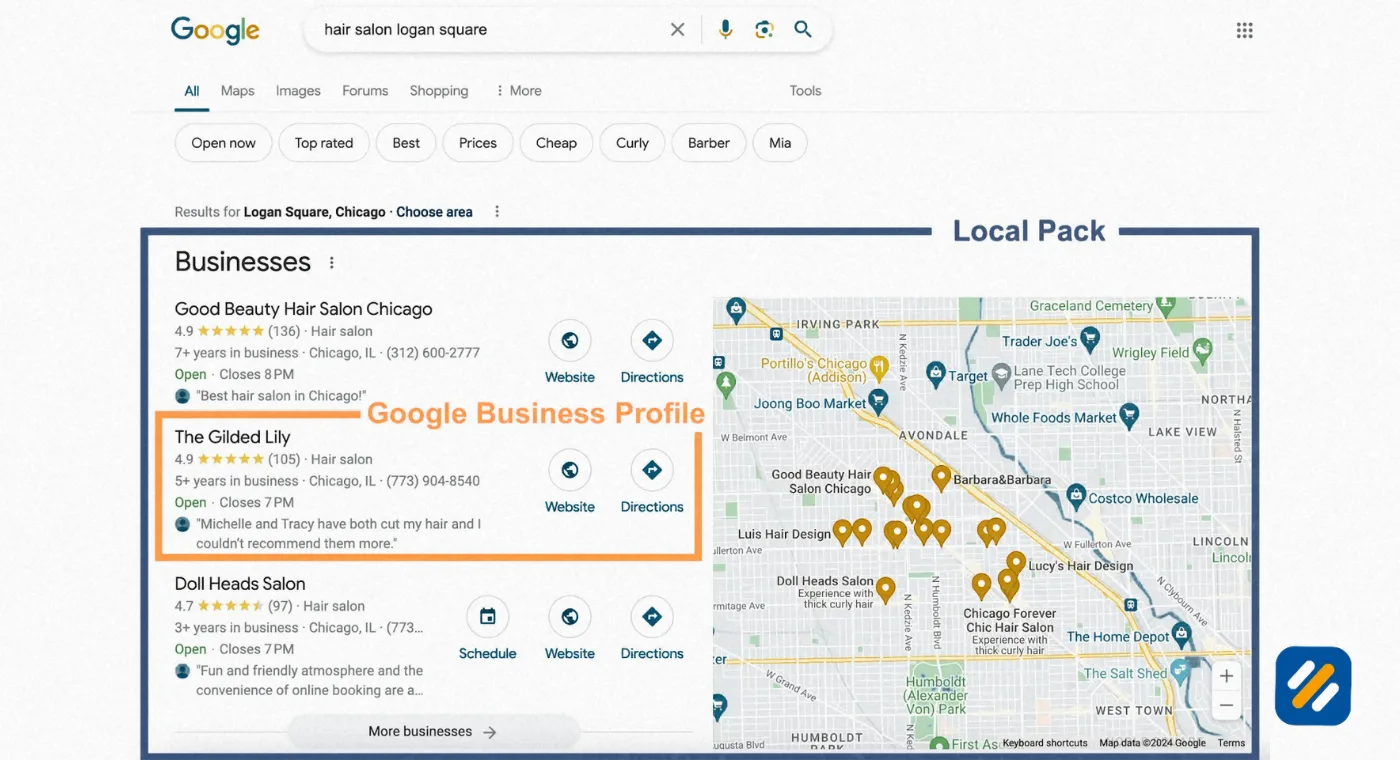
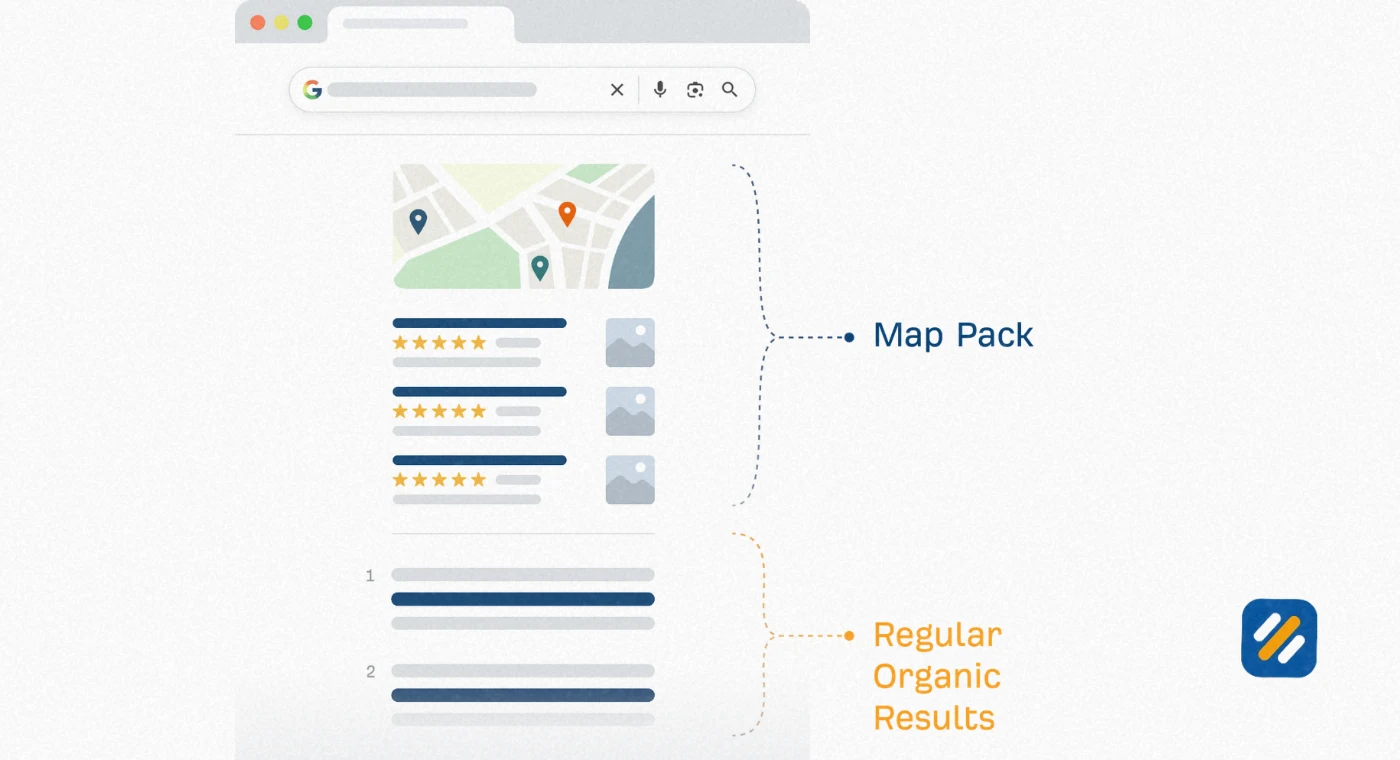
When all three signals align, your business appears in the coveted local pack: the three business listings that appear above organic results and below the map for almost every local search query.
4 Does Local SEO Still Work
The short answer is yes. Local SEO not only still works, it is more competitive and more valuable than it has ever been.
Here is why some people doubt it. When AI Overviews started appearing in Google search results in 2024 and expanded significantly through 2025, some business owners worried that local results would be displaced. The opposite happened. Google's AI Overviews for local searches almost always pull from Google Business Profiles and local pack data. A well-optimised GBP is now feeding both traditional local results and AI-generated local recommendations.
Mobile search has also continued to shift the value of local SEO upward. Over 60% of Google searches now come from mobile devices, and mobile searches have far higher local intent than desktop searches. A person searching on their phone at 7pm on a Saturday night looking for a restaurant that is open now is ready to spend money within the hour.
Voice search through devices like Siri, Google Assistant, and Alexa has further increased local search volume. Voice queries are almost always local in nature and are phrased as natural questions. "Where is the nearest Thai restaurant?" and "What time does the pharmacy near me close?" are the kinds of queries that drive local pack impressions every day for businesses with strong local SEO.
The businesses that say local SEO does not work are almost always the ones who set up a Google Business Profile once, never updated it, have three reviews from 2021, and wonder why they cannot compete with the business down the street that has 200 reviews and posts updates every week.
5 How to Do Local SEO | The Complete Step by Step Strategy
This is the full local SEO strategy I use with clients. Not a summary. The actual process in the order it should be executed.
Step 1 | Set Up and Fully Optimise Your Google Business Profile
Your Google Business Profile is the foundation of everything. Go to business.google.com and claim your listing if you have not already. Verify your business through Google's verification process which usually involves a postcard, phone call, or video verification.
Once verified, complete every single field in your profile. Most businesses leave at least 40% of their profile empty and this directly limits how often Google shows them. Fill in
- Business name exactly as it appears on your shopfront and all other directories
- Primary category that most accurately describes your main service
- Secondary categories for additional services you offer
- Full address or service area if you are a mobile business
- Phone number and website URL
- Business hours including special hours for holidays
- Business description with your primary local keyword used naturally in the first sentence
- Products and services with descriptions and prices where applicable
- At least 10 photos covering your interior, exterior, team, and work
Step 2 | Do Local Keyword Research the Right Way
Local keyword research is different from standard keyword research because you are adding geographic modifiers to every keyword. The process works like this.
Start with your core service keyword, for example "physiotherapy." Add location modifiers to create local keywords: "physiotherapy in Austin," "physiotherapist near me," "best physiotherapy clinic Austin Texas," "physiotherapy Austin TX."
Use Google Autocomplete by typing your service plus a location name and noting every suggestion that appears. These autocomplete suggestions are real searches happening right now in that location. Each one is a keyword opportunity.
Use Google Keyword Planner to check monthly search volume for your shortlisted keywords filtered by your target city or region. Focus on keywords with at least 50 monthly local searches. Volume is lower for local keywords than national ones but the conversion intent is much higher.
Check your competitors by searching your primary keyword in Google and looking at which three businesses appear in the local pack. These are your direct local SEO competitors, not necessarily your business competitors. Understanding why they rank above you is the most direct path to outranking them.
Step 3 | Build NAP Consistency Across All Directories
NAP stands for Name, Address, and Phone Number. Google cross-references your business information across dozens of online directories and uses the consistency of that information as a trust signal.
If your business is listed as "Smith Plumbing Ltd" on Google, "Smith Plumbing" on Yelp, and "Smith Plumbing Services" on your local chamber of commerce directory, Google sees three different entities and its confidence in your business information drops.
Start by auditing your existing citations using a free tool like Moz Local or the free version of BrightLocal. Find every place your business is mentioned online and check whether the name, address, and phone number match exactly. Then fix every discrepancy.
The core directories every local business should be listed on are: Google Business Profile, Bing Places, Apple Maps, Yelp, Facebook Business, TripAdvisor (if relevant), and any industry-specific directories for your niche.
Step 4 | Build a Review Generation System
Reviews are one of the strongest prominence signals in Google's local algorithm. A business with 150 reviews at an average rating of 4.6 will almost always outrank a business with 20 reviews at 5.0, because Google sees the higher volume as a stronger trust signal.
The mistake most businesses make is waiting for reviews to come in organically. That is too slow. You need a system.
After every completed job or successful customer interaction, send a direct link to your Google review page. The easiest way to generate this link is to search your business name on Google, click "Write a Review" on your GBP, and copy the URL. Share this link via text message, email, or WhatsApp immediately after the service is complete while the customer's experience is still fresh.
Always respond to every review within 24 hours. Thank positive reviewers by name and mention the specific service they used, which adds keyword-rich content to your GBP naturally. For negative reviews, respond professionally and offer to resolve the issue offline. Never argue with a reviewer publicly.
Step 5 | Optimise Your Website for Local Search
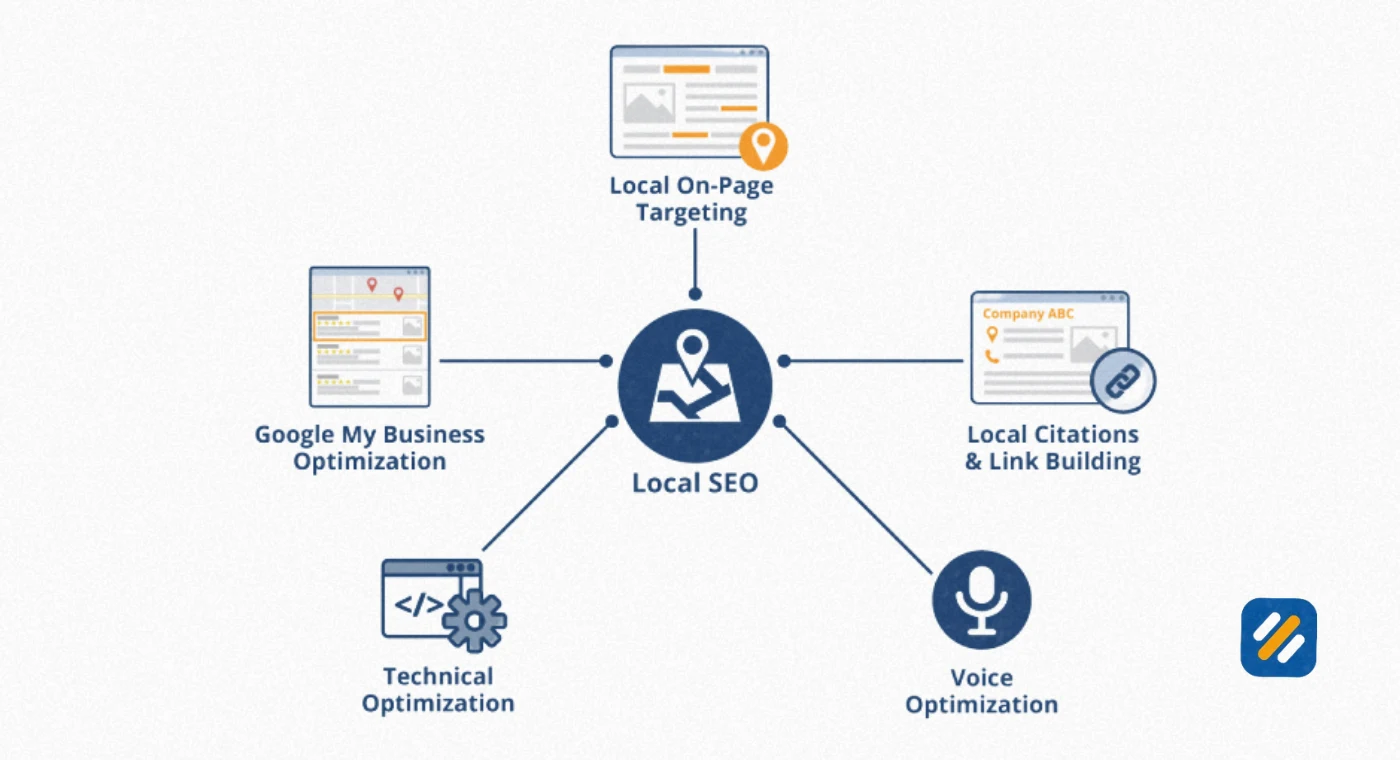
Your website supports your GBP and helps you rank in organic results below the local pack. For local SEO, these are the most important on-page elements:
Create a dedicated location page for every city or area you serve. If you serve three cities, you need three separate pages, each with unique content tailored to that specific location. Generic pages that just swap out the city name with no other differences are not effective and can be penalised as duplicate content.
Include your full NAP information in the footer of every page on your website, exactly matching what appears on your GBP. This reinforces your business information across every page Google crawls.
Embed a Google Map on your contact page showing your business location. This is a simple signal that confirms your physical location to Google.
Add LocalBusiness schema markup to your homepage. This is structured data that tells Google explicitly what type of business you are, where you are located, and your contact details. Rank Math makes this easy with its Local SEO module.
Step 6 | Build Local Backlinks
Local backlinks from websites in your geographic area carry more weight for local SEO than national backlinks from unrelated industries.
The most effective local link-building sources are: your local chamber of commerce website, local newspaper coverage, sponsorship of local events or sports teams, partnerships with complementary local businesses, and guest posts on locally-focused blogs or community websites.
Even a single backlink from your city's most-read news website or a well-known local blogger can significantly move your local rankings.
6 How to Learn Local SEO as a Beginner
One of the most common questions I get from small business owners is: where do I even start learning this?
The honest answer is that local SEO is one of the most learnable areas of digital marketing because the core tasks are practical and repeatable. You do not need to understand complex algorithms. You need to understand what your customer searches for and make sure Google can see your business clearly when they do.
Here is a beginner learning path that works
Month 1: Master your Google Business Profile. This is where the fastest results come from. Read Google's official GBP help documentation, complete your profile fully, set up a review request system, and start posting weekly GBP updates. You can see ranking improvements within weeks just from GBP optimisation alone.
Month 2: Learn local keyword research. Use Google Autocomplete and Google Keyword Planner to build a list of 20 to 30 local keywords for your business. Understand the difference between "near me" searches and city-specific searches and how to target both.
Month 3: Audit and fix your NAP citations. Use Moz Local free tool or BrightLocal free trial to find your existing citations. Fix any inconsistencies. Add your business to any major directories where it is missing.
Month 4 onwards: Content and backlinks. Start creating location-specific content on your website and pursuing local backlinks through community involvement and press coverage.
The single biggest mistake beginners make is trying to learn everything before doing anything. Start with your GBP today. Learn as you go. The practical experience of seeing your rankings change as you make optimisations is the best SEO education available.
7 Local SEO Ranking Factors | What Actually Matters Most in 2026
| Ranking Factor | Impact Level | What to Do |
|---|---|---|
| Google Business Profile completeness | Very High | Fill every field, add photos, keep hours updated |
| Review quantity and rating | Very High | Build a review request system, respond to every review |
| NAP consistency across directories | High | Audit all citations and fix discrepancies |
| Proximity to searcher | High | Cannot be changed, optimise other factors instead |
| On-page local signals | High | Location pages, local keywords in title tags, schema markup |
| Local backlinks | High | Chamber of commerce, local press, community sponsorships |
| GBP post activity | Medium | Post weekly updates, offers, and events |
| Website mobile speed | Medium | Use WP Rocket and Cloudflare, test with PageSpeed Insights |
| Click through rate from local pack | Medium | Strong GBP photos and review count drive more clicks |
| Social signals and brand mentions | Low to Medium | Active social presence reinforces local prominence |
8 Local SEO for Small Businesses | What Makes It Different From Enterprise Local SEO
Most local SEO guides are written with enterprise multi-location brands in mind. If you are a single-location small business, your strategy looks different and frankly more manageable.
A small local business has one significant advantage over a national chain. Google's local algorithm rewards genuine local relevance. A locally-owned plumber whose entire website, GBP, and online presence focuses on one city will often outrank a national franchise in that city's local pack because every signal points to that one location.
Your competitors as a small local business are the other small businesses in your area, not national brands. The bar for winning local search in most cities and towns is still surprisingly low because most small businesses have incomplete GBPs, inconsistent NAP citations, and almost no review generation strategy.
The businesses winning local search in your city right now are almost certainly doing just three things better than everyone else: their GBP is completely filled out, they have more reviews than anyone else in their category, and their website mentions their city and services clearly on every key page.
That is a manageable list for any small business owner to address in a single month
9 Local SEO Strategy for Multiple Locations
If your business operates in more than one location, your local search engine optimization strategy needs to scale without becoming repetitive or thin.
The core principle is one Google Business Profile per physical location. Each profile should have its own unique phone number, its own set of photos specific to that location, and its own set of reviews. Managing multiple GBPs through Google Business Manager keeps everything organised in one dashboard.
On your website, create a dedicated location page for each branch or service area. Each page needs genuinely unique content that goes beyond just swapping the city name. Include the specific address, local staff names if appropriate, photos of that specific location, testimonials from customers in that area, and information about any local partnerships or community involvement.
Do not use the same content template across all location pages. Google recognises duplicate location pages and may only fully rank one of them. The more unique and locally specific each page is, the better it will perform independently.
10 3 Expert Tips to Dominate Local Search Engine Optimization
Tip 1: Post to Your Google Business Profile Every Single Week
Most businesses set up their GBP and never touch it again. Google rewards active profiles with better visibility. Post a weekly update about a service, a promotion, a team achievement, or a local event you are involved in. Each post keeps your profile fresh and signals to Google that your business is active and engaged.
Tip 2: Add Local Keywords to Your GBP Business Description Naturally
Your GBP business description is 750 characters of pure local SEO opportunity that most businesses waste with generic language. Write your description to include your primary service, your city name, and a secondary keyword naturally in the first two sentences. For example: "Smith Plumbing is a family-run emergency plumber in Austin, Texas, serving residential and commercial clients across Travis County since 2009."
Tip 3: Use Photos as a Local SEO Signal, Not Just a Visual
Upload geotagged photos to your GBP. Before uploading images, use a free tool like GeoImgr to embed your business's GPS coordinates into the image metadata. When Google reads a photo with location data matching your business address, it reinforces the geographic relevance of your profile. Most competitors never do this and it gives you a quiet ranking advantage.
11 Conclusion
Local search engine optimization is not complicated but it does require consistency and attention to detail that most small businesses never apply. The businesses dominating local search in your city are not outspending you. They are out-executing you on a short list of high-impact activities that anyone can learn and implement.
Claim your Google Business Profile. Complete it fully. Build a review generation system. Get your NAP consistent across every directory. Create location-specific pages on your website. Build local backlinks through community involvement.
Do those six things consistently over the next three months and your local search visibility will look completely different. The customer who searches for your service tomorrow in your city should find you first. Local SEO is how you make that happen.
Have a question about local search engine optimization for your specific business? Leave a comment below and I will give you a personalised answer.
Join 1,000+ business owners and bloggers who get one actionable SEO tip every week — straight to their inbox. Free forever.
Get Free Weekly Tips →