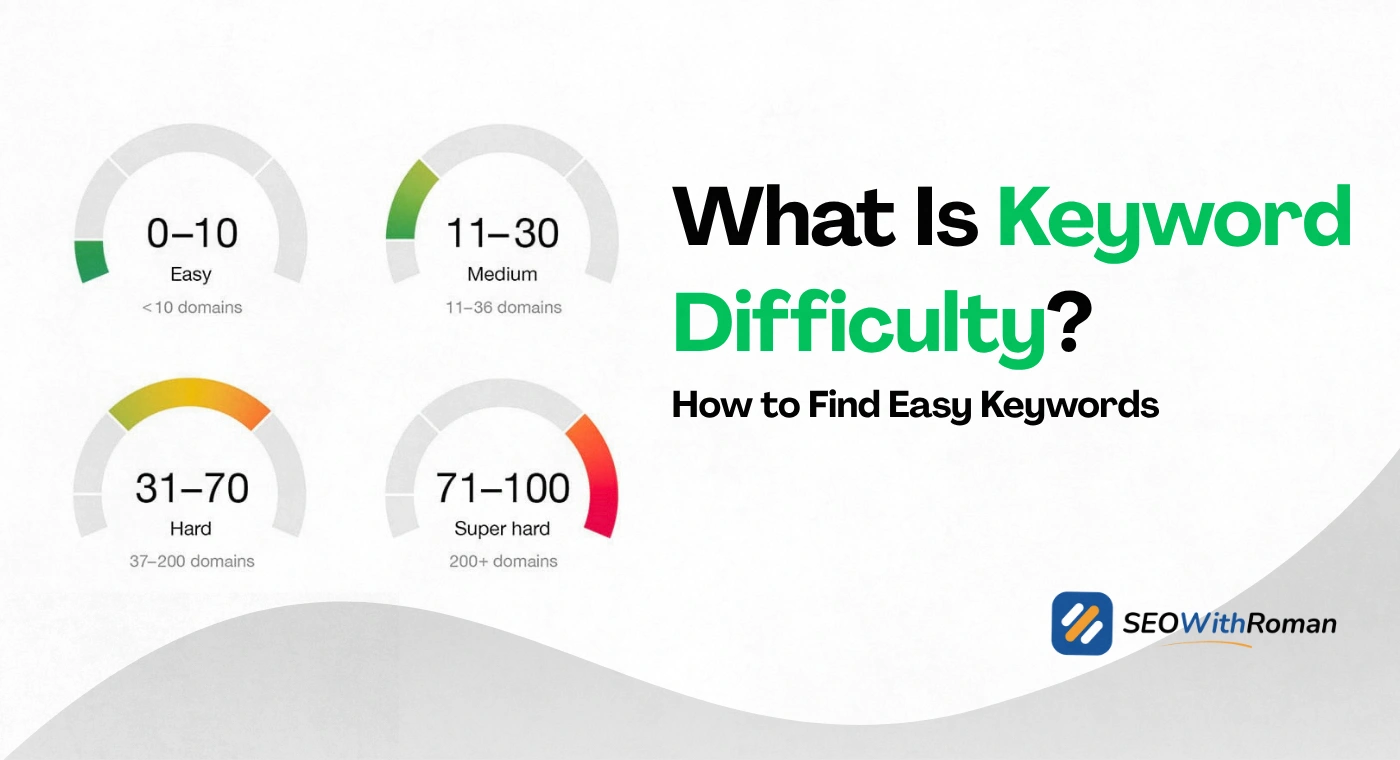
- Keyword difficulty is an SEO metric scored from 0 to 100 that estimates how hard it would be to rank on Google's first page for a given keyword
- Different tools calculate keyword difficulty differently, so the same keyword can show a KD of 13 in one tool and 56 in another
- A new website should only target keywords with a KD score under 20 for the first 6 to 12 months
- KD score alone never tells the full story. Search intent, content quality, and domain authority all affect your real chances of ranking
- Low KD keywords with clear search intent are the fastest path to first page rankings for any new website
1 What Is Keyword Difficulty and Why Every Beginner Gets It Wrong
When I started doing SEO many years ago, I made the same mistake almost every beginner makes. I picked keywords based on search volume alone. High volume meant high traffic potential, so I targeted them without checking how competitive they were. Every article I wrote disappeared into page five or beyond, never to be found.
"Keyword difficulty is the metric that would have saved me months of wasted effort"
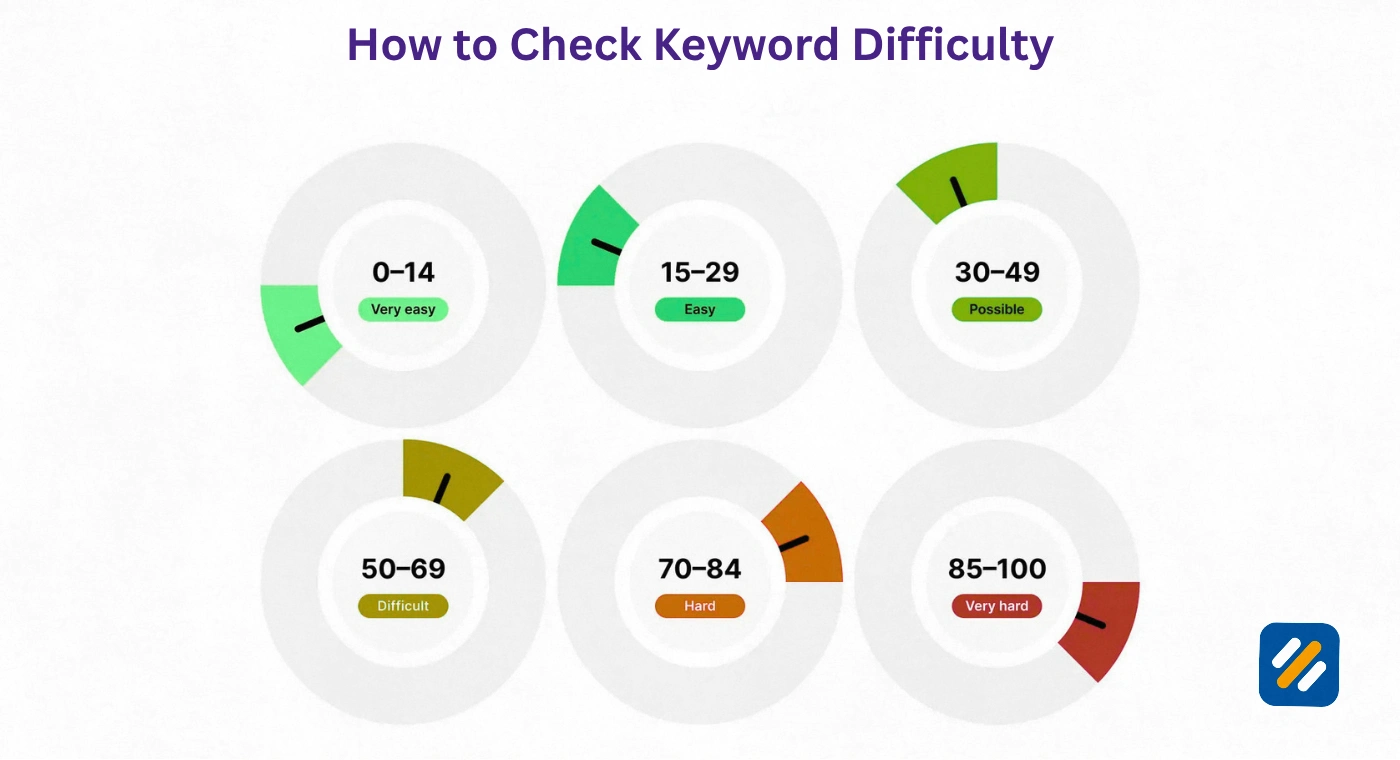
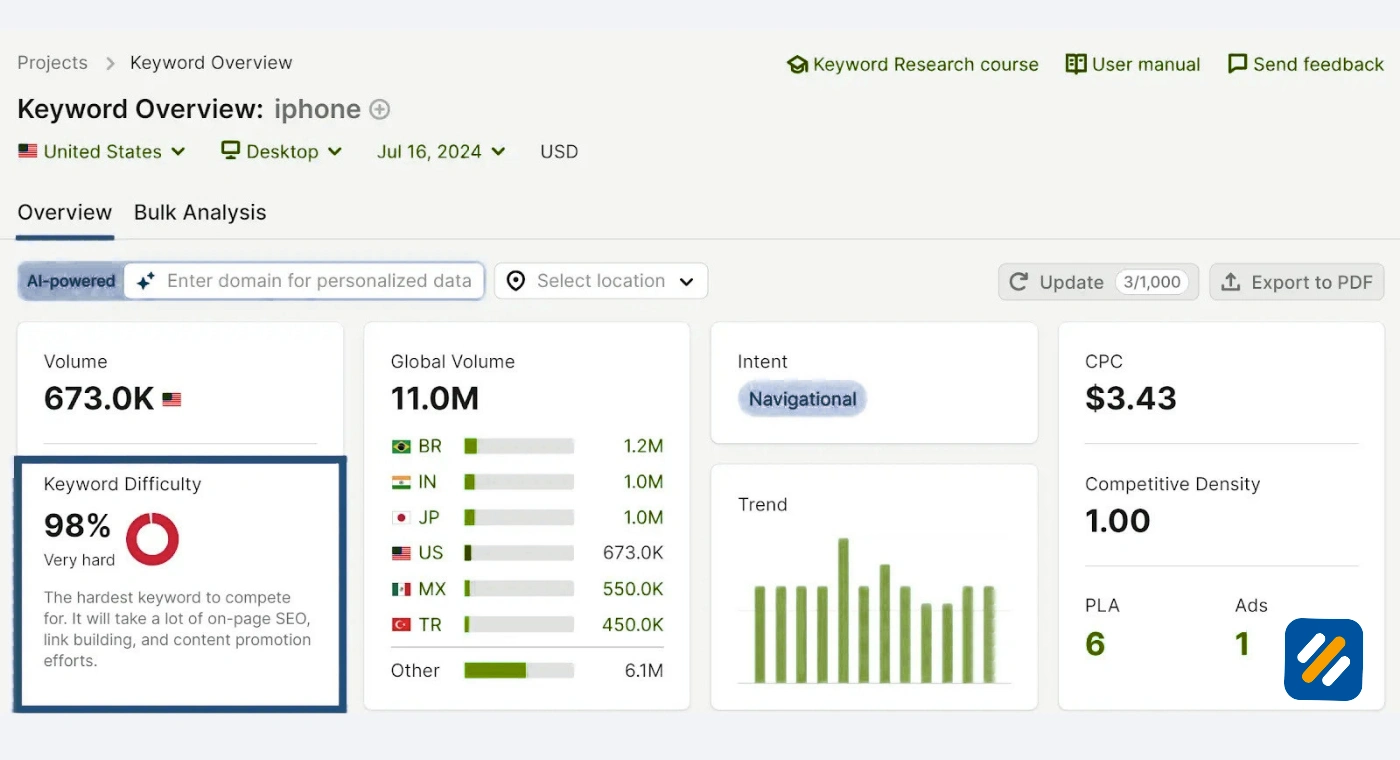
Keyword difficulty, commonly referred to as KD in SEO tools, is a score from 0 to 100 that estimates how hard it would be to rank on Google's first page for a specific keyword. The higher the score, the more authority, backlinks, and content quality you need to compete. The lower the score, the more realistic it is for a newer website to rank.
Think of it like a competition entry requirement. Some competitions are open to anyone. Others require years of credentials before you can even apply. Keyword difficulty tells you which competition you are trying to enter before you spend time preparing for it.
A score of 0 to 10 means almost any website can rank with good content. A score of 70 to 100 means you are competing against established websites with thousands of backlinks built over years. For a new website, targeting a KD 80 keyword is not ambitious. It is simply unrealistic at that stage of growth.
2 How Is Keyword Difficulty Actually Calculated
This is where most guides stop at a surface level explanation. Understanding how KD is calculated changes how you use and interpret the number.
Every major SEO tool calculates keyword difficulty differently. They all use the same 0 to 100 scale, but the inputs behind that number vary significantly between platforms. This is why the same keyword can show wildly different KD scores depending on which tool you check.
Here is how the main tools approach the calculation:
| SEO Tool | Primary KD Calculation Method | What It Measures |
|---|---|---|
| Ahrefs | Number of referring domains pointing to the top 10 ranking pages | Backlink strength of current top rankers |
| SEMrush | Combination of backlink authority, on-page signals, and search intent factors | Multi-factor competitive analysis |
| Moz | Page authority and domain authority of top ranking pages | Overall page and domain strength |
| KWFinder | Backlinks, domain authority, page authority, and social signals | Composite authority score |
| Google Keyword Planner | Ad competition level, not organic difficulty | Paid search competition only |
The most important thing to understand from this table is that Google Keyword Planner does not measure organic keyword difficulty at all. It measures paid ad competition. Beginners who rely on Keyword Planner's competition column for organic SEO decisions are reading completely the wrong signal.
Ahrefs uses the simplest and most transparent method. It looks at how many unique referring domains link to each of the top 10 ranking pages. The more backlinks those pages have, the higher the KD score. This gives you a clear, actionable benchmark: if you want to rank, you roughly need as many quality backlinks as the current top 10 pages have.
3 What Keyword Difficulty Score Should You Target as a Beginner
This is the question that matters most practically and the answer depends on where your website is right now.
A brand new website has no domain authority, no backlink profile, and no established trust with Google. Competing for high KD keywords from day one is like entering a Formula 1 race in a standard road car. The race is real. Your vehicle just is not built for it yet.
Here is a practical KD targeting guide based on your website's current stage:
| Website Stage | Recommended KD Range | Reasoning |
|---|---|---|
| Brand new website, 0 to 3 months old | KD 0 to 15 | No authority yet, needs wins to build momentum |
| Growing site, 3 to 6 months, 20 to 30 articles | KD 10 to 25 | Some trust established, can compete slightly harder keywords |
| Established site, 6 to 12 months, 50+ articles | KD 20 to 40 | Topical authority building, domain stronger |
| Authority site, 12+ months, backlinks earned | KD 30 to 60 | Competitive keywords now within realistic reach |
| Strong authority site, 2+ years | KD 50 to 80 | Can compete for high value keywords with sustained effort |
The single most important rule for any new website is this. Do not let high search volume tempt you into targeting high KD keywords before your site is ready. A keyword with 500 monthly searches and KD 8 will bring you more traffic in month three than a keyword with 10,000 monthly searches and KD 75 will bring you in year one.
Start where you can win. Win consistently. Then move to harder keywords from a position of established strength.
4 Why KD Score Alone Is Never the Full Picture
Here is the insight that separates experienced SEO professionals from beginners who rely entirely on KD scores.
Keyword difficulty is a useful starting filter but it is not the final decision. A keyword with KD 35 might be genuinely easier to rank for than a keyword with KD 20, depending on the specific pages currently ranking for it and what gaps they leave unfilled.
The concept Ahrefs calls "Personal Keyword Difficulty" captures this perfectly. The standard KD score tells you how hard the keyword is for the average website. Your personal keyword difficulty is how hard it is specifically for your website, based on your domain authority, your existing topical coverage, and the quality of your content compared to current top rankers.
Four factors that affect your real ranking difficulty beyond the KD score:
Search intent alignment: If the top 10 results for a keyword are all free tools and you are publishing a blog post, you will not rank regardless of how strong your content is. Google has already decided the format searchers want. Your content format must match that.
Content freshness: A keyword where the top ranking articles were last updated in 2021 is genuinely easier to crack than the KD score suggests. Fresher, more comprehensive content can outrank older articles even when those older articles have more backlinks.
SERP cracks: Look at the Domain Rating of every page currently ranking in the top 10. If one or two positions are held by low authority websites with DR under 20, that is a signal that content quality can outperform backlink quantity for that keyword.
Topical authority: If your website has already published 15 articles on keyword research and you are adding one more, Google recognises your website as a topical authority on that subject. That topical relevance effectively reduces your personal keyword difficulty for all related terms.
5 How to Check Keyword Difficulty for Free Step by Step
You do not need a paid tool subscription to check keyword difficulty as a beginner. Here is the exact process using free resources:
Step 1: Use Ahrefs Free Keyword Generator
Go to ahrefs.com/keyword-generator, enter your seed topic, and select your target country. The free version shows KD scores for the top keyword suggestions without requiring an account.
Step 2: Check SEMrush Free Version
SEMrush gives you 10 free keyword searches per day. Enter your target keyword and note the KD score alongside the monthly search volume. The combination of both numbers tells you whether the keyword is worth pursuing.
Step 3: Validate With Google Search Console
If your website is already live, check GSC for the keywords you currently rank for in positions 5 to 20. These are keywords where you are already competitive. Find similar keywords in the same difficulty range and target them next.
Step 4: Check the SERP Manually
Search your target keyword in Google and look at the first page results. Check the Domain Rating of the ranking sites using the free Ahrefs SEO Toolbar browser extension. If several results come from low DR websites, the keyword is more accessible than the KD number alone suggests.
Step 5: Assess Content Quality of Top Rankers
Read the top three ranking articles. Are they genuinely comprehensive or are they thin, outdated, and poorly structured? If you can write something significantly more useful and detailed, content quality can compensate for lower domain authority on low to mid KD keywords.
6 How to Find Low KD Keywords That Actually Have Search Volume
Finding keywords with low difficulty and meaningful search volume is the skill that separates growing websites from stagnant ones. Here are the most effective methods:
Method 1: Long-Tail Keyword Expansion
Start with a broad seed keyword and look for longer, more specific variations. "SEO" has a KD of 95. "SEO tips for small business owners" might have a KD of 12 with 300 monthly searches. The more specific the keyword, the lower the competition and the clearer the search intent.
Method 2: Question-Based Keywords
Questions are almost always lower difficulty than their statement counterparts. "Keyword difficulty" might have KD 65. "What does keyword difficulty mean" might have KD 15. Use Google's People Also Ask section to find question variations of any competitive keyword.
Method 3: Location-Based Keywords
Adding a location to almost any keyword dramatically reduces difficulty. "SEO services" has high competition globally. "SEO services for small business in Manchester" or "affordable SEO consultant London" have significantly lower KD scores with highly specific commercial intent.
Method 4: Competitor Gap Analysis
Use SEMrush or Ahrefs free Webmaster Tools to find keywords your competitors rank for that you do not. Filter this list for KD under 20 and search volume above 100. These are proven, rankable keywords that your competitor has already validated for you.
Method 5: Emerging Topics
New topics, tools, and trends have low KD simply because not many articles exist yet. Use Google Trends to identify rising topics in your niche and publish early. Being first on an emerging topic means you accumulate backlinks and authority before competition arrives.
7 Keyword Difficulty Tools Compared | Free and Paid Options
| Tool | KD Feature | Cost | Best For |
|---|---|---|---|
| Ahrefs Keywords Explorer | Most accurate backlink-based KD score | Paid, free generator available | Professional keyword research with SERP data |
| SEMrush Keyword Magic Tool | Multi-factor KD including intent signals | Paid, 10 free searches daily | Comprehensive research with competitor overlap |
| Moz Keyword Explorer | DA and PA based difficulty score | Paid, 10 free queries monthly | Domain and page authority focused analysis |
| KWFinder by Mangools | Clean interface, composite KD score | Paid, limited free trial | Beginners wanting simple visual KD data |
| Ahrefs Free Keyword Generator | Basic KD scores, no account needed | Free | Quick KD checks for seed keywords |
| Google Search Console | Shows keywords you already rank for | Free | Finding existing ranking opportunities to improve |
| Ubersuggest | KD score with content suggestions | Free tier available | Beginner friendly with basic difficulty data |
For a new website with no budget, the combination of Ahrefs free keyword generator, SEMrush free daily searches, and Google Search Console covers every keyword difficulty check you need for the first 12 months.
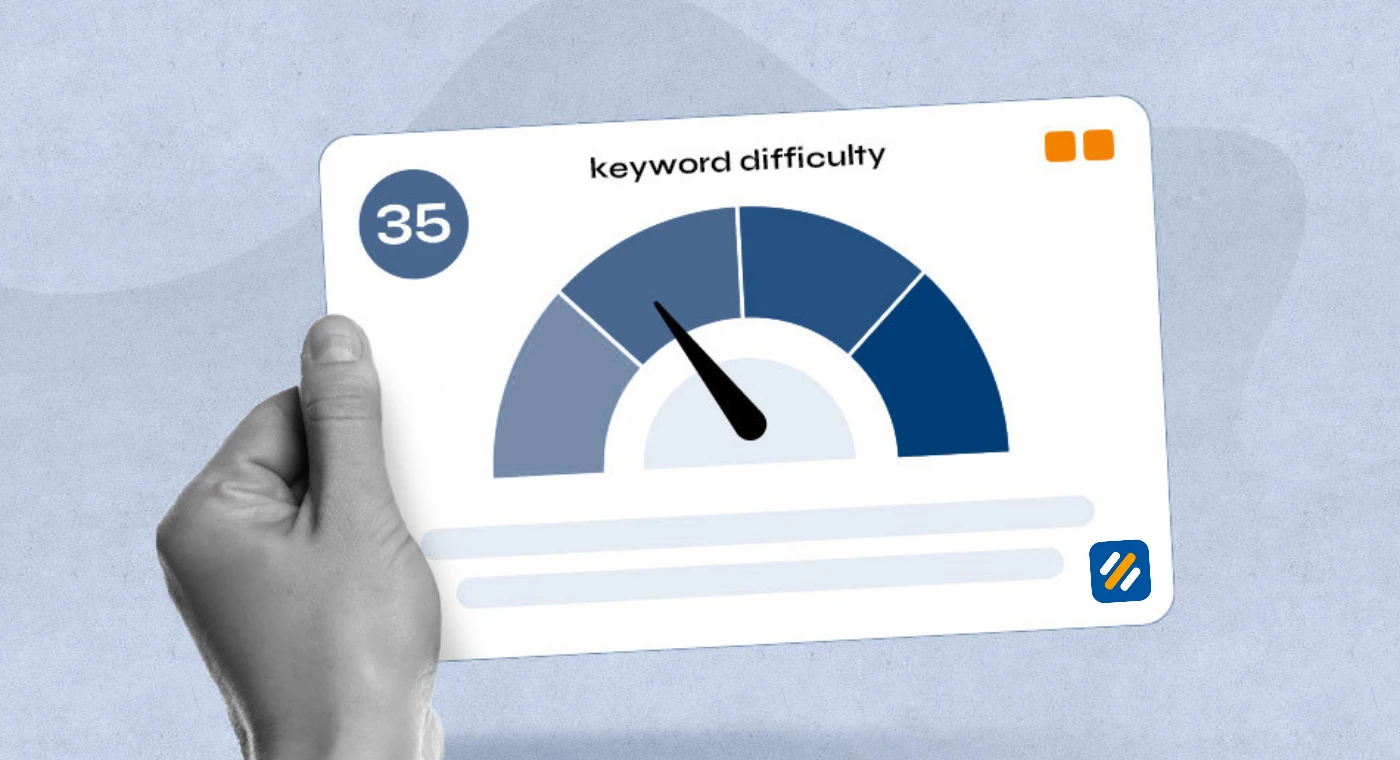
8 What Is KD in Ahrefs and What Does the Ahrefs Rank Mean
Since Ahrefs is the most widely used keyword difficulty tool among professional SEOs, understanding how to read its specific metrics is worth covering in detail.
In Ahrefs, the KD score is calculated purely based on the number of referring domains pointing to the top 10 ranking pages for that keyword. It is an absolute metric, not relative to your website specifically.
Here is what each KD range means in Ahrefs specifically:
| Ahrefs KD Score | Label | Referring Domains Needed | Realistic For |
|---|---|---|---|
| 0 to 10 | Super Easy | 0 to 10 | Any website, including brand new ones |
| 11 to 25 | Easy | 10 to 50 | Websites with some published content |
| 26 to 40 | Possible | 50 to 100 | Sites with 3 to 6 months of consistent publishing |
| 41 to 60 | Hard | 100 to 200 | Established sites with real backlink profiles |
| 61 to 80 | Very Hard | 200 to 500 | Authority sites with strong domain ratings |
| 81 to 100 | Super Hard | 500 or more | Top-tier authority sites with years of link building |
Ahrefs Rank is a separate metric that ranks every website in the Ahrefs database from strongest to weakest based on backlink profile strength. Ahrefs Rank 1 is the most linked-to website in the database. A lower Ahrefs Rank number means a stronger website. When you check a SERP and see websites with Ahrefs Ranks in the millions ranking on page one, that is a clear signal that a newer site with good content can compete for that keyword.
9 3 Expert Tips for Using Keyword Difficulty Like a Pro
Tip 1: Always Check the Actual SERP Before Trusting the KD Score
A KD score of 30 means nothing if five of the top ten results are from websites with DR 80 or above. Conversely, a KD of 45 becomes very attractive if two or three positions are held by low DR websites. The KD number is your filter, not your final answer. Always look at the actual pages ranking before you commit to a keyword.
Tip 2: Target Clusters of Low KD Keywords, Not Individual Keywords
Instead of targeting one low KD keyword per article, build a cluster of five to ten related low KD keywords around the same topic and cover all of them in one comprehensive article. This approach builds topical authority faster and gives you multiple ranking opportunities from a single piece of content. Google ranks pages. Topical authority lifts entire websites.
Tip 3: Revisit Your High KD Targets Every Six Months
A keyword that was too competitive for your website six months ago may now be within reach as your domain authority grows. Keep a list of your most wanted keywords, even the ones with KD 50 to 70, and reassess them every six months. Many successful SEO blogs today rank for extremely competitive keywords because they started targeting them early, kept improving the content, and built authority gradually until the rankings followed.
10 Conclusion
Keyword difficulty is not a barrier. It is a map.
It shows you which keywords your website can realistically compete for right now, which ones to prepare for in six months, and which ones to add to your long-term target list as your authority grows.
The beginner who ignores KD wastes months writing content that will never rank. The beginner who understands KD builds a logical progression from easy wins to competitive keywords, accumulating authority and traffic at every step.
Start with KD under 20. Win those rankings. Use the traffic and credibility they build to go after harder keywords six months from now. That is not settling for small. That is building smart.
Have a question about keyword difficulty or a specific keyword you want to check? Drop a comment below and I will personally tell you whether it is worth targeting right now.
Join 1,000+ business owners and bloggers who get one actionable SEO tip every week — straight to their inbox. Free forever.
Get Free Weekly Tips →