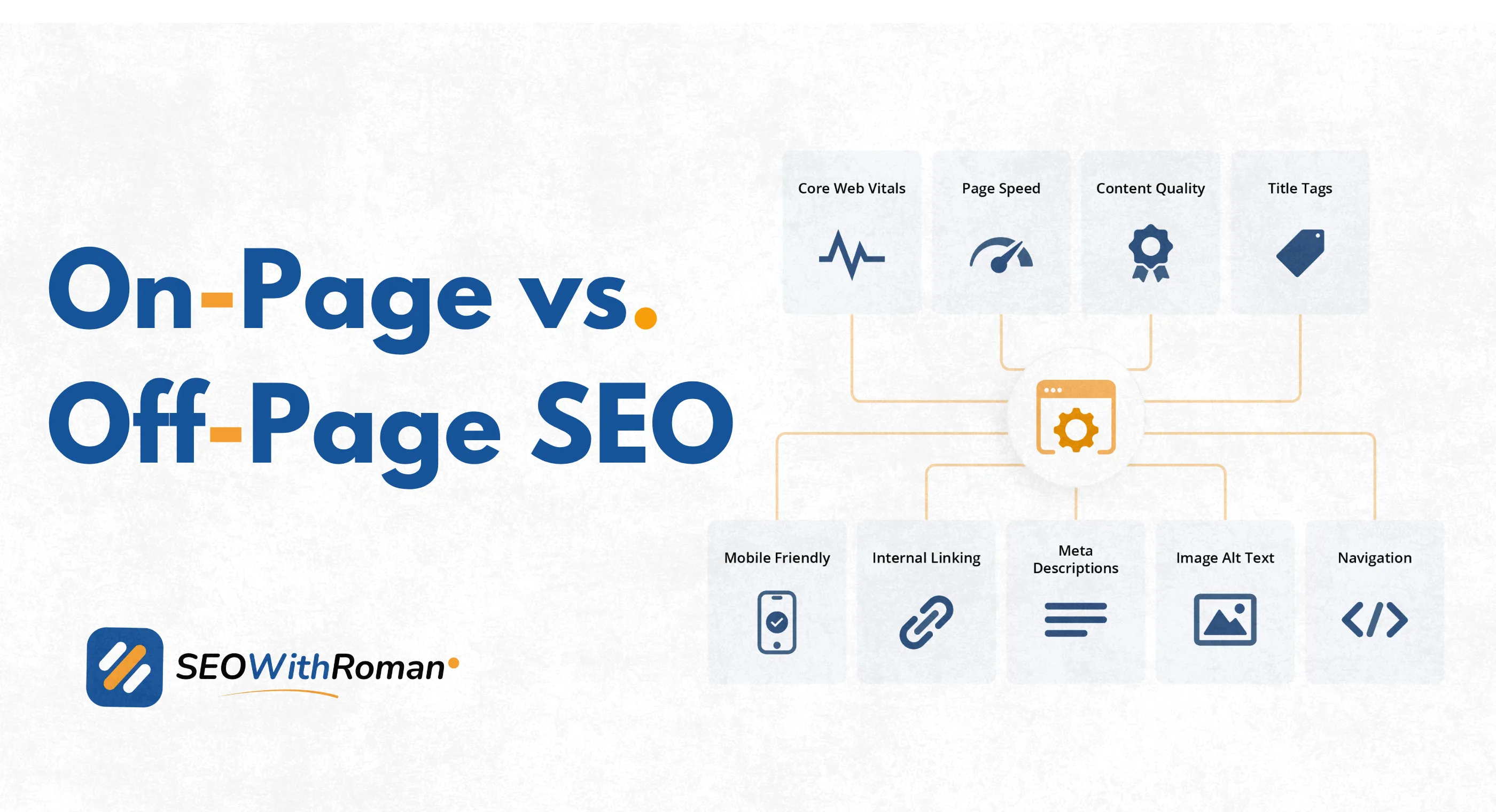
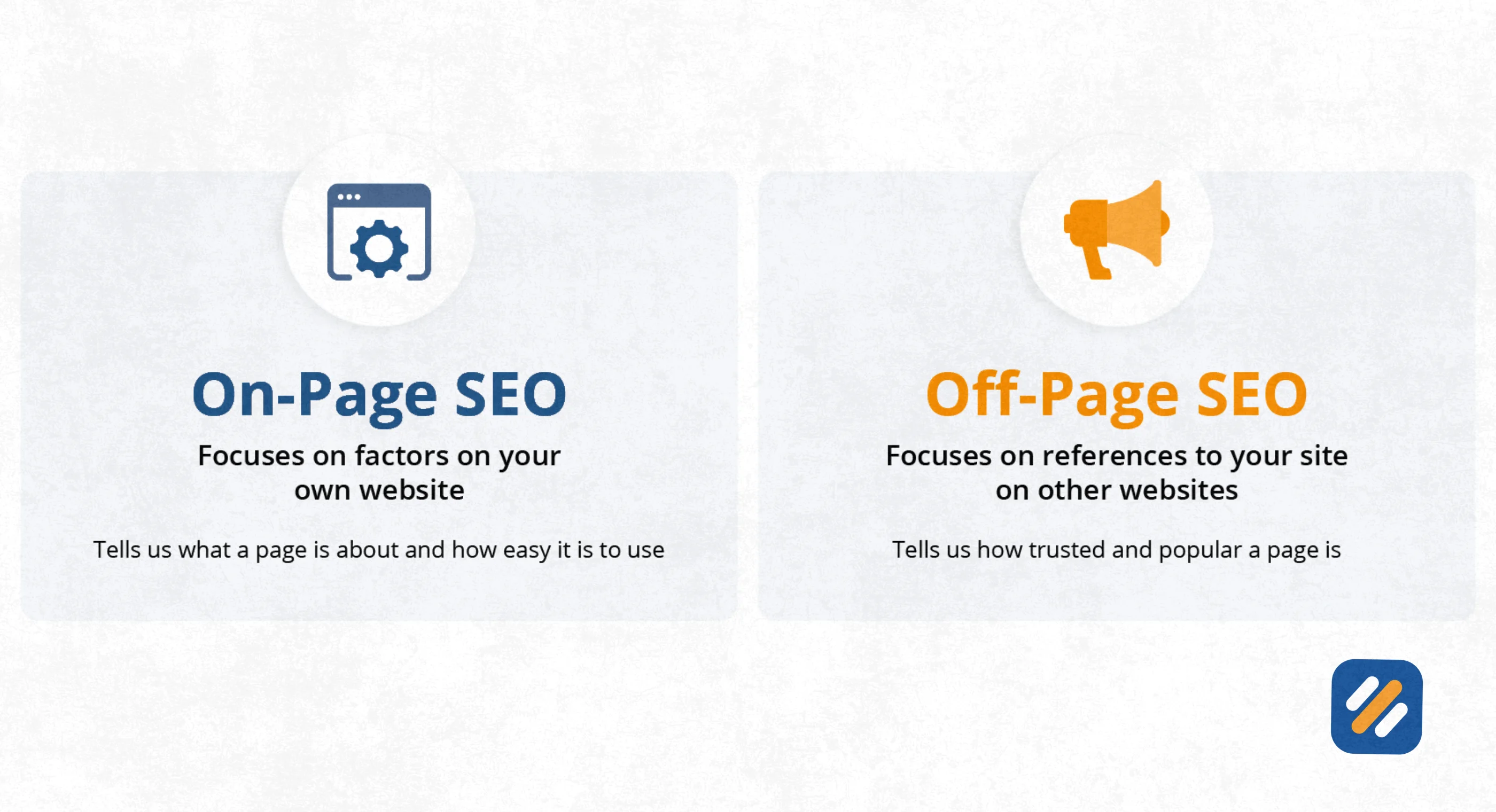
- On-page SEO covers everything you optimise directly on your webpage including content, title tags, headings, and internal links
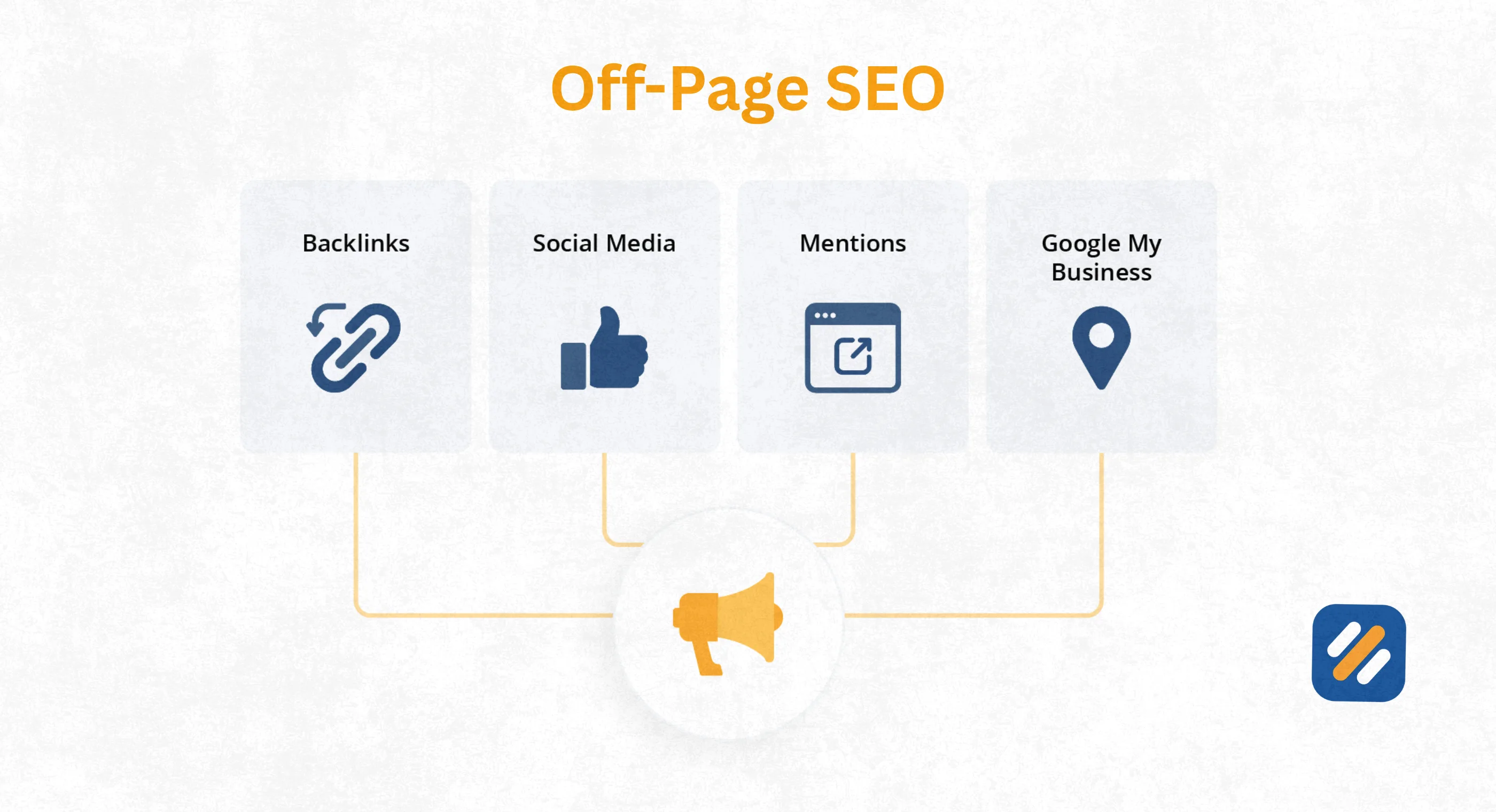
- Off-page SEO covers everything outside your website that builds your authority including backlinks, social signals, and brand mentions
- On-page SEO tells Google what your page is about, off-page SEO tells Google how much to trust it
- Both are essential, but on-page SEO must come first because off-page efforts on a poorly optimised page produce minimal results
- A website with strong on-page SEO and zero off-page SEO will outrank a website with weak on-page SEO and hundreds of backlinks for most beginner level keywords
1 Why Understanding This Difference Changes Everything About Your SEO Strategy
When I started doing SEO professionally, I made the same mistake most beginners make. I spent months building backlinks to pages that were not properly optimised on-page. The results were frustrating and slow. The moment I reversed the order and got the on-page foundation right first, everything accelerated.
The difference between on-page and off-page SEO is not just academic. It determines which work you should be doing right now, what order you should do it in, and why some websites rank with far fewer backlinks than their competitors.
On-page SEO is your signal to Google about what your page covers. Off-page SEO is the vote from the rest of the internet confirming that what you say is worth trusting. You need both. But you need the signal before the vote makes any difference.
This guide covers every element of both, how they interact, which techniques actually work, and the exact sequence a beginner should follow when starting from zero.
2 What Is On-Page SEO?
On-page SEO, also called on-site SEO or onpage optimization, refers to every action you take directly on a webpage to help it rank higher in Google's search results.
The word "on-page" is important. Every element covered by on-page SEO exists on the page itself. You control it completely. You can change it today, publish it, and Google will see the new version the next time it crawls your page.
This complete control is what makes on-page SEO the natural starting point for any website. You do not need to wait for other websites to link to you. You do not need to spend money on outreach. You simply need to make your page the best possible answer to the search query it targets.
On-page SEO covers:
- Title tags and meta descriptions
- Heading structure (H1, H2, H3)
- Keyword placement and density
- Content quality, depth, and search intent matching
- Internal linking between your own pages
- Image optimisation and alt text
- URL structure
- Schema markup
- Page speed and Core Web Vitals
- Mobile usability
Each of these elements sends a signal to Google about what your page is about, how trustworthy the information is, and how good the experience is for the user reading it.
3 What Is Off-Page SEO?
Off-page SEO, also called off-site SEO or off page optimization, refers to every action taken outside your website that influences your rankings in Google's search results.
Unlike on-page SEO, off-page work happens beyond your direct control. You cannot force another website to link to you. You cannot make a journalist mention your brand. You cannot manufacture genuine social proof. You can only create the conditions that make these things more likely to happen and then actively pursue them.
The core idea behind off-page SEO is authority. Google needs to know not just what your page is about but whether it can be trusted to give searchers accurate, valuable information. Off-page signals are how the rest of the internet votes on your credibility.
Off-page SEO covers:
- Backlinks from external websites
- Brand mentions with or without a link
- Google Business Profile optimisation
- Social media signals and engagement
- Reviews and ratings on third-party platforms
- Guest posting and digital PR
- Local citations (Name, Address, Phone number consistency)
- Podcast appearances and video mentions
- Forum participation and community building
The most important of all of these is backlinks. A single high quality backlink from a respected website in your industry can lift your rankings more than dozens of minor off-page signals combined.
4 On-Page vs Off-Page SEO: The Complete Side by Side Comparison
| Factor | On-Page SEO | Off-Page SEO |
|---|---|---|
| Where it happens | Directly on your webpage | Outside your website |
| Your control level | Full control | Partial to indirect control |
| Primary purpose | Tells Google what your page is about | Tells Google how much to trust your page |
| Key elements | Title tags, content, headings, internal links | Backlinks, brand mentions, reviews, citations |
| Time to implement | Same day | Weeks to months |
| Time to see results | 2 to 6 weeks after Googlebot crawls | 1 to 6 months depending on link quality |
| Cost | Free with tools like Rank Math | Ranges from free to expensive outreach |
| Difficulty for beginners | Moderate, learnable quickly | Higher, requires relationship building |
| Which to do first | Always first | After on-page foundation is solid |
| Impact on ecommerce | Product pages, category pages, schema | Product reviews, brand authority, influencer links |
| Impact on local SEO | Local keyword targeting, location pages | Google Business Profile, NAP citations, reviews |
5 On-Page SEO Factors Explained | Everything That Matters
Title Tags
Your title tag is the clickable blue headline in Google search results. It is the single most important on-page SEO element because it directly tells Google what your page is about and directly influences whether a human clicks your result.
Your primary keyword must appear in the title tag, ideally within the first four words. Keep it between 50 and 60 characters. Add a power word or benefit phrase. Never stuff multiple keywords into one title tag.
Meta Descriptions
Meta descriptions do not directly affect rankings but they dramatically affect click through rate. A compelling meta description that matches search intent and includes your primary keyword naturally will consistently outperform a generic one in terms of clicks. More clicks over time sends positive engagement signals back to Google, which can indirectly improve your position.
Keep meta descriptions under 160 characters. Write them for humans, not for algorithms.
Heading Structure
Every page needs one H1 tag that closely matches or is identical to your title tag. Below that, H2 tags organise your main sections. H3 tags organise sub-points within those sections. This hierarchy helps Google understand how your content is structured and which sections are most important.
Never use multiple H1 tags on one page. Never skip from H1 directly to H3. Think of your heading structure like a table of contents.
Content Quality and Search Intent
This is where most on-page SEO guides stop short. Content quality is not just about grammar and readability. It is about EEAT and matching the exact intent behind the search query.
Before writing any page, Google the keyword you are targeting and study the top three results. Are they guides, lists, comparisons, or product pages? That format tells you what Google considers the right answer for that query. Matching that format while going deeper and adding your own expertise is the foundation of content that outranks competitors.
Keyword Placement and Density
Your primary keyword should appear in the first 100 words of your content, in at least one H2 heading, and naturally throughout the body at roughly 1% density. Secondary keywords belong in supporting headings and body paragraphs where they fit naturally.
Keyword stuffing is a Google penalty risk. If reading your content out loud sounds unnatural because of repeated keyword use, rewrite it.
Internal Linking
Internal links connect your pages to each other and distribute authority across your website. Every new article you publish should link to at least two or three related articles already on your site. This helps Google discover all your content and understand the topical relationships between your pages.
The anchor text you use in internal links also matters. Descriptive anchor text like "how to write a meta description" tells Google more about the linked page than "click here" or "read more."
Image Optimisation and Alt Text
Every image on your page should have a descriptive alt text tag explaining what the image shows. This helps Google's image search index and assists screen reader users. File names also matter. An image named "seo-title-tag-example.jpg" is more informative than "image1.jpg."
Compress all images before uploading. Uncompressed images are one of the most common causes of slow page speed on WordPress websites.
URL Structure
Your URL should be short, descriptive, and contain your primary keyword. Use hyphens to separate words. Avoid numbers, dates, or random characters in URLs for evergreen content.
A clean URL like yoursite.com/on-page-seo-guide is more readable to both users and Google than yoursite.com/p=12847.
6 Off-Page SEO Techniques That Actually Work
Backlink Building
Backlinks remain the most powerful off-page SEO signal. A backlink from a relevant, authoritative website tells Google that your content is credible enough for another expert to recommend it.
The most sustainable approach to earning backlinks for a personal brand or small business website is creating content so genuinely useful and data-rich that other websites naturally reference it. This is called linkable asset creation.
Other proven off-page SEO techniques for earning backlinks include:
- Guest posting on industry blogs with real editorial standards
- Digital PR outreach sharing original data, research, or unique perspectives
- Broken link building, finding broken links on relevant websites and suggesting your content as a replacement
- Resource page link building, getting listed on curated resource pages in your niche
What does not work and actively risks your rankings: buying links from link farms, participating in private blog networks, and exchanging links in large quantities with unrelated websites.
Google Business Profile Optimisation
For any website targeting local searches or serving specific geographic markets, Google Business Profile is one of the highest-impact off-page SEO actions available. A fully optimised and regularly updated GBP listing increases your visibility in Google's Map Pack, which appears above all organic results for local searches.
Key optimisation steps: complete every field in your profile, upload real photos regularly, respond to every review within 24 hours, and post updates at least once per week.
Brand Mentions and Digital PR
Google's systems track brand mentions across the internet, not just backlinks. When your brand name appears on authoritative websites, in podcast transcripts, or in news articles even without a direct link, these unlinked mentions contribute to your domain's perceived authority.
Building brand mentions deliberately means doing things worth mentioning. Publishing original research, taking a unique public position on an industry topic, or creating a genuinely useful free tool in your niche are all strategies that generate earned media coverage.
Reviews and Ratings
For both local and ecommerce websites, third party reviews are a critical off-page SEO signal. Google uses review content to understand what your business actually offers and match it to relevant searches. A consistent stream of genuine, detailed reviews builds trust signals that affect both rankings and click through rates.
Never buy fake reviews. Google detects patterns in inauthentic review activity and can suspend your GBP listing entirely.
Off-Page SEO for Ecommerce
Off page SEO for ecommerce websites has some unique considerations that general guides often miss. Product reviews on third party platforms like Trustpilot, Google Shopping, and industry comparison sites directly influence both rankings and purchase decisions. Influencer collaborations that generate real product reviews and mentions from relevant creators build off-page authority in ways that traditional backlink outreach cannot easily replicate at scale.
For ecommerce specifically, schema markup on product pages (which sits at the intersection of on-page and technical SEO) helps Google display star ratings, price, and availability directly in search results, significantly improving click through rates.
7 Which Should You Focus On First | On-Page or Off-Page SEO
This is the most practical question in this entire guide and the answer is unambiguous.
On-page SEO always comes first.
Here is why. Off-page SEO, particularly backlinks, amplifies what is already on your page. If your page is poorly optimised, has weak content, targets the wrong search intent, or loads slowly, backlinks pointing to it will produce a fraction of the results they would on a properly optimised page.
Think of it this way. A backlink is a recommendation. If someone recommends your restaurant to a friend and that friend visits and finds the food mediocre, the recommendation was wasted. Getting more recommendations does not fix a mediocre restaurant. Improving the food does.
Here is the sequence that produces results for a new website:
Month 1 to 2: Get technical SEO right. Set up Google Search Console. Publish first articles with complete on-page optimisation using Rank Math. Focus on keywords under KD 20.
Month 2 to 4: Build out content library. Strengthen internal linking. Improve any pages Google Search Console shows are ranking between positions 10 and 20.
Month 4 onwards: Begin off-page efforts. Guest posting, digital PR outreach, and broken link building now amplify a solid on-page foundation rather than propping up a weak one.
8 On-Page and Off-Page SEO for Different Website Types
| Website Type | On-Page Priority | Off-Page Priority | Special Consideration |
|---|---|---|---|
| Personal brand blog | Content depth, E-E-A-T signals, topic clustering | Guest posts, podcast appearances, LinkedIn mentions | Author credibility signals are both on-page and off-page |
| Local service business | Location pages, local keyword targeting, schema | Google Business Profile, NAP citations, local reviews | Map Pack visibility depends almost entirely on off-page signals |
| Ecommerce store | Product page optimisation, schema markup, faceted navigation | Product reviews, influencer mentions, comparison site listings | Off-page SEO for ecommerce includes review platforms most guides ignore |
| B2B SaaS | Solution pages, comparison content, use case pages | Digital PR, industry publication mentions, integration partner links | Topical authority through content clusters dominates this space |
| Affiliate site | Keyword targeting precision, content depth, comparison tables | Backlinks from review aggregators, niche forum mentions | On-page quality gap is where most affiliate sites lose to established brands |
9 3 Expert Tips on Balancing On-Page and Off-Page SEO
Tip 1: Fix On-Page First on Pages You Are Already Building Links To
If you are doing outreach or have existing backlinks pointing to a page that is not ranking well, check its on-page optimisation before doing anything else. A poorly optimised page with good backlinks will always underperform. One afternoon of on-page fixes often produces more ranking movement than months of additional link building on the same page.
Tip 2: Use Your Off-Page Mentions to Identify On-Page Gaps
When other websites link to or mention your content, look at the anchor text they use and the context surrounding the mention. This tells you exactly what angle people find most valuable about your content. Use that insight to expand those specific sections on-page and create deeper supporting content around those angles.
Tip 3: Never Start Off-Page Work on a Page With a Rank Math Score Below 70
This is a personal rule I apply to every client website before any outreach begins. If a page scores below 70 in Rank Math, its on-page foundation is not strong enough to convert backlink authority into ranking movement efficiently. Spend one hour getting every target page above 80 in Rank Math before a single link building email goes out.
10 Conclusion
The difference between on-page and off-page SEO is the difference between what you say and who believes you. On-page SEO is your message. Off-page SEO is your reputation. You need both to rank consistently in a competitive space.
But the order matters. Build your on-page foundation so solidly that your pages deserve to rank. Then build your off-page authority so Google has every reason to put them there.
Start today by auditing your most important page with Rank Math. Get it above 80. Then look at who is linking to your competitors for that topic and start your first outreach email this week.
That is the complete picture of on-page and off-page SEO. Everything else is variation on these fundamentals.
Have a question about which to prioritise on your specific website? Drop a comment below and I will give you a direct answer.
Join 1,000+ business owners and bloggers who get one actionable SEO tip every week — straight to their inbox. Free forever.
Get Free Weekly Tips →