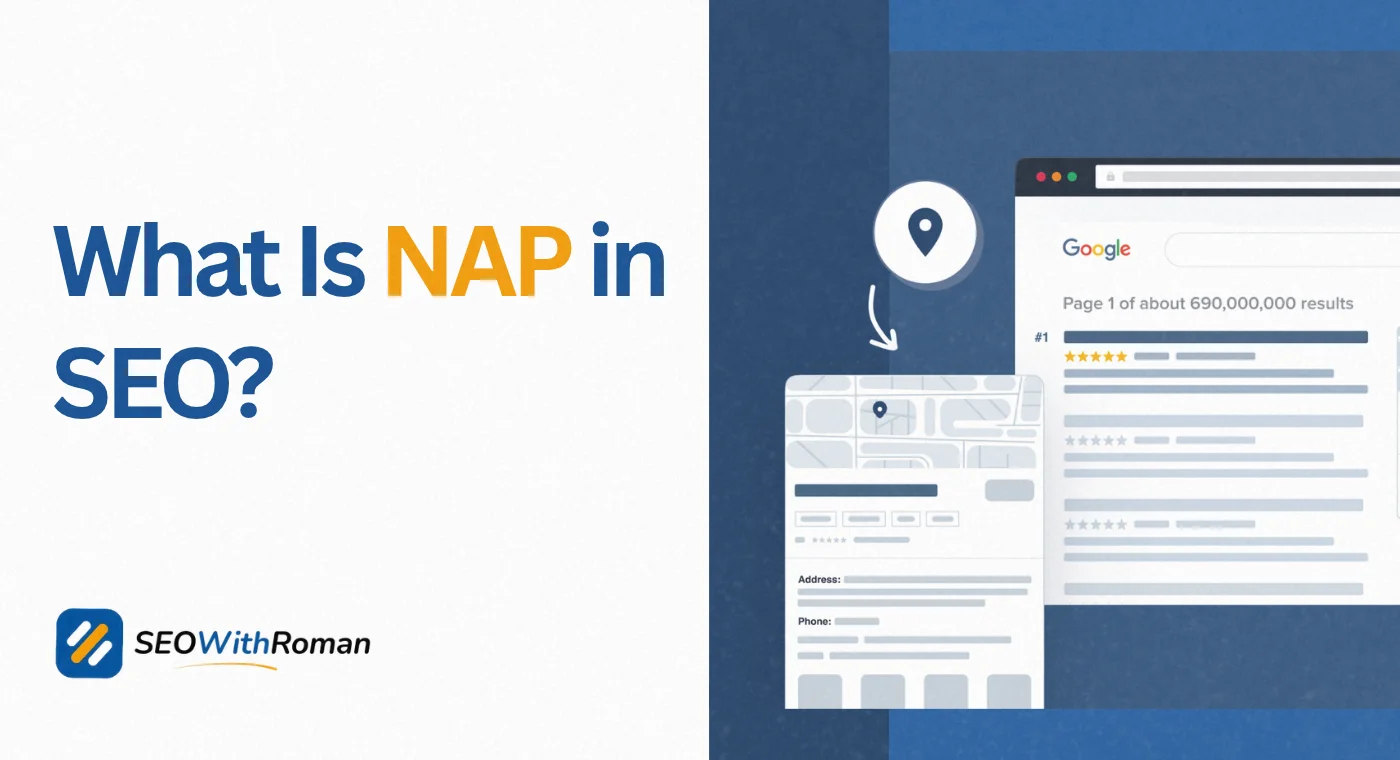
- NAP stands for Name, Address, and Phone Number and it is the foundation of every local SEO strategy
- Inconsistent NAP across online directories confuses Google and directly reduces your local search rankings
- Google uses NAP data to verify your business is legitimate before showing it in the Local Pack and Google Maps
- NAP citations from authoritative directories like Yelp, Yellow Pages, and Google Business Profile build trust signals Google rewards
- A business with consistent NAP across 50 plus directories consistently outranks a business with inconsistent NAP, even with fewer reviews
1 What Does NAP Stand For and Why Does It Matter More Than Most Businesses Realise
NAP stands for Name, Address, and Phone Number. Three simple pieces of information that most business owners think are too basic to worry about. That assumption is one of the most expensive mistakes in local SEO.
Every time your business name, address, or phone number appears somewhere online, that appearance is called a citation. Google collects these citations from hundreds of sources across the web, including business directories, review platforms, social media profiles, news articles, and local chamber of commerce listings. It then cross-references all of them against each other.
When the information matches everywhere Google looks, it gains confidence in your business. That confidence translates directly into higher local search rankings, better visibility in Google Maps, and more appearances in the Local Pack, which is the group of three businesses that appears at the very top of local search results.
When the information does not match, something very different happens. Google’s algorithms see conflicting signals about who your business is, where it is located, and how to contact it. That uncertainty pushes your business down in local search results, sometimes significantly.
In many years of doing SEO for clients across multiple industries, NAP inconsistency is the single most overlooked local SEO problem I encounter on client audits. It is invisible to the business owner but completely visible to Google.
2 What Does NAP Stand For | Breaking Down Each Element
Most guides treat NAP as a simple acronym and move on. Understanding what each element actually means in a local SEO context helps you implement it correctly from day one.
Name refers to your exact legal or trading business name. Not a shortened version. Not a version with extra keywords added. The precise name you use on your storefront, your business registration, and your Google Business Profile. If your business is registered as “Roman Digital Marketing Ltd” then that is the name every citation must use, not “Roman SEO” or “Roman Digital.”
Address means your complete, formatted physical address including street number, street name, suite or unit number if applicable, city, state or county, and postcode. The format matters as much as the content. “St” versus “Street,” “Rd” versus “Road,” and suite listed on the same line versus a separate line can all create inconsistency signals.
Phone Number should be your primary local phone number, formatted consistently. In the US and UK this means deciding whether you use brackets, spaces, or hyphens and then using that exact same format everywhere. A business in London should use the same format on Google Business Profile, Yelp, and every other directory it appears on.
What NAP sometimes also includes:
Beyond the core three, many SEO professionals also track what is sometimes called NAPW, which adds your Website URL, or NAPWH, which adds Hours. While these extra elements are not part of the original NAP acronym, they are increasingly important signals Google uses to verify your business information.
3 Is NAP Important for SEO | The Data Behind the Answer
Yes. NAP consistency is one of the most important local ranking factors for any business that serves customers in a specific geographic area.
According to Moz’s Local Search Ranking Factors study, citation signals including NAP consistency account for a significant portion of the factors that determine local pack rankings. BrightLocal’s research consistently shows that businesses with consistent NAP across top directories outperform businesses with inconsistent citations in local search results.
Here is the practical reason this matters. Google’s local search algorithm works very differently from its organic search algorithm. For a national website ranking for a broad keyword, domain authority and content quality are the dominant factors. For a local business trying to appear in the Google Maps Local Pack for “plumber in Manchester” or “accountant near me,” Google relies heavily on:
- The completeness and accuracy of your Google Business Profile
- The consistency of your NAP across trusted third-party directories
- The number of quality local citations mentioning your business
- The proximity of your business to the searcher’s location
- The volume and quality of your Google reviews
NAP consistency directly affects two of those five factors. It is not an optional nice-to-have for local businesses. It is a core requirement for appearing in local search results at all.
4 What Is NAP Validation and How Google Uses It
NAP validation is the process of verifying that your business information is accurate, complete, and consistent across every place it appears online. Google performs its own version of NAP validation automatically using its crawlers, which scan the web continuously looking for mentions of businesses.
When Google crawls a citation for your business on Yelp and finds the same name, address, and phone number it sees on your Google Business Profile and on your website, it validates your business data. That validation builds trust. The more consistently your NAP appears across trusted sources, the more confident Google becomes that your business is legitimate, active, and worthy of appearing in front of local searchers.
When Google crawls your Yelp listing and finds a different phone number than your Google Business Profile, or a slightly different address format, or a business name with an extra word in it, it cannot validate the match. That uncertainty reduces its confidence in your data and can cause your local rankings to drop.
| NAP Element | Common Inconsistency Example | SEO Impact |
|---|---|---|
| Business Name | “Best Roman’s Plumbing” vs “Best Plumbing” vs “Best Plumbing Services” | Confuses Google entity recognition |
| Street Address | “14 High St” vs “14 High Street” vs “14 High Street, Suite 2” | Creates address mismatch signals |
| Phone Number | “0161 234 5678” vs “01612345678” vs “+44 161 234 5678” | Prevents citation matching |
| Website URL | “https://bestplumbing.com” vs “http://www.bestplumbing.com” | Splits link equity across versions |
| Business Hours | Different hours on GBP vs Yelp vs Facebook | Reduces user trust and engagement |
5 What Are NAP Citations and Why They Are the Building Blocks of Local SEO
A NAP citation is any online mention of your business that includes your Name, Address, and Phone Number. Citations are to local SEO what backlinks are to organic SEO. They are external signals that tell Google your business exists, where it is, and how trustworthy it is.
There are two types of citations you need to understand
Structured citations appear on dedicated business listing platforms and directories where your business has its own profile page. These include Google Business Profile, Yelp, Yellow Pages, Bing Places, Apple Maps, Facebook, TripAdvisor, and hundreds of industry-specific directories. Structured citations are the most powerful type because they come from platforms Google explicitly trusts.
Unstructured citations appear in editorial content like news articles, blog posts, local government websites, and community directories. A local newspaper article that mentions your business name and address is an unstructured citation. These are harder to build deliberately but carry strong trust signals because they are earned rather than submitted.
The most important NAP citation sources for any local business:
| Directory | Why It Matters | Priority Level |
|---|---|---|
| Google Business Profile | Direct ranking factor for Google Maps and Local Pack | Essential, do first |
| Bing Places for Business | Powers Bing local search and Alexa voice results | High priority |
| Apple Maps | Powers Siri and Apple Maps local searches | High priority |
| Yelp | High domain authority, heavily crawled by Google | High priority |
| Yellow Pages | Established directory Google has cited for decades | High priority |
| Facebook Business Page | Social proof plus citation signal | High priority |
| Foursquare | Powers many data aggregators | Medium priority |
| TripAdvisor | Essential for hospitality and food businesses | Industry specific |
| BBB (Better Business Bureau) | Strong trust signal especially for US businesses | Medium priority |
| Local Chamber of Commerce | High trust local citation, often .org domain | Medium priority |
6 How Inconsistent NAP Damages Your Local Search Rankings
The damage from inconsistent NAP is not always immediate and it is rarely dramatic. It is quiet and cumulative, which is why so many businesses do not notice it until their local rankings have already been significantly impacted.
Here is exactly what happens when your NAP is inconsistent across directories
Google cannot confidently match citations to your business. When it crawls a citation with a slightly different name or phone number, its algorithm cannot determine with certainty whether this is the same business or a different one. Rather than risk surfacing inaccurate information, it reduces your local ranking signals.
Your crawl budget is wasted on duplicate entity resolution. Google’s local algorithm spends processing resources trying to reconcile conflicting business data. This is time and resources not being spent on ranking your business more prominently.
Competitors with cleaner NAP profiles rank above you. Two businesses in the same city targeting the same keywords, with similar review counts and similar Google Business Profile completeness, will see the business with consistent NAP outrank the one with inconsistent NAP. I have seen this directly in client audits where fixing NAP consistency alone moved a business from position 7 to position 3 in the Local Pack within six weeks.
Voice search and AI-powered local results fail to find you. Siri, Google Assistant, Alexa, and ChatGPT’s local search features all rely on structured business data that aggregators pull from directories. Inconsistent NAP means these platforms cannot confidently surface your business in voice and AI search results, which are growing rapidly as a local discovery channel.
7 How to Build and Manage NAP Citations | A Step by Step Process
Building NAP citations is not complicated but it requires patience and consistency. Here is the exact process I follow when building citations for a new local business or cleaning up citations for an existing one:
Step 1: Create your master NAP document.
Before submitting your business to any directory, write down the exact version of your NAP that you will use everywhere. Include your business name exactly as it should appear, your full address in the exact format you will use, your primary phone number in a consistent format, your website URL with or without www decided, and your business hours. Every single citation you build or update must match this master document exactly.
Step 2: Claim and optimise your Google Business Profile first.
Google Business Profile is the most important citation source for any local business. Claim your profile, verify it, and fill out every single field including business description, category, attributes, photos, and hours. Your GBP NAP becomes the reference point that all other citations should match.
Step 3: Submit to the core data aggregators.
In the US and UK, a small number of data aggregators feed business information to hundreds of smaller directories automatically. Submitting to these first multiplies the reach of a single submission. Key aggregators include Neustar Localeze, Data Axle, Foursquare, and Acxiom. BrightLocal and Whitespark both offer services that submit to these aggregators for you.
Step 4: Build citations on the top twenty directories manually.
Manually claim and build your profiles on the high authority directories listed in the table above. Take the time to fill out every field completely, not just NAP. Add photos, descriptions, categories, and any attributes each platform offers. Complete profiles outperform incomplete ones in local search results.
Step 5: Find and fix existing inconsistent citations.
Use BrightLocal, Whitespark, or Moz Local to run a citation audit. These tools scan hundreds of directories and identify every instance where your NAP appears incorrectly. Work through the list systematically, correcting each inconsistency to match your master NAP document.
Step 6: Build industry-specific and local citations.
Beyond the general directories, every industry has specific platforms where local citations carry extra weight. A restaurant needs to be on OpenTable and Zomato. A hotel needs TripAdvisor. A law firm needs Avvo and FindLaw. A contractor needs Houzz and Angi. Find the top directories in your specific industry and build your presence there.

8 Local Business Schema | The Technical Side of NAP That Most Businesses Skip
NAP consistency across directories is essential. But there is a second layer of NAP optimisation that most local business guides do not cover: local business schema markup.
Schema markup is structured data code that you add to your website to tell Google explicitly who your business is, where it is located, and how to contact you. Instead of making Google infer your NAP from reading your contact page, schema markup delivers it in a format Google can read instantly and without ambiguity.
For a local business, the most important schema types are LocalBusiness schema and its sub-types like Restaurant, MedicalClinic, LegalService, or HomeAndConstructionBusiness.
A basic LocalBusiness schema block includes
- Business name exactly as it appears in your GBP
- Full address using addressLocality, addressRegion, postalCode, and streetAddress properties
- Telephone in the exact format used across all citations
- URL of your website
- Opening hours using the openingHoursSpecification property
- Geographic coordinates using the geo property for extra precision
On a WordPress website, Rank Math makes adding local business schema straightforward. Go to Rank Math, then Schema, then add a LocalBusiness schema type and fill in each field from your master NAP document.
The benefit of schema is that it creates a direct, machine-readable signal of your NAP that Google can use to verify your citation data across the web. It also increases your eligibility for rich results in local search, including the knowledge panel that appears when someone searches directly for your business name.
9 Is NAP a Ranking Factor | What Google Actually Says
Google has never published a definitive list of local ranking factors. But its public statements, its guidelines for Google Business Profile, and years of correlation research from SEO platforms all point in the same direction.
Google’s own documentation for Google Business Profile states clearly that businesses with complete and accurate information are easier to match with searches. It explicitly recommends keeping business information accurate and up to date across Google’s products and discourages misrepresenting business details.
Google’s Davide Illescas and other members of the search quality team have confirmed publicly that local search algorithms use business information signals to assess relevance and prominence. NAP consistency is a core part of those signals.
Moz’s Local Search Ranking Factors survey, which collects data from hundreds of local SEO practitioners, consistently identifies citation signals as a significant ranking factor for the local pack, particularly for competitive local markets.
The practical answer is this. NAP is not a direct algorithmic ranking factor in the same way that domain authority or review count might be. But it functions as a trust and verification signal that enables your other local ranking factors to work properly. A business with perfect reviews, a complete GBP, and strong local backlinks but inconsistent NAP will underperform against a competitor with the same signals and clean NAP data.
10 3 Expert Tips for NAP in Local SEO
Tip 1: Fix your Google Business Profile NAP before touching any other directory.
Your GBP is the master reference point Google uses to verify all other citations. If your GBP has the wrong phone number and you build 50 citations matching the wrong number, you have scaled the problem rather than fixing it. Always start with GBP and then build outward.
Tip 2: Use a single local phone number, never a tracking number, as your primary NAP phone.
Call tracking numbers are useful for measuring marketing performance but they create NAP inconsistency if used across directories. Use your permanent local number as your NAP phone and implement call tracking through your website or GBP separately.
Tip 3: Audit your NAP citations every six months, not just when you set them up.
Directories update their data from aggregators, old listings resurface, and data errors propagate automatically. A citation audit you ran eighteen months ago is not the same as your current citation profile. Schedule a BrightLocal or Whitespark audit every six months to catch new inconsistencies before they accumulate.
11 Conclusion
NAP in SEO is not complicated. It is three pieces of information that need to be accurate, complete, and consistent everywhere your business appears online. But the impact of getting it right, or wrong, is anything but small.
A business with consistent NAP across its Google Business Profile, its website, and its key directory listings sends Google a clear, confident signal: this business is real, it is where it says it is, and it can be trusted to appear in front of local searchers.
A business with inconsistent NAP sends the opposite signal, and Google responds accordingly.
Start with your master NAP document. Claim and optimise your Google Business Profile. Add local business schema to your website. Then build your citations outward from those two foundations.
That is the complete NAP strategy. And it is one of the highest return activities in local SEO because you do the work once and it pays dividends in local search visibility for years.
Have a question about your NAP setup or local citations? Drop a comment below and I will help you work through it.
Join 1,000+ business owners and bloggers who get one actionable SEO tip every week — straight to their inbox. Free forever.
Get Free Weekly Tips →