- Enterprise SEO tools are built for large websites managing thousands of pages, multiple domains, and complex team structures
- The best enterprise SEO tools go beyond rank tracking and cover technical audits, content optimisation, backlink analysis, and now AI visibility
- In 2026 the biggest shift in enterprise SEO software is the addition of AEO and LLM tracking to monitor how brands appear in ChatGPT, Gemini, and Perplexity answers
- Pricing for enterprise SEO platforms ranges from $139 per month for Semrush Business to custom six-figure contracts for platforms like BrightEdge and Conductor
- Choosing the right enterprise SEO platform depends on your team size, technical needs, budget, and whether you need traditional SEO, AI visibility tracking, or both
1 What Does Enterprise SEO Mean and Why It Is Different From Regular SEO
Before looking at tools, you need to understand what enterprise SEO actually means. This question comes up constantly and most guides skip past it without giving a real answer.
Enterprise SEO refers to the practice of managing search engine optimisation at scale. Not ten pages. Not one hundred pages. We are talking about websites with thousands to millions of indexed pages, multiple subdomains or country-specific domains, large internal teams with different stakeholders, and SEO decisions that directly affect millions of dollars in revenue.
A small business doing SEO needs to publish consistent content, fix basic technical issues, and build some backlinks. An enterprise brand doing SEO needs to coordinate across marketing, development, legal, and executive teams simultaneously, manage crawl budget across a site with 500,000 pages, run A/B tests on title tags at scale, and report performance to a C-suite that measures SEO in terms of revenue attribution, not keyword rankings.
The tools required for these two jobs are completely different in their capabilities, their data depth, and their pricing.
Enterprise SEO software is built specifically for the second scenario. It is designed to handle enormous scale, support large teams with role-based permissions, integrate with business intelligence systems, and surface the kind of strategic insights that individual site audit tools simply cannot produce.
2 What Is Enterprise SEO Software and What Should It Actually Do
Enterprise SEO software is a platform built to manage, monitor, and optimise organic search performance at scale across large websites and multiple digital properties.
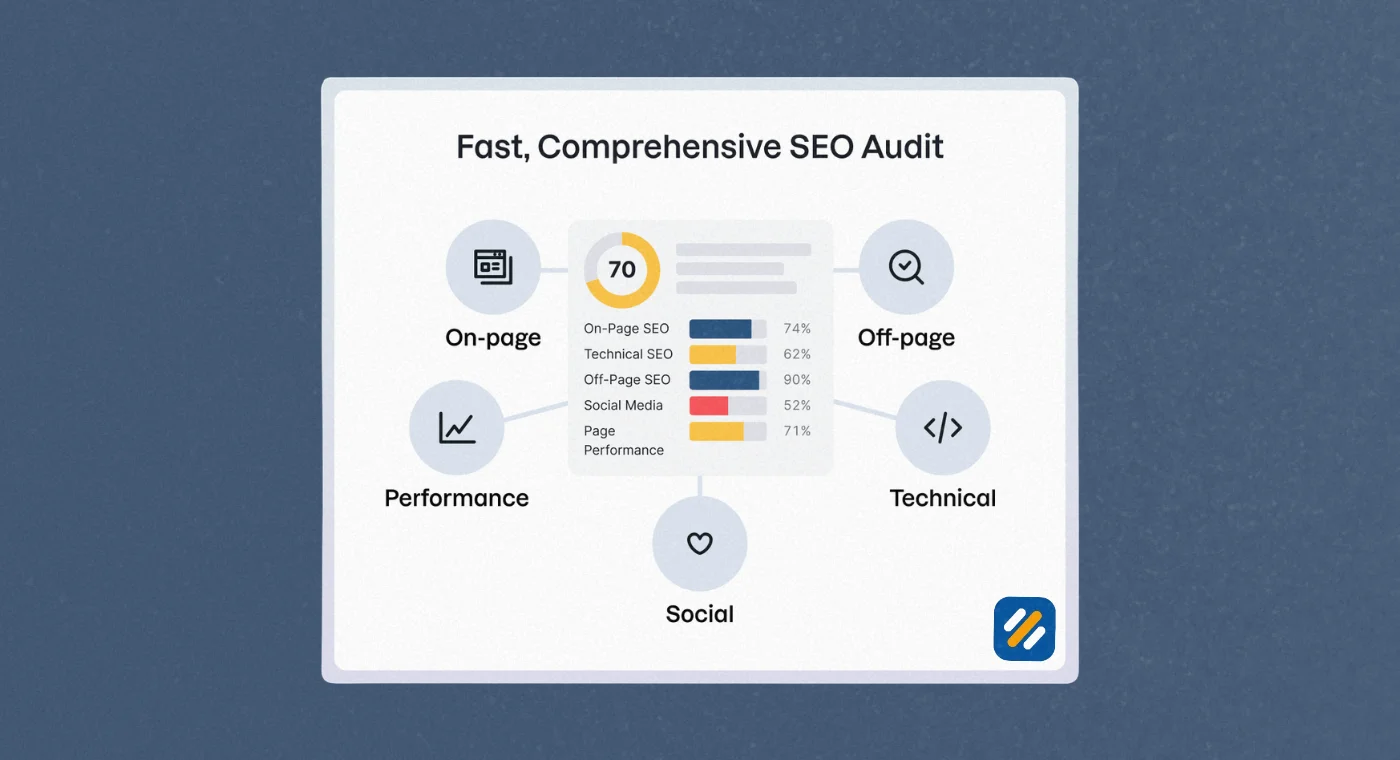
At the minimum, a legitimate enterprise SEO platform covers these core functions
Rank tracking at scale: Monitoring thousands of keywords across multiple regions, devices, and languages simultaneously. Not just national rankings but city-level and zip code-level data for brands with local presence across multiple markets.
Technical site auditing: Crawling millions of pages to identify indexation issues, broken links, duplicate content, page speed problems, Core Web Vitals failures, and structural errors that block Google from accessing and ranking important content.
Backlink analysis and management: Monitoring the full backlink profile of a large domain, identifying toxic links, tracking competitor link acquisition, and managing link equity distribution across a complex site architecture.
Content performance analysis: Identifying which pages are driving organic revenue, which are declining, which have untapped ranking potential, and where content gaps exist relative to competitors.
Competitor intelligence: Tracking market share across search results for entire topic clusters rather than individual keywords.
Team collaboration and reporting: Supporting multiple users with different permission levels, creating automated executive dashboards, and integrating with tools like Salesforce, Slack, Jira, and Google Data Studio.
In 2026, the best enterprise SEO tools have added a critical new capability: AI visibility tracking. This means monitoring how your brand appears in answers generated by ChatGPT, Google’s AI Overviews, Perplexity, and Gemini. For enterprise brands, showing up in AI-generated answers is now as important as ranking on page one.
3 The 7 Best Enterprise SEO Tools in 2026 Compared
After working across multiple enterprise client campaigns and studying the current landscape closely, here are the platforms that consistently deliver results for large organisations in 2026.
| Tool | Best For | Starting Price | AI Visibility Tracking | Free Trial |
|---|---|---|---|---|
| Semrush Business | All-in-one SEO for existing users | $239/month with AI add-on | Yes, paid add-on | Yes, 7 days |
| Ahrefs Enterprise | Backlink intelligence and content research | Custom pricing | Limited | No |
| BrightEdge | C-suite reporting and market share analysis | Custom pricing | No native AEO | No |
| Conductor | Cross-functional team collaboration | Custom pricing | No native AEO | No |
| seoClarity | Technical SEO automation at scale | Custom pricing | No native AEO | No |
| Botify | Crawl budget and indexation for large sites | Custom pricing | AI bot crawl tracking | No |
| Cairrot | Budget-friendly AEO and LLM tracking | From $39.99/month | Yes, native | Yes |
4 Semrush Business | Best All-in-One Enterprise SEO Platform
Semrush is the platform most enterprise SEO teams encounter first because of its breadth. It covers keyword research, site auditing, backlink analysis, rank tracking, content optimisation, and competitor intelligence all inside one dashboard.
For enterprise use, the Business plan and above give you access to expanded keyword tracking limits, API access, historical data, and the ability to manage multiple projects across different domains from a single account.
In 2026 Semrush added its AI Visibility Toolkit as a paid add-on, which allows enterprise teams to track how their brand appears in ChatGPT, Perplexity, and Google AI Overviews. This add-on costs an additional $99 per month on top of the base subscription and is priced per domain, which can become expensive for agencies managing multiple client brands.
Key features
- Keyword Magic Tool with over 25 billion keywords in the database
- Site Audit tool covering over 140 technical SEO issues
- Backlink Analytics with daily updated link data
- Position Tracking across unlimited keywords and locations
- Content Marketing Platform for topic research and optimisation
- AI Visibility Score for brand presence in LLM answers
Pricing: Base Business plan starts at approximately $140 per month. With the AI Visibility Toolkit add-on the total is approximately $239 per month. Enterprise-level custom contracts are available for larger organisations.
Who it is best for: Teams already using Semrush who want to consolidate their SEO and AI visibility tracking under one platform without switching tools.
5 Ahrefs Enterprise | Best for Backlink Intelligence and Content Gap Analysis
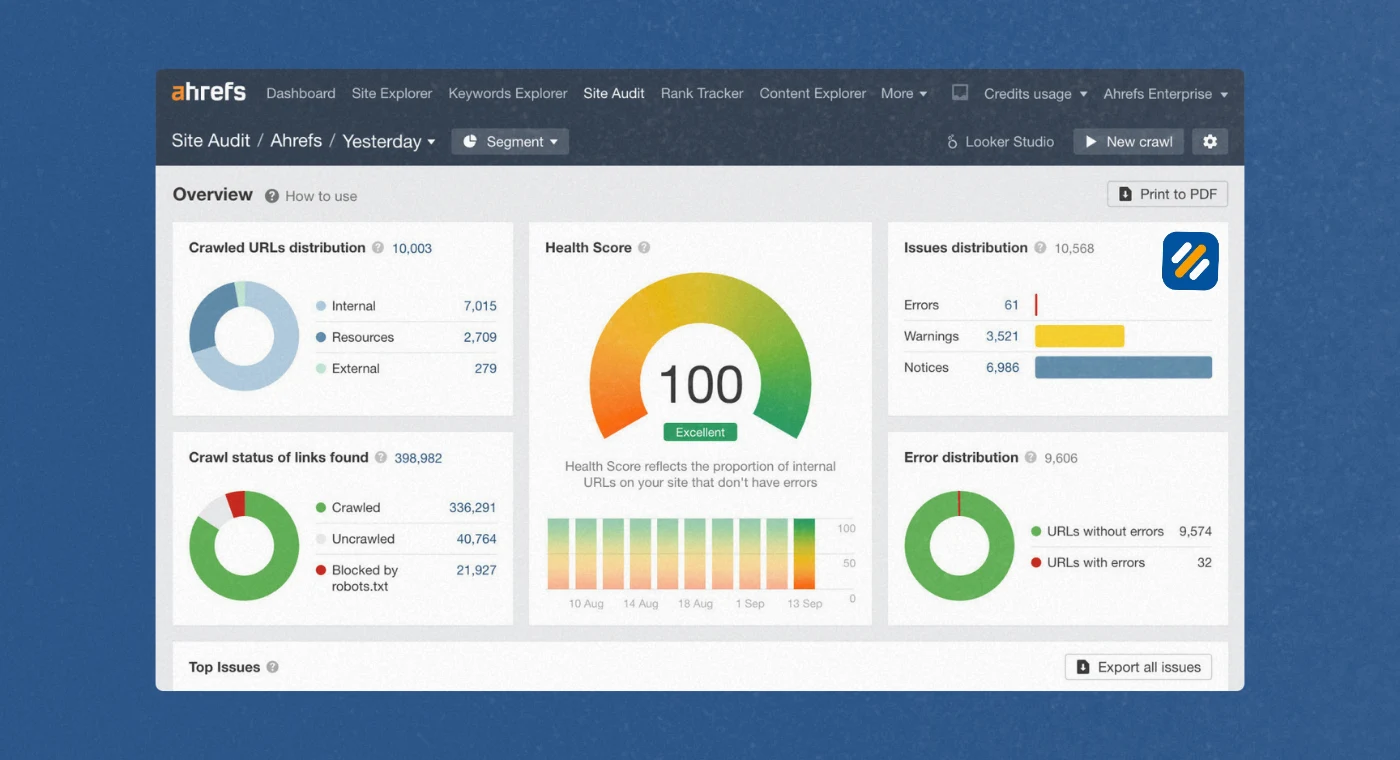
Ahrefs built its reputation on having the most comprehensive backlink database in the industry and that reputation holds in 2026. For enterprise brands where link acquisition is a competitive priority and where content gap analysis needs to happen at scale, Ahrefs delivers data depth that few competitors match.
The Enterprise plan adds features designed specifically for large teams including SSO support, audit logs, custom reporting, API access, and the ability to manage multiple workspaces with different user permissions.
What distinguishes Ahrefs at the enterprise level is the combination of its backlink database size, the freshness of its crawl data, and the quality of its Content Explorer which allows teams to find high-performing content ideas backed by real traffic and backlink data.
Key features
- Site Explorer with comprehensive backlink and organic traffic data
- Keywords Explorer covering over 170 countries
- Content Explorer with over 15 billion pages indexed
- Site Audit with JavaScript rendering support
- Rank Tracker with competitor comparison
- API access for custom integrations and reporting
Pricing: Custom pricing for enterprise plans. Standard plans start at $129 per month for smaller teams. Enterprise contracts are negotiated based on scale and usage requirements.
Who it is best for: Enterprise teams where backlink strategy, content research, and competitive intelligence are the highest priorities.
6 BrightEdge | Best for C-Suite Reporting and Revenue Attribution
BrightEdge has been one of the most recognised names in enterprise SEO software for over a decade and its positioning in 2026 remains focused on connecting SEO performance to business outcomes in a way that executives and board members can understand.
The platform’s StoryBuilder feature creates dynamic dashboards that translate keyword rankings and organic traffic data into revenue projections and market share metrics. For global brands that need to present SEO performance to a CFO or CMO, this is a genuinely powerful capability that most SEO-focused tools do not offer.
BrightEdge’s DataCube provides access to a vast keyword intelligence database that allows enterprise teams to analyse market share across entire topic areas rather than tracking individual keywords in isolation.
Key features
- DataCube for keyword and market share intelligence at scale
- StoryBuilder for executive-level revenue dashboards
- BrightEdge Copilot for AI-powered task recommendations
- Deep integrations with Adobe Analytics, Salesforce Marketing Cloud, and major CMS platforms
- International SEO support across multiple languages and regions
Pricing: Custom pricing upon request. BrightEdge operates on annual enterprise contracts. No AEO tracking is included natively in 2026.
Who it is best for: Global enterprise brands that need to demonstrate SEO’s revenue contribution to C-suite leadership and that operate across multiple markets and languages.
7 Botify | Best for Technical SEO on Massive Websites
Botify occupies a very specific and very important position in the enterprise SEO software market. It is the platform built specifically for the technical challenge of managing crawl budget, indexation, and rendering on websites with millions of pages.
For large ecommerce sites and publishers where a significant percentage of the site is either not being crawled or not being indexed correctly, Botify’s Log File Analyzer provides insights that no other platform comes close to matching. It shows exactly how Google and other search engine bots are spending their crawl budget across the site, which pages they are visiting, how often, and which they are skipping entirely.
In 2026 Botify is also uniquely positioned for the AI era because its Log File Analyzer can track the behaviour of AI crawlers like GPTBot and Google-Extended natively without any additional cost. This tells enterprise teams how AI systems are discovering and interacting with their content at a technical level.
Key features
- Log File Analyzer for real-time crawl behaviour analysis including AI bots
- Real-time JavaScript rendering to identify indexation issues on JS-heavy sites
- Botify Activation for automated implementation of SEO recommendations
- Crawl-to-conversion funnel connecting technical fixes to revenue outcomes
- Integrations with Cloudflare, Akamai, Fastly, and major cloud storage platforms
Pricing: Custom pricing based on site size and crawl volume. Botify is positioned as a premium technical SEO investment for large ecommerce and publishing operations.
Who it is best for: Large ecommerce sites, news publishers, and any website with millions of pages where crawl budget efficiency directly impacts rankings and revenue.
8 seoClarity | Best for Technical Automation and API-First Teams
seoClarity is the enterprise SEO platform of choice for technically sophisticated teams that want automation, granular control, and the ability to build custom workflows on top of a robust data infrastructure.
Its Clarity Grid proprietary technology provides real-time sitewide health monitoring across large web ecosystems. The AI Content Fusion feature uses Natural Language Processing to analyse content at scale and identify semantic gaps relative to what Google is rewarding for specific query clusters.
The platform’s GraphQL API is one of the most powerful in the enterprise SEO space, allowing data engineering teams to pipe seoClarity data directly into existing business intelligence infrastructure like Snowflake, BigQuery, Tableau, or Redshift.
Key features
- Clarity Grid for real-time technical monitoring across millions of pages
- AI Content Fusion for NLP-powered content analysis and creation at scale
- Advanced rank tracking with granular competitive comparison
- GraphQL API with connections to BigQuery, Snowflake, Tableau, Looker, Redshift, and S3
- Integrations with Jira and Asana for development team coordination
Pricing: Custom pricing. Designed for large organisations with complex technical requirements.
Who it is best for: Technically focused enterprise SEO teams that manage complex websites with frequent code deployments and need deep API-driven data access.
9 Cairrot | Best Budget-Friendly Enterprise AEO and LLM Tracking Tool
Cairrot is the newest category of enterprise SEO software and represents the direction the market is moving in 2026. It is built specifically to track brand visibility inside AI-generated answers across multiple large language models simultaneously.
Where traditional enterprise SEO platforms have added AEO tracking as expensive bolt-on features, Cairrot was built from the ground up to answer one question: how often is your brand being recommended, cited, or mentioned when users ask AI tools questions relevant to your industry?
For enterprise brands where the marketing question has shifted from “do we rank on Google” to “does ChatGPT recommend us,” Cairrot provides multi-LLM monitoring at a price point that makes it accessible to teams that cannot justify spending thousands per month on platforms built for a different era.
Key features
- Multi-LLM monitoring across ChatGPT, Gemini, Perplexity, Claude, and DeepSeek
- Competitor heatmap reporting for share-of-voice in AI answers
- AI bot crawl tracking showing how often GPTBot and Google-Extended visit your site
- Free advanced API included on all plans including the entry tier
- Integration with Google Search Console and Google Analytics 4
Pricing: Starter plan at $39.99 per month. Pro plan at $99 per month adding Claude, Gemini, and DeepSeek tracking. Enterprise plan at $299 per month. Grok tracking available as a $25 per month add-on.
Who it is best for: Marketing agencies and enterprise growth teams that need comprehensive AEO and LLM visibility tracking at a budget-friendly price.
10 How Enterprise SEO Tools Work | The Core Technology Behind the Platforms
Understanding how these platforms actually work helps you evaluate which one is right for your specific situation rather than choosing based on brand recognition alone.
Every enterprise SEO platform is built on three core technical components:
The crawler. The platform sends its own bots to regularly visit and read every page on your website. The crawler reads HTML, processes JavaScript, follows internal links, and records technical data about each page including load speed, response codes, and on-page elements. Larger platforms crawl billions of pages across millions of websites and aggregate that data into their databases.
The keyword database. Platforms like Semrush and Ahrefs maintain enormous proprietary databases of keyword data pulled from search engine APIs, clickstream data, and their own user panels. These databases allow you to look up any keyword and see estimated search volume, difficulty scores, and which pages are currently ranking for it.
The rank tracking infrastructure. Enterprise platforms run automated daily searches across thousands of locations, devices, and languages to record where your pages rank for your tracked keywords. This data is stored historically so you can see ranking trends over time rather than just current positions.
The most advanced enterprise SEO tools in 2026 have added a fourth component: the LLM query engine. This sends automated prompts to AI models like ChatGPT and Gemini, records which brands appear in the answers, and tracks how often and how favourably your brand is cited over time.
11 Enterprise SEO Tools Pricing Breakdown | What to Expect at Each Budget Level
One of the most confusing aspects of buying enterprise SEO software is that most platforms do not publish their pricing publicly. Here is an honest breakdown of what different budget levels actually get you:
| Budget Level | Monthly Cost Range | What You Get | Example Platforms |
|---|---|---|---|
| Entry enterprise | $100 to $300 | Core rank tracking, site audit, backlink data, limited API | Semrush Pro, Cairrot Pro |
| Mid enterprise | $300 to $1,000 | Expanded keyword limits, team access, API, white-label reporting | Semrush Business, Nightwatch, AthenaHQ |
| Full enterprise | $1,000 to $5,000 | Unlimited projects, custom integrations, dedicated support, advanced AI tracking | Evertune, Bluefish AI, custom plans |
| Premium enterprise | $5,000 and above | Full platform access, custom data pipelines, C-suite dashboards, SLA guarantees | BrightEdge, Conductor, seoClarity, Botify |
The gap between mid-enterprise and premium enterprise pricing reflects the difference between using software to support an SEO team and buying an SEO intelligence infrastructure that connects to your entire marketing technology stack.
For most businesses, the $300 to $1,000 per month range provides everything needed to run professional enterprise-level SEO campaigns. The premium platforms are designed for organisations where SEO is a multi-million dollar revenue channel that justifies the investment.
12 3 Expert Tips for Getting the Most From Enterprise SEO Software
These are the tips that separate teams who spend money on enterprise SEO tools and see results from teams that spend the same money and wonder why nothing changed.
Tip 1: Start With Your Data Before Buying Any Tool
Before signing any enterprise SEO software contract, pull 90 days of data from Google Search Console and Google Analytics 4. Identify your highest traffic pages, your fastest declining pages, and your highest converting keywords. This gives you a baseline that no tool can give you, and it tells you exactly which platform features you actually need versus which ones look impressive in a sales demo.
Tip 2: Integrate Your SEO Platform With Your BI Tool on Day One
The biggest waste I see enterprise teams make with SEO software is treating it as a standalone dashboard that only the SEO team looks at. Connect your enterprise SEO platform to your business intelligence tool, whether that is Looker Studio, Tableau, or BigQuery, on the first week of your subscription. This makes SEO data visible to stakeholders across the business and dramatically increases the likelihood that technical recommendations actually get implemented by development teams.
Tip 3: Track AI Visibility Separately From Traditional Rankings
In 2026, your Google ranking and your AI visibility are two different metrics that do not always move together. A page can rank number one on Google and never appear in ChatGPT’s answers on the same topic. Set up separate tracking for both, use your traditional enterprise SEO tool for Google rankings and add a dedicated AEO tool like Cairrot for AI visibility, and report them as two distinct performance indicators to your leadership team.
13 Conclusion
The best enterprise SEO tools in 2026 are not simply bigger versions of the tools small businesses use. They are purpose-built platforms that handle scale, team complexity, data integration, and now AI visibility in ways that basic SEO software simply cannot replicate.
For most enterprise teams, the starting point is choosing between an all-in-one platform like Semrush Business that covers traditional SEO comprehensively, a specialist technical platform like Botify for crawl and indexation challenges, or a dedicated AEO tool like Cairrot for AI visibility tracking. The most sophisticated enterprise SEO operations use a combination of all three.
The right enterprise SEO platform is the one that fits your team’s actual workflow, integrates with your existing marketing technology stack, and provides data at the level of depth your decision-making requires.
Start with a clear definition of what you need to measure and who needs to see that data. Then choose the platform that answers those specific questions most effectively. That approach will always produce better results than choosing based on which platform has the longest feature list.
Have a question about which enterprise SEO tool is right for your organisation? Leave a comment below and I will give you a direct recommendation based on your specific situation.
Join 1,000+ business owners and bloggers who get one actionable SEO tip every week — straight to their inbox. Free forever.
Get Free Weekly Tips →