- Ahrefs has the largest backlink index in the industry with over 35 trillion links crawled, making it the stronger tool for link analysis
- Moz invented Domain Authority, the metric most marketers still use today, but Ahrefs DR is now considered more accurate by most SEO professionals
- Ahrefs wins on keyword research depth, backlink data, and site audit power while Moz wins on beginner friendliness and community support
- Pricing starts at $29 per month for Ahrefs and $49 per month for Moz, but the value difference between plans is significant
- For small businesses and beginners, Moz is easier to start with. For serious SEO professionals and agencies, Ahrefs delivers more actionable data
1 Why the Ahrefs vs Moz Debate Still Matters
If you have spent more than five minutes researching SEO tools, you have already encountered this debate. Ahrefs or Moz. Which one do you actually need, and is the price difference worth it?
I have used both tools extensively across client projects covering B2B, ecommerce, SaaS, and local business SEO. My teams have run keyword research, backlink audits, competitor analysis, and technical site audits on both platforms across dozens of websites. This comparison is not based on reading product pages. It is based on real usage across real campaigns.
The short answer is that Ahrefs and Moz are built for different types of users with different priorities. The right choice depends less on which tool is objectively better and more on where you are in your SEO journey and what you need the tool to do for you.
Here is everything you need to make that decision confidently
2 Ahrefs vs Moz at a Glance | Quick Comparison
Before going deep into each feature, here is the high-level picture:
| Feature | Ahrefs | Moz Pro |
|---|---|---|
| Starting Price | $29 per month | $49 per month |
| Free Option | Free Webmaster Tools forever | 7 day free trial |
| Keyword Database | 28 billion plus keywords | 1.25 billion plus keywords |
| Backlink Index | 35 trillion plus links, updated every 15 to 30 minutes | Smaller index, updated less frequently |
| Domain Metric | Domain Rating (DR) | Domain Authority (DA) |
| Site Audit | Advanced, enterprise level | Good for beginners, less depth |
| Rank Tracker | 170 plus countries supported | Core markets supported |
| Ease of Use | Moderate learning curve | Beginner friendly |
| Best For | SEO professionals, agencies, advanced users | Beginners, small in-house teams |
| AI Features | Brand Radar for LLM visibility tracking | AI Overview alerts in rank tracker |
| Customer Support | Help centre, community | Help centre, community, live chat on higher plans |
3 History and Background | Understanding What Each Tool Was Built For
Understanding where Ahrefs and Moz came from explains why they behave so differently today.
Moz was founded in 2004 by Rand Fishkin and Gillian Muessig in Seattle. It started as an SEO consulting blog and community before building software tools. Moz invented Domain Authority, the 0 to 100 score that became the industry standard metric for measuring website strength. For years, DA was the number every SEO professional quoted when assessing a website's competitive position.
Moz also built one of the most valuable free learning communities in SEO history through Moz Blog and the Whiteboard Friday video series. Its educational approach made it the entry point for an entire generation of SEO professionals, including many who later switched to other tools as their skills grew.
Ahrefs was founded in 2011 by Dmitry Gerasimenko in Singapore. Unlike Moz, Ahrefs was built from the ground up as a data tool rather than a community platform. Its initial focus was entirely on backlink analysis, and it built the largest third-party backlink crawler in the world. That crawler now processes over 8 billion pages per day and updates its index every 15 to 30 minutes, faster than any competitor.
Over time Ahrefs expanded into keyword research, content analysis, rank tracking, and site auditing, becoming a full SEO platform. But its DNA remains in data depth and speed of index updates.
4 Keyword Research | Ahrefs vs Moz Compared Feature by Feature
Keyword research is where the difference between these two tools becomes most visible for everyday SEO work.
Ahrefs Keywords Explorer has a database of over 28 billion keywords across 170 plus countries. For each keyword it shows monthly search volume, keyword difficulty score, click potential, traffic potential for the top ranking page, and the estimated cost per click value for advertisers. It also shows a SERP overview with the top ranking pages and their individual metrics, which is essential for understanding whether a keyword is actually winnable.
One feature Ahrefs offers that Moz does not match is Traffic Potential. This metric shows not just how many people search the exact keyword but how much total organic traffic the top ranking page receives including all the related keywords it ranks for. This is a more accurate representation of the real opportunity behind any keyword.
Moz Keyword Explorer has a database of over 1.25 billion keywords. It provides monthly volume, keyword difficulty, organic click through rate estimates, and priority scores that combine multiple metrics into a single recommendation signal. Moz also shows which pages currently rank and provides a list of related keyword suggestions.
Moz's keyword difficulty score is generally considered more conservative than Ahrefs, which some beginners find easier to work with. However the smaller database means less coverage for niche or long-tail keywords, which is exactly where most new websites need to start building their traffic.
| Keyword Feature | Ahrefs | Moz |
|---|---|---|
| Keyword database size | 28 billion plus | 1.25 billion plus |
| Countries covered | 170 plus | Core markets |
| Keyword difficulty score | Yes, 0 to 100 | Yes, 0 to 100 |
| Traffic potential metric | Yes, unique to Ahrefs | No |
| Click through rate estimate | Yes | Yes |
| SERP overview | Detailed with page metrics | Basic |
| Related keyword suggestions | Extensive | Moderate |
| Free daily searches | Limited via free tools | 3 searches per day |
Winner: Ahrefs for depth, database size, and the Traffic Potential metric which gives a more complete picture of keyword opportunity.
5 Backlink Analysis | Where Ahrefs Built Its Reputation
This is the area where Ahrefs has the clearest and most significant advantage over Moz, and it is not a close comparison.
Ahrefs has the largest backlink index outside of Google itself. With over 35 trillion known links and an index that updates every 15 to 30 minutes, Ahrefs shows you backlinks that Moz has not yet discovered. In competitive niches where a competitor built ten new backlinks this week, Ahrefs will show you those links within hours. Moz may not show them for days or weeks.
Ahrefs Site Explorer provides a complete backlink profile for any domain or URL. You can see every referring domain, every individual backlink URL, the anchor text used, the DR of the linking page, whether the link is followed or nofollow, and when the link was first and last seen. The broken backlinks report shows you every external site linking to a 404 page on your domain, which is where most websites are silently losing link equity.
Moz Link Explorer covers the same basic territory but with a smaller index and slower update frequency. It shows domain authority, page authority, spam score, and top linking domains. For most beginners these metrics are sufficient. But for any serious competitive analysis or link building campaign, the gap in index size and freshness means you are working with incomplete information.
The Moz Spam Score is one feature Moz seo tool offers that Ahrefs does not replicate directly. It identifies potentially toxic backlinks that could be harming your rankings. This can be useful for websites recovering from a manual penalty or dealing with a negative SEO attack.
Winner: Ahrefs and it is not close. The index size, update frequency, and depth of backlink data make Ahrefs the clear choice for any serious backlink analysis work.
6 Moz DA vs Ahrefs DR | Which Domain Metric Is More Accurate
This is one of the most searched questions in the entire Ahrefs vs Moz debate and it deserves a direct, honest answer.
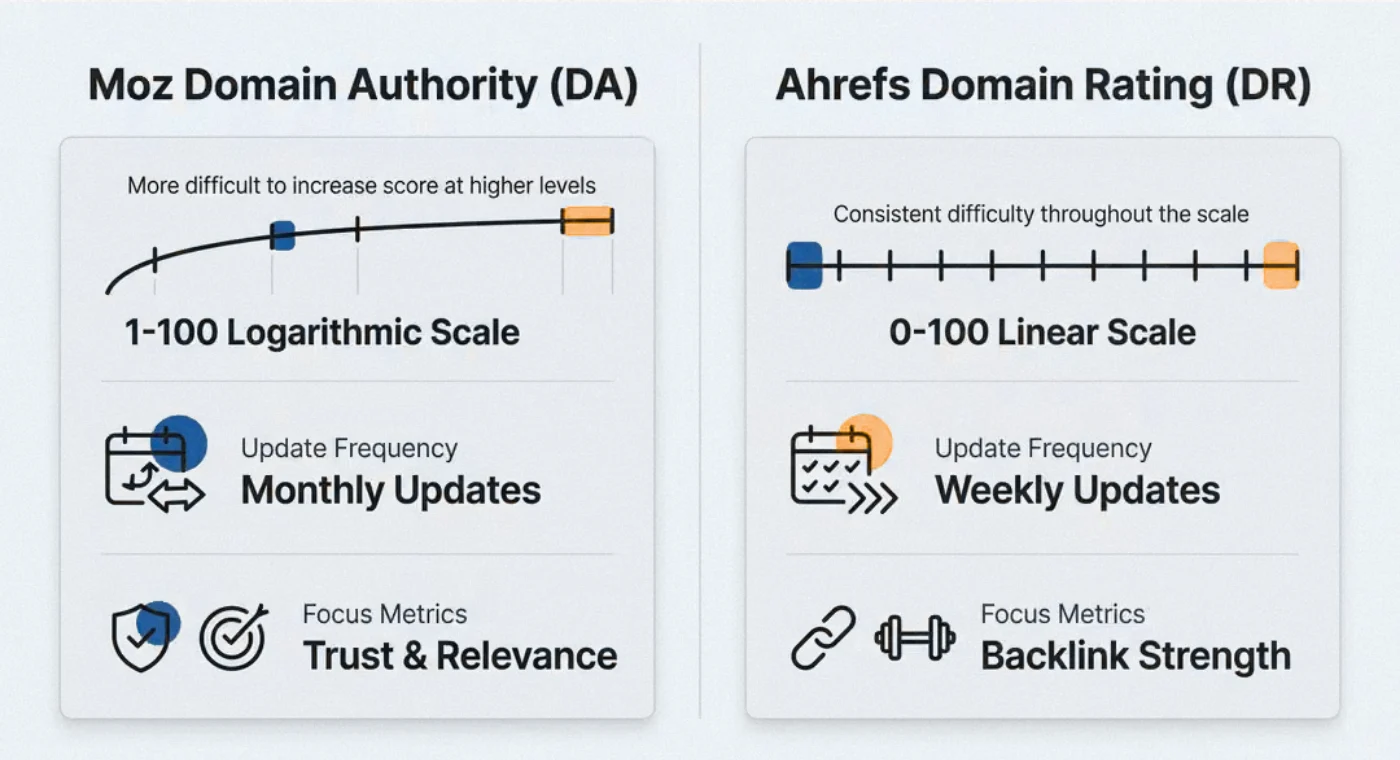
Moz Domain Authority (DA) is a score from 0 to 100 that Moz developed to predict how well a domain would rank in search results. It is calculated based on the quality and quantity of links pointing to a domain. DA was so widely adopted that it became the default metric the entire SEO industry used for years to assess website strength, price guest post placements, and evaluate potential link partners.
Ahrefs Domain Rating (DR) is also a 0 to 100 score measuring the strength of a website's backlink profile. Unlike DA which attempts to predict ranking ability, DR is purely a measure of link profile strength based on the number and quality of websites linking to the domain.
In practice, most experienced SEO professionals now consider DR more reliable than DA for two reasons. First, Ahrefs crawls a significantly larger backlink index, meaning DR is calculated from more complete data. Second, DA has been gamed more heavily by low-quality link sellers who inflate their scores by acquiring large volumes of cheap links.
| Metric | Moz DA | Ahrefs DR |
|---|---|---|
| Full name | Domain Authority | Domain Rating |
| Scale | 0 to 100 | 0 to 100 |
| What it measures | Predicted ranking ability | Backlink profile strength |
| Data source | Moz link index | Ahrefs link index (larger) |
| Update frequency | Periodic | More frequent |
| Industry adoption | Widely used, especially by clients | Preferred by SEO professionals |
| Susceptibility to manipulation | Higher, DA sellers exist | Lower, harder to inflate artificially |
| Best used for | Client reporting, quick assessments | Competitive analysis, link prospecting |
The honest verdict is that neither metric perfectly predicts Google rankings because neither Moz nor Ahrefs has access to Google's actual ranking algorithm. Both are useful reference points, not definitive scores. Use DR for competitive research and link prospecting. Use DA for client reporting where the client is already familiar with the metric.
7 Site Audit | Technical SEO Capabilities Compared
A site audit tool crawls your website and identifies technical SEO problems that could be preventing your pages from ranking. Both Ahrefs and Moz offer site audit functionality but at very different levels of depth.
Ahrefs Site Audit crawls up to 5,000 pages per month on the Starter plan and scales up significantly on higher tiers. It identifies over 100 types of technical SEO issues and organises them by severity: errors, warnings, and notices. The dashboard provides a health score, trend over time, and a breakdown of issues by category including crawlability, indexability, on-page SEO, links, performance, and hreflang for international sites.
One feature that makes Ahrefs Site Audit genuinely useful in practice is the ability to schedule automatic recrawls on a weekly or monthly basis. You set it up once and Ahrefs sends you an email whenever new issues are detected. This is the kind of passive monitoring that saves hours of manual checking every month.
Moz Site Crawl covers the essential technical SEO checks including missing title tags, duplicate content, broken links, redirect issues, and missing meta descriptions. The interface is clean and approachable for beginners. Issues are categorised and explained with clear language that does not assume technical knowledge.
Where Moz falls short compared to Ahrefs is in the depth of issues it checks, the crawl speed on larger sites, and the granularity of its reporting. For websites under 100 pages, Moz's audit tool is sufficient. For larger sites or agencies managing multiple client websites, Ahrefs seo tool provides considerably more coverage and flexibility.
Winner: Ahrefs for depth, scheduling, and scalability. Moz for ease of use and beginner-friendly reporting.
8 Rank Tracking | Monitoring Your Google Positions
Both tools include rank tracking but differ significantly in what they show you alongside your position data.
Ahrefs Rank Tracker monitors keyword rankings across 170 plus countries and devices. For each keyword it shows current position, position history, estimated traffic, SERP feature presence (featured snippets, People Also Ask boxes, local packs), and competitor positions for the same keywords. The visibility metric gives you a single score representing how visible your website is across all your tracked keywords combined, making it easy to spot overall trends at a glance.
Moz Rank Tracker covers core markets and shows position data, position changes, and SERP feature tracking. Moz also shows whether AI Overviews are appearing for your tracked keywords, which is a genuinely useful feature as AI-generated search results become more common in 2026.
For most small businesses tracking 50 to 100 keywords in one country, both tools provide sufficient rank tracking. The Ahrefs advantage becomes clear when tracking large keyword sets across multiple countries, which is common for agencies managing international clients or ecommerce sites targeting multiple regions.
Winner: Ahrefs for volume, international coverage, and competitor position tracking. Moz for AI Overview monitoring on tracked keywords.
9 Pricing | What You Actually Get for Your Money
Pricing is where the Moz vs Ahrefs comparison becomes more nuanced than most comparison articles acknowledge.
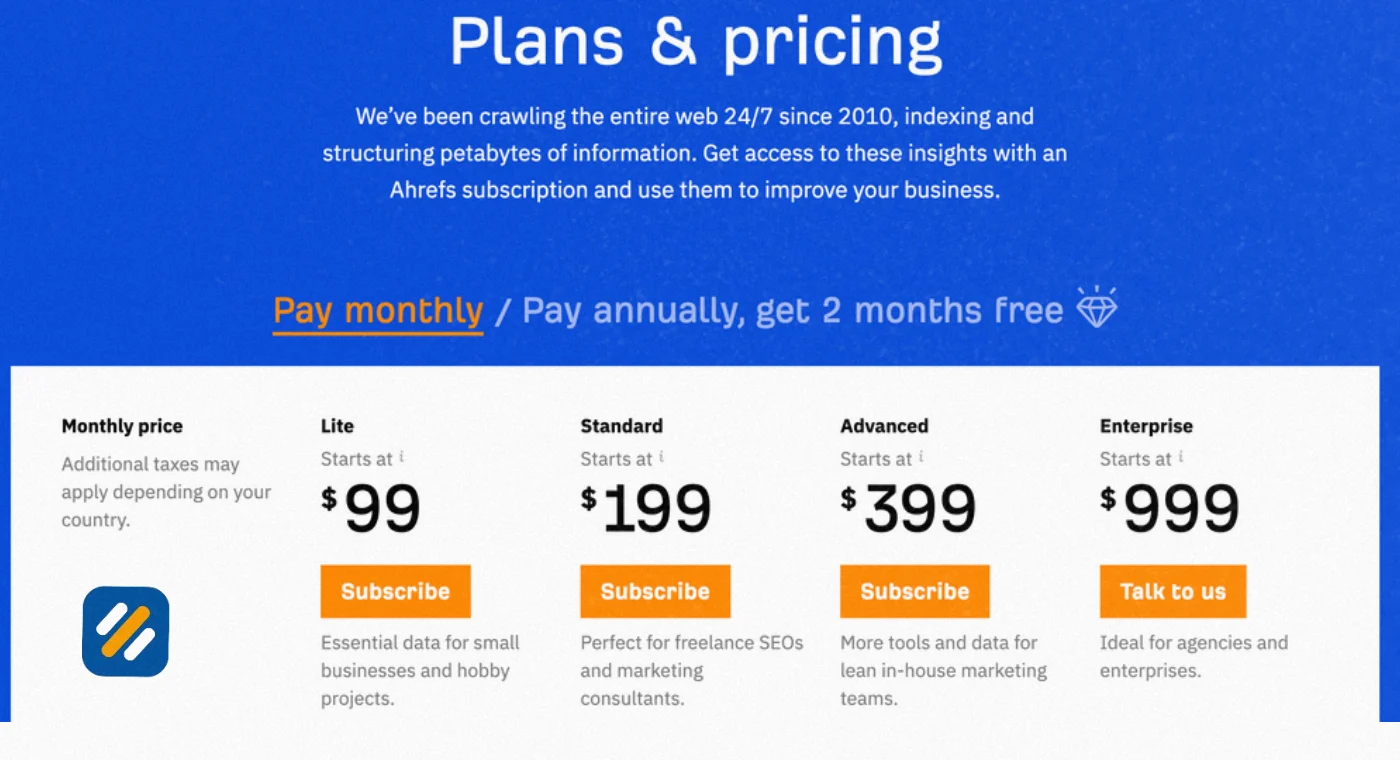
Ahrefs Pricing:
- Starter: $29 per month, 100 credits, core tools access, no annual commitment
- Lite: $129 per month ($108 annually), one user, standard limits
- Standard: $249 per month ($208 annually), one user, higher limits
- Advanced: $449 per month ($374 annually), multiple users
- Enterprise: $1,499 per month, annual commitment, full access
Moz Pro Pricing:
- Starter: $49 per month ($39 annually), basic features
- Standard: $99 per month ($79 annually), standard limits
- Medium: $179 per month ($143 annually), higher limits
- Large: $299 per month ($239 annually), maximum limits
| Plan Comparison | Ahrefs | Moz Pro |
|---|---|---|
| Entry level price | $29 per month | $49 per month |
| Mid-tier price | $249 per month | $179 per month |
| Free option | Webmaster Tools forever free | 7 day trial only |
| Annual discount | Up to 20% | Up to 20% |
| Multi-user access | From Advanced plan | From Medium plan |
| Best value entry point | Starter at $29 | Starter at $39 annually |
The Ahrefs Starter plan at $29 per month is genuinely useful for solo website owners and small businesses doing basic keyword research and backlink checking. The Moz Starter plan at $49 offers a 7 day trial which is an advantage if you want to test the platform thoroughly before committing.
For professional SEO use, the mid-tier plans tell a different story. Ahrefs Standard at $249 per month gives you significantly more data depth than Moz Medium at $179. If data volume and accuracy matter for your work, the extra cost per month is justified.
Winner: Ahrefs on entry-level value with the $29 Starter plan and the forever-free Webmaster Tools. Moz wins if you want to trial before buying.
10 Ease of Use | Which Tool Is Friendlier for Beginners
This is the one area where Moz genuinely outperforms Ahrefs and the gap matters for certain users.
Moz was built with education as a core value. Its interface uses plain language to explain what each metric means and what you should do with the information. The Moz Academy, Moz Blog, and Whiteboard Friday video library give beginners a structured path to learning SEO alongside using the tool. If you are new to SEO and trying to learn while you work, Moz's ecosystem is genuinely helpful.
Ahrefs has a steeper learning curve. The data is richer but requires more context to interpret correctly. A beginner looking at Ahrefs's Site Explorer for the first time can feel overwhelmed by the volume of metrics and reports available. Ahrefs has invested in its own academy and YouTube channel, both of which are excellent, but the platform itself assumes a degree of prior SEO knowledge.
In my experience working with clients across different skill levels, I have seen beginners get meaningful results faster using Moz while professionals get more actionable data faster using Ahrefs.
Winner: Moz for beginner friendliness, community, and educational resources.
11 Ahrefs vs Moz for Specific Use Cases | Who Should Use Which
| Use Case | Recommended Tool | Reason |
|---|---|---|
| Complete beginner learning SEO | Moz | Easier interface, better educational resources |
| Small business owner managing own site | Moz Starter or Ahrefs free tools | Cost effective, covers basic needs |
| Freelance SEO consultant | Ahrefs | Better data depth for client reporting and competitive research |
| SEO agency managing multiple clients | Ahrefs | Scales better, faster data, stronger backlink index |
| Blogger building content strategy | Ahrefs Starter | Keyword research depth justifies the cost |
| Local business doing local SEO | Either tool | Both cover local keyword research adequately |
| Ecommerce site with large product catalogue | Ahrefs | Technical audit depth and crawl scale |
| In-house marketing team at a mid-sized company | Moz Medium or Ahrefs Standard | Depends on team's SEO maturity |
| Link building focused campaigns | Ahrefs | Backlink index is significantly larger and fresher |
| International SEO campaigns | Ahrefs | 170 plus country support in rank tracker |
12 Can You Use Ahrefs and Moz Together
Yes and some SEO professionals do exactly this, though it requires justifying the combined cost.
The most common reason to use both is that Moz DA is still the metric most clients and non-SEO stakeholders recognise and ask for. If you present DR to a client who has been using DA for years, you spend time explaining the difference rather than discussing strategy. Some agencies use Moz purely for client-facing DA reporting while running all their actual research in Ahrefs.
A smaller number of professionals use both for backlink verification. When Ahrefs shows a backlink that Moz does not, it helps confirm the link exists rather than being a data error. However, for most budgets and workflows, choosing one tool and mastering it thoroughly produces better results than splitting time between two platforms.
The combination that genuinely makes sense is Ahrefs plus Semrush rather than Ahrefs plus Moz, because Semrush adds paid search intelligence and social analytics that Ahrefs does not cover, whereas Moz largely overlaps with Ahrefs on core features.
13 3 Expert Tips for Getting the Most From Whichever Tool You Choose
Expert Tip 1: Never Trust a Single Tool's Domain Metric in Isolation
Whether you use DA or DR, always cross-reference with at least one other signal before making decisions based on domain authority scores. Check the actual organic traffic of a prospect using Ahrefs Site Explorer or Moz's traffic estimates. A site with DA 60 and zero organic traffic is worth far less as a link partner than a site with DA 30 and 10,000 monthly visitors. The metric is a starting point, not a final verdict.
Expert Tip 2: Use the Free Version of Ahrefs Before Paying for Moz
Ahrefs Webmaster Tools is permanently free and gives you full access to Site Explorer and Site Audit for your own verified domains. Before paying for any tool, verify your website in Ahrefs Webmaster Tools and spend two weeks using the free data. Most small business owners and beginner bloggers will find the free Ahrefs data covers 80% of what they actually need before upgrading.
Expert Tip 3: Build Your Keyword Research Process Before Choosing Your Tool
The biggest mistake I see beginners make is choosing an SEO tool and then trying to build a keyword research process around it. Do the opposite. Decide what questions you need to answer about your keywords, your competitors, and your backlink profile. Then evaluate which tool answers those questions most effectively for your specific situation. A tool is only as useful as the process it supports.
14 Conclusion
The Ahrefs vs Moz debate does not have a universal answer because both tools serve different people at different stages of their SEO journey.
If you are just starting out, learning SEO while building your first website, or working with a limited budget and a small site, Moz gives you a gentler entry point, a strong educational community, and all the core data you need to make progress.
If you are an experienced SEO professional, a freelancer managing client accounts, an agency running large scale audits, or a serious blogger building content at scale, Ahrefs gives you the data depth, backlink index size, keyword database coverage, and technical audit capability that your work demands.
My personal recommendation after many years of using both across real client campaigns: start with Ahrefs free Webmaster Tools. If you outgrow it, upgrade to Ahrefs Starter before considering Moz. The backlink data and keyword research depth at $29 per month is genuinely hard to match.
But if you are a complete beginner who wants hand-holding and community support alongside your tools, Moz earns its place as the friendlier starting point.
Have a question about which tool is right for your specific situation? Drop a comment below and I will give you my honest recommendation.
Join 1,000+ business owners and bloggers who get one actionable SEO tip every week — straight to their inbox. Free forever.
Get Free Weekly Tips →