- A buyer persona is a detailed, research-based profile of your ideal customer that goes far beyond basic demographics
- Businesses with documented buyer personas are twice as likely to exceed their revenue goals
- There are four main types of buyer personas and each requires a different marketing and content approach
- Buyer personas directly improve your SEO strategy by revealing the exact keywords and questions your audience actually searches
- Creating even two or three well-researched personas can transform your content, email, and paid advertising performance
1 What Is a Buyer Persona? The Definition That Actually Makes Sense
Most marketing definitions of a buyer persona make it sound more complicated than it needs to be. So let me start with the clearest explanation I have found after years of working with B2B and B2C clients across multiple industries.
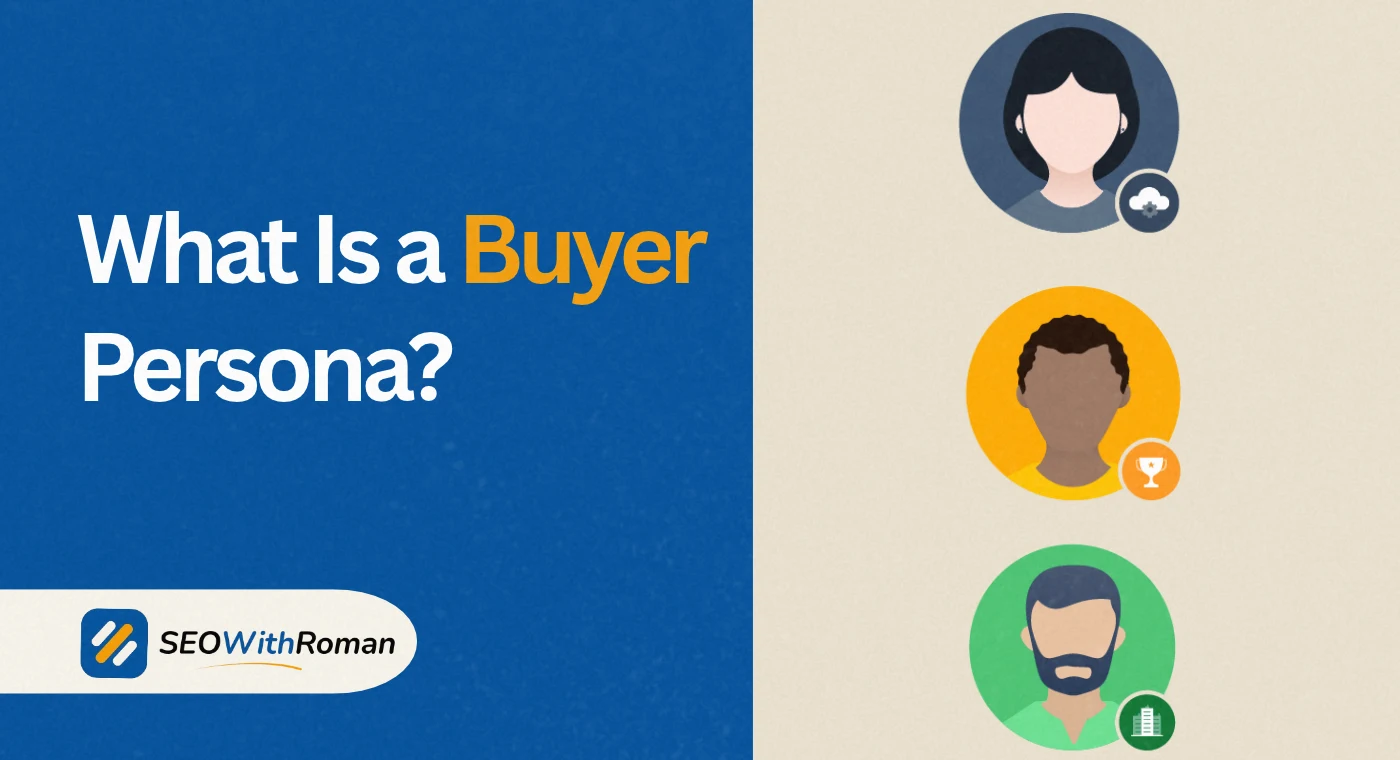
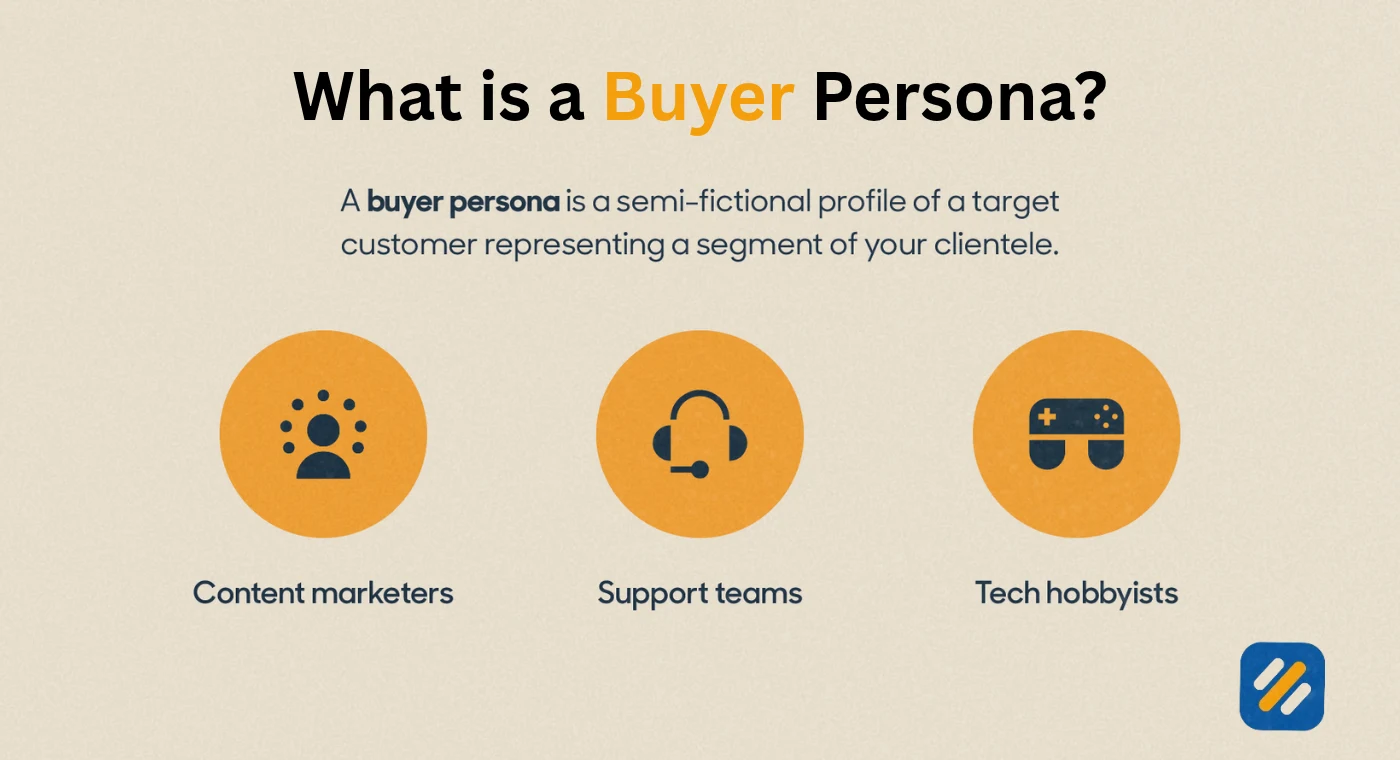
A buyer persona is a detailed, semi-fictional profile of your ideal customer built from real data, interviews, and research. It gives your customer a name, a job title, a set of goals, a list of frustrations, and a clear picture of how they make decisions.
Think of it this way. Instead of saying “we target marketing managers aged 30 to 45,” you say “we target Marketing Manager Maria, a 34-year-old at a mid-sized SaaS company who is under pressure to prove ROI to her CEO, spends her mornings on LinkedIn, and makes tool purchasing decisions based on peer recommendations and case studies.”
The difference between those two descriptions is not just detail. It is the difference between guessing what your audience needs and actually knowing it.
A buyer persona is also known as a customer persona, marketing persona, or audience persona. All of these terms refer to the same concept: a researched character profile that represents a segment of your real target audience.
According to HubSpot research, 71% of companies that exceed their revenue goals have documented buyer personas. Yet the majority of businesses still rely on vague demographic segments that tell them almost nothing about why their customers buy.
2 What Is a Buyer Persona Made Of? The Complete Anatomy
A buyer persona is not just a list of demographics. That is the most common misconception and the reason most buyer personas end up useless. Here is what a complete, actionable buyer persona actually contains:
| Persona Element | What It Includes | Why It Matters |
|---|---|---|
| Demographics | Age, location, income, job title, education | Establishes the basic profile and targeting parameters |
| Psychographics | Values, beliefs, lifestyle, interests | Reveals what motivates decisions beyond price or features |
| Professional background | Industry, company size, seniority, tools used | Critical for B2B personas and content tone decisions |
| Goals | Personal and professional objectives | Aligns your product or content with what they are trying to achieve |
| Pain points | Challenges, frustrations, fears | The most powerful element for messaging and SEO keyword targeting |
| Buying behaviour | Research process, decision triggers, approval chain | Determines what content to create for each funnel stage |
| Preferred content | Formats, channels, frequency | Guides your content calendar and distribution strategy |
| Common objections | Price concerns, trust barriers, competitor comparisons | Arms your sales team with the right responses |
| Real quotes | Actual words from customer interviews | Makes the persona feel human and keeps teams grounded in reality |
The elements that most guides skip over are the real quotes and the buying behaviour sections. These two elements are what separate a persona that collects dust in a Google Drive folder from one that actively shapes every piece of content and every sales conversation.
3 What Are the Four Types of Buyer Personas?
Not all customers make decisions the same way. Research into buyer behaviour consistently identifies four distinct persona types based on how people approach decisions and what they need to feel confident buying. Understanding these types helps you create content and messaging that speaks to each one individually.
Type 1: The Analytical Buyer
The analytical buyer makes decisions slowly, methodically, and based on data. They read every word of a case study, compare every feature on a pricing page, and will not move forward without evidence that your solution works.
What they need from your marketing: Detailed technical documentation, ROI calculators, comparison charts, data-backed claims, and peer-reviewed research. Vague promises and enthusiastic testimonials mean nothing to them. Numbers do.
In B2B settings, analytical buyers are often found in finance, IT, or engineering roles. They are frequently the people who slow down deals while they conduct thorough due diligence.
Type 2: The Driver Buyer
The driver buyer moves fast and wants results. They care about outcomes, not process. Give them the bottom line immediately and skip the background. They will not read a ten-page whitepaper but they will watch a two-minute results video.
What they need: Executive summaries, bold outcome statements, quick-start guides, and direct access to decision-relevant information. Case studies that open with the result work better than ones that build to it slowly.
Driver buyers are commonly C-suite executives, founders, and senior sales leaders who are accountable for outcomes and have limited time.
Type 3: The Expressive Buyer
The expressive buyer makes decisions based on relationships, trust, and alignment with their values. They want to know who is behind the product, what the company believes in, and whether other people like them have had good experiences.
What they need: Behind-the-scenes content, community proof, testimonials from people they identify with, brand storytelling, and a human voice in all communications. They are more likely to buy from someone they follow on social media than from a company they found through a cold ad.
Expressive buyers are common in B2C markets, creative industries, and mission-driven organisations. They respond to authenticity more than expertise.
Type 4: The Amiable Buyer
The amiable buyer avoids conflict and dislikes making risky decisions. They need reassurance, social proof, and a low-friction path to purchase. They are often the last to adopt new tools or approaches and the first to churn if they feel unsupported post-purchase.
What they need: Friendly, jargon-free content, strong onboarding support, money-back guarantees, FAQ sections that address every possible concern, and evidence that other cautious buyers made this decision safely. They respond very well to “you are not alone” messaging.
In B2B settings, amiable buyers often hold roles in HR, customer success, or administration. In B2C, they are the shoppers who read every review before clicking buy.
4 Buyer Persona Examples | Real Profiles Across B2B and B2C
Reading about buyer personas in theory only gets you so far. Seeing completed examples is what makes the concept click. Here are four detailed buyer persona examples across different industries:
B2B Buyer Persona Example: “SEO-Savvy Sarah”
Role: Marketing Manager at a US-based SaaS company with 50 to 200 employees
Age: 32
Income: $75,000 to $95,000
Goals: Grow organic traffic by 40% this year, prove marketing ROI to her CEO, reduce dependency on paid ads
Pain points: Struggles to get developer support for technical SEO fixes, overwhelmed by conflicting SEO advice online, cannot justify expensive agency retainers to her leadership team
Preferred content: Step by step guides, short video tutorials, comparison articles, LinkedIn posts from named SEO experts
Buying triggers: A colleague recommendation, a free trial that delivers quick wins, a case study featuring a company similar to hers
How this shapes your content: Every article on SEOWithRoman.com that explains a concept in plain English, compares tools honestly, and shows a real result speaks directly to Sarah.
B2B Buyer Persona Example: “Decision-Maker David”https://seowithroman.com/blog/technical-seo-explained-a-simple-guide
Role: Operations Director at a UK-based BPO company with 200 to 500 employees
Age: 44
Income: $110,000 to $140,000
Goals: Reduce operational costs, improve process efficiency, evaluate new technology vendors for the next fiscal year
Pain points: Too many tools that do not integrate, difficulty measuring team productivity, boards that want results in 90 days
Preferred content: ROI calculators, executive summaries, vendor comparison reports, analyst research
Buying trigger: A peer recommendation from someone at a similar company, a clear business case with projected savings
How this shapes your content: B2B content for David needs to lead with outcomes, use professional language, and make the business case immediately.
B2C Buyer Persona Example: “Beginner Blogger Ben”
Role: Part-time blogger trying to monetise a food and recipe website
Age: 27
Income: $35,000 to $50,000
Goals: Get his first 1,000 organic visitors per month, understand SEO without hiring anyone, eventually earn enough from AdSense to reduce his day job hours
Pain points: Confused by technical SEO advice, does not know which free tools to trust, has tried three different strategies with no visible results
Preferred content: Beginner guides written in plain English, numbered step by step articles, YouTube tutorials, Reddit threads
Buying trigger: Free content that actually works, a community of people in the same situation
How this shapes your content: Every beginner article on SEOWithRoman.com is written for Ben. Short sentences, no jargon, real examples, clear next steps.
Negative Buyer Persona Example: “Shortcut-Seeking Sam”
Role: Website owner looking for black hat SEO tactics or guaranteed quick rankings
Goals: Rank on page one within two weeks with minimal effort
Behaviours: Downloads free guides without reading them, asks for shortcuts in comments, tries to find loopholes in Google’s algorithm
Why to exclude: Sam will not invest in white hat SEO content. He will churn from any tool or service quickly and generate negative reviews when shortcuts do not deliver.
How this shapes your content: You do not write for Sam. You do not promise overnight rankings. You attract the audience willing to put in the consistent work.
5 What Is a Buyer Persona Used For? How It Transforms Marketing and SEO
Creating a buyer persona is not a standalone exercise. It is the foundation that every other marketing and SEO decision should rest on. Here is exactly how buyer personas change the quality of your work across every channel:
Buyer Personas and SEO
This is the connection that most marketing guides completely miss, and it is one of the most powerful applications of buyer persona research.
When you know your buyer persona’s pain points, goals, and the exact language they use to describe their problems, you have a keyword research shortcut that no tool can fully replicate. Your persona tells you:
Which keywords your audience actually types, because they describe their problem the way a frustrated non-expert would, not the way an industry insider would.
Which search intent applies to each topic. An analytical buyer searching “SEO ROI calculator” has commercial intent. An amiable buyer searching “is SEO worth it for a small business” has informational intent. The same topic, two completely different content formats needed.
Which content length and format Google is already rewarding for that audience, because search intent is directly tied to persona type.
When I write content for SEOWithRoman.com, every keyword I target starts with a question: which persona would search this, and what do they need to feel confident after reading it? That question shapes the title, the structure, the depth, and the tone of every article.
Buyer Personas and Content Marketing
Your persona tells you what topics to cover, what questions to answer first, which examples will resonate, and what tone to use. Without it, content is guesswork.
Buyer Personas and Email Marketing
Segmenting your email list by persona and sending content relevant to each persona’s specific stage and concerns consistently outperforms sending the same email to everyone. Even basic persona-based segmentation improves open rates and reduces unsubscribes.
Buyer Personas and Paid Advertising
Knowing your persona’s preferred platforms, demographics, and trigger phrases allows you to write ad copy that speaks to a real person rather than a statistical average. This directly reduces your cost per click and improves conversion rates.
6 How to Create a Buyer Persona Step by Step
Creating an accurate buyer persona requires research, not assumption. Here is the exact process:
Step 1: Gather quantitative data from sources you already have
Start with what you know. Pull data from Google Analytics to understand your existing audience demographics and the pages they engage with most. Review your CRM for patterns in your customer base by job title, industry, company size, and purchase behaviour. Check your Google Search Console for the exact search queries bringing people to your site.
This data tells you who is already finding you and what they are already looking for. It is the baseline your persona research builds from.
Step 2: Conduct real customer interviews
This is the step most businesses skip and the reason most buyer personas are inaccurate. Data tells you what people do. Interviews tell you why.
Aim for five to eight interviews per persona. Talk to your best customers, your most recently churned customers, and a handful of prospects who evaluated you but did not buy. Each group gives you a different and necessary angle.
Questions to ask in every interview
- What were you trying to solve when you first started looking for something like this?
- How did you find us?
- What almost stopped you from buying or signing up?
- How do you typically research solutions like ours?
- What content formats do you actually find useful?
Step 3: Analyse patterns across your research
After conducting interviews and reviewing your data, look for recurring themes. Which pain points come up in almost every conversation? Which goals do multiple customers share? Which objections appear consistently?
Group your findings by theme rather than by individual customer. Three customers who all mention “not knowing which SEO tool to trust” are telling you something about your persona’s decision-making environment that should shape your content strategy.
Step 4: Build and document your persona profiles
Give each persona a name, a photo, and a one-paragraph summary that makes them feel like a real person. Then document every element from the anatomy table earlier in this article. The goal is a profile that any team member can read and immediately understand how to communicate with that person.
Step 5: Share personas across your entire organisation
A buyer persona that only lives in the marketing team’s folder creates half the value of one that informs every customer-facing team. Your sales team needs to know which persona they are talking to. Your customer success team needs to understand which persona is most likely to churn and why. Your content team needs it for every brief.
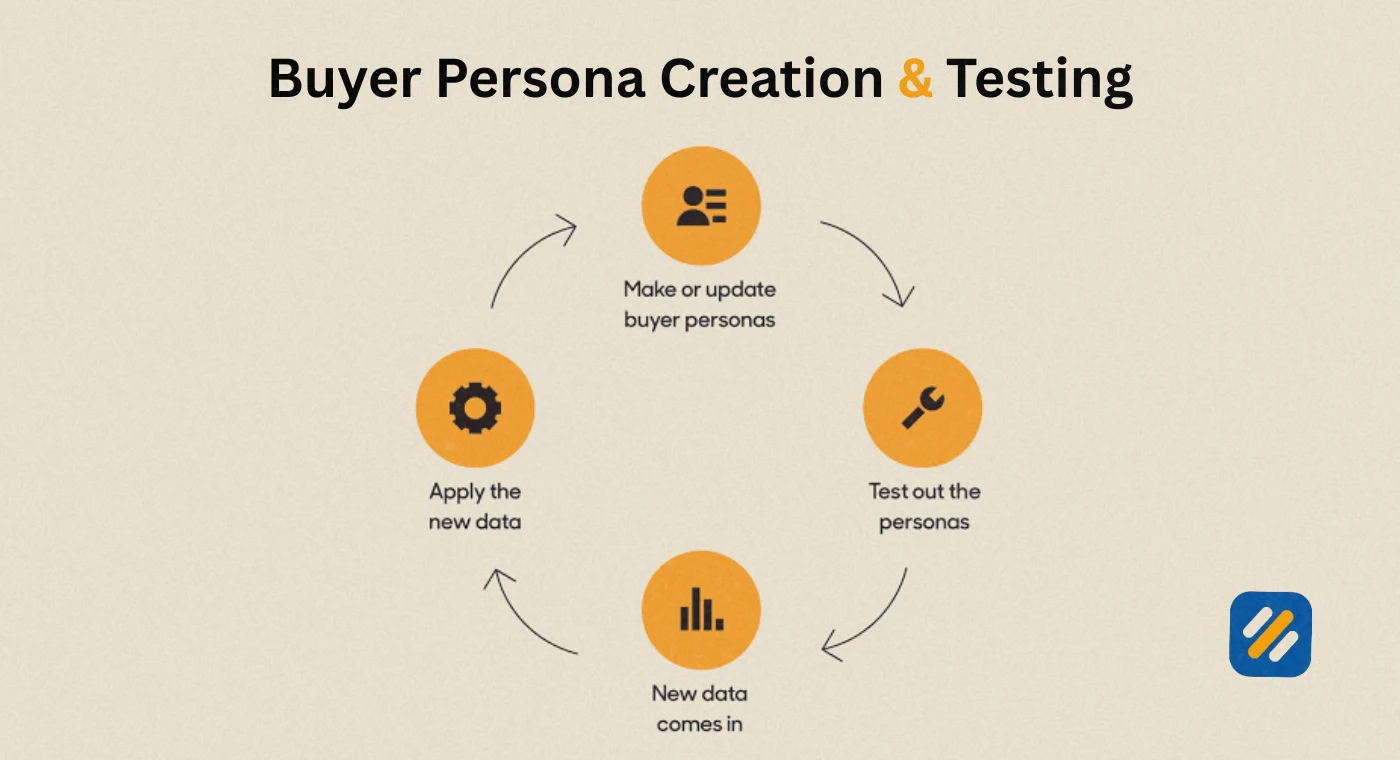
Step 6: Review and update at least annually
Buyer personas are not static. Your audience evolves. New competitors emerge. Economic conditions change. Review your personas every twelve months and after any major product change, market shift, or campaign that produced unexpected results.
7 B2B Buyer Persona vs B2C Buyer Persona | Key Differences
| Factor | B2B Buyer Persona | B2C Buyer Persona |
|---|---|---|
| Decision maker | Often multiple stakeholders across departments | Usually an individual or couple |
| Decision timeline | Weeks to months with multiple approval stages | Minutes to days |
| Purchase motivation | Business ROI, efficiency, risk reduction | Personal benefit, emotion, social proof |
| Content preference | Case studies, whitepapers, ROI data, technical specs | Reviews, social proof, short video, lifestyle content |
| Primary pain points | Cost, integration complexity, internal buy-in | Price, convenience, trust, peer recommendations |
| Keyword language | Professional, industry-specific terminology | Everyday conversational language |
| Sales cycle involvement | Marketing nurtures, sales closes | Marketing often drives the full conversion |
| Relationship importance | Very high, long-term vendor relationships valued | Moderate, brand loyalty varies widely |
The most important practical difference for SEO and content strategy is keyword language. A B2B buyer searching for a project management tool types “enterprise project management software integration” while a B2C buyer solving the same problem types “easy app to organise team tasks.” Same underlying need, completely different search behaviour.
8 How Buyer Personas Directly Improve Your SEO Strategy
Most SEO guides treat keyword research as a purely technical exercise. Find keywords with search volume. Check difficulty. Write the article. But this approach consistently produces content that ranks without converting because it ignores who is actually doing the searching.
Buyer personas transform SEO from a keyword exercise into a customer understanding exercise. Here is how:
Persona-driven keyword research finds the keywords your audience actually uses: When you interview real customers and ask them how they described their problem before they found a solution, they use completely different language than any keyword tool would suggest. Those exact phrases are often lower competition, higher intent keywords that your competitors have missed entirely.
Personas reveal which search intent applies to each topic: Knowing whether your persona is in the awareness, consideration, or decision stage of their journey tells you exactly what type of content to create for a given keyword. The wrong content format for the right keyword consistently underperforms even when rankings are achieved.
Personas improve your content depth: When you write for a specific persona, you naturally include the specific concerns, objections, and questions that persona has. This depth is what Google’s E-E-A-T framework rewards. It is also what keeps readers on page long enough to improve your engagement metrics.
Personas guide your internal linking strategy: When you know your persona’s journey through your content, you can build internal link structures that mirror their natural progression from awareness to conversion rather than linking randomly between related articles.
9 3 Expert Tips for Creating Buyer Personas That Actually Get Used
Tip 1: Build your personas from interviews, not assumptions
The biggest mistake I see is teams creating buyer personas in a conference room without talking to a single real customer. Personas built from internal assumptions reflect what your team thinks customers care about, not what customers actually experience. Even three to five genuine customer interviews will reveal insights that completely change your content and messaging strategy.
Tip 2: Give every persona one primary pain point, not ten
Personas that try to capture everything become too complex to use practically. Identify the single most important pain point for each persona and make every piece of content you create for that persona speak to that pain first. Clarity in your persona leads to clarity in your messaging.
Tip 3: Connect your personas directly to your keyword list
After creating each persona, sit down with your keyword research tool and filter your keyword list through the lens of each persona. Ask: would this person search this? Does this keyword match their language, their stage, and their goal? Delete every keyword that does not serve a defined persona. This single step removes the wasted content effort that plagues most content strategies.
10 Conclusion
A buyer persona is not a marketing document that gets created once and filed away. It is the lens through which every piece of content, every keyword decision, every email subject line, and every sales conversation should be viewed.
The businesses that consistently outperform their competition in organic search, content engagement, and conversion rates are almost always the ones who understand their customers at this level of depth. They are not guessing what their audience wants. They researched it, documented it, and built their entire strategy around it.
Start with one persona. Interview five real customers. Find the patterns. Build the profile. Then let that profile shape your next ten articles, your next email campaign, and your next keyword research session.
The difference between content that ranks and content that converts is almost always this: the converting content was written for a specific person with a specific problem. A buyer persona is how you find that person and speak directly to them.
Have you created buyer personas for your business yet? Drop a comment below and tell me which persona type describes your main audience. I read every reply.
Join 1,000+ business owners and bloggers who get one actionable SEO tip every week — straight to their inbox. Free forever.
Get Free Weekly Tips →