- SEO page ranking refers to the position your webpage holds in Google search results for a specific keyword
- Google Search Console is the most accurate free SEO page rank checker available because the data comes directly from Google
- A good SEO ranking is anything in the top 3 positions, which collectively receive over 50% of all clicks for any given keyword
- Checking your page ranking regularly is not vanity. It is the feedback loop that tells you whether your SEO strategy is working
- SEO is not dead in the AI era. It has evolved, and websites that adapt their content for both Google and AI overviews will gain more visibility than ever before
1 What Is SEO Page Ranking and Why It Determines Everything About Your Traffic
Every webpage on the internet competes for a position in Google search results. SEO page ranking is the specific position your webpage holds when someone searches for a keyword related to your content.
Position 1 means your page appears first. Position 10 means you are at the bottom of page one. Position 11 means you have fallen to page two, where most searchers never scroll.
Understanding your SEO page rank is not optional if you are serious about organic traffic. It is the fundamental measurement that tells you whether the content you are creating, the keywords you are targeting, and the optimisation work you are doing is actually translating into visibility on Google.
I have been doing SEO for many years across multiple client websites in B2b, healthcare, ecommerce, and local services. In every single campaign, the first thing I establish before any strategy decision is a baseline ranking report. You cannot improve what you cannot measure. And you cannot measure what you are not tracking.
Here is what makes SEO page ranking so critical. Research from Backlinko consistently shows that the first three positions in Google capture over 50% of all clicks for any keyword. Position one alone averages 27.6% of clicks. By position five you are getting roughly 6.3%. By position ten you are below 2%.
The difference between ranking position 3 and position 8 for a keyword with 1,000 monthly searches is the difference between 150 visitors per month and 20. That is not a small gap. That is the entire gap between a website that generates leads and one that sits invisible.
2 What Is a Good SEO Ranking and What Should You Actually Be Aiming For
Most beginners think getting to page one is the goal. That is only partially right. Getting to page one is the entry point. The real goal is positions 1 to 3.
Here is the honest breakdown of what each ranking position actually delivers in terms of click through rate and what it means for your website
| Google Position | Average Click Through Rate | What It Means in Practice |
|---|---|---|
| Position 1 | 27.6% | Dominant. Gets more traffic than positions 2 through 5 combined |
| Position 2 | 15.8% | Strong. Solid traffic but significantly below position 1 |
| Position 3 | 11.0% | Good. Still highly visible and worth targeting |
| Position 4 | 8.4% | Decent. Traffic is meaningful but declining quickly |
| Position 5 | 6.3% | Average. Worth improving but not a crisis |
| Position 6 to 10 | 2% to 5% | Below average. Page one but minimal impact |
| Position 11 to 20 | Under 1% | Page two. Near invisible to most searchers |
| Position 21 plus | Negligible | Effectively zero organic traffic |
A good SEO ranking for a brand new website is anything on page one, even positions 6 to 10, because it proves Google trusts your content enough to display it. A good SEO ranking for an established website with six months of consistent publishing is positions 1 to 3 for your target keywords.
The important thing to understand is that ranking positions are not fixed. A page sitting at position 8 today with some strategic improvements, stronger internal linking, and a content update can move to position 3 within weeks. Knowing your current position is what allows you to identify these opportunities and act on them.
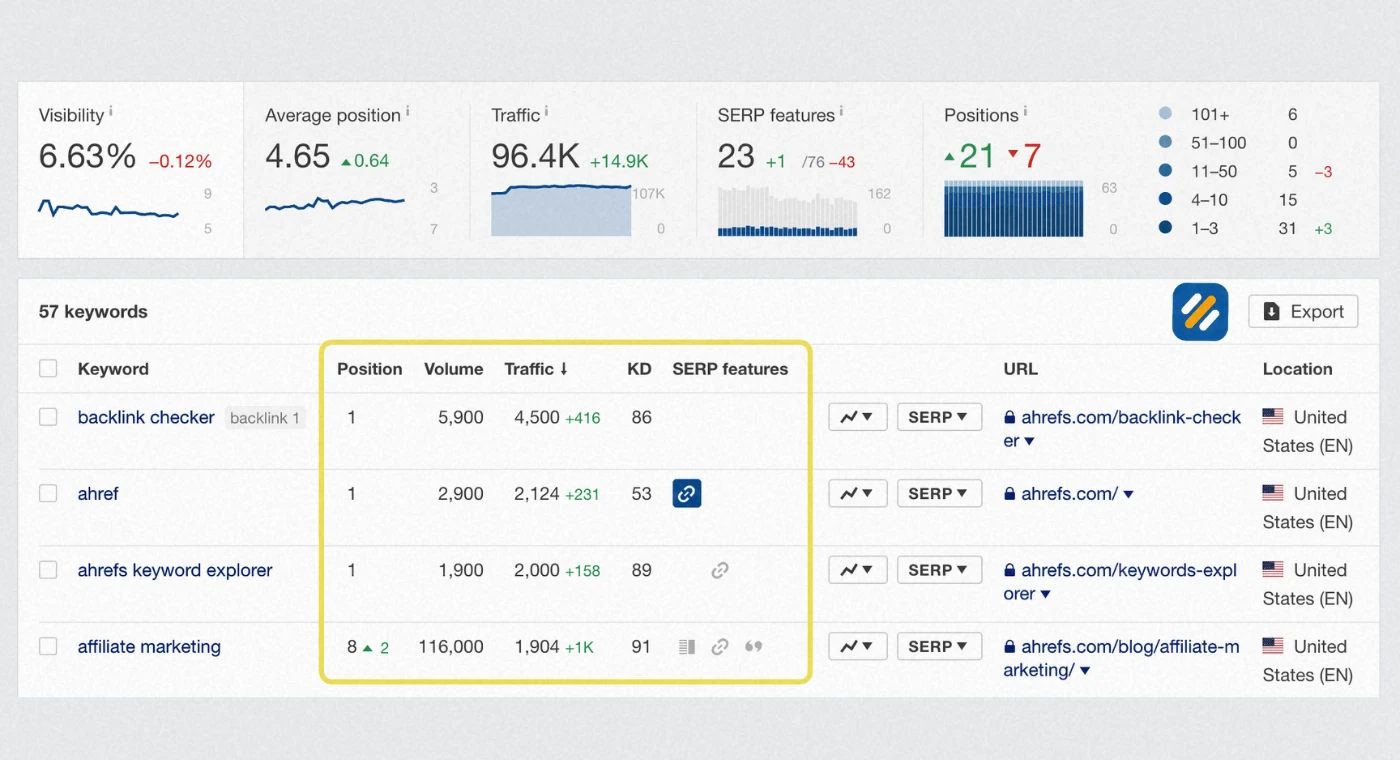
3 How to Check SEO Page Ranking For Free | 6 Methods That Actually Work
There are more free SEO page rank checker options available in 2026 than most people realise. Here is the complete breakdown of every method worth using, from the most accurate to the most convenient.
4 Method 1: Google Search Console | The Most Accurate Free SEO Rank Checker
Google Search Console is the single most reliable free tool for checking your SEO page ranking because the data comes directly from Google itself. No estimation. No third party database. Real position data from real searches.
To check your page ranking in GSC
Go to search.google.com/search-console and open your property. Click Performance in the left sidebar. You will see your average position, total clicks, total impressions, and click through rate for the date range you select.
Click the Pages tab to see ranking data per page. Click the Queries tab to see which keywords each page is ranking for and at what average position. Click any individual keyword to filter the data and see exactly which pages are ranking for that term and at what position.
The limitation of GSC is that it shows average positions rather than real-time rank checks. But for understanding your overall ranking landscape and tracking progress over time, nothing available at any price point gives you more accurate data.
Method 2: Ahrefs Free Webmaster Tools
Connect your website to Ahrefs Webmaster Tools for free at ahrefs.com/webmaster-tools. Once connected, Ahrefs crawls your site and shows you ranking data for every keyword your website appears for in Google's top 100 results.
The advantage over GSC is that Ahrefs also shows you keyword difficulty scores, estimated traffic, and competitor ranking data side by side. This makes it easier to prioritise which keywords to focus on improving.
Method 3: Google Search | The Manual Method
The simplest way to check where a specific page ranks for a specific keyword is to search for that keyword in Google while logged out of your Google account or in an incognito window. Google personalises results for logged-in users, so checking while logged in gives you inaccurate position data.
Search your target keyword, count the positions until you find your page, and record the result. This method is time-consuming for tracking multiple keywords but is perfectly accurate for checking individual rankings quickly.
Method 4: Semrush Free Account
Semrush's free account gives you 10 keyword searches per day. Enter your domain in the Domain Overview tool and Semrush shows you your top ranking keywords, their positions, search volume, and estimated traffic. The free version limits the depth of data but gives enough information to understand your ranking landscape at a high level.
Method 5: Ubersuggest Free Plan
Neil Patel's Ubersuggest offers a free plan that includes basic ranking data for your domain. Enter your URL and Ubersuggest shows your top ranking pages, the keywords they rank for, and estimated traffic. The free limit is three searches per day but the data is useful for identifying your best-performing content quickly.
Method 6: Google Search Console Performance API
For those comfortable with data tools, Google's Search Console API gives you programmatic access to all your ranking data at no cost. You can pull position data for every keyword and page combination directly into Google Sheets using free community connectors. This is the most powerful free method for websites with large content libraries.
5 Free SEO Page Rank Checker Tools Compared
| Tool | Cost | Data Source | Keywords Tracked | Best Feature | Limitation |
|---|---|---|---|---|---|
| Google Search Console | Free | Direct from Google | Unlimited | Most accurate data available | Average positions, not real time |
| Ahrefs Webmaster Tools | Free | Ahrefs database | Unlimited for your site | Competitor data alongside rankings | Limited to your own verified sites |
| Semrush Free | Free | Semrush database | 10 searches per day | Competitor keyword overlap | Daily search limit |
| Ubersuggest Free | Free | Ubersuggest database | 3 searches per day | Clean simple interface | Very limited on free plan |
| Google Search Incognito | Free | Direct from Google | Manual, unlimited | Real time accuracy | Time consuming, one keyword at a time |
| Rank Math SEO Plugin | Free | GSC integration | Unlimited via GSC | Built into WordPress dashboard | WordPress only |
6 Off-Page SEO Ranking Factors That Directly Affect Your Page Rank
Most beginners focus exclusively on on-page SEO when trying to improve their page ranking. They optimise title tags, adjust keyword density, and improve their content structure. All of that matters. But off-page SEO ranking factors often have a bigger impact on where your pages rank than anything you do on the page itself.
Here are the off-page SEO ranking factors that directly influence your Google SEO page rank
Backlinks from authoritative websites. A single backlink from a domain with strong authority can move a page from position 15 to position 5 faster than any on-page change. Google still uses backlinks as one of its most powerful ranking signals because they represent a vote of confidence from another website. Quality matters far more than quantity. One backlink from a trusted industry publication outweighs fifty backlinks from low-quality directories.
Brand mentions and unlinked citations. Google's systems are capable of identifying when your brand is mentioned online even without a hyperlink. Consistent brand mentions across reputable websites signal to Google that your business is established and trustworthy. This contributes to your overall domain authority which lifts all of your pages' rankings simultaneously.
Social signals and content sharing. While Google has officially stated that social shares are not a direct ranking factor, the correlation between widely shared content and improved rankings is well-documented. Content that earns social shares earns more visibility, which leads to more backlinks, which improves rankings. The relationship is indirect but real.
Domain authority and trust. The overall authority of your entire domain affects how easily individual pages rank. A page on a high-authority domain can rank for competitive keywords with minimal on-page optimisation. The same page on a new domain with no authority would need significantly stronger on-page signals and more backlinks to achieve the same position.
7 How to Improve Your SEO Page Rank | The Proven Step by Step Process
Checking your rankings is only the first step. Here is what to do with that data to actually move your pages up in Google search results.
Step 1: Identify your pages ranking between positions 5 and 20
These are your highest priority improvement opportunities. Pages in this range are already indexed and trusted by Google. They just need a push to cross into positions 1 to 4. Open Google Search Console, go to Performance, click Pages, and sort by position. Filter for pages with average position between 5 and 20.
Step 2: Check what keyword each page ranks for
Click the page URL in GSC and then click Queries to see which keywords that page appears for and at what position. Identify the primary keyword this page is targeting and confirm whether it is properly optimised for that keyword in the title tag, H1, and first paragraph.
Step 3: Improve the content depth
Compare your page to the top three pages currently ranking above you for the same keyword. What do they cover that you do not? What questions do they answer that your page ignores? Add those angles. Google rewards comprehensive content that leaves no reasonable question unanswered.
Step 4: Strengthen internal linking to this page
Go to other pages on your website that are already ranking well and add internal links pointing to the page you want to improve. Use descriptive anchor text that contains your target keyword. More internal links signal to Google that this page is important within your website's topic structure.
Step 5: Improve your title tag and meta description for click through rate
A page ranking at position 5 with a 20% click through rate will often outrank a page at position 4 with a 5% click through rate over time because Google interprets high CTR as a quality signal. Rewrite your title tag with a stronger power word or a clearer benefit. Make your meta description impossible to ignore.
Step 6: Build one or two backlinks to this page
Reach out to websites that have linked to similar content and let them know about your improved article. Write a guest post on a relevant website and include a contextual link back to the page you want to rank. Even one quality backlink to a page sitting at position 8 can push it onto page one.
8 Google SEO Page Rank vs PageRank | Understanding the Difference
Many beginners confuse two terms that sound similar but mean completely different things: SEO page rank and Google PageRank.
Google PageRank was Google's original algorithm, created by Larry Page (hence the name), that ranked webpages based on the number and quality of backlinks pointing to them. It was publicly visible as a score from 0 to 10 through the Google Toolbar. Google officially retired the public PageRank score in 2016, though the underlying concept of link-based authority still influences rankings internally.
SEO page ranking is simply the position a specific webpage holds in Google search results for a specific keyword. It is a measurement of where your page appears, not an algorithm.
| Term | What It Means | Still Relevant in 2026 |
|---|---|---|
| Google PageRank (original) | Algorithm measuring backlink authority, 0 to 10 scale | Retired publicly in 2016 but concept still used internally |
| SEO Page Rank | Position of your page in Google SERP for a keyword | Fully relevant, core SEO measurement |
| Domain Authority (Moz) | Third party estimate of domain-wide ranking power | Useful as a relative comparison metric |
| Domain Rating (Ahrefs) | Ahrefs estimate of backlink profile strength | Widely used SEO benchmark |
| URL Rating (Ahrefs) | Ahrefs estimate of specific page link authority | Useful for page-level optimisation decisions |
Understanding this distinction matters because many SEO page rank software tools use different metrics to estimate authority. None of these third party metrics are what Google actually uses internally. Google Search Console position data is the only measurement that shows you exactly where Google is placing your pages.
9 Is SEO Dead Now With AI? The Honest Answer Every Website Owner Needs to Hear
This is the question I get asked more than any other in 2026. With Google's AI Overviews appearing at the top of search results, ChatGPT answering questions directly, and Perplexity pulling information without sending users to websites, many small business owners are wondering whether SEO page ranking still matters.
The honest answer is that SEO is not dead. It has changed. And the websites that understand how it has changed are gaining more visibility than at any previous point in Google's history.
Here is what is actually happening. AI Overviews pull content from specific sources to generate their summaries. Those sources are overwhelmingly pages that rank in positions 1 to 5 for the relevant keyword. Getting your page into an AI Overview requires the same thing that has always driven SEO success: ranking high for the keyword the AI is answering a question about.
The websites that are losing traffic in the AI era share a specific profile. They published thin, generic content designed purely to rank rather than to genuinely help users. AI can summarise that kind of content in two sentences and the user never needs to click through. But content that demonstrates genuine firsthand experience, contains specific data, real examples, and expert insight that cannot be scraped and summarised without losing its value? That content is becoming more valuable, not less.
What has changed:
Informational queries, the "what is" and "how does" questions, now frequently trigger AI Overviews that answer the question directly on the search results page. Click through rates for these queries have declined for websites that were getting traffic purely from searchers looking for a quick definition.
What has not changed:
High intent queries where the user wants to buy something, hire someone, compare options, or solve a specific problem still drive click-throughs at similar rates as before. These are the keywords that drive actual business results and they are largely unaffected by AI Overviews.
What is growing:
Websites that are mentioned and cited by AI tools are seeing a new type of visibility called GEO, Generative Engine Optimisation. When ChatGPT, Perplexity, or Google's AI Overview cites your content as a source, you receive brand visibility and traffic that did not exist three years ago. This traffic is additive, not a replacement for organic search traffic.
SEO page ranking remains the foundation. The strategies that improve your position in Google also increase your probability of being cited by AI systems. The two are not in competition. They run on the same engine: trustworthy, expert content that fully answers real questions.
10 3 Expert Tips to Check and Improve Your SEO Page Rank Faster
These are the tips that go beyond standard advice and reflect what actually moves the needle based on real campaign experience.
Expert Tip 1: Filter GSC Data by Country Before Making Any Ranking Decisions
Google Search Console shows your average position across all countries by default. If you are targeting US or UK audiences, your average position may be dragged down by rankings in countries you are not targeting. Always filter your GSC Performance report by country before assessing your rankings. A page averaging position 12 globally may already be at position 4 in the UK. Knowing this changes your entire optimisation priority.
Expert Tip 2: Track Position Changes Weekly, Not Daily
Daily ranking checks create anxiety and lead to bad decisions. Rankings fluctuate naturally by one to three positions every day due to Google's continuous algorithm updates and testing. Weekly tracking smooths out this noise and shows you the real trend. If your page is consistently moving from position 8 to 7 to 6 over four weeks, that is a genuine positive signal worth maintaining. Daily checks of the same page might show 8, 11, 7, 9 and lead you to think nothing is working when it actually is.
Expert Tip 3: Use the GSC Search Appearance Filter to Find Featured Snippet Opportunities
In Google Search Console, open the Performance report and click Search Type, then filter by Web. Then look at the Search Appearance filter and select Featured Snippets. This shows you keywords where your page is already appearing in a featured snippet position. These pages are your highest priority for content formatting improvements because small changes to how you structure an answer, using a clear definition in the first sentence, a numbered list, or a comparison table, can lock in featured snippet placement and significantly increase your click through rate.
11 Conclusion
Checking your SEO page ranking is not a vanity exercise. It is the most fundamental measurement in your entire SEO strategy. Without knowing where your pages rank, you are publishing content without knowing whether it is reaching anyone, optimising pages without knowing which ones need attention, and making strategic decisions without data.
Start with Google Search Console today. It is free, accurate, and gives you more useful ranking data than most paid tools. Connect it to your website, open the Performance report, and spend 15 minutes understanding where your pages currently stand.
Then use the improvement process in this guide to move your most promising pages from positions 5 to 20 into the top three. Those are the positions that generate real traffic, real leads, and real revenue from organic search.
SEO page ranking is not complicated. It rewards consistency, genuine expertise, and content that actually helps the people searching for it.
Have a question about your specific page rankings? Drop a comment below and I will help you work out your next move.
Join 1,000+ business owners and bloggers who get one actionable SEO tip every week — straight to their inbox. Free forever.
Get Free Weekly Tips →