
- The exact meaning of long tail keywords, with real examples from actual searches
- The real difference between long tail and short tail keywords, and when each one wins
- All 16 types of SEO keywords, organized in a way that actually makes sense
- Whether LSI keywords are still a real thing worth chasing in 2026
- Free and paid methods for how to get long tail keywords without guesswork
- Exactly where on your website to place long tail keywords for maximum impact
1 What Are Long Tail Keywords
Long tail keywords are longer, more specific search phrases, usually three words or more, that individually get searched far less often than short, broad terms, but collectively make up the vast majority of all searches happening on Google every day.
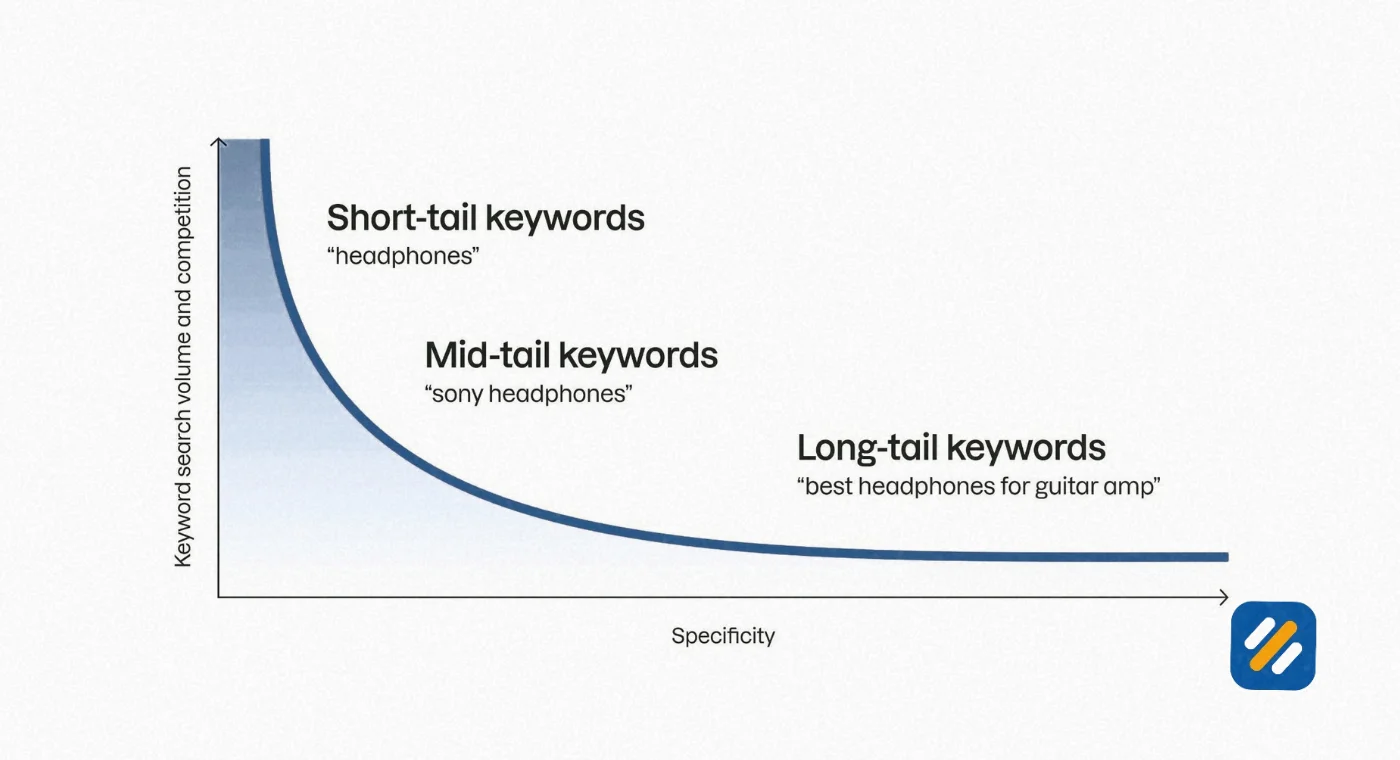
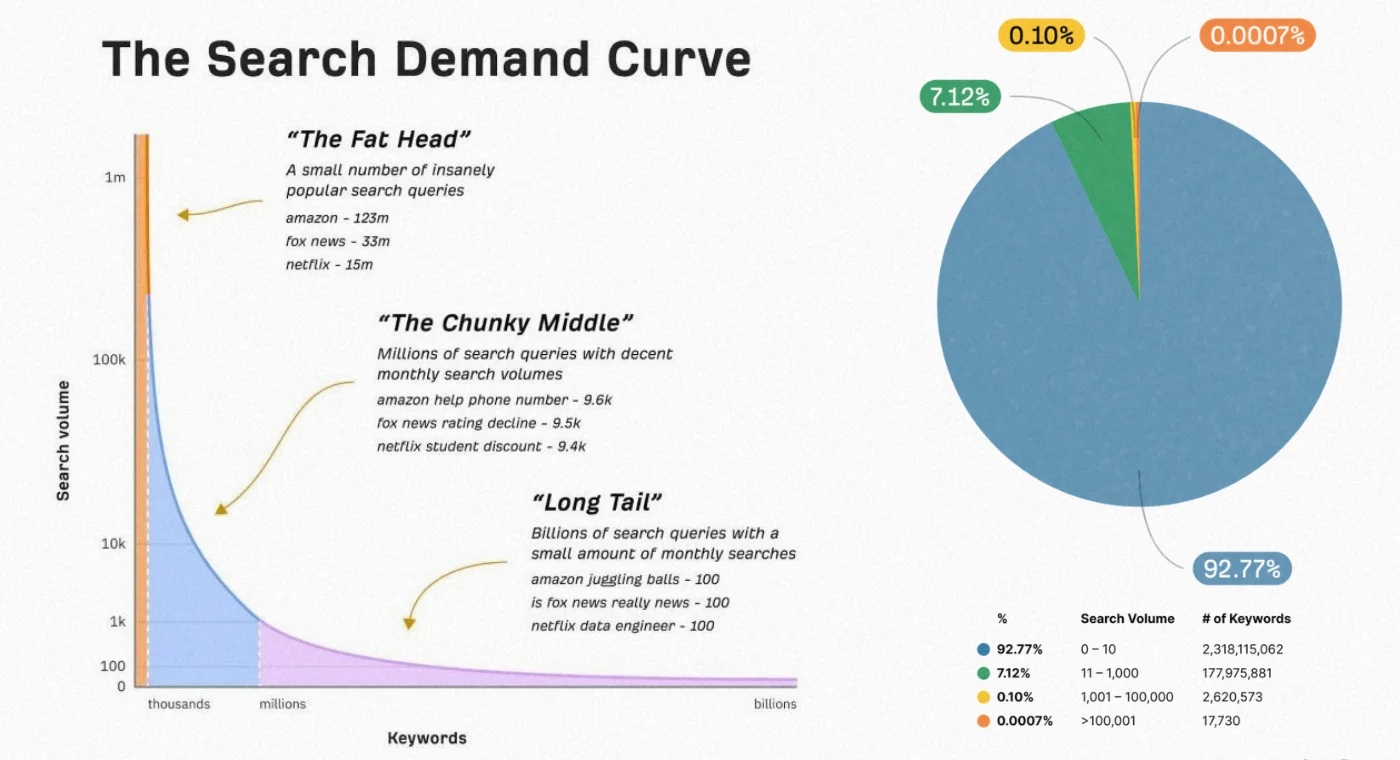
Picture a graph of search demand across every possible keyword. A small handful of broad terms, like "shoes" or "insurance," sit at the tall end on the left, each getting massive search volume. But stretching out to the right is a long, low tail of thousands upon thousands of specific phrases, each searched only a handful of times a month. That visual shape is exactly where the name comes from.
Here is a concrete example. "Shoes" is a short tail keyword, searched millions of times monthly, but it is impossibly broad and brutally competitive. "Waterproof hiking shoes for wide feet under $100" is a long tail keyword, searched only a few hundred times monthly, but every single person typing that exact phrase knows precisely what they want.
What makes long tail keywords genuinely powerful is scale in aggregate. Research into real search query data has consistently found that roughly 92 percent of all keywords typed into Google receive ten or fewer searches per month. That single statistic flips the entire conversation. The long tail is not a niche tactic, it is actually where most real search demand lives.
2 Long Tail vs Short Tail Keywords: The Real Difference
This comparison trips people up more than it should, mostly because the terms get thrown around loosely. Here is the difference laid out clearly.
| Factor | Short Tail Keywords | Long Tail Keywords |
|---|---|---|
| Word count | One to two words | Three or more words |
| Search volume per term | Very high | Low to moderate |
| Competition | Extremely high | Low to moderate |
| Search intent | Often vague or broad | Usually specific and clear |
| Time to rank | Months to years for a new site | Often weeks to a few months |
| Conversion potential | Lower, visitor still exploring | Higher, visitor closer to a decision |
Long tail vs short tail keywords is not really a competition where one side wins outright. A smart seo long tail keywords strategy almost always uses both together, short tail terms to build broad topical authority over time, and long tail terms to win actual rankings and traffic while that authority is still being built.
3 Why Long Tail Keywords Matter for SEO
There are two separate reasons long tail search terms deserve a real place in your strategy, and most articles on this topic only ever explain one of them.
Reason one, they are dramatically less competitive: A head term like "link building" returns billions of competing results in Google, meaning a brand new site realistically has almost no shot at page one within its first year. A long tail version of that same topic, something like "link building software for small agencies," faces a fraction of that competition, which means a smaller or newer site can genuinely compete and win.
Reason two, they convert noticeably better: Someone searching "keto diet" is probably still learning what the term even means. Someone searching "keto diet meal delivery service near me" is close to opening their wallet. The extra words in a long tail search almost always signal a more specific, more decided intent, and that specificity is exactly why long tail traffic tends to convert at a meaningfully higher rate than broad head term traffic, even though the raw visitor count is smaller.
I have watched this play out directly on client sites. A page targeting a single broad term sat flat for eight months. The moment we rebuilt the content around six long tail variations of that same topic instead, organic traffic nearly tripled within one quarter, not because the page got better written, but because it finally matched specific, findable demand instead of one impossibly broad phrase.
4 The 16 Types of SEO Keywords You Should Know
Long tail keywords are just one category inside a much bigger keyword landscape. Understanding where they fit alongside everything else makes your overall strategy far more coherent. Here are all 16 types, grouped into four useful buckets.
| Group | Keyword Types Inside It |
|---|---|
| By length | Short-tail, mid-tail, long-tail |
| By role on the page | Focus keyword, secondary keyword, semantic keyword |
| By target | Market-specific, generic, branded, product-related, customer-defining, location-specific |
| By search intent | Informational, commercial, transactional, navigational |
That is three plus three plus six plus four, sixteen total types, each describing a different angle on the same keyword. A single real search term can actually belong to several of these groups at once. "Best waterproof hiking shoes for wide feet" is simultaneously long-tail by length, product-related by target, and commercial by intent, all in one phrase. Thinking in these layers, rather than picking just one label, is what separates a genuinely thought out keywords for seo strategy from a flat list of random phrases.
5 What Are LSI Keywords (And Should You Still Care)
LSI stands for Latent Semantic Indexing, a mathematical text analysis method from the 1980s that older SEO advice claims Google uses to find "related" keywords to sprinkle into content. This idea has mostly been debunked. There is no solid public evidence that Google's modern ranking systems rely on LSI directly, and Google representatives have pushed back on the term publicly more than once.
What people actually mean when they say LSI keywords today is usually semantically related keywords, meaning words and phrases a real subject matter expert would naturally use when writing about a topic in depth. For a page about long tail keywords, that naturally includes terms like search intent, keyword research, search volume, and content strategy, not because a tool generated a list, but because those words genuinely belong in an honest, thorough explanation of the topic.
The practical takeaway is simple. Do not go hunting for an "LSI keyword list." Instead, write with real depth and expertise on your topic, and the semantically related vocabulary will appear naturally, which is exactly what both human readers and modern search algorithms actually reward.
6 How to Get Long Tail Keywords (Free Methods That Work)
Here is exactly how to get long tail keywords without paying for anything, starting with the sources closest to real search behavior.
Google's "Searches related to" section. Scroll to the bottom of any Google results page and you will find a handful of closely related long tail phrases, pulled directly from real aggregate search behavior, not guesswork.
Google Autocomplete. Start typing your seed keyword into Google's search bar and pay attention to what it suggests, then try adding a single letter after it, a through z, to surface dozens more long tail variations.
The "People also ask" box. Click to expand a few questions in this box, and Google will keep generating new related questions, each one a legitimate long tail keyword opportunity in its own right.
Google Search Console. If your site already has any traffic at all, this free tool shows you long tail queries you are already ranking for on page two or three, often requiring only minor content tweaks to push onto page one.
Real customer language. Reviews, support emails, and sales call notes are full of the exact specific phrasing real customers use, which frequently differs meaningfully from the generic phrasing marketers assume people type.
Forum and community threads. Active discussion threads on Reddit or niche forums reveal long, specific, naturally phrased questions that rarely show up in standard keyword tools.
7 Long Tail Keyword Research Tools Worth Using
Beyond the free manual methods above, dedicated long tail keyword research tools speed up the process considerably, especially once you need volume and difficulty data at scale.
| Tool | What It's Good For | Free Option |
|---|---|---|
| Google Keyword Planner | Volume and competition data tied directly to Google's own ad system | Yes, with a Google Ads account |
| AnswerThePublic | Visualizes question based long tail phrases around any seed topic | Limited free searches daily |
| Google Search Console | Reveals long tail queries you already rank for but have not optimized | Yes, fully free |
| Ahrefs or Semrush keyword tools | Filter results by word count to isolate long tail opportunities at scale | Limited free trial access |
| Ubersuggest | Scrapes Google Autocomplete data automatically, saving manual typing | Limited free daily searches |
Whichever long tail keywords tool you choose, filter your results by word count, generally four or more words, and by monthly search volume on the lower end, roughly ten to three hundred searches, to isolate the genuine long tail opportunities from the medium tail terms mixed into the same list.
8 What Are Some Good SEO Keywords (How to Judge Quality)
Not every long tail phrase you find is worth targeting. A genuinely good SEO keyword satisfies three conditions at once, and skipping any one of them wastes content effort.
It has real, if modest, search demand: A keyword with zero actual monthly searches, even a highly specific one, will not generate traffic no matter how well you rank for it.
It matches content you can genuinely deliver on: Ranking for a keyword you cannot actually satisfy with useful content leads to high bounce rates, which eventually hurts rankings anyway.
It fits a realistic competition level for your site's current authority: A brand new site chasing a term currently dominated by major, well established publishers is fighting a battle it is very unlikely to win in year one.
A good practical test, before investing time writing content: search the exact phrase yourself and look honestly at what currently ranks. If the results are mostly thin, outdated, or genuinely unhelpful pages, you likely have a real opportunity. If established, authoritative sites already cover it thoroughly, that specific phrase may need a more patient, longer term approach.
9 Long Tail Keyword Examples by Industry
Seeing real long tail keywords examples side by side with their short tail parent term makes the concept click immediately. Here are a few across different industries.
| Industry | Short Tail Term | Long Tail Version |
|---|---|---|
| Fitness | workout plan | 30 minute home workout plan for beginners with no equipment |
| Finance | credit cards | best cashback credit card for small business owners |
| Education | online courses | affordable online data analytics certificate for career changers |
| Food | coffee beans | best single origin coffee beans for pour over brewing |
| Travel | hotels | pet friendly hotels near downtown with free parking |
Notice the pattern across every example. Each long tail version adds a specific audience, constraint, or qualifier, beginner, small business, certificate, pour over, pet friendly, that the short tail term alone never captures, and that specificity is exactly what makes the long tail search both easier to rank for and more valuable once you do.
10 Where to Include Long Tail Keywords in Your Website
Knowing where to include long tail keywords in website content matters just as much as finding them in the first place. Here is the practical placement checklist.
Page title and H1 heading: place the full long tail phrase naturally near the start when possible
Subheadings throughout the content: break your page into sections that each answer one specific long tail variation of your core topic
The opening paragraph: confirm within the first few sentences that this page genuinely addresses the specific search
Blog post titles themselves: an entire blog post built around one long tail phrase is often the single fastest route to a first page ranking for a new site
FAQ sections: question-based long tail phrases fit naturally into a dedicated FAQ block near the end of a page
Image alt text: a natural, descriptive long tail phrase here supports both accessibility and image search visibility
11 Two Proven Long Tail SEO Strategies
There are really only two sound approaches to using long tail keywords, and most successful sites end up blending both over time.
Strategy one, build an entire piece of content around one long tail term. This works best when the term has decent standalone search volume and a clearly satisfiable intent. The tradeoff is scale, since individually low volume terms mean you need a genuinely large content library to add up to meaningful traffic this way alone.
Strategy two, sprinkle long tail variations into a page built around a broader term. Write one comprehensive page targeting a medium or short tail keyword, then naturally weave in several related long tail phrases throughout the body content, headings, and FAQ section. A single well built page using this approach can end up ranking for thousands of different long tail keyword variations it was never individually optimized for, simply as a side effect of covering the topic with genuine depth.
Most mature, high traffic websites rely heavily on strategy two, because it compounds. One deeply thorough page naturally absorbs far more long tail search traffic over time than dozens of thin, narrowly targeted pages ever could.
12 Common Mistakes With Long Tail Keywords
Chasing zero volume phrases: extremely specific does not automatically mean valuable, some long tail phrases genuinely have no real search demand at all
Writing one page per tiny variation: near identical long tail phrases often belong on the same page, not split across competing thin pages
Ignoring intent behind the extra words: a long tail phrase with buying signals needs commercial content, not a purely educational blog post
Forgetting to update over time: specific long tail phrasing shifts as language and trends evolve, so a list built two years ago may already be stale
Forcing the exact phrase unnaturally: a long tail keyword is still just a sentence a real person typed, it should read like natural language, not a robotic tag
13 Tools and Trusted Sources for Long Tail Keyword Research
| Resource | What It Helps With | Link |
|---|---|---|
| Google Search Console | Shows long tail queries you already rank for | search.google.com/search-console |
| Google Keyword Planner | Free volume and competition data | ads.google.com/keywordplanner |
| Google Trends | Tracks rising and falling interest in specific phrases | trends.google.com |
| Google Search Central | Official documentation on how Google evaluates content relevance | developers.google.com/search |
| AnswerThePublic | Question based long tail keyword visualization | answerthepublic.com |
14 Three Expert Tips for Long Tail Keyword Success
Tip 1: Build a running swipe file from your own support inbox. Every question a customer has ever asked you directly is a long tail keyword candidate in disguise. Keep a simple running list, and you will have a steady stream of highly relevant, zero cost keyword ideas that generic tools will never surface.
Tip 2: Treat your top ranking page as a long tail magnet, not a finished product. Once a comprehensive page starts ranking for its main target term, revisit it every few months and add new sections answering fresh long tail questions you spot in Search Console, compounding its reach rather than starting a brand new page each time.
Tip 3: Match content length to search intent, not to a word count target. A long tail keyword with a simple, direct intent deserves a short, direct answer near the top of the page. Padding a simple answer with unnecessary length to hit an arbitrary word count hurts readability and rarely improves rankings for genuinely specific searches.
15 Conclusion
Long tail keywords are not a beginner's consolation prize for sites too small to compete on big terms, they are where the actual majority of real search behavior happens, and where competition is realistic enough for most sites to genuinely win. Understanding the difference between long tail and short tail keywords, knowing where each of the 16 keyword types fits into your broader strategy, and placing your long tail terms naturally throughout genuinely useful content is a far more reliable path to sustainable organic traffic than chasing a handful of massive, nearly unwinnable head terms.
Start small. Pick one specific, decently searched long tail phrase your current content does not yet cover, build one genuinely thorough page or section around it, and let that single win teach you the pattern before scaling it across your whole site.
Have a question about finding your own long tail keywords, or want a second opinion on a list you have already put together? Drop a comment below and I will take a look personally.
Join 1,000+ business owners and bloggers who get one actionable SEO tip every week — straight to their inbox. Free forever.
Get Free Weekly Tips →