- What LSI keywords are and what the abbreviation actually stands for
- Why Google has publicly said LSI keywords do not exist in its ranking system
- How LSI keywords relate to real semantic SEO and topical relevance
- Ten practical, free ways to find semantically related keywords for any topic
- How to use related keywords in your content without keyword stuffing
- The tools worth using, and the ones selling you an outdated idea
1 What Are LSI Keywords
LSI keywords are words and phrases that SEO writers describe as being related in meaning to a main target keyword, said to help search engines understand what a page is about beyond the exact phrase being targeted. That is the popular definition you will find across the SEO industry, and it is the reason so many people search for what is an LSI keyword every single month.
Here is the part most articles skip. LSI keywords meaning, in its literal and technical sense, has almost nothing to do with how Google actually ranks pages today. The term borrows its name from Latent Semantic Indexing, a real but old information retrieval method, and the SEO industry attached that name to a much simpler idea: use related terms so your content reads as genuinely relevant to a topic.
I get asked about this constantly by clients who read an old blog post telling them to stuff ten LSI keywords into every article. My honest answer is always the same: the term is misleading, but the underlying instinct behind it, covering a topic with the full vocabulary an expert would use, is genuinely one of the most useful things you can do for modern SEO.
Quick definition: When people say LSI keyword, they almost always mean a semantically related keyword, meaning a word or phrase that naturally appears alongside your main topic because real experts and real searchers use it when discussing that subject.
2 What Does LSI Stand For: The Real Origin of Latent Semantic Indexing
LSI stands for Latent Semantic Indexing, sometimes also called Latent Semantic Analysis or LSA. It is not an SEO concept at all in its original form. It was introduced in a 1988 research paper by Scott Deerwester and a team of researchers, as a mathematical technique for improving how library and document retrieval systems matched search queries to documents.
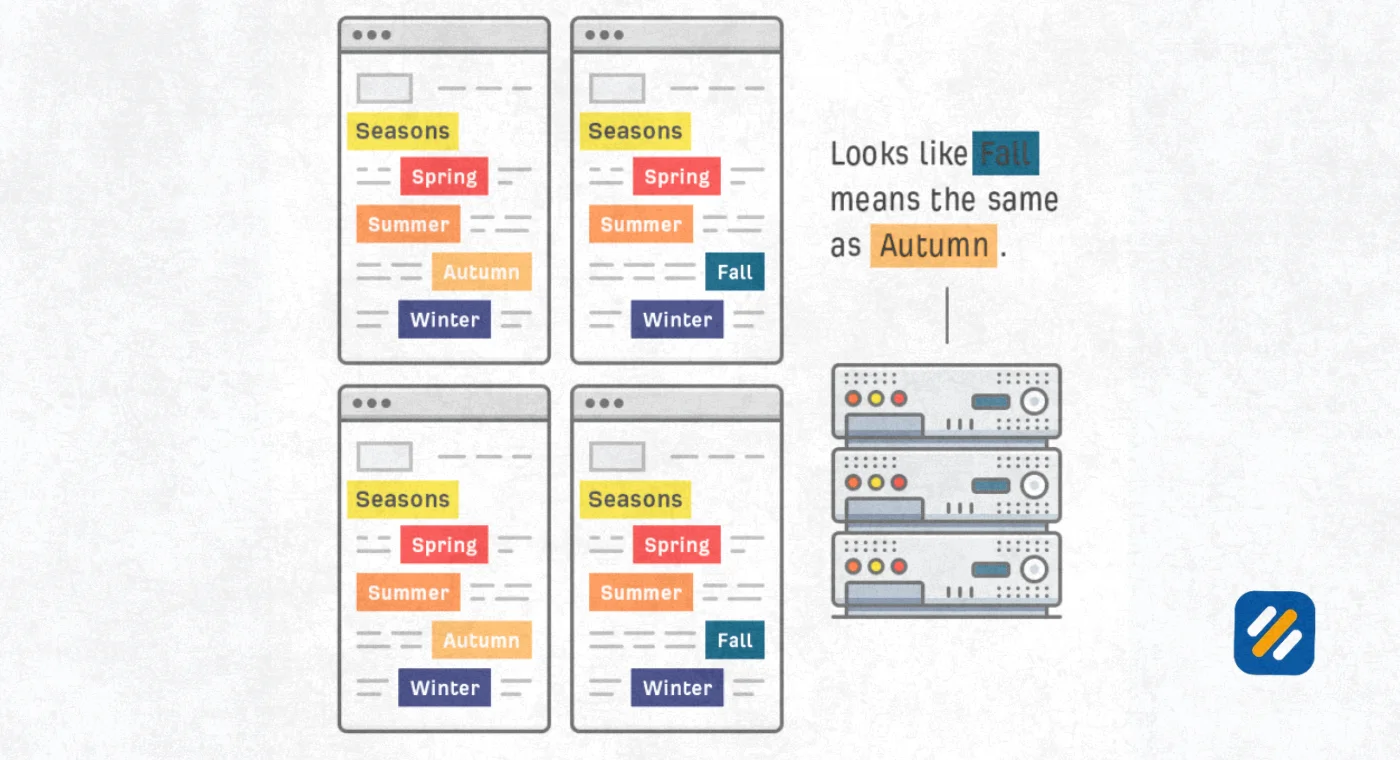
The technique works by building a matrix of terms and documents, then applying a mathematical method called singular value decomposition to find hidden, or latent, relationships between words that frequently appear together. In plain language, it was a way for a computer to guess that two documents were related even if they did not share the exact same words.
The important detail people miss is scale. Latent semantic indexing keywords were designed for small, fixed collections of documents, like a university library catalog, not for a constantly changing web made of trillions of pages. That mismatch is the entire reason the technique never made it into modern web search engines the way SEO folklore claims.
3 Does Google Actually Use LSI Keywords
No. This is one of the few places in SEO where a Google representative has addressed a myth in exact, unambiguous words. In July 2019, Google's Search Advocate John Mueller responded to a question about LSI keywords on social media by stating plainly, "There's no such thing as LSI keywords." He repeated a version of that same correction again in 2023 when the topic resurfaced.
Bill Slawski, one of the most respected patent researchers in the SEO industry before his passing, spent years reviewing Google's public patents and found no evidence that Google's ranking systems ever used latent semantic indexing as a technique. His research lines up with what Mueller said directly.
So why does SEO LSI still show up in so many guides? Mostly momentum. The term became popular in the mid 2010s, tools were built and marketed around it, and once a piece of terminology sticks in an industry, it tends to outlive the facts that disproved it. Understanding this history matters because it changes how you should actually use the concept.
The Honest Takeaway: Google does not use LSI keywords as a ranking signal, because latent semantic indexing was never built into its search algorithm. What Google does use is a combination of neural matching, BERT, and its knowledge graph to judge whether your content genuinely covers a topic. The result looks similar on the surface, use related terms, but the mechanism behind it is completely different.
4 LSI Keywords vs Semantic SEO: How They Are Actually Connected
This is where a lot of confusion comes from. LSI keywords and semantic SEO get used almost interchangeably in casual conversation, but they are not the same thing, and understanding the difference will save you from wasting time on the wrong tactic.
Semantic SEO is the modern, evidence backed practice of optimizing content around topics, entities, and search intent, using the way Google's current systems, like the knowledge graph and BERT, actually understand language. LSI in SEO is an outdated technique from the 1980s that inspired part of that idea but was never the mechanism behind it.
Think of it this way. LSI keywords were the industry's first, imperfect attempt to explain why covering a topic thoroughly seemed to help rankings. Semantic SEO is the accurate, current explanation for the exact same observation. If you want the full picture of how modern semantic search actually works, entities, topical authority, and schema markup included, that is worth exploring as its own topic once you have the keyword side covered here.
5 Why Related Keywords Still Matter, Even Though the LSI Label Is Wrong
Here is the part that should not get lost in the myth busting. Even though the term LSI keywords is technically inaccurate, using semantically related keywords naturally throughout your content produces real, measurable SEO benefits. The label is wrong, the practice is not.
Broader ranking potential: a page that naturally covers related terms tends to rank for dozens of long tail variations it never explicitly targeted
Stronger topical depth: content that uses the full vocabulary of a subject signals genuine expertise rather than a thin, keyword focused page
Lower risk of keyword stuffing: when you write naturally about related concepts, you stop needing to repeat your exact primary keyword unnaturally
Better chances in AI Overviews: answer engines favor content that demonstrates complete topic coverage rather than a single narrow phrase
Improved user experience: readers get a genuinely more useful page, which supports longer time on page and fewer people bouncing back to the search results
None of these benefits come from the mythical version of LSI. They come from the same place all good SEO comes from now, which is writing content that actually satisfies the person searching.
6 How to Find LSI Keywords: Ten Free and Practical Methods
Finding LSI keywords, or more accurately, finding semantically related keywords, does not require expensive software. Here are the methods I actually use when researching a new topic for a client.
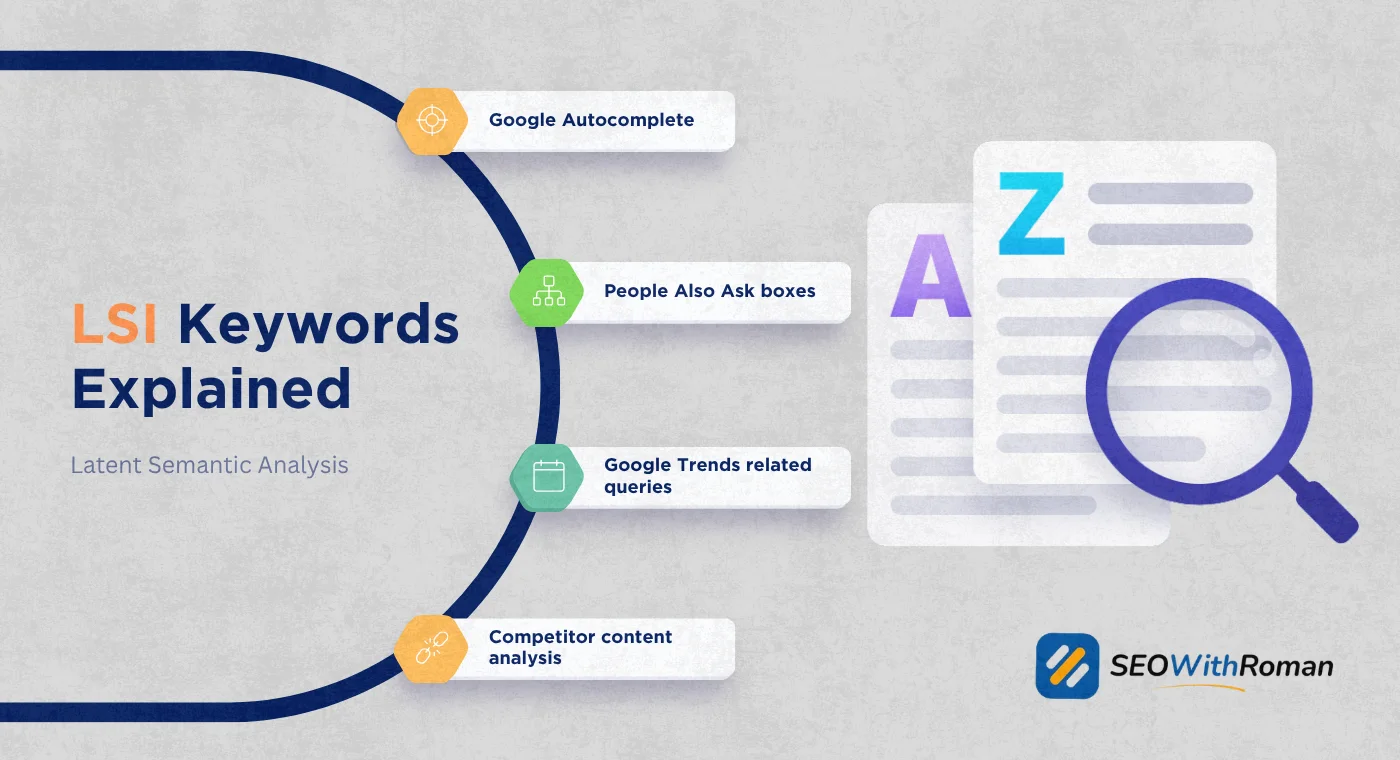
1: Google Autocomplete. Type your main keyword into Google's search bar and note every suggestion that appears before you finish typing. These come directly from real searcher behavior.
2: People Also Ask boxes. Search your keyword and expand every question in the People Also Ask section. Each one reveals a related subtopic worth covering in your content.
3: Related Searches at the bottom of the results page. Scroll to the bottom of any Google results page for a list of closely related search terms people also use for that topic.
4: Google Trends related queries. Enter your keyword into Google Trends and check the "Related queries" panel to see rising and top searches connected to your topic.
5: Competitor content analysis. Read the top five ranking pages for your keyword and list every subtopic and term they all mention, since overlap usually signals genuine topical importance.
6: Reddit and Quora threads. Search your topic on Reddit or Quora to see the exact language real people use when discussing it, which is often more natural than tool generated lists.
7: Wikipedia's table of contents. Open the Wikipedia page for your broad topic and scan its section headings for the subtopics an encyclopedic source considers essential.
7 LSI Keywords Generator Tools: Free and Paid Options Compared
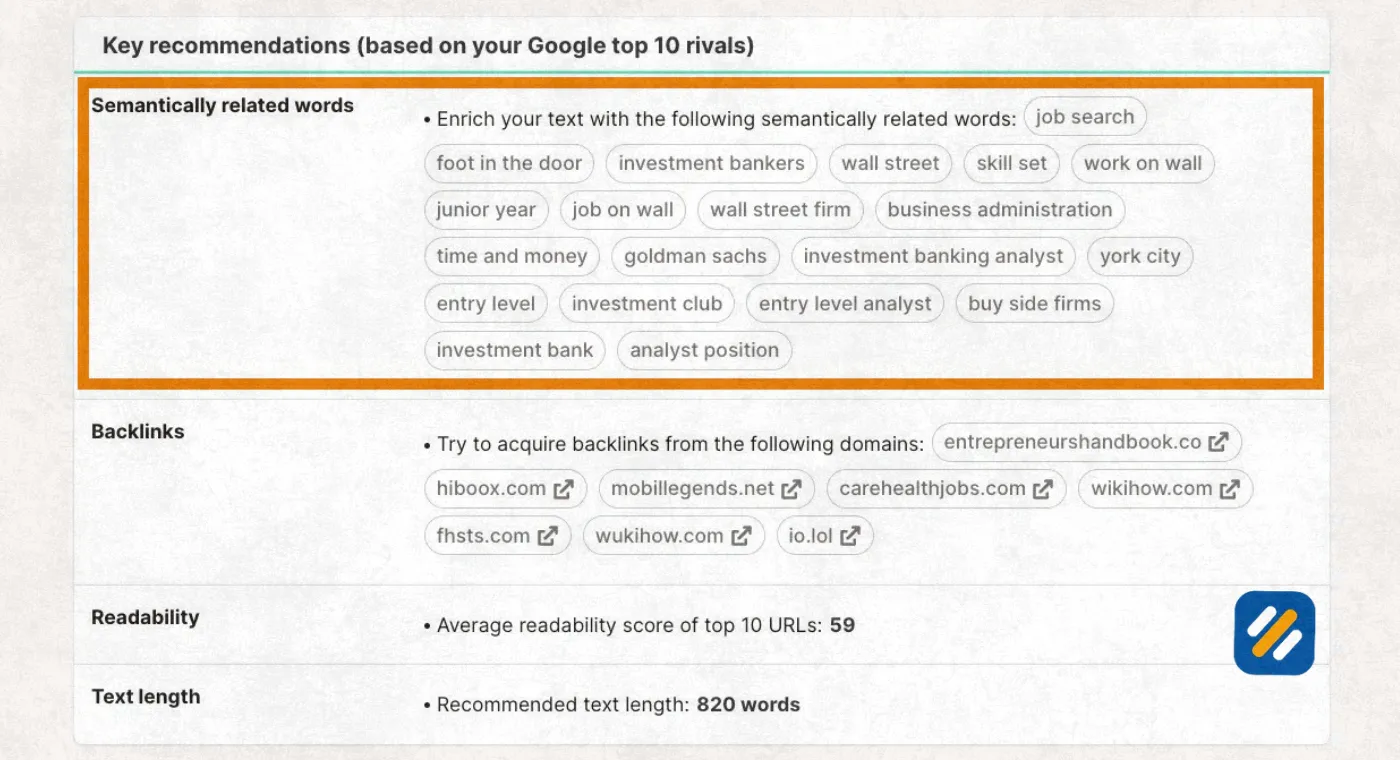
If you want to speed up the process above, several tools exist to generate LSI keywords automatically. It is worth knowing what each one is actually doing behind the scenes before you rely on it.
| Tool | Type | What It Actually Does |
|---|---|---|
| Google Keyword Planner | Free | Shows real related keyword ideas and search volume data straight from Google Ads |
| AnswerThePublic | Free tier available | Visualizes real questions and phrases people search around your keyword |
| Google Trends | Free | Reveals rising and related search queries connected to your topic over time |
| LSIGraph | Freemium | Generates a list of related terms, though the name overstates the underlying method |
| Ahrefs Keywords Explorer | Paid | Shows genuinely related keywords through its "Also rank for" and "Also talk about" reports |
| Google's Natural Language API | Free demo, paid at scale | Shows how Google's own language models classify entities and salient terms in your text |
Pro Tip: Do not trust a generator list blindly. Run every suggested term through a quick gut check: would a genuine expert on this topic naturally say this phrase out loud? If the answer is no, skip it, no matter how official the tool looks.
8 How to Use LSI Keywords in Your Content the Right Way
Once you have a list of semantically related keywords, placement matters more than volume. Here is where to use them without it feeling forced.
Headings and subheadings: use related terms naturally in a few H2 or H3 headings instead of repeating your exact primary keyword in every single one
The first one hundred words: introduce a couple of related concepts early so both readers and search engines understand the full scope of the page immediately
Body paragraphs: weave related terms into sentences exactly as you would explain the topic to a colleague, never as a standalone dumped list
Image alt text: describe images using natural, related language instead of repeating the same keyword phrase on every image
Meta description: a related term here can help your snippet feel more relevant and complete to someone scanning the results page
The test I use with every client draft is simple: read the paragraph out loud. If a related keyword makes the sentence sound like something you would actually say, keep it. If it makes the sentence sound like a keyword list wearing a sentence's clothing, cut it.
9 LSI Keywords Example: Seeing It in Practice
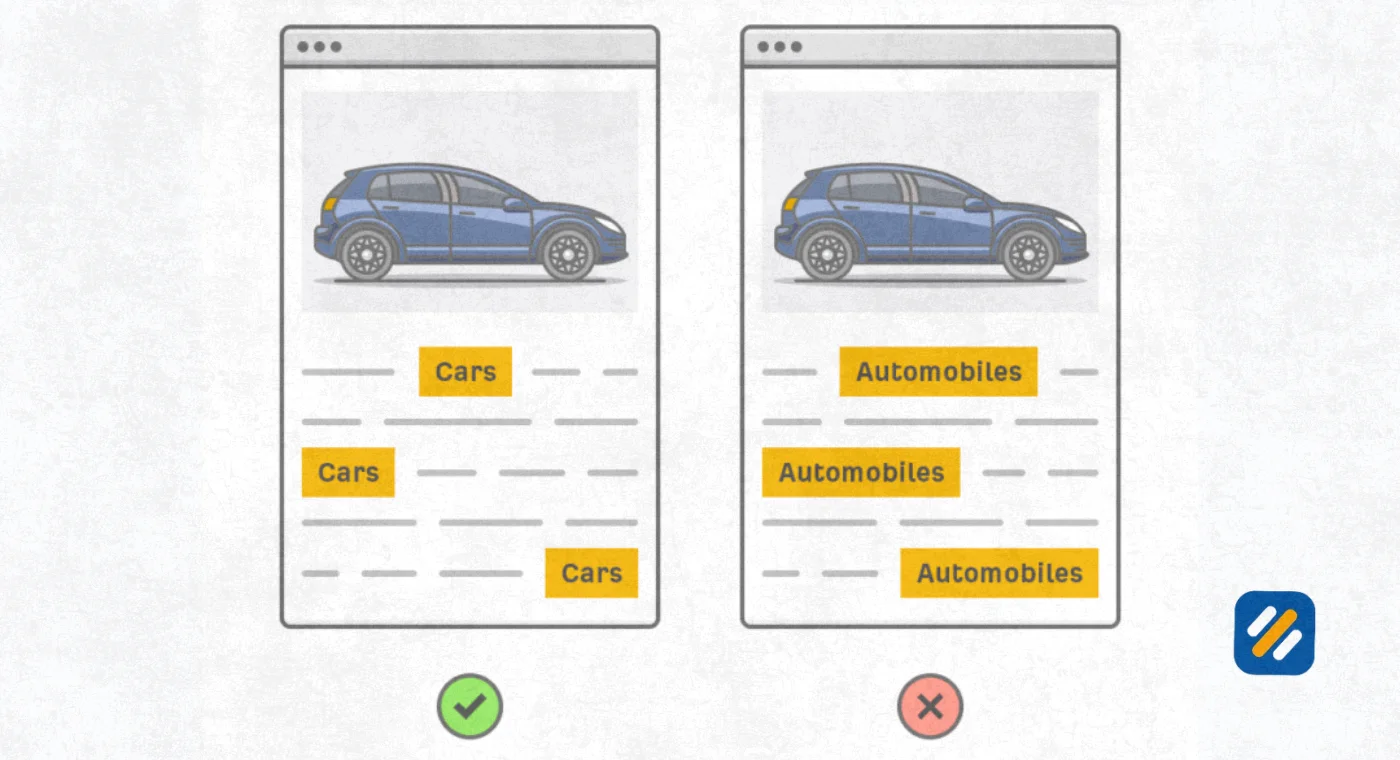
Abstract advice is hard to apply, so here is a worked example. Say your primary keyword is "home coffee brewing." A page targeting only that exact phrase repeatedly would miss most of what a real coffee guide needs to cover.
| Primary Keyword | Naturally Related Terms a Real Article Would Include |
|---|---|
| Home coffee brewing | coffee grind size, French press, pour over method, water temperature, coffee to water ratio, espresso machine, bean freshness, brewing time |
Notice that none of these terms are synonyms for "home coffee brewing." They are the surrounding vocabulary a genuine coffee enthusiast would use without thinking twice. That distinction is the entire difference between real topical depth and a forced LSI keyword list.
10 Common Mistakes People Make With LSI Keywords
Treating a generator's list as gospel: automated tools sometimes suggest terms that are only loosely related, and blindly including them dilutes your content's focus
Keyword stuffing under a new name: repeating a long list of related terms unnaturally is exactly the same mistake as keyword stuffing, just with a different vocabulary
Ignoring search intent: a page can include every related term imaginable and still fail if it does not answer the actual reason someone searched
Believing it is a direct ranking factor: related keywords help through better topical coverage, not because Google is literally scoring you on an LSI checklist
Skipping original insight: no amount of related keywords replaces genuine, first hand knowledge of the subject you are writing about
11 Trusted Sources for Further Reading
If you want to verify any of this yourself, these are the primary sources worth reading directly.
| Source | Why It Matters | Link |
|---|---|---|
| Search Engine Roundtable | Documented John Mueller's original statement debunking LSI keywords | seroundtable.com |
| Google Search Central | Official documentation on how Google's ranking systems actually work | developers.google.com/search |
| Google's Natural Language API | Lets you see how Google's own models identify entities and salient terms in text | cloud.google.com/natural-language |
| Google Trends | Free source of real related and rising search queries for any topic | trends.google.com |
12 3 Expert Tips for Using Related Keywords Effectively
Tip 1: Write the outline before you touch a keyword tool. Draft your content outline from real knowledge of the topic first, then check it against a keyword tool afterward. This order matters. Writers who start with a tool's list tend to write around the keywords, while writers who start with real expertise naturally include the right terms and simply use the tool to catch anything they missed.
Tip 2: Group related terms by subtopic, not by list. Instead of one long list of forty related terms, sort them into small clusters that match natural sections of your article. This turns a keyword list into an outline, which is a far more useful way to actually structure content that reads well.
Tip 3: Check your draft against a competitor with real authority. Pick the single best performing page for your target keyword and read it after you finish your own draft. Note anything they cover that you missed. This is not about copying their structure, it is a final check that you have not left an obvious subtopic out.
13 Conclusion
LSI keywords are a case where the name is wrong but the habit behind the name is genuinely worth keeping. Google has been direct about this: latent semantic indexing was never part of how modern search ranks content, and treating a related keyword list as a literal ranking checklist misunderstands how search actually works today.
What actually moves the needle is simpler and more honest than any generator tool. Understand your topic deeply enough that the right related terms show up in your writing naturally, structure your content around real subtopics instead of a keyword list, and use tools only to double check your own expertise rather than replace it.
Start your next article by drafting from what you actually know about the topic, then run it past one free tool like Google's Related Searches to catch anything you missed. That single habit will do more for your rankings than any list of LSI keywords ever could.
Have a question about LSI keywords or how to find the right related terms for your content? Drop a comment below and I will answer it personally.
Join 1,000+ business owners and bloggers who get one actionable SEO tip every week — straight to their inbox. Free forever.
Get Free Weekly Tips →