- What SEO marketing is and how it differs from paid ads
- Whether SEO is paid or free, and whether it counts as an IT skill
- How to do SEO as a beginner, and when doing your own SEO stops making sense
- A seven step process, scorecard and red flag list for choosing an agency focused on AEO visibility
- What to expect in the first 90 days and which numbers to ask for
1 What Is SEO Marketing?
SEO stands for search engine optimization. So if you've ever typed "what is seo mean" into a search bar, here is the short answer: it's the work of making a website easy for search engines to find, understand and trust. SEO marketing is the business side of that work, where each improvement is tied to leads, sales or brand awareness.
It lives inside digital marketing and sits beside email, social and paid ads. You'll also see it called SEO digital marketing, digital marketing SEO or search engine optimization marketing. Italian and French speaking teams often write strategie SEO for the same idea. The label changes, the job doesn't.
One common mix up is worth clearing early. Some people say SEO advertising, but organic rankings aren't ads. You don't pay per click, and you can't buy a position. That is also why the first organic result matters so much. Backlinko data cited by Coursera puts its share of clicks at 27.6%, and clicks fall sharply on page two.
2 How SEO Marketing Works: The Four Stages
Every search engine does roughly the same four things, and each one is a place where SEO can help or hurt you.
| Stage | What happens | What you control |
|---|---|---|
| Crawl | Bots discover pages through links and sitemaps | Internal links, XML sitemap, robots rules |
| Index | The page is stored and understood | Clean HTML, unique content, canonical tags |
| Rank | Pages are ordered for a query | Relevance, quality, links, page experience |
| Retrieve and cite | AI features pull pages to support an answer | Clear answers, checkable facts, consistent brand details |
That fourth stage is new enough to deserve a note. Google says AI Overviews and AI Mode may use a "query fan-out" technique, which means issuing several related searches across subtopics before building an answer. In practice, one page rarely wins alone. A cluster of pages that covers a topic from several angles has better odds, and that is why SEO content marketing is no longer optional.
3 The Main Types of SEO Marketing
- On-page SEO: the content and structure of a page, including titles, headings, copy and internal links.
- Off-page SEO: signals from outside your site, mainly backlinks and brand mentions.
- Technical SEO: how easily search engines can crawl and load your site, from speed to structured data.
- Local SEO: visibility for location based searches, led by your Google Business Profile.
- Content SEO: the planned publishing that answers real questions across the buying journey.
Here is the part most guides skip. When you evaluate an agency later, ask which of these five they do in-house and which they outsource. An agency that is strong on content but sends technical work to a freelancer you never meet creates gaps that surface in month four.
4 SEO vs AEO vs GEO: What Actually Changes
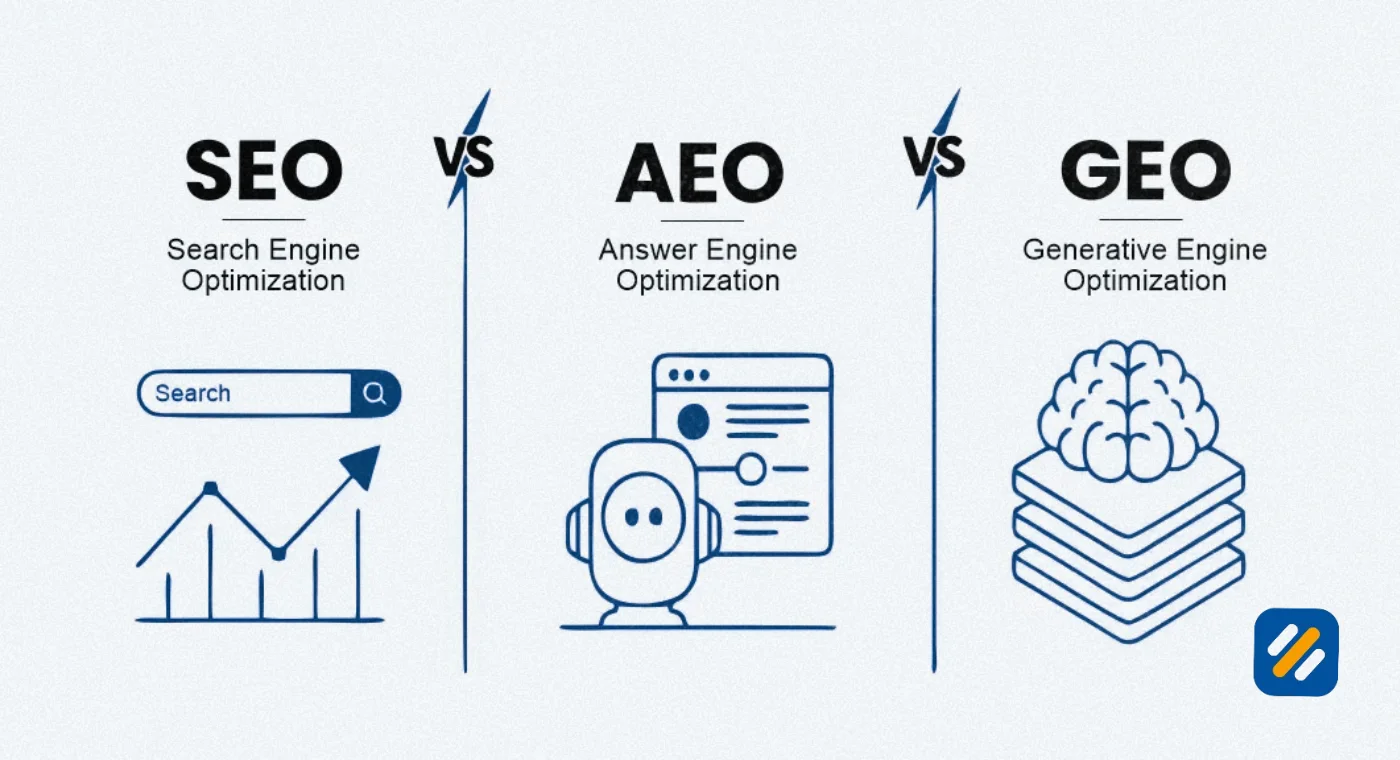
AEO means answer engine optimization. GEO means generative engine optimization. Both are part of the same family as classic SEO optimization, with a different finish line.
| Term | Goal | Where it shows up | What you'd track |
|---|---|---|---|
| SEO | Rank your pages | Blue links, snippets | Rankings, clicks, conversions |
| AEO | Be the direct answer | Featured snippets, voice, AI Overviews | Answer appearances, question query impressions |
| GEO | Be cited by generative tools | AI Mode, ChatGPT, Gemini, Perplexity answers | Mentions, citations, branded searches |
Now the reality check. Google's documentation says there are no additional requirements to appear in AI Overviews or AI Mode, and no special optimizations are necessary. It has also said you don't need new AI text files or special markup. So AEO is a lens, not a loophole. It rewards pages that give a clear answer early, back it with facts someone can verify, and come from a brand the web recognizes. Remember that sentence, because it becomes your best filter when an agency pitches you "secret AI tactics."
5 Is SEO Paid or Free? The Honest Answer
SEO is free in one sense: you never pay a search engine for an organic ranking. It is not free to do, though. You pay with hours, tools or people.
| Cost bucket | Doing it yourself | Hiring an agency |
|---|---|---|
| Money | Mostly tools and any freelance help | Retainer, project fee or hourly rate |
| Time | Several hours a week, often more at the start | Your time shifts to approvals and feedback |
| Risk | Slow learning curve | Paying for work that doesn't fit your goals |
| Free essentials | Google Search Console and basic analytics | Same tools, set up for you |
Paid search works differently. Ad clicks stop when the budget stops. An SEO marketing program takes longer to ramp, but a page that ranks keeps working without a per click fee. Many SEO studies and case write ups show the strongest results come when both channels support each other, so treat it as a budget mix, not a fight.
6 Is SEO an IT Skill?
Partly, but mostly no. SEO borrows from IT, writing, research, analytics and public relations. Only one slice of it needs a developer's mindset.
| SEO task | Skill family | Coding needed? |
|---|---|---|
| Site audits, speed, structured data | IT and development | Some |
| Keyword and intent research | Research and analytics | No |
| Page copy and editing | Writing | No |
| Earning links and mentions | Communications | No |
| Reporting | Analytics | Light |
This matters for hiring. Coursera notes that businesses often work with web developers on technical SEO. A healthy agency team therefore has a technical lead, a content lead and someone who handles outreach. If one person claims to do everything brilliantly, ask who covers the rest.
7 How to Do SEO as a Beginner: A Seven Step Starter Plan
If you're starting SEO for a website with no experience, this order keeps you from wasting a month.
1: Set up Google Search Console and an analytics tool first. You need a baseline before you change anything.
2: Choose the pages that make money. Services, products, booking pages. Improve these before the blog.
3: Learn search intent. Search your target keyword and look at what ranks. Is it information, a comparison or a purchase page? Match that.
4: Fix titles and descriptions. Coursera suggests 50 to 60 characters for a title tag and up to 160 for a description, with one clear H1 per page.
5: Handle the basics. Check mobile layout, compress large images, fix broken links and submit your sitemap.
6: Claim your Google Business Profile if you serve a local area, and keep your name, address and phone number identical everywhere.
7: Earn a few real links. Partners, suppliers and local publications are easier than strangers.
Then review monthly and give each change a few weeks before judging it.
Tip 1: Keep a change log. Write down every edit with its date and the page it touched. When traffic moves, you'll know which change to credit or undo. Beginners who skip this end up guessing.
8 Can You Do Your Own SEO? Yes, Until You Hit These Five Walls
Yes, you can. Google's own help page says its SEO starter guide describes much of what an SEO professional will do for you. Plenty of small sites grow on DIY effort alone. These five walls are where it usually stalls:
- A site migration or redesign where one wrong redirect can erase rankings
- A sudden traffic drop you can't explain
- Hundreds of pages that need a template level fix
- Technical limits in your platform that you can't edit
- A competitive niche where outreach and content volume decide the winner
When two or more of these apply, seo marketing help from a specialist usually pays for itself.
9 When Is It Time to Hire SEO Marketing Help?
| Your situation | Better path |
|---|---|
| One small site, you can edit pages, a few spare hours weekly | DIY with the starter plan |
| Local business with one location | DIY plus a one time audit |
| Ecommerce store with hundreds of products | Agency or in-house specialist |
| Planned migration or rebrand | Hire before launch |
| You want AI visibility across several topics | Agency with content and PR depth |
Google adds two useful points. Hiring earlier tends to work better. And if you aren't willing to make the changes an SEO recommends, hiring one isn't worthwhile.
10 How to Choose an SEO Agency for AEO Visibility: Seven Steps
Step 1: Define the outcome before you shop
"Rank number one" isn't an outcome. Try something measurable instead: qualified leads from organic search, and being named in AI answers for your three core questions. Write that down. Every agency should be judged against it.
Step 2: Build your shortlist from referrals, not cold emails
Google warns you to be wary of firms that email you out of the blue. Ask peers in your industry, check agencies that publish how they work, and read client reviews on independent platforms.
Step 3: Run a two-way interview
A good agency asks as many questions as you do. Google says a quality SEO will be interested in your business, such as what makes it unique, who your competitors are and how customers find you. If the first call is all slides and no questions, that tells you how the work will feel.
Step 4: Ask the AEO questions
These separate agencies that understand answer engines from those who added "AEO" to a pitch deck:
- How would you make our pages easy to quote, and which pages first?
- How do you check whether AI tools mention or cite our brand today?
- What do you do off our site to build recognition, such as press, partnerships and reviews?
- Which AI visibility tactics do you consider unproven, and why?
- How do you report AI mentions next to organic traffic?
The fourth question is the trap. A strong answer is honest about uncertainty. A weak one promises a special file, secret schema or guaranteed citations.
Step 5: Pay for an audit before a retainer
Google notes that you may be asked to pay for an audit, and that it should give realistic estimates of improvement and the work involved. Treat that as a cheap test. An agency that arrives with a ready made to-do list and no audit is selling a template, not strategy.
Step 6: Check references and case studies
Ask past clients whether the work was useful and easy to collaborate on, which is also Google's advice. Ask the agency for results beyond rankings: leads, revenue, assisted conversions.
Step 7: Read the contract slowly
Find out whether you pay hourly, monthly or per project, how often invoices are due, and whether early termination carries fees. Make sure you keep ownership of your content and admin access to Search Console, analytics and your CMS.
Tip 2: Give read-only access first. Start the engagement with view-only access to Search Console and analytics. Expand permissions after the audit proves the agency knows what it is doing.
The agency scorecard
| Criterion | Green flag | Red flag |
|---|---|---|
| Promises | Realistic ranges and a stated method | Guaranteed first page rankings |
| Onboarding | Asks for site and analytics access and past audits | Starts work without looking at your data |
| Approach | Custom plan built from an audit | The same checklist for every client |
| AEO claims | Explains what is proven and what is testing | Says a special file or markup is required |
| Transparency | Shares every change made to your site | Vague about tactics |
| Pricing | Clear scope, deliverables and terms | Far cheaper than every other quote |
More red flags worth knowing
- They claim an inside relationship with Google or any search engine.
- They ask you to link to them. Google says you should never have to.
- They hide behind jargon when you ask what they will actually do.
- They promise results in a few weeks.
Remember that Google also says you are responsible for the actions of any company you hire. Understanding their method protects you.
Tip 3: Start with a 90 day pilot. Agree on defined deliverables, a baseline report and a review date before committing to a 12 month contract. A confident agency won't mind.
11 What to Expect in the First 90 Days
| Window | Typical agency work | What you should see |
|---|---|---|
| Month 1 | Access, audit, baseline and priorities | A written audit and a clear plan |
| Month 2 | Technical fixes, content briefs, page updates | A change log and first publishing |
| Month 3 | New and refreshed pages, outreach, first report | Early movement in impressions and queries |
Speed varies by site and niche. Even so, be skeptical of anyone promising dramatic outcomes in the first few weeks.
12 How to Measure SEO Marketing Results, Including AI Visibility
Ask for a baseline in week one, then a monthly view of these:
- Organic clicks and conversions from Search Console and analytics
- Branded searches, which rise as more people learn your name through search and AI answers
- AI mentions and citations, checked by running the same set of questions monthly and logging what appears
- Impressions on question style queries, a sign your answers are getting surfaced
Google notes that sites appearing in AI features are included in overall Search Console traffic, so the data you already have is a starting point. Pair it with your own prompt log, and you'll see where SEO and internet marketing efforts overlap.
13 The Bottom Line
SEO marketing rewards patience, clarity and proof. Learn the basics well enough to ask sharp questions, then pick an agency that interviews you back, audits before it promises, and reports AI visibility honestly. Do that, and you'll be buying a partner, not a pitch deck.
Join 1,000+ business owners and bloggers who get one actionable SEO tip every week — straight to their inbox. Free forever.
Get Free Weekly Tips →