- A straight answer on which SEO tool to pick for AEO, based on your budget and team size
- What AEO (answer engine optimization) means, and how it differs from GEO, AIO, and classic SEO
- Whether AEO will replace SEO, using what Google itself says
- How AEO tools work behind the dashboard, and what they cannot tell you
- A practical AEO strategy you can start this week, with or without paid software
- A fair comparison of the best AEO tools for 2026, with approximate prices and honest limits
Short answer: yes, but it depends on what you want the tool to do. If you already pay for Semrush or Ahrefs, switch on their AI visibility add-ons first. If you are starting from zero, begin with a low-cost tracker such as Otterly or HubSpot’s AEO tool, or a free grader, before you sign anything enterprise. And keep one thing in mind: no tool improves AEO by itself. A tool shows you where AI answers mention you, skip you, or get you wrong. The improving happens in your content, your site, and the places across the web that talk about you.
That is the honest version of the question “can you recommend an SEO tool to improve AEO?” and the rest of this guide unpacks it, with a shortlist, a plain explanation of how these tools work, and a strategy that does not depend on any single product.
1 Can You Recommend an SEO Tool to Improve AEO? The Short List
Here is the shortlist, organized by the situation you are probably in. Prices are approximate and were checked against public write-ups in September and October 2026, so confirm them on each vendor’s site before you buy.
| Your situation | Start with | Why | Approx. entry cost |
|---|---|---|---|
| Already pay for Semrush | Semrush AI Visibility Toolkit | AI metrics sit beside the keyword data you already use | About $99 per domain per month (reported) |
| Already pay for Ahrefs | Ahrefs Brand Radar | AI mentions and off-site sources next to your backlink data | Sold as an add-on, check Ahrefs pricing |
| Use HubSpot | HubSpot AEO | Visibility score, citation analysis, and recommendations in one place | $50 per month, per HubSpot |
| Solo marketer or tiny budget | Otterly Lite, or a free grader | Cheapest way to find out whether AI mentions you at all | From $29 per month |
| Agency with many clients | Peec AI or Otterly Standard | Multi-brand reporting and unlimited seats | From about $95 per month (Peec) |
| Enterprise, regulated industry, or attribution needed | Profound | Real prompt data, crawler analytics, and published compliance | Quote based for most teams |
| Want fixes written and published, not just reported | Frase, AthenaHQ, or Writesonic | Tracking tied to content workflows | Varies, trials available |
| Ecommerce brand | Yotpo Discover | SKU-level tracking built around reviews and product data | Waitlist at time of writing |
Treat this as a starting point, not a ranking. Section 8 compares the tools in detail, and section 9 shows how to choose.
One more thing I noticed while preparing this guide. I read the AEO guides and roundups published by HubSpot, Profound, Frase, and Yotpo, and every one of them ranks its own product first or recommends it as the answer. That is normal marketing, and I am not criticizing it, but it is a good reason to read any list, including this one, with your own criteria in hand. I built this guide from vendor documentation, Google’s own guidance, and independent pricing write-ups, and I have not hands-on tested every tool listed.
2 What Is AEO (Answer Engine Optimization)?
Answer engine optimization AEO is the practice of making your brand and content easy for AI answer engines to find, understand, trust, and cite when they respond to a question. Answer engines include ChatGPT, Gemini, Perplexity, Claude, Microsoft Copilot, and Google’s AI Overviews and AI Mode.
So what is AEO trying to win? Four things, roughly in this order: being mentioned, being cited with a link, being described accurately, and being recommended over alternatives. Notice that only one of those four involves a click. That is the biggest mindset shift from classic SEO.
If you are wondering what is answer engine optimization compared with the other labels floating around, this table untangles them.
| Term | Plain meaning | How people use it |
|---|---|---|
| SEO | Optimizing to rank in traditional search results | Measured by rankings, clicks, and traffic |
| AEO | Optimizing to be cited and recommended inside AI answers | Measured by mentions, citations, share of voice |
| GEO | Generative engine optimization, the tactics for generative AI answers | Often used interchangeably with AEO. Some teams treat GEO as the techniques and AEO as the overall strategy |
| AIO | Short for AI Overviews, Google’s AI summaries in search | Often confused with “AI optimization” |
| LLMO | Large language model optimization | Another label for roughly the same job |
AEO answer engine optimization, boiled down to one line, means making it easy for machines to quote you correctly. My advice is not to get stuck on the labels. The tools, tactics, and metrics overlap so heavily that you could swap AEO and GEO in most conversations and nobody would notice. AEO marketing, in practice, simply means pointing your content, PR, reviews, and community work at the places answer engines read, and then measuring whether it shows up in the answers.
3 Will AEO Replace SEO? No, and Here Is the Evidence
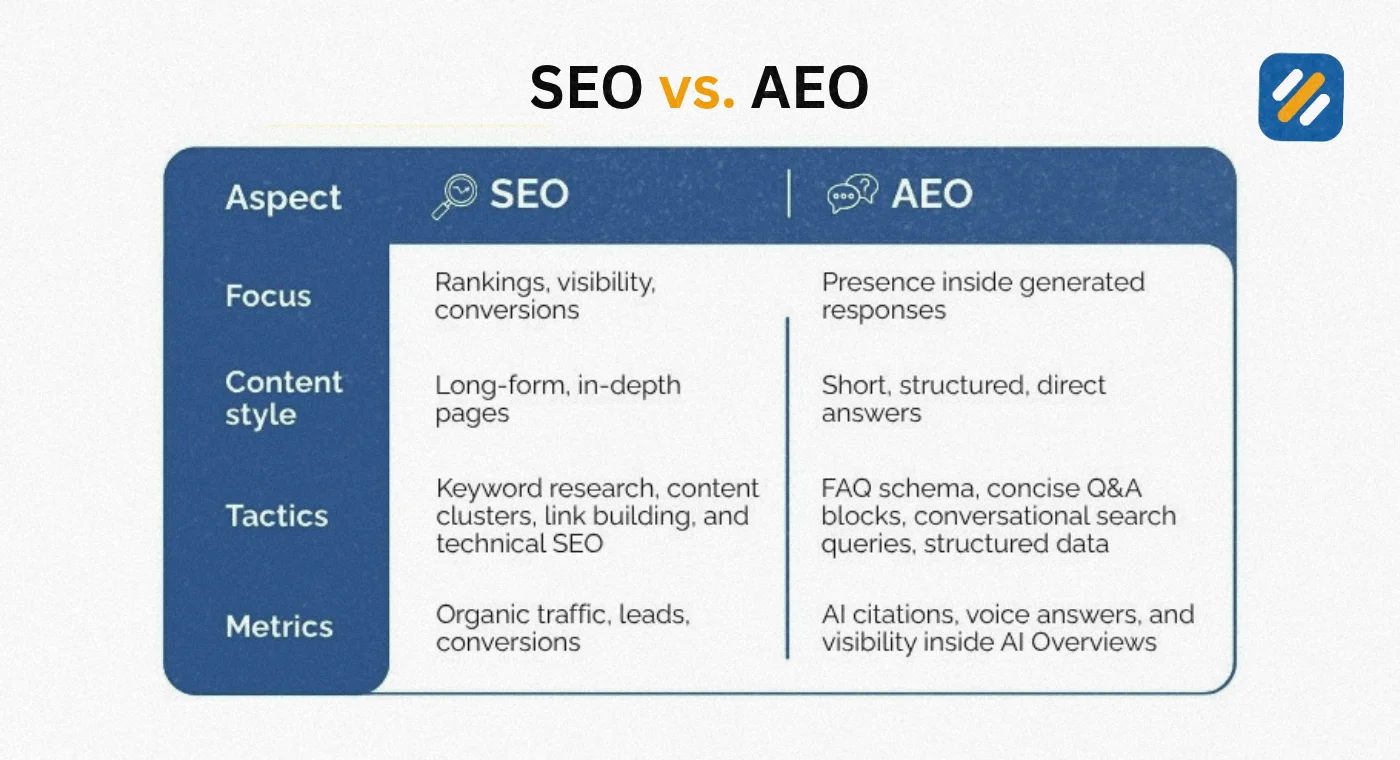
This is the question behind most AEO panic, so let me answer it directly. AEO will not replace SEO. It sits on top of it. The overlap in SEO AEO work is far bigger than the difference, and the proof comes from Google’s own documentation.
Google says the fundamentals still apply: Its guidance on AI features and your website states that SEO best practices remain relevant for AI Overviews and AI Mode, and that no special optimization is required to appear in them. A page needs to be indexed and eligible to show with a snippet.
AI answers are built from searches: Google explains that these features may use “query fan-out,” meaning they run multiple related searches across subtopics before writing a response. The answer draws from the same web index that classic search uses.
You now control your inclusion: Google added a Search Console setting that lets site owners choose whether their pages appear in and help ground generative AI features. Sites that opt out receive no traffic or impressions from those features, and Google says the control is not a ranking signal for regular results. If you manage a site, check that setting before you spend a dollar on any tool.
At the same time, ignoring AEO would be a mistake, because behavior is genuinely shifting
- Google says AI Overviews has more than 2.5 billion monthly active users and AI Mode has passed one billion monthly users.
- Pew Research Center’s analysis of browsing data found that people clicked a traditional result in about 8 percent of visits when an AI summary appeared, compared with about 15 percent when none did.
- HubSpot reported in January 2026 that 42 percent of CRM software buyers use AI search as part of their evaluation.
Put those together and the picture is clear. Fewer clicks go to informational pages, and more buying research happens inside answers. That does not kill SEO, it raises the value of being the source an answer engine trusts.
| SEO | AEO | |
|---|---|---|
| Main goal | Rank and earn clicks | Be mentioned, cited, and recommended in answers |
| Where you appear | A list of links | Inside a written answer or recommendation |
| Typical metrics | Rankings, impressions, clicks, CTR | Mention rate, citation share, share of voice, AI referral visits |
| Content shape | Pages built around keywords and intent | Self-contained, answer-first sections plus off-site proof |
| Stability | Rankings move slowly | Answers vary run to run, so you track trends |
| Typical tools | Rank trackers, site auditors, backlink tools | AEO trackers, citation analysis, prompt monitoring |
My take: keep SEO as your foundation and add AEO as a measured layer. Teams that treat them as rivals end up doing the same work twice.
4 How AEO Tools Work (and Why a Single Check Proves Nothing)
Under the dashboards, almost every AEO tool follows the same basic loop.
1: You define prompts. These are the questions your buyers ask, such as “best CRM for a five-person team” or “how do I fix a leaking boiler.”
2: The tool runs those prompts on a schedule across engines like ChatGPT, Gemini, Perplexity, and Google AI features. Some tools capture what a real user sees in the front end. Others call APIs, which can return a thinner or different answer.
3: It reads each answer for brand mentions, cited URLs, list position, and tone.
4: It aggregates the results into visibility scores, citation share, and share of voice against competitors you name.
5: Higher tiers add layers on top, such as recommendations, content briefs, crawler analytics, and attribution.
Here is the part vendors tend to underplay. AI answers are not stable. Profound’s research reports that the domains cited in AI answers can turn over by 40 to 60 percent month to month. That means a single manual check, or a single screenshot, tells you almost nothing. You need repeated runs, a decent prompt set, and a few weeks of data before a trend means anything.
| Metric | What it means | Watch out for |
|---|---|---|
| Mention rate | Share of tracked prompts where your brand is named | A mention without a link or a favorable tone is a weak win |
| Citation share | How often your URL is listed as a source | Different engines show citations very differently |
| Share of voice | Your mentions compared with named competitors | It depends entirely on which prompts you chose |
| Sentiment and accuracy | How the answer describes you | AI can state wrong facts about you confidently |
| AI referral traffic | Visits arriving from AI engines in your analytics | It undercounts, because many AI answers send no click or hide the referrer |
| Crawler activity | AI bots visiting your site, seen in server logs | Needs a CDN or log integration to see it |
Also be careful with “prompt volume” numbers. Some platforms say theirs come from real user conversations, and others estimate demand from keyword data. Even vendors in this space describe some of these numbers as directional. Use them to compare topics against each other, not as precise forecasts.
5 What an AEO Tool Cannot Do
A few honest limits, because a good tool and a good expectation go together.
- It cannot guarantee a citation. Nobody can see inside the models. Any vendor promising a result is selling you hope.
- It reflects the prompts you choose. Two tools can give the same brand very different scores because their prompt sets and engines differ.
- It cannot write your expertise for you. Tools can draft and score content, but original data, real examples, and a point of view have to come from your team.
- It cannot fix what lives off your site. If the community threads, reviews, and listings that describe you are thin or outdated, a dashboard will only confirm it.
6 How to Improve AEO: A Practical Strategy in Nine Steps
AEO optimization is mostly unglamorous work, and this is the part that actually moves results. You can start without buying anything.
1: Take a baseline. Write 25 prompts your buyers really ask. Run them in ChatGPT, Gemini, Perplexity, and Google AI Mode, logged out and with identical wording. Record whether you were mentioned, cited, described accurately, and which competitors appeared.
2: Check eligibility and access. Confirm your pages are indexed, confirm the Search Console generative AI setting is on, and make sure robots rules or firewalls are not blocking crawlers you want. Also make sure your key facts live in crawlable text, not only inside scripts, images, or pop-ups.
3: Write answer-first sections. Use headings that mirror real questions, then put a direct answer of roughly 40 to 60 words right underneath before adding detail. HubSpot recommends this pattern, and it also suits featured snippets. Make each section stand on its own, because engines often lift individual passages.
4: Add what only you can add. Original data, firsthand testing, named experts, real prices, and honest trade-offs. A 2023 academic paper on generative engine optimization reported visibility gains of up to 40 percent in generated answers from tactics such as more authoritative, better-sourced writing, and the lesson holds: specific beats generic.
5: Use structured data for clarity. Article, Organization, Product, and Review markup help describe your content unambiguously. Be realistic, though: Google says no special markup is required for its AI features. Treat schema as a clarity aid, not a switch.
6: Build off-site consensus. Answer engines cross-check. Make sure your brand is described consistently on your site, LinkedIn, review sites, industry lists, YouTube, and community forums such as Reddit. Ask happy customers for specific, detailed reviews rather than star ratings alone.
7: Keep key pages fresh. Update pricing, features, dates, and statistics the moment they change, and review your top pages every quarter. Stale facts spread fast through AI answers.
8: Work the gaps. Find prompts where competitors are named and you are not. Open the pages that get cited, and ask what they cover, show, or prove that yours does not.
9: Measure monthly and adjust. Track mention rate, citation share, AI referral sessions, branded search, and leads. Change one thing at a time so you know what worked.
| Tactic | What it influences | Tool type that helps |
|---|---|---|
| Baseline prompt log | Your starting visibility | A spreadsheet, or any AEO tracker |
| Crawl and rendering checks | Whether engines can read you | Site auditor, server logs |
| Answer-first rewrites | Passage-level citations | Content editor, outline tools |
| Original data and expert input | Trust and uniqueness | Nothing automated, this is human work |
| Off-site mentions and reviews | Consensus across sources | Citation analysis in AEO platforms, PR and review tools |
| Refresh cycles | Accuracy and recency | Content decay alerts, calendar reminders |
How fast does it work? Some tool vendors claim AI engines re-cite changed pages within weeks, while others say to expect a few months. My read is that small structural fixes can show up quickly, and brand-level trust takes longer. Plan on a quarter before judging.
7 AEO Marketing: Where It Fits in Your Funnel and How to Prove ROI
AEO search behavior looks different from keyword searching. People type full questions, add constraints, and ask follow-ups, so the buyer often arrives at your site already informed. HubSpot says AEO-sourced leads converted about three times better for its own business, though that is a vendor-reported figure and your numbers will differ. Still, it hints at why this traffic matters more than its small volume suggests.
Because many AI answers produce no click, you need a scorecard that goes beyond traffic
| KPI | How to track it | How often |
|---|---|---|
| Mention rate on your prompt set | AEO tracker or manual log | Weekly or monthly |
| Citation share vs. competitors | AEO tracker | Monthly |
| Accuracy of how you are described | Manual review of top 10 prompts | Monthly |
| AI referral sessions | Analytics (see tip below) | Monthly |
| Branded search impressions | Search Console | Monthly |
| Leads or sales from AI sources | CRM or “how did you hear about us” field | Monthly |
Analytics tip: in Google Analytics 4, create a custom channel group for AI referrals using a source rule that matches domains such as chatgpt.com, perplexity.ai, gemini.google.com, copilot.microsoft.com, and claude.ai. Adjust the list to whatever actually appears in your referral reports. Add a “how did you hear about us” question on your forms too, since AI answers often leave no trackable referrer.
8 Best AEO Tools for 2026, Compared
Searches for the best AEO tools and the best answer engine optimization tools return long lists, and many tools do different jobs. It helps to sort them by job first.
| Type of tool | Examples | What it does | Main limit |
|---|---|---|---|
| AEO trackers | Otterly, Peec AI | Monitors mentions, citations, and sentiment across engines | Mostly monitoring, so content work happens elsewhere |
| SEO suites with an AI add-on | Semrush, Ahrefs, Conductor, BrightEdge | Adds AI visibility beside familiar SEO data | Engine coverage and refresh speed can trail dedicated tools |
| AEO platforms with action layers | Profound, AthenaHQ, Frase, Writesonic, Goodie AI | Pairs tracking with recommendations, content, or attribution | More cost and more to learn |
| Content and question research | MarketMuse, AnswerThePublic | Finds topics and questions, shapes content for citation | Does not measure your AI visibility |
| Commerce-specific | Yotpo Discover | Tracks product-level visibility, ties in reviews | Built for ecommerce only |
Here is the side-by-side view. Prices are approximate entry points and change often, so verify them
| Tool | Best for | Approx. entry price | Standout | Watch out for |
|---|---|---|---|---|
| Semrush AI Visibility Toolkit | Teams already on Semrush | About $99 per domain per month | AI data beside keywords and backlinks | AEO content workflows are limited |
| Ahrefs Brand Radar | Teams already on Ahrefs | Add-on, varies | AI mentions plus offsite sources | Prompts reportedly keyword-derived, so treat as directional |
| HubSpot AEO | HubSpot users, beginners | $50 per month | Simple score, citation analysis, recommendations | Newer product, in beta at the time of writing |
| Otterly.ai | Solo marketers, small teams | $29 per month (15 prompts) | Cheap, fast setup | Small prompt limits, extra engines cost more |
| Peec AI | Agencies, multi-brand reporting | From about $95 per month | Clean reporting, unlimited seats | Report-focused, so content work is separate |
| Profound | Enterprise programs | Quote based for most teams | Deep data, crawler analytics, compliance | More than a small team needs |
| AthenaHQ | Teams wanting prescriptive fixes | Around $295 per month (reported) | Action Center recommendations | Output usually needs editing |
| Scrunch | Brands optimizing for AI agents | Roughly $250 to $300 per month | Serves AI-friendly pages to crawlers | Content generation is limited |
| Frase | Teams that want to fix and publish | Trial available, see site | Tracking linked to drafting and publishing | A content platform first, tracker second |
| Goodie AI | Mid-market teams | Check vendor | Monitoring, content, and attribution together | Newer and smaller |
| Yotpo Discover | Ecommerce brands | Waitlist | SKU-level tracking and review-based content | Commerce focus only |
Semrush AI Visibility Toolkit
If your SEO life already happens in Semrush, this is the least disruptive way to start. It adds share of voice, sentiment, and prompt tracking next to keyword and backlink data. The trade-off, according to a comparison published by a competing vendor, is narrower engine coverage and slower refreshes than purpose-built AEO tools, plus no AEO-specific content workflows. Best as a benchmarking layer on a suite you already fund.
Ahrefs Brand Radar
Brand Radar adds AI mention tracking, including offsite sources such as YouTube and Reddit, inside the Ahrefs environment. That is a smart fit if you already live in Ahrefs. A competing vendor’s comparison notes that its prompts are derived from keyword data rather than real AI conversations, so treat the numbers as signals rather than precise measurements.
HubSpot AEO
HubSpot’s tool runs your chosen prompts daily across ChatGPT, Perplexity, and Gemini, then shows a brand visibility score, citation analysis, competitor comparison, and prioritized recommendations. At $50 per month it is one of the cheapest guided ways to start, and HubSpot also offers free graders. HubSpot labels it beta at the time of writing, and the version tied to Marketing Hub Pro uses CRM data to suggest prompts.
Otterly.ai
Otterly is the budget entry point. Lite costs $29 per month for 15 tracked prompts across four base engines, with Standard at $189 for 100 prompts and Premium at $489 for 400. Claude, Gemini, and Google AI Mode are paid add-ons. It is a sensible way to learn whether AI mentions you before spending real money, but 15 prompts is a proof of concept, not a program.
Peec AI
Peec is a Berlin-built AI search analytics tool with a clean interface and a reputation for easy-to-share reports. Plans start at about $95 per month for 50 prompts and three models, with unlimited users. It is a strong pick for agencies reporting across many brands. It is mainly a monitor, so you will do the content work elsewhere.
Profound
Profound positions itself as an enterprise AEO platform, with large-scale prompt data, query fan-out views, content agents, and crawler analytics tied to traffic. Its own site lists SOC 2 Type II and HIPAA compliance, which matters for regulated industries. For most small teams it is more than needed, and most pricing is quote based.
AthenaHQ
AthenaHQ is known for its Action Center, which turns visibility data into specific next steps and can create tasks in tools such as Jira and Linear. It suits teams that want prescriptive guidance rather than raw dashboards. Expect to review and edit what it suggests, as with any generated recommendation.
Scrunch
Scrunch combines monitoring with an Agent Experience Platform that serves an AI-optimized version of your pages to crawlers without changing what humans see. It is an interesting idea for brands thinking about AI agents as a channel. A competing vendor’s comparison notes that monitored prompts are ones you configure and that content generation is still limited.
Frase
Frase is a content platform that has added AI visibility tracking. Its pitch is closing the loop: when a citation slips, you research, draft, score for SEO and GEO, and publish from the same place. It offers a free AI Visibility Checker and a 7-day trial. If your bottleneck is producing and updating content rather than measuring, it is worth a look.
Goodie AI
Goodie AI is a newer AI-first platform covering monitoring, an AEO content writer, and attribution for mid-market teams. It is a credible all-in-one option for teams that want fewer tools, though it is smaller and has a shorter track record than the established names.
Yotpo Discover
If you sell products online, Discover is built for that world. It tracks how products appear across ChatGPT, Gemini, and Google AI Overviews at the SKU and category level, and it connects to review and loyalty data. Access was waitlist based at the time of writing.
Also worth knowing: Conductor, BrightEdge, and Adobe LLM Optimizer extend large enterprise SEO stacks into AI visibility, MarketMuse helps plan content for topical depth, and AnswerThePublic is a cheap way to collect real questions. Writesonic and AirOps lean toward producing content at volume.
How popular is each tool? Instead of claiming a winner, I checked which names appeared across the vendor roundups I read. Profound, Semrush, Ahrefs, and Conductor showed up in at least three of them. Otterly, Peec AI, AthenaHQ, Scrunch, Writesonic, and Goodie AI each showed up in two or more. Appearing often does not mean performing best, but it does tell you which of the most popular answer engine optimization tools and top answer engine optimization software get compared most.
So what is the best AEO tool? There is no single best AEO tool, and anyone selling one answer is selling their product. For a small team, I would start with Otterly or HubSpot AEO. For an existing Semrush or Ahrefs shop, use the add-on you already own. For enterprise attribution and compliance, shortlist Profound and the suite vendors. For fixing and publishing, test Frase or AthenaHQ.
9 How to Choose the Right AEO Tool
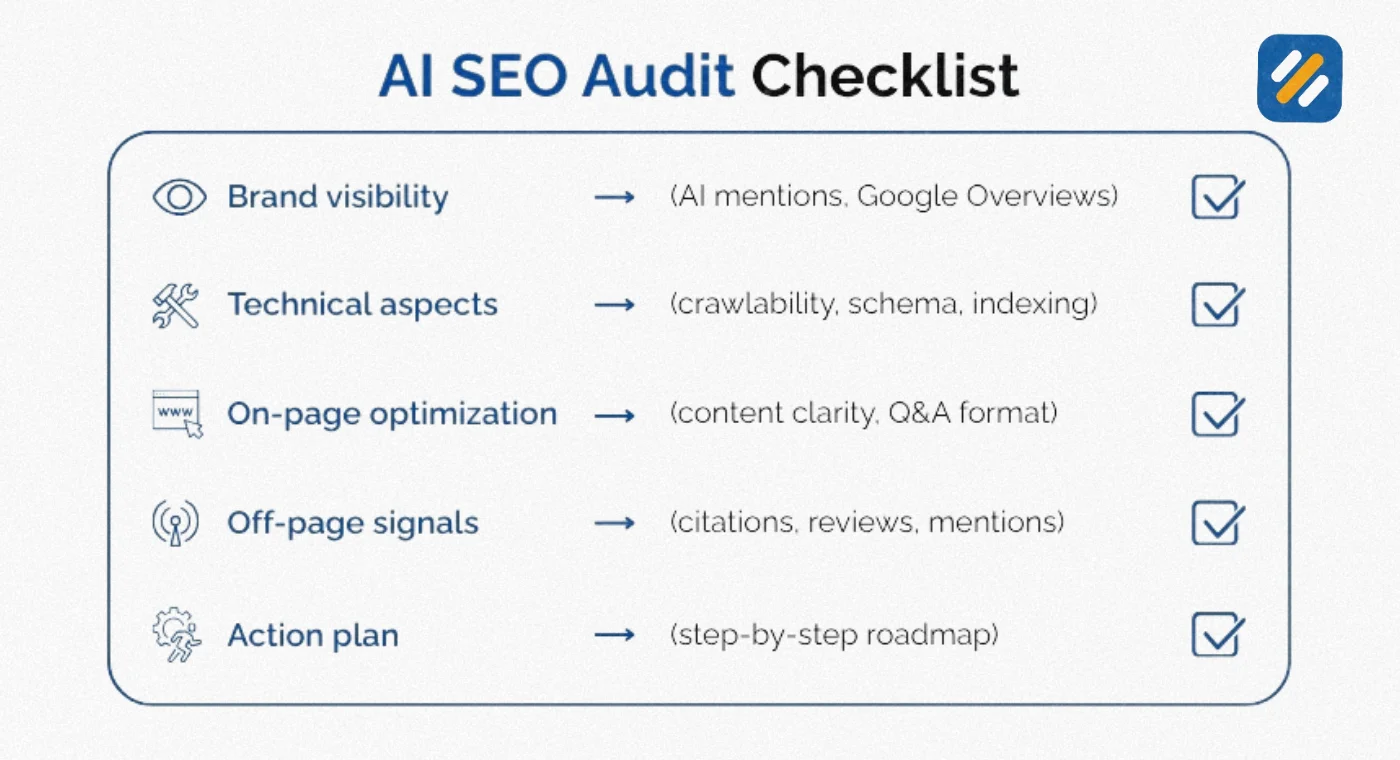
If your real question is still “can you recommend an SEO tool to improve AEO?”, this checklist is the fastest way to narrow it down. Use it when you evaluate any AEO platform, and write down the answers.
| Question to ask | Why it matters |
|---|---|
| Which engines are covered, and are they all daily? | Two engines is a slice of the picture, and weekly updates miss volatility |
| Where do prompts come from? | Real conversation data and keyword-derived guesses are different things |
| Does it capture real front-end answers or API output? | They can differ from what your buyers see |
| Can you see which sources get cited? | Source detail tells you what to fix |
| Can you benchmark named competitors? | Scores mean little without a comparison |
| Is there a content or action layer? | Without one, you need another workflow |
| Can you export data or use an API? | You will want it in your own reports |
| How is pricing metered: prompts, seats, credits, or domains? | Costs can balloon as you add prompts or engines |
| What security certifications exist? | Required in regulated industries |
| How easy is it to cancel? | Avoid annual lock-in until you trust the data |
Red flags: guaranteed rankings or citations, no disclosure of how data is collected, and a demo that only shows a polished score with no source-level detail.
Run a 14-day pilot. Pick 25 prompts. Run them manually, record the results, then compare them with what each shortlisted tool reports. If a tool’s numbers are wildly different from your manual checks and the vendor cannot explain why, move on. Most vendors offer trials, so this costs you time rather than money.
One more rule of thumb: a tool without an owner becomes shelfware. Decide who reads the dashboard weekly and who is responsible for acting on it before you subscribe.
10 The Free AEO Stack for Teams With No Budget
You can get a long way without paying. Here is a free setup.
| Need | Free option | Note |
|---|---|---|
| Eligibility and Google AI traffic | Google Search Console | AI features traffic is included in overall Web search performance, and the generative AI setting lives here |
| Quick baseline | Free graders from HubSpot, Ahrefs, Frase, and Backlinko | Good for a first snapshot, not a trend |
| Prompt tracking | A spreadsheet | Columns: prompt, engine, date, mentioned, cited, accurate, competitors named, notes |
| Question research | Google People Also Ask, autocomplete, AnswerThePublic’s free searches | Source prompts from real wording |
| AI referral tracking | Google Analytics 4 custom channel group | See the analytics tip in section 7 |
| Markup testing | Google Rich Results Test, Schema.org validator | Catches errors before publishing |
A weekly 30-minute routine is enough to start. Run your ten most important prompts, log the results, note which competitor pages get cited, and pick one page to improve.
11 AEO for Ecommerce and Local Businesses
Ecommerce. AI shopping answers lean on structured product facts and on what real buyers say. Use Product and Review markup, present specifications in clean tables and lists, and keep price and availability current. Google’s guidance also reminds merchants to keep Merchant Center information accurate. Detailed customer reviews matter because they provide the conversational, experience-based detail that answers draw on.
Local businesses. Keep your Google Business Profile complete and accurate, make sure your name, address, phone number, and services match everywhere they appear, and publish location or service pages that answer real local questions. Reviews that mention specific services and neighborhoods help engines match you to specific questions.
12 Best Answer Engine Optimization Services: When to Hire Help
Searching for the best answer engine optimization services usually means one of two things: you lack time, or you lack expertise. Here is a quick way to decide.
| Option | Best when | Trade-off |
|---|---|---|
| DIY with free tools | You have time and a small site | Slow, but great for learning |
| Tool plus in-house owner | You have a writer or SEO who can act on data | Needs a dedicated owner |
| Agency or consultant | You lack capacity or need strategy fast | Costs more, and quality varies widely |
If you hire, ask for proof. Request before-and-after share of voice on a named prompt set, the list of pages that gained citations, and a clear explanation of the process. Be cautious with anyone guaranteeing citations, anyone who cannot explain how they measure, and anyone selling the same package to every client. Retainer prices vary too much to quote responsibly, so get two or three proposals and compare deliverables, not just fees.
13 Common AEO Mistakes to Avoid
- Trusting one check. One screenshot of one answer is noise. Look at trends across prompts and weeks.
- Tracking only brand-name prompts. The real opportunity sits in unbranded questions where buyers have not picked a brand yet.
- Buying a tool before assigning an owner. A dashboard nobody acts on is a monthly bill.
- Ignoring off-site presence. Answer engines read reviews, forums, and third-party lists as well as your own site.
- Blocking crawlers by accident. Firewall and robots rules sometimes shut out the bots you want.
- Letting facts go stale. Old prices and outdated features get repeated by AI answers long after you change them.
- Writing for the engine, not the person. Thin FAQ blocks stuffed with keywords help nobody.
- Chasing every engine equally. Start where your audience actually asks questions.
14 Tools and Trusted Sources for AEO Research
| Resource | What it helps with | Link |
|---|---|---|
| Google: AI features and your website | Official guidance on AI Overviews and AI Mode | developers.google.com/search/docs/appearance/ai-features |
| Google blog: new controls for website owners | The Search Console generative AI setting and usage figures | blog.google/products-and-platforms/products/search/new-controls-website-owners |
| Google Search Console | Search performance and AI feature settings | search.google.com/search-console |
| Schema.org | The structured data vocabulary | schema.org |
| Pew Research Center: AI summaries and clicks | Independent data on click behavior | pewresearch.org/short-reads/2025/07/22/google-users-are-less-likely-to-click-on-links-when-an-ai-summary-appears-in-the-results |
| Generative Engine Optimization (academic paper) | Early research on visibility in generated answers | arxiv.org/abs/2311.09735 |
| HubSpot: AEO guide | Best practices and the HubSpot AEO tool | hubspot.com/products/marketing/aeo-guide |
| Profound: AEO platform comparison | A vendor view of 19 platforms | tryprofound.com/blog/9-best-answer-engine-optimization-platforms |
| Frase: best AEO tools | A vendor view of 10 tools and a free checker | frase.io/blog/best-aeo-tools-2026 |
| Yotpo: AEO tools for ecommerce | Commerce-focused AEO guidance | yotpo.com/blog/best-aeo-tools-ecommerce |
15 3 Expert Tips for Getting More From Any AEO Tool
Tip 1: Build your prompt list from sales calls, not from a brainstorm. The questions prospects actually ask, in their own wording, make a far better prompt set than anything you invent. Pull 25 from call notes, support tickets, and Search Console queries, and keep the list stable for a few months so your trend lines mean something.
Tip 2: Track unbranded prompts first. Brand-name prompts mostly confirm what you already know. The prompts that decide growth are the ones where a buyer asks for a category recommendation and your name is absent. Make those the center of your dashboard.
Tip 3: Pair every gap with one fix and one date. When a tool shows you are missing from a prompt, write down the single page you will change, the change you will make, and the date you will recheck. Small, dated experiments beat a long to-do list of recommendations nobody finishes.
16 Conclusion
So, can you recommend an SEO tool to improve AEO? Yes, but the right answer is a pairing: a tool that shows where you stand, and a plan that changes it. Start where your budget and existing stack point you, whether that is the AI add-on inside Semrush or Ahrefs, a low-cost tracker like Otterly or HubSpot AEO, or a free grader and a spreadsheet. Then put your effort into the work that actually earns citations: clear answers, original proof, accessible pages, and a consistent story across the web.
AEO will not replace SEO. It will reward the teams who treat both as one discipline, measure carefully, and keep improving. Pick a tool, run your first 25 prompts this week, and fix one page. That alone puts you ahead of most of your competitors.
Have a question about choosing an AEO tool, or want a second opinion on your shortlist? Drop a comment below and I will take a look personally.
Join 1,000+ business owners and bloggers who get one actionable SEO tip every week — straight to their inbox. Free forever.
Get Free Weekly Tips →