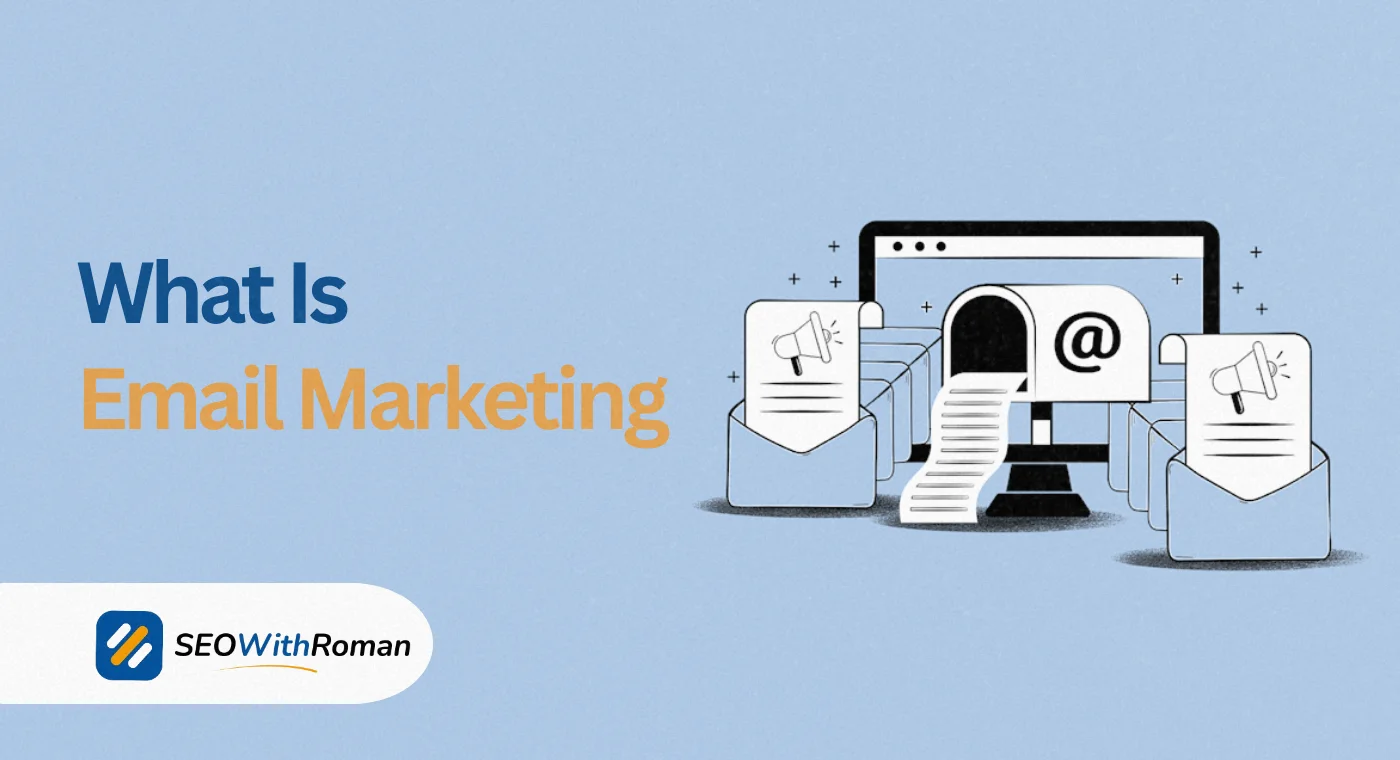
- Email marketing is the process of sending targeted emails to a list of subscribers to build relationships, promote products, and drive revenue
- For every $1 spent on email marketing, businesses earn an average return of $36 to $42 making it the highest ROI digital marketing channel available
- There are 9 types of marketing emails every business should know: welcome, newsletter, promotional, nurturing, transactional, re-engagement, survey, seasonal, and dedicated emails
- You can start email marketing for free using tools like Mailchimp, Brevo, or MailerLite with zero upfront investment
- Email marketing is not dead in 2026. The global email marketing industry hit $12 billion this year and is projected to reach $22 billion by 2030
1 What Is Email Marketing and Why Every Business Needs It
Let me give you the most straightforward definition you will find anywhere.
Email marketing is the practice of sending targeted, permission-based emails to a list of people who have chosen to hear from you. It is used to build relationships, promote products or services, share useful content, and generate revenue directly from your audience.
Unlike social media where an algorithm decides who sees your content, email lands directly in your subscriber’s inbox. You own that relationship. No platform can take it away from you, throttle your reach, or change the rules overnight.
Here is the number that made me take email marketing seriously when I first started working in digital marketing. According to data from Litmus, email marketing delivers an average ROI of $36 for every $1 spent. Some industries see returns as high as $45 per dollar. No other digital marketing channel consistently comes close to that figure.
People worldwide send and receive approximately 392 billion emails every day in 2026. That number is projected to reach 424 billion by 2028. Email is not declining. It is growing. And the businesses that build their email marketing strategy now are building an asset that will compound in value for years.
For a small business owner or blogger, email marketing gives you something paid ads and social media cannot. A direct, personal connection to people who have already raised their hand and said they want to hear from you.
2 A Brief History of Email Marketing | From $13 Million to a $12 Billion Industry
Most people think email marketing is a recent invention. It is not. And understanding where it came from explains why it has outlasted every “email is dead” prediction for the past three decades.
In 1971, computer engineer Ray Tomlinson sent the very first email. It was just a string of numbers and letters, but it introduced the @ symbol in email addresses and changed communication forever.
In 1978, a marketing manager at Digital Equipment Corporation named Gary Thuerk sent the first commercial email to a list of 400 addresses. The result was approximately $13 million in sales from a single email campaign. Email marketing was born, and the return on investment was extraordinary from day one.
By the 1990s, as the internet became commercially available, email became a mainstream communication tool and marketers recognised its potential for direct customer outreach. This also triggered the first wave of spam, which eventually led to regulatory frameworks like the CAN-SPAM Act in the United States and the GDPR in the European Union.
Today in 2026, email marketing is a $12 billion global industry, and it is projected to reach $22 billion by 2030. What started as a single manager sending 400 emails has become one of the most powerful and measurable marketing channels in the world.
3 How Does Email Marketing Actually Work | The Simple Explanation
Most beginners overcomplicate email marketing in their heads before they even start. The mechanics are genuinely straightforward once you see them laid out.
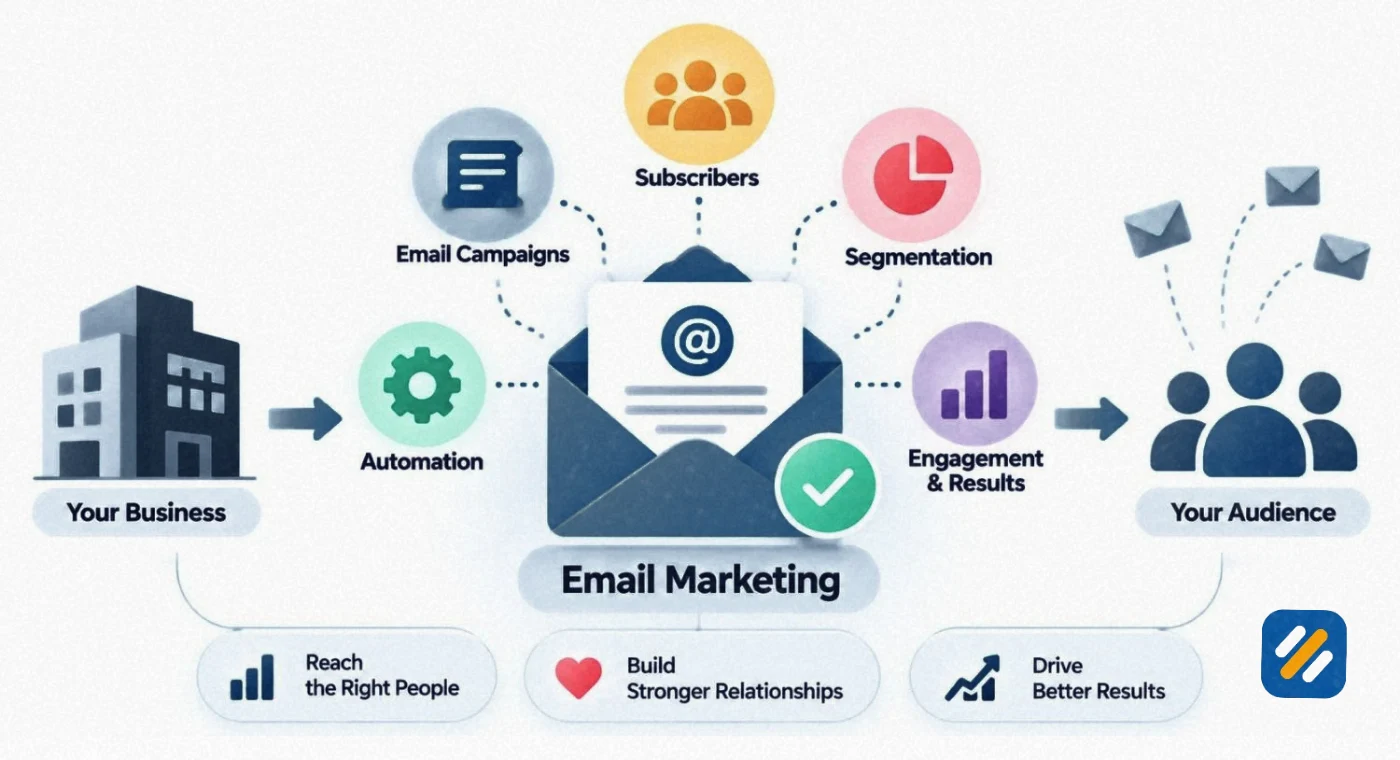
Here is how email marketing works from start to finish
Step 1: You build a list of subscribers. Someone visits your website or social media and signs up to receive emails from you. They give you their email address voluntarily in exchange for something valuable, a free guide, a discount, a newsletter, or exclusive content.
Step 2: You choose an email marketing platform. This is the software that stores your subscriber list, lets you design emails, and sends them at scale. Platforms like Mailchimp, Brevo, and MailerLite handle all the technical delivery so your emails reach inboxes reliably.
Step 3: You create and send emails. You write an email, add a subject line, design the layout, and schedule it to send to your list or a specific segment of it.
Step 4: Your subscribers receive and interact with your emails. They open the email, click links, visit your website, and take whatever action your email was designed to encourage, whether that is buying a product, reading an article, or booking a call.
Step 5: You measure and improve. Your email platform tracks open rates, click rates, and conversions so you can see exactly what is working and refine your approach for the next campaign.
That cycle, build, send, measure, and improve, is email marketing at its core. Everything else is just a variation of these five steps.
4 9 Types of Marketing Emails Every Business Should Know
Not all marketing emails serve the same purpose. Sending the right type of email at the right moment in the customer journey is what separates businesses that get results from ones that see unsubscribes.
| Email Type | Purpose | When to Send | Key Element |
|---|---|---|---|
| Welcome Email | Introduce your brand to new subscribers | Immediately after someone signs up | Warm tone, clear next step, optional welcome offer |
| Newsletter | Share valuable content and stay top of mind | Weekly or fortnightly on a consistent schedule | Useful content, low sales pressure |
| Promotional Email | Drive sales with offers or discounts | During campaigns, product launches, sales events | Clear offer, strong CTA, urgency element |
| Lead Nurturing Email | Move prospects toward a purchase decision | Series sent over days or weeks after signup | Educational content, builds trust gradually |
| Transactional Email | Confirm purchases, bookings, or account actions | Triggered automatically after a user action | Accurate information, reassuring tone |
| Re-engagement Email | Win back inactive subscribers | After 60 to 90 days of no engagement | Direct subject line, compelling reason to return |
| Survey Email | Gather customer feedback | After purchase or at regular intervals | Short, one clear ask, optional incentive |
| Seasonal Email | Promote holiday offers or seasonal events | Before major holidays or seasonal peaks | Time-sensitive offer, festive relevance |
| Dedicated Email | Target a specific segment with tailored content | When you have segment-specific news or offers | Highly personalised, relevant to that segment only |
Understanding which email type to send and when is one of the most underrated skills in email marketing. Most beginners only send promotional emails and wonder why their list goes cold.
5 The Real Benefits of Email Marketing for Small Businesses in 2026
Every marketing channel claims to be essential. Here is why email marketing specifically delivers results that most other channels genuinely cannot match.
Direct access to your audience without algorithm interference: When you post on Instagram or LinkedIn, an algorithm decides who sees your content. Sometimes that is 5% of your followers. Sometimes it is 1%. With email, you reach every subscriber in your list directly, every single time. No platform can throttle that reach.
The highest ROI of any digital marketing channel: Litmus research consistently shows email delivering $36 to $42 return for every $1 invested. For context, paid social media advertising typically returns $2 to $3 per dollar. The difference is not small.
You own your list permanently: Your email list is an asset you control. Social media accounts get banned, reach gets throttled, platforms disappear. Your email list belongs to you regardless of what happens to any third-party platform.
Automation multiplies your output without multiplying your workload: Once you set up automated email sequences, they work for you 24 hours a day without any additional effort. A welcome sequence can nurture a new subscriber through five emails over two weeks while you focus on other work. Research from Omnisend shows automated emails make up just 2% of total email volume but generate 30% of total email revenue.
Measurable results on every campaign: Every email you send tells you exactly how many people opened it, which links they clicked, and how many converted. That level of data is not available on most other marketing channels at the same cost.
6 How to Start Email Marketing for Free | Step by Step
The biggest misconception about email marketing is that it requires a significant budget to start. It does not. Here is the exact process to begin today with zero investment.
Step 1: Choose a free email marketing platform
Mailchimp offers a free plan for up to 500 subscribers with basic automation. Brevo offers unlimited contacts on its free plan with a daily sending limit of 300 emails. MailerLite gives you 1,000 subscribers and 12,000 emails per month for free. Any of these is sufficient to start building and emailing your first list.
Step 2: Create a lead magnet to attract subscribers
A lead magnet is something valuable you offer in exchange for an email address. It does not need to be complex. A one-page PDF checklist, a free mini-guide, a discount code, or access to exclusive content all work well. The more specific and immediately useful your lead magnet is, the faster your list will grow.
Step 3: Add a signup form to your website
Every email platform generates an embed code for a signup form. Add this to your homepage, your most popular blog posts, and your About page. If you use WordPress, most email platforms have a free plugin that makes this a five-minute setup.
Step 4: Write your first welcome email
Before you send a single campaign, set up an automated welcome email that triggers the moment someone subscribes. This email should thank them for subscribing, deliver whatever you promised as a lead magnet, and tell them exactly what to expect from you going forward.
Step 5: Plan your email schedule
Consistency matters more than frequency. Decide whether you will email your list weekly, fortnightly, or monthly. Write it in your calendar and stick to it. Subscribers who never hear from you forget who you are. Subscribers who hear from you too often unsubscribe.
Step 6: Send your first campaign and measure results
After your first two or three emails, check your open rate and click rate. An average open rate across industries sits between 20% and 35%. If yours is significantly below that, focus on improving your subject lines. If your click rate is low, your email content or call to action needs to be stronger.
7 How to Use Email Marketing for Sales | The Strategy That Works
Email marketing is not just about sending newsletters. When used strategically, it is one of the most effective sales channels a small business can have. Here is how to use email marketing to drive consistent revenue.
Build a segmented list from day one: Not all subscribers are at the same stage of their buying journey. Someone who just discovered your brand needs different emails than someone who has already bought from you twice. Segmenting your list by behaviour, purchase history, or signup source lets you send more relevant emails that convert at a higher rate. Research from Campaign Monitor shows segmented email campaigns increase revenue by up to 760% compared to non-segmented campaigns.
Use an email funnel to move subscribers toward a purchase: An email funnel is a sequence of emails designed to take a new subscriber from awareness to purchase over a set period. A basic five email funnel looks like this: Day 1 sends a welcome email with your lead magnet. Day 3 sends an educational email solving a problem your product addresses. Day 5 sends a social proof email with customer results or testimonials. Day 7 sends a soft introduction to your product or service. Day 10 sends a direct offer with a clear call to action and an optional limited time incentive.
Use abandoned cart emails for ecommerce: If you run an online store, abandoned cart emails are the single highest-converting email campaign available to you. When a customer adds products to their cart and leaves without purchasing, an automated email sent within one hour can recover 5% to 15% of those sales depending on your industry.
Promote your products in context, not in isolation: The most effective promotional emails do not just announce a product and link to a sales page. They tell a story, share a problem the product solves, provide evidence it works, and then offer the product as the natural next step. Emails that sell without feeling like they are selling are the ones that convert consistently.
8 Can You Earn Money From Email Marketing? The Honest Answer
Yes. Email marketing is one of the most reliable ways to generate income online, both directly and indirectly. Here is how people actually earn from it.
Selling your own products or services: If you have a product, course, consulting service, or freelance offering, your email list is your most responsive audience. Subscribers who opted in to hear from you have already demonstrated interest in what you do. A well-crafted promotional email to a list of even 500 engaged subscribers can generate significant revenue.
Affiliate marketing through email: You can earn commission by recommending other people’s products to your list. When a subscriber clicks your affiliate link and makes a purchase, you earn a percentage of the sale. This works particularly well when the products you recommend are genuinely useful to your audience and directly related to the content you regularly share.
Sponsored email placements: Once your email list grows to a few thousand engaged subscribers, brands in your niche will pay to have their products mentioned or featured in your emails. Sponsorship rates vary by audience size and engagement but can range from $50 to $500 per email mention for a list of 3,000 to 10,000 subscribers.
Selling the email list itself as a business: A high-quality, engaged email list is a business asset. Many content businesses and newsletters are acquired specifically because of the value of their subscriber base. Building a list in a valuable niche is building an asset with real market value.
The key to earning from email marketing is the same in all four cases. A list of engaged subscribers who trust your recommendations is worth far more than a large list of people who never open your emails. Quality and engagement always outperform raw list size.
9 Is Email Marketing Still Worth It in 2026?
Every few years someone declares email marketing dead. Every time, the data proves them wrong.
Here is what the numbers actually show in 2026:
| Email Marketing Stat | 2026 Data | Source |
|---|---|---|
| Global email marketing market size | $12 billion | The Business Research Company |
| Projected market size by 2030 | $22 billion | The Business Research Company |
| Daily emails sent and received worldwide | 392 billion | Statista |
| Average ROI per $1 spent on email | $36 to $42 | Litmus |
| Marketers who say email is essential to strategy | 90% | Mailchimp/Edelman DXI |
| Consumers who prefer email over other brand communication | 4 in 5 | Mailchimp/Edelman DXI |
| Revenue share from automated email campaigns | 30% of total email revenue | Omnisend |
Email marketing is not just surviving in 2026. It is one of the fastest growing segments of the digital marketing industry. AI-powered personalisation, smarter automation, and tighter integration with SMS and social channels have made email more effective than it has ever been.
The businesses that treat email marketing as an afterthought are leaving significant revenue on the table. The ones building their lists consistently, sending valuable content regularly, and optimising their campaigns based on data are compounding an asset that grows more valuable with every new subscriber.
Further Read: Single Page Website SEO
10 Top 3 Email Marketing Tools for Beginners in 2026
You do not need an expensive platform to run effective email marketing campaigns. These three tools cover everything a beginner needs and all have strong free plans to start with.
Tool 1: Mailchimp
Mailchimp is the most widely recognised email marketing platform in the world and for good reason. It offers a free plan for up to 500 subscribers, a drag and drop email builder, pre-built automation, and detailed analytics. Its interface is clean and beginner-friendly, and it integrates with virtually every website platform including WordPress, Shopify, and Squarespace. Free plan includes basic automation, landing pages, and email templates.
Tool 2: Brevo (formerly Sendinblue)
Brevo’s free plan is one of the most generous in the industry. It gives you unlimited contacts with a daily sending limit of 300 emails. Unlike Mailchimp which charges based on contact count, Brevo charges based on emails sent, making it significantly more affordable as your list grows. It also includes SMS marketing, live chat, and CRM features in its paid plans. For small businesses managing both email and SMS marketing, Brevo is worth serious consideration.
Tool 3: MailerLite
MailerLite offers 1,000 subscribers and 12,000 monthly emails on its free plan, which is the most generous subscriber limit available on any major platform’s free tier. It includes automation workflows, landing page builders, and a clean email editor that is faster to use than most competitors. MailerLite is particularly popular with bloggers and content creators because of its straightforward interface and the quality of its email deliverability rates.
Further Read: Best Google Keyword Position Checker Tools
11 Email Marketing Best Practices | 5 Rules That Separate Good Campaigns From Great Ones
Following these five practices from day one will put your email marketing ahead of most small business owners who learn them the hard way after months of poor results.
Always use double opt-in: When someone signs up, send them a confirmation email asking them to verify their address before they are added to your list. This eliminates fake addresses, improves deliverability, and ensures your list contains only people who genuinely want your emails.
Write subject lines that earn the open: Your subject line is the only thing standing between your email and the delete button. Keep it under 50 characters, make it specific rather than clever, and test two versions against each other to find what resonates with your audience. The average email open rate across industries is 35%. A strong subject line is the single fastest way to move yours above that.
Send at consistent intervals: Whether you email weekly or monthly, consistency builds the expectation that makes subscribers open your emails habitually. Irregular sending patterns, where you disappear for two months and then send three emails in a week, destroy subscriber trust and spike unsubscribe rates.
Segment before you send: Not every email is relevant to every subscriber. A promotional email about a product only relevant to new customers should not go to people who already purchased it. Basic segmentation by purchase history, signup source, or engagement level dramatically improves conversion rates with minimal additional effort.
Track the four metrics that matter: Open rate tells you whether your subject line worked. Click rate tells you whether your content and CTA were compelling. Unsubscribe rate tells you whether your frequency or relevance is off. Conversion rate tells you whether your email achieved its goal. Everything else is secondary.
12 3 Expert Tips to Take Your Email Marketing Further
Tip 1: Treat your welcome email sequence as your most important campaign.
Most businesses send one welcome email and move on. The most effective email marketers build a five to seven email welcome sequence that runs automatically over the first two weeks of a subscription. This is when subscriber engagement is highest, and a well-crafted sequence can convert a new subscriber into a paying customer before your next regular newsletter even goes out.
Tip 2: Clean your list every 90 days.
Sending emails to subscribers who never open them damages your sender reputation with email providers. Every 90 days, identify subscribers who have not opened a single email in the past three months. Send them one re-engagement email asking whether they still want to hear from you. If they do not respond, remove them. A smaller, engaged list always outperforms a large, inactive one in both deliverability and revenue.
Tip 3: Write every email as if it is going to one person.
The most common mistake beginners make is writing in a corporate, broadcast tone. “Dear subscribers, we are pleased to inform you.” The emails that get the highest open and click rates are written conversationally, as if the sender is writing personally to one specific reader. Use “you” not “subscribers.” Use “I” not “our team.” The moment your email feels like a one-to-one conversation rather than a broadcast announcement, engagement rates change noticeably.
13 Conclusion
Email marketing is not a trend. It is the most direct, most measurable, and most consistently high-returning channel in digital marketing. It has been since 1978 and the fundamentals have not changed: reach the right people, with the right message, at the right time.
You do not need a large list to start. You do not need a large budget. You need a lead magnet, a free platform, and a commitment to sending valuable emails consistently.
Start building your list today. Set up your welcome sequence this week. Send your first campaign before the end of the month.
Every subscriber you add is a direct line to someone who chose to hear from you. Treat that relationship with care and it will generate returns that no social media algorithm or paid ad campaign can match.
Have a question about getting started with email marketing? Leave a comment below and I will answer it personally.
Join 1,000+ business owners and bloggers who get one actionable SEO tip every week — straight to their inbox. Free forever.
Get Free Weekly Tips →