1 What Is a Tagline | The Definition Most People Get Wrong
Most people think a tagline is just a clever phrase a marketing team came up with. That definition undersells what a great tagline actually does.
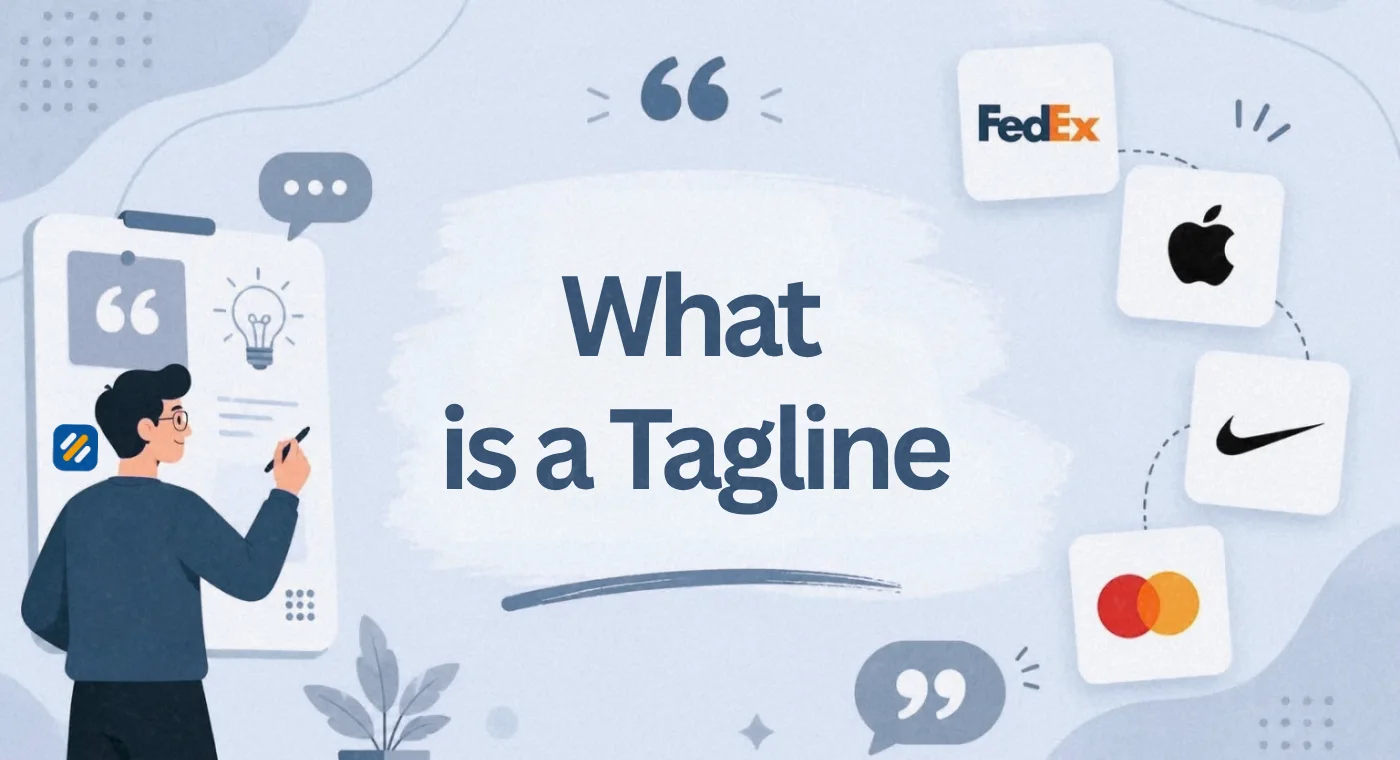
A tagline is a short, memorable statement that captures the core promise, personality, and purpose of a brand in as few words as possible. It is the distillation of everything a company stands for, compressed into a line that can sit beneath a logo, close a TV commercial, or appear on a product package and communicate something meaningful in under three seconds.
The word comes from advertising history. In the early days of print and broadcast advertising, the final line of an ad copy that summarised the message was literally called the “tag line.” Over time it became a permanent fixture of brand identity rather than just a closing line in a campaign.
Here is what separates a great tagline from a forgettable one. A forgettable tagline describes what a company does. A great tagline describes how a company makes you feel or what it believes. Nike does not make athletic shoes. Nike believes anyone can push their limits. “Just Do It” communicates that belief in three words without mentioning shoes, sports, or the company name at all.
That is the tagline definition that actually matters in marketing and branding
2 What Is a Tagline Example | 15 of the Most Powerful in Business History
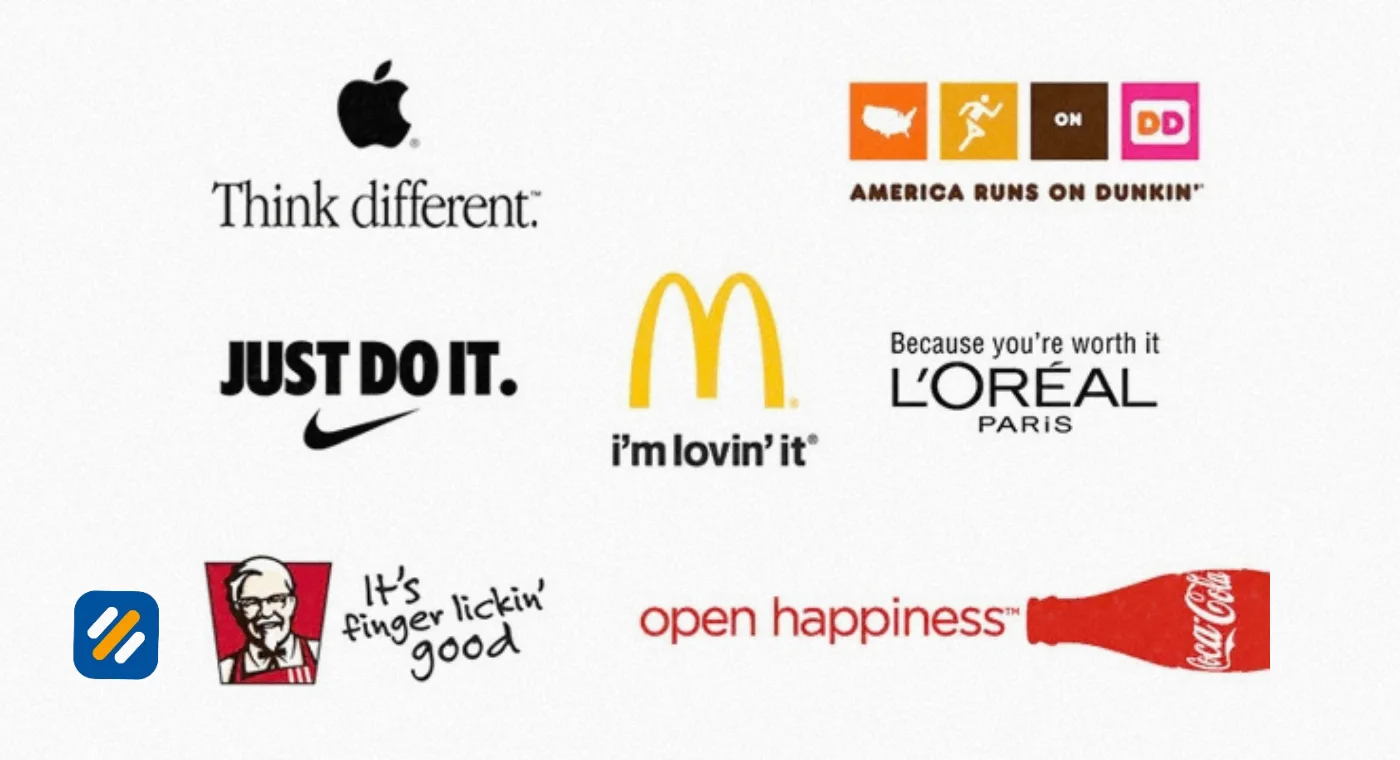
The fastest way to understand what a tagline is and what makes one work is to look at real examples across different industries and analyse exactly why they work.
| Brand | Tagline | Why It Works |
|---|---|---|
| Nike | Just Do It | Action-oriented, universal, emotionally motivating |
| Apple | Think Different | Positions the brand as anti-conformist, speaks to creative identity |
| McDonald’s | I’m Lovin’ It | Emotional and sensory, creates positive association with the product |
| L’Oreal | Because You’re Worth It | Speaks directly to the customer’s self-worth, not the product |
| De Beers | A Diamond Is Forever | Created a cultural belief, not just described a product |
| BMW | The Ultimate Driving Machine | Bold claim, targets aspiration, positions against all competitors |
| M&Ms | Melts in Your Mouth, Not in Your Hands | Solves a real problem in six words, unforgettable product benefit |
| Disneyland | The Happiest Place on Earth | Pure emotional promise, not a feature or benefit |
| Subway | Eat Fresh | Two words, health positioned brand in a category of fast food |
| Airbnb | Belong Anywhere | Reframes accommodation as an emotional experience, not a transaction |
| Dollar Shave Club | Shave Time. Shave Money. | Wordplay, humour, communicates value in four words |
| Mastercard | There Are Some Things Money Can’t Buy | Paradox from a payments company, creates emotional depth |
| Dunkin | America Runs on Dunkin | Creates community identity, positions the brand as essential |
| Allstate | You’re in Good Hands | Trust and protection in four words, perfect for insurance |
| Harley Davidson | All for Freedom. Freedom for All. | Speaks to a lifestyle and community, not a motorcycle |
Notice what none of these taglines do. None of them describe the product in detail. None of them list features. None of them use industry jargon. Every single one connects to a feeling, a belief, or a promise that goes beyond the product itself.
That is what separates a tagline example worth studying from a marketing phrase that disappears the moment the campaign ends.
3 Tagline vs Slogan | The Difference That Confuses Everyone
This is one of the most searched questions about taglines and also one of the most consistently misunderstood, even by marketing professionals.
A tagline and a slogan are not the same thing. Using them interchangeably suggests a misunderstanding of how brand strategy actually works.
A tagline is permanent: It represents the brand’s long-term identity and rarely changes. It sits beneath the logo, opens and closes brand communications, and functions as the single most consistent piece of brand language a company has. A well-built tagline can last decades. “Just Do It” has been Nike’s tagline since 1988.
A slogan is temporary: It is campaign-specific, created to support a particular product launch, seasonal promotion, or marketing message. It grabs attention for a defined period and then changes when the next campaign begins. McDonald’s “I’m Lovin’ It” started as a campaign slogan in 2003 but became so successful it evolved into a tagline. That is the exception, not the rule.
| Factor | Tagline | Slogan |
|---|---|---|
| Duration | Long-term, rarely changes | Short-term, campaign-specific |
| Purpose | Communicates brand identity | Promotes a specific product or message |
| Tone | Consistent with core brand voice | Can vary by campaign |
| Placement | Logo, website, all brand materials | Ads, packaging, specific campaigns |
| Example | Nike: “Just Do It” | Allstate: “Get Allstate and be better protected from mayhem” |
| Flexibility | Low, consistency is the point | High, designed to change |
| SEO value | High, used across all brand touchpoints | Lower, limited to campaign lifespan |
Understanding this difference matters practically for your business. If you are building a brand from scratch, you need a tagline first. Slogans come later when you have specific campaigns to run. Starting with a slogan and calling it a tagline means rebuilding your brand voice every few months, which costs both consistency and recognition.
4 What Is the Purpose of a Tagline | The 5 Real Jobs It Does for Your Brand
A tagline is not decoration. Every great tagline is doing several specific jobs simultaneously, and understanding those jobs is what allows you to write one that actually works.
Job 1: Instant brand communication
A tagline communicates your brand promise to a complete stranger in the time it takes them to glance at your logo. In a world where attention spans are shrinking and advertising competition is at an all-time high, a tagline does in five words what a paragraph of brand copy takes fifty words to accomplish.
Job 2: Emotional differentiation
Features can be copied. Technology can be replicated. Prices can be matched. But the feeling a tagline creates in a customer’s mind is harder to duplicate. “The Ultimate Driving Machine” does not describe features. It creates an emotional category that BMW owns entirely. A strong tagline is your most defensible competitive advantage because it lives in the mind, not in the product.
Job 3: Consistency across all marketing channels
A tagline is the one piece of language that appears everywhere. Your website, your social media profiles, your packaging, your email signatures, your TV ads, your Google ads. Consistent tagline usage across all channels builds what marketers call brand salience, the automatic mental association a customer makes between your tagline and your brand without conscious effort.
Job 4: SEO and digital marketing support
This is the angle most tagline guides completely ignore. A tagline used consistently across your digital presence creates a branded keyword association that supports your search engine presence. When your tagline is memorable enough that customers search it directly, it drives branded search volume. When it contains a relevant keyword, it reinforces topical relevance across your site. Your WordPress website’s tagline field, your meta description template, and your social bio all benefit from having a single consistent tagline that reinforces brand identity.
Job 5: Internal alignment
Great taglines do something most business owners never consider. They give your entire team a north star. When a marketing team, a customer service department, and a product team all share the same tagline, it gives everyone a filter for decisions. “Does this action align with what our tagline promises?” is one of the most powerful brand strategy questions a business can ask internally.
5 Tagline vs Mission Statement | Another Distinction Worth Knowing
Since we are clarifying definitions, there is one more distinction that causes confusion in brand strategy conversations.
A mission statement explains why your company exists and what it aims to achieve. It is internal-facing, often long, and written for stakeholders, employees, and investors. Most customers never read a mission statement.
A tagline is external-facing, short, and written for customers. It is a public-facing distillation of your brand promise, not an internal declaration of corporate purpose.
Patagonia’s mission statement is “We’re in business to save our home planet.” Their tagline has historically been “Don’t Buy This Jacket,” a provocative campaign line that challenged overconsumption in direct alignment with their mission. The mission statement drives strategy. The tagline drives customer perception.
Your tagline is not your mission statement shortened. It is a completely different kind of communication serving a completely different purpose.
6 How to Write a Tagline | A Step by Step Process That Actually Works
Most guides on how to write a tagline jump straight to word choice and brainstorming. That is the wrong starting point. The words come last. Here is the correct sequence:
Step 1: Define your core brand promise in one sentence
Before you write a single tagline option, write down the one thing your brand genuinely does better than anyone else. Not a feature. Not a specification. A human outcome. “We help small business owners get found on Google without hiring an expensive agency” is a brand promise. “Many years of SEO experience” is a feature.
Step 2: Identify the emotion your brand creates
Ask your existing customers how they feel after using your product or service. The most common emotion in those answers is the emotion your tagline should evoke. Relief, confidence, excitement, belonging, pride, trust. Pick one and build from it.
Step 3: Study your audience’s language
The words your customers use to describe their problems and your solutions are more powerful than any words a copywriter can invent. Customer reviews, support emails, and social media comments are a goldmine of authentic language that can become the foundation of a great tagline.
Step 4: Write twenty options without judging any of them
Set a timer for fifteen minutes and write every tagline option you can think of. Do not evaluate. Do not edit. Write taglines that are too long, too short, too obvious, and too obscure. Quantity at this stage creates the raw material you will refine.
Step 5: Filter by these four criteria
Take your twenty options and score each one against these questions:
- Is it under eight words?
- Does it connect to an emotion or outcome, not a feature?
- Could only your brand say this, or could a competitor use the exact same line?
- Does it sound good when spoken out loud?
Any tagline that passes all four criteria is worth developing further.
Step 6: Test it in context
Put your top three tagline options next to your logo and show them to five people outside your business. Ask what they think the company does and how it makes them feel. If the tagline communicates your brand promise accurately and creates the intended emotion, it is ready. If it creates confusion, go back to step four.
7 How to Create a Tagline for a Personal Brand or Small Business
Writing a tagline for a personal brand, a freelancer’s website, or a small business follows the same principles but with one important difference. Your name and your story are part of the brand in a way that a corporate brand rarely is.
For a personal brand, your tagline should answer this question for a stranger who lands on your website: “What do you do, who do you help, and why should I trust you?” in under eight words.
Here are some tagline examples for a person or small business that demonstrate this
| Personal or Small Business Context | Tagline Example | What It Communicates |
|---|---|---|
| Freelance SEO specialist | “SEO That Actually Gets You Found” | Outcome-focused, implies others do not deliver this |
| Independent financial planner | “Your Money. Your Future. Your Plan.” | Ownership language, personal and empowering |
| Small business accountant | “Numbers Made Simple. Business Made Stronger.” | Benefit driven, addresses the fear of complexity |
| Fitness coach | “Stronger Every Day. Starting Today.” | Motivational, action-oriented, removes the barrier to starting |
| Copywriter | “Words That Work While You Sleep.” | Clever, speaks to passive benefit, memorable |
| Marketing consultant | “Strategy First. Results Always.” | Bold claim, professional positioning |
The tagline for a personal brand also plays an important SEO role. When used consistently in your website’s tagline field in WordPress, your meta descriptions, your LinkedIn bio, and your social profiles, it creates a branded keyword signature that search engines associate with your name and expertise over time.
8 Tagline and SEO | The Connection Most Business Owners Miss Completely
Here is something competitors in this article’s search results do not cover at all, and it is one of the most practically useful things I can tell you about taglines.
Your tagline is an SEO asset when used correctly.
Here is how
WordPress tagline field: When you build a website on WordPress, there is a site title and tagline field in your general settings. Google reads this tagline as part of your homepage’s identity signal. A tagline that contains a relevant keyword naturally reinforces your topical relevance to search engines without any additional optimisation effort.
Meta description consistency: Using your tagline or a variation of it consistently in your meta descriptions across key pages creates a consistent brand voice in search results and increases click-through rates. When searchers see the same memorable phrase appear repeatedly in your search listings, brand recognition builds even before they visit your site.
Branded search volume: A truly memorable tagline eventually generates its own branded search traffic. People who hear or read your tagline in one context will search it later to find you again. This is one of the clearest indicators that a tagline has become genuinely embedded in your audience’s memory.
Social proof and E-E-A-T: A tagline that communicates expertise and trustworthiness directly supports Google’s E-E-A-T framework. “Learn SEO That Actually Gets You Found on Google” signals expertise and a clear value proposition to both searchers and Google’s quality assessment systems.
9 3 Expert Tips for Writing a Tagline That Stands the Test of Time
Tip 1: Write for your customer, not for yourself
The most common tagline mistake is writing a line that the business owner loves but the customer does not connect with. Your tagline is not for you. Test it with real customers before committing to it. Their reaction in the first three seconds tells you everything.
Tip 2: Avoid words that every competitor could also use
Words like “quality,” “trusted,” “innovative,” and “leading” appear in thousands of taglines across every industry. If your competitor could put their logo next to your tagline and it would still make sense, the tagline is not distinctive enough. Push for language that only your brand could credibly claim.
Tip 3: Say it out loud before you finalise it
A tagline lives in the spoken world as much as the written one. It appears in radio ads, video content, and sales conversations. If it is awkward to say out loud, it will never become the kind of phrase customers repeat naturally. Every great tagline passes the spoken test effortlessly.
10 Conclusion
A tagline is not a slogan, not a mission statement, and not a marketing afterthought. It is the single most concentrated piece of brand communication your business has, and when it is done right, it does more work per word than any other asset in your marketing toolkit.
The brands that get remembered are rarely the ones with the biggest budgets. They are the ones with the clearest sense of what they stand for and the discipline to say it the same way every single time.
Start with your brand promise. Find the emotion behind it. Compress it into eight words or fewer. Test it with real people. Then use it everywhere, consistently, and without apology.
That is how a tagline goes from a phrase you wrote in an afternoon to the thing customers say when they describe your business to someone else.
Have you written a tagline for your business yet? Drop it in the comments below and I will tell you honestly what is working and what could be stronger.
Join 1,000+ business owners and bloggers who get one actionable SEO tip every week — straight to their inbox. Free forever.
Get Free Weekly Tips →