- AI search engines combine traditional web indexing with large language models to deliver direct answers instead of a list of links
- Perplexity AI is currently the best standalone AI search engine for accuracy, citations, and conversational follow-ups
- Google AI Mode, Bing Copilot, and You.com all offer strong free AI-powered search experiences
- AI search engines are changing SEO permanently, content optimised for GEO and AIO now ranks inside AI answers, not just blue links
- For SEO professionals, understanding how AI search tools discover and cite content is becoming as important as traditional keyword optimisation
1 What Is an AI Search Engine and How Is It Different From Google
If you have used Google in the last two years and noticed a summary box appearing above the traditional blue links, you have already experienced AI-powered search. But a dedicated AI search engine goes much further than a summary box on top of a regular results page.
A traditional search engine like Google works by crawling billions of web pages, indexing their content, and ranking them based on relevance signals like keyword match, backlinks, and user engagement. When you search, it gives you a ranked list of links. You click. You read. You find the answer yourself.
An AI search engine does something fundamentally different. It crawls and indexes pages the same way, but then it reads those pages using a large language model and generates a direct answer to your question, complete with citations. You get the answer without visiting multiple websites.
The practical difference matters enormously. Traditional search requires you to evaluate ten links, click two or three, scan the content, and synthesise the answer yourself. An AI search engine collapses that entire process into one response in seconds.
After many years working in SEO across B2B, B2b, and ecommerce verticals, the shift I am seeing in 2026 is not gradual. It is a fundamental change in how people find information online. AI search tools are not replacing traditional SEO. They are adding a new layer on top of it that content creators and SEO professionals cannot afford to ignore.
2 How Do AI Search Engines Actually Work Behind the Scenes
Most people use AI search engines without understanding what is happening technically. Understanding the process changes how you create content for it.
Here is what happens when you type a query into an AI search engine
Step 1: Query understanding. The AI model interprets your query using natural language processing. Unlike traditional search engines that match keywords, AI search understands intent, context, and even ambiguous or conversational phrasing. “What phone should I buy if I care more about camera than battery” is processed meaningfully, not just matched to keywords.
Step 2: Source retrieval. The engine queries its search index and retrieves the most relevant pages based on your query. This part works similarly to traditional search, pulling from a database of crawled and indexed pages.
Step 3: Content reading and synthesis. This is what separates AI search from traditional search. The large language model reads the retrieved pages and synthesises the information into a single coherent answer. It identifies the most relevant sections, checks for consistency across sources, and compiles a response.
Step 4: Citation and sourcing. The best AI search engines attach citations to every claim in the generated answer. This allows users to verify information and click through to original sources, which is also why well-cited, clearly structured content ranks inside AI answers.
Step 5: Follow-up handling. Most AI search engines maintain context across a conversation. If you ask a follow-up question, the engine understands it in the context of your original query without you having to repeat it.
This process is why AI search engines favour content that is clear, well-structured, and directly answers specific questions. Vague or padded content gets passed over in synthesis even if it ranks well in traditional search.
3 Why AI Search Engines Matter for SEO and GEO in 2026
This is the section most beginner SEO guides completely miss. AI search engines are not just a new way for users to find information. They are actively reshaping how content ranks and gets discovered.
In traditional SEO, ranking means appearing in the top ten blue links. The goal is position one and the 27.6% click-through rate that comes with it.
In AI-powered search, ranking means being cited inside the AI-generated answer. A page cited in Perplexity’s answer, Google’s AI Overview, or Bing Copilot’s response gets visibility even if the user never clicks through to the website. This is what GEO (Generative Engine Optimisation) and AIO (AI Overview Optimisation) refer to.
Here is what makes content more likely to be cited in AI search answers
Direct, clear answers in the opening paragraph: AI models prioritise content that answers the question immediately. Introductions that take three paragraphs to reach the point are passed over in synthesis.
Structured content with clear headings: AI search engines parse heading structure when extracting information. H2 and H3 headings that directly match the sub-questions a searcher might ask significantly improve citation likelihood.
Original data, statistics, and named expertise: AI models are trained to prefer authoritative sources. Content that cites specific research, includes original data, or comes from a named expert with verifiable credentials gets weighted more heavily in synthesis.
Short, quotable sentences on complex points: AI search models pull specific sentences when generating answers. Content written in clear, quotable statements is more extractable than dense, complex prose.
Frequent updates and fresh information: AI search engines generally prefer recently updated content for time-sensitive queries. Articles with a visible last-updated date and current statistics consistently appear more in AI-generated answers.
4 The 10 Best AI Search Engines in 2026 at a Glance
| AI Search Engine | Best For | Free Plan | Paid Plan | Cites Sources |
|---|---|---|---|---|
| Perplexity AI | Best overall AI search experience | Yes, with limits | From $20/month | Yes |
| Google AI Mode | Google ecosystem users, local search | Yes | Included in Google One AI | Yes |
| Bing Copilot | Microsoft users, Office integration | Yes | Microsoft 365 subscription | Yes |
| You.com | Customisable AI search with modes | Yes | From $15/month | Yes |
| Brave Search | Privacy-focused AI search | Yes | $3/month premium | Yes |
| Consensus | Academic and scientific research | Yes, 15 searches/month | From $10/month | Yes, academic papers |
| Kagi | Ad-free premium search | No | From $5/month | Yes |
| Exa AI | Developer and API-based AI search | Limited free tier | Usage-based pricing | Yes |
| Phind | Developer and coding queries | Yes | From $15/month | Yes |
| Andi Search | Clean, minimalist AI web search | Yes | Free | Yes |
5 Perplexity AI | The Best Overall AI Search Engine Right Now
If someone asks me which AI search engine to use today, my answer without hesitation is Perplexity AI. It is the closest thing to a true replacement for traditional Google search that currently exists.
Perplexity was built as an AI search engine from day one, not as a traditional search engine with AI bolted on top. When you enter a query, it retrieves real-time web results, reads them, and generates a synthesised answer with numbered citations visible beside each claim. You can click any citation to go directly to the source article.
What sets Perplexity apart from every other tool on this list is the follow-up conversation. Ask “what is the best AI search engine” and Perplexity gives you a cited answer. Ask “which one is best for academic research” as a follow-up and it understands the context without you repeating the original query. This conversational depth is what traditional search has never been able to do.
Perplexity also offers focused search modes. You can restrict results to academic papers, Reddit discussions, financial data, or news. For SEO research specifically, the ability to search within a topic and ask structured follow-up questions is genuinely useful for content planning and keyword intent analysis.
Perplexity pricing: Free plan with standard searches. Pro plan from $20 per month with access to advanced models, unlimited Pro searches, and image generation.
Best for: Everyday search replacement, research, content planning, SEO intent research.
6 Google AI Mode | The Most Powerful AI Search for Existing Google Users
Google entering AI search was inevitable. The question was always whether they would execute it well enough to compete with purpose-built tools like Perplexity.
The answer in 2026 is: yes, for certain use cases.
Google AI Mode is a separate tab within Google Search that provides a full conversational AI experience powered by a custom version of Gemini. It retrieves results from Google’s unmatched search index, the largest in the world, and synthesises them into cited answers with full follow-up conversation support.
Where Google AI Mode genuinely outperforms every other tool on this list is local search, shopping, and integration. When you search for a restaurant, AI Mode pulls from Google Maps reviews, hours, and ratings alongside web results. When you search for a product, it pulls from Google Shopping data. No standalone AI search engine can match this depth of structured data integration.
The limitation is consistency. AI Overviews, the version of AI search embedded directly in standard Google results, remains uneven in quality. Some queries trigger excellent summaries. Others produce vague or occasionally inaccurate responses. AI Mode itself is more reliable but requires deliberately switching to a separate tab, which many users never do.
Is Google AI search free? Yes, completely. Both AI Overviews in standard search and the dedicated AI Mode tab are available at no cost to all Google users.
Best for: Local search, shopping research, users already in the Google ecosystem who want AI-enhanced results without switching platforms.
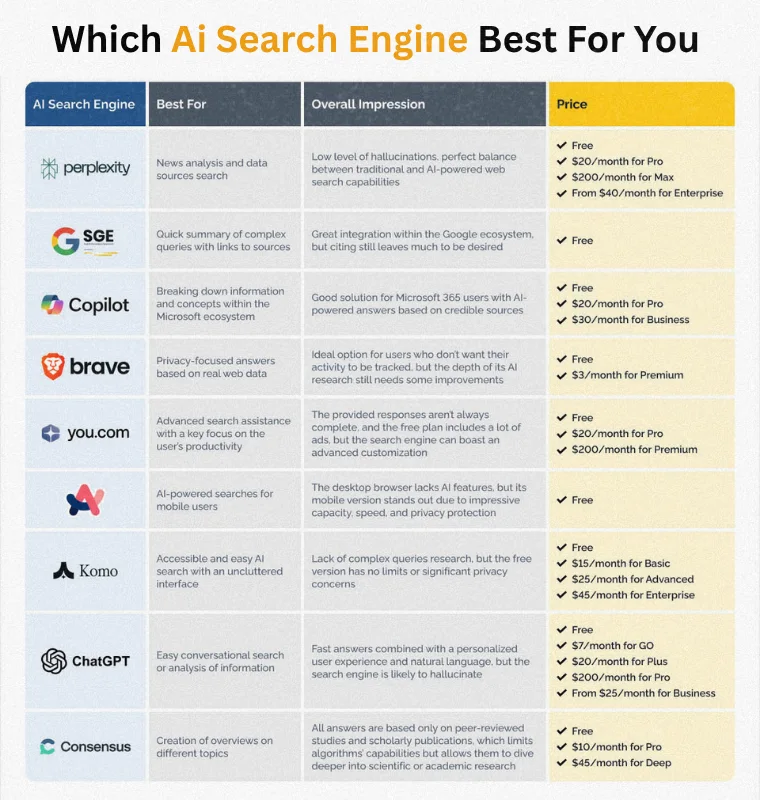
7 Bing Copilot | The Best AI Search Engine for Microsoft Users
Bing Copilot was one of the first major AI search integrations to launch publicly when Microsoft integrated GPT-4 into Bing in 2023. Three years later, it remains one of the most capable and widely used AI search experiences available.
Bing Copilot sits directly inside the Bing search interface and provides cited AI answers for virtually every query. For Microsoft 365 users, it also integrates directly with Word, Excel, and Outlook, meaning you can pull live web research into your documents without switching between tools.
The quality of Bing Copilot’s search synthesis is strong. In side-by-side testing across informational, commercial, and navigational queries, Bing Copilot consistently produced well-cited, accurate answers with clear follow-up conversation capability.
For SEO professionals specifically, Bing Copilot is worth monitoring because Bing’s market share, while smaller than Google’s, is significantly higher among desktop users in enterprise environments. Content cited in Bing Copilot answers reaches a valuable B2B audience that SEO strategies often underweight.
Bing Copilot pricing: Free for all users. Enhanced capabilities included with Microsoft 365 subscriptions.
Best for: Microsoft 365 users, enterprise B2B content, Windows desktop users, anyone wanting a capable free AI search experience.
8 You.com | The Most Customisable AI Search Tool
You.com takes a different approach to AI search than any other tool on this list. Rather than offering one AI search mode, it gives users a set of distinct search modes that can be switched based on the task.
You can search in standard AI mode for general queries, switch to a research mode for in-depth academic-style synthesis, use a code mode optimised for programming questions, or activate a writing mode that generates content based on search results. This flexibility makes You.com the most versatile AI search tool available.
For content creators and SEO professionals, You.com’s research mode is particularly valuable. It retrieves a wider range of sources than standard AI search, synthesises them into a structured answer with full citations, and allows you to export the research output. This makes it useful not just as a search tool but as a content research assistant.
You.com pricing: Free plan with standard AI search. YouPro plan from $15 per month with unlimited access to advanced AI models and research modes.
Best for: Content creators, researchers, SEO professionals who need versatile search modes for different research tasks.
9 Brave Search | The Best Free AI Search Engine for Privacy
Brave Search is built on a completely independent search index that does not rely on Google or Bing data. This makes it genuinely different from most AI search engines, which use Google or Bing as their underlying index and layer AI synthesis on top.
The privacy angle is real, not just marketing. Brave does not track your search history, build an advertising profile, or share data with third parties. Every search is treated as independent. For users who want the benefits of AI-powered search without surrendering their data to the major platform ecosystems, Brave Search is the most credible option available.
The AI answer quality in Brave Search is surprisingly strong for a tool built on an independent index. Answers are cited, accurate on most queries, and available without creating an account or paying for a subscription.
Brave Search pricing: Free for all AI search features. $3 per month for Search Premium, which removes all ads.
Best for: Privacy-conscious users, anyone who wants a fully free AI search experience without data tracking, users who want an alternative to Google and Bing ecosystems.
10 Consensus, Kagi, Phind, Exa AI, and Andi | Specialist AI Search Engines Worth Knowing
These five tools serve specific use cases that the major platforms do not cover as well.
Consensus is built specifically for academic and scientific research. Enter a research question and it searches peer-reviewed papers, synthesises the findings, and shows the current scientific consensus on the topic. For students, researchers, and anyone writing evidence-based content, it is the most reliable AI search tool for evidence-backed answers.
Kagi is a fully paid, ad-free search engine with integrated AI features. At $5 per month for a basic plan, it offers a clean, fast, unbiased search experience with AI summaries on request. The absence of advertising pressure means results are ranked purely on quality, which produces noticeably cleaner results than ad-supported alternatives.
Phind is designed specifically for developers. It searches technical documentation, Stack Overflow, GitHub, and developer-focused sources, then synthesises the answer in a format optimised for coding problems. For technical SEO professionals or developers doing research, it is significantly more useful than general AI search for programming queries.
Exa AI provides AI search capabilities through an API, making it the best option for developers building AI-powered applications that need live web search integrated into their products. It is less of a consumer tool and more of an infrastructure layer for AI-powered search applications.
Andi Search offers a clean, minimalist AI search experience with no ads, no tracking, and no clutter. Results are presented visually with cited summaries and a conversational follow-up interface. It is completely free and works well for users who want a simple, distraction-free alternative to mainstream AI search platforms.
11 Who Is the Best AI Search Engine in 2026 | Honest Comparison
| Use Case | Best AI Search Engine | Why |
|---|---|---|
| Best overall AI search experience | Perplexity AI | Purpose-built, best citations, strongest follow-up conversation |
| Best for Google ecosystem users | Google AI Mode | Deepest integration with Maps, Shopping, local data |
| Best free AI search engine | Brave Search | Fully free, private, independent index |
| Best for academic research | Consensus | Searches peer-reviewed papers, shows scientific consensus |
| Best for Microsoft users | Bing Copilot | Strong Microsoft 365 integration, free, reliable |
| Best for privacy | Brave Search | No tracking, no data sharing, independent index |
| Best for developers | Phind | Searches technical docs, code-focused synthesis |
| Best for content research | You.com | Multiple search modes, research export functionality |
| Best for ad-free premium search | Kagi | Paid but clean, no ads, unbiased ranking |
| Best for AI app developers | Exa AI | API access, live search for AI product builders |
12 3 Expert Tips for Using AI Search Engines to Improve Your SEO
Tip 1: Search your own keywords in Perplexity and study what gets cited
Type your target keywords into Perplexity and look at which sources it cites in its answer. These are the content formats, structures, and authority levels that the AI considers most credible for that topic. Your content needs to match or exceed those standards to be cited alongside them.
Tip 2: Write your H2 headings as the exact questions AI search engines answer
AI search engines pull content at the heading level. If your H2 is “Keyword Research Tools” you are invisible. If your H2 is “What Are the Best Free Keyword Research Tools for Beginners” you are directly answering a conversational query that AI search engines are actively synthesising answers for.
Tip 3: Add a clear, direct answer in the first two sentences of every section
AI models extract the opening sentences of each section when synthesising answers. Every H2 section in your article should start with a direct, quotable answer to the question that heading asks. The supporting detail follows after. This structure makes your content significantly more extractable for AI search synthesis.
13 Conclusion
AI search engines are not the future of search. They are the present. In 2026, a significant and growing share of informational queries are being answered inside AI-generated responses on Perplexity, Google AI Mode, Bing Copilot, and a growing number of specialist platforms without users ever visiting a traditional blue link.
For small business owners, bloggers, and SEO professionals, this changes one fundamental thing. Great content is still the foundation. But that content now needs to be structured, cited, and written in a way that AI search engines can read, synthesise, and quote directly inside their answers.
The ten AI search engines covered in this article represent the best options available right now across every use case, budget, and technical requirement. Perplexity leads for everyday search. Google AI Mode leads for ecosystem integration. Brave leads for privacy. Consensus leads for research. Every other tool on this list fills a genuine gap that the major platforms do not cover.
Start by using Perplexity for your own research this week and pay close attention to which sources it cites and why. That observation will teach you more about GEO and AIO optimisation than most paid courses currently offer.
Have a question about any of these AI search engines or how to optimise your content for them? Drop a comment below and I will answer it personally.
Join 1,000+ business owners and bloggers who get one actionable SEO tip every week — straight to their inbox. Free forever.
Get Free Weekly Tips →