- Google Business Profile optimization is the single most powerful free tool for local SEO and Google Map Pack visibility
- Google ranks GBP listings based on three factors: relevance, distance, and prominence
- A fully completed and actively managed profile consistently outranks incomplete profiles regardless of business age
- Review velocity matters more than total review count, meaning recent reviews carry more weight than old ones
- GMB SEO and traditional website SEO work together, your GBP and your website must send consistent signals to Google
- SEO is not dead in 2026, it has evolved into a multi-channel discipline that includes AI search, GBP, and voice results
1 What Is Google Business Profile and Why It Is the Most Underused Free SEO Tool in Existence
Let me start with something most small business owners do not fully appreciate.
Your Google Business Profile is not just a directory listing. It is a standalone search engine result that can outrank websites with years of backlinks and thousands of published pages. I have seen a brand new local business with a fully optimised GBP ranking above established competitors who had been investing in website SEO for years, simply because nobody had bothered to properly set up and manage their profile.
Google Business Profile, previously known as Google My Business, is a free platform that lets businesses manage how they appear across Google Search and Google Maps. When someone searches for a service near them, the results that appear in the Map Pack, those three business listings shown above organic results alongside a map, come directly from Google Business Profile data.
The numbers behind this are significant. According to Google, businesses with complete profiles are twice as likely to be considered reputable by users. Profiles with photos receive 42% more direction requests and 35% more website clicks than those without. And the Map Pack itself appears in roughly 30% of all Google searches, which means your GBP directly influences a third of all search results pages in your niche.
For a local business, a service area business, or any company serving customers in a specific geographic region, Google Business Profile optimization is not optional. It is the highest return on investment SEO activity you can do for free.
2 What Does Google Business Profile Optimization Actually Do for Your Business
This is a question I get from almost every small business client I work with. They set up their profile, add their address and phone number, and then wonder why nothing has changed. The answer is always the same: claiming a profile and optimising a profile are two completely different things.
Google Business Profile optimization is the process of making every element of your profile as complete, accurate, and actively managed as possible so that Google chooses to show your business over competitors when someone nearby searches for what you offer.
Here is what a fully optimised Google Business Profile actually does:
It makes you eligible for the Google Map Pack, the three-business box that appears at the top of local search results. Appearing here generates significantly more visibility than any organic listing below it.
It improves your visibility in Google AI Overviews and AI-generated local results. In 2026, Google is surfacing AI-powered local packs that pull directly from GBP data. A profile with accurate categories, keyword-rich descriptions, and recent reviews is far more likely to be pulled into these AI results than an incomplete one.
It builds trust before a potential customer ever visits your website. When someone finds your business through Google, your GBP is their first impression. Photos, reviews, accurate hours, and a clear business description all influence whether they contact you or scroll to a competitor.
It signals consistency to Google across the web. When your GBP information matches your website, your social profiles, and other directory listings, Google’s trust in your business data increases, which directly supports both local and organic rankings.
3 The 3 Google Business Profile Ranking Factors Every Business Owner Must Understand
Google does not rank GBP listings randomly. It uses three specific factors to decide which businesses appear in the Map Pack for any given search. Understanding these factors is what separates a profile that ranks from one that sits invisible.
Relevance means how closely your business matches what the searcher is looking for. Google determines relevance through your primary business category, the keywords in your business description, the services and products you have listed, and the keywords appearing in your customer reviews. A business that has selected the wrong primary category or written a vague description will consistently underperform in relevance-based ranking decisions.
Distance means how close your business location is to the person searching or to the location they specified in their search query. This factor is partly outside your control since you cannot move your physical address. However, defining your service areas accurately in GBP settings and building local citations across directories that confirm your location help Google understand your geographic relevance more precisely.
Prominence means how well-known and authoritative your business appears to be both online and offline. Google measures prominence through the number and quality of your Google reviews, your overall star rating, the number of times your business is mentioned across the web, and the authority of your website if you have one linked to your profile. Prominence is the factor most directly influenced by an ongoing GMB SEO strategy.
| Ranking Factor | What Google Measures | How to Improve It |
|---|---|---|
| Relevance | Category accuracy, description keywords, services listed | Choose precise primary category, write keyword-rich description |
| Distance | Physical proximity to searcher location | Accurate address, defined service areas, local citations |
| Prominence | Reviews, star rating, web mentions, website authority | Consistent review strategy, respond to all reviews, build citations |
| Profile Completeness | Percentage of profile fields completed | Fill every available field, add photos, list all services |
| Engagement Signals | Clicks, calls, direction requests, website visits | Active posting, strong CTA in description, photo updates |
| Review Velocity | Rate of new reviews in recent months | Ask for reviews after every positive customer interaction |
4 How to Fully Optimize Your Google Business Profile Step by Step
This is the section most guides rush through. I am going to give you the complete process exactly as I execute it for clients, in the right order, with nothing left out.
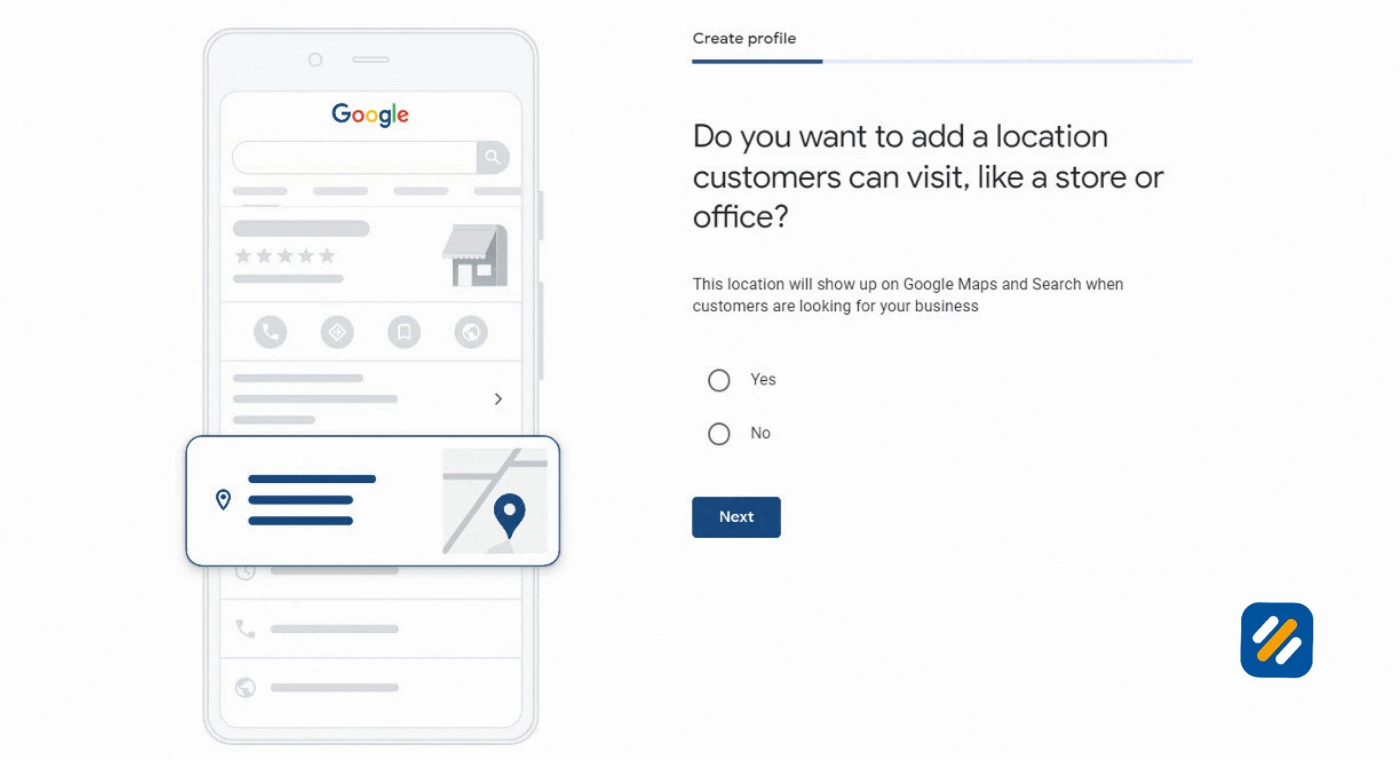
Step 1: Claim and verify your profile. Go to business.google.com and either claim an existing listing for your business or create a new one. Google will send a verification postcard to your business address with a code. Enter this code to verify ownership. Without verification, you cannot edit or optimise your profile.
Step 2: Choose your primary category with precision. This is the single most important decision you make in your entire GBP setup. Your primary category tells Google the core type of business you are. Do not choose a broad category when a specific one exists. A solicitor should choose “Law Firm” not “Professional Services.” A pizza restaurant should choose “Pizza Restaurant” not “Restaurant.” Google gives the primary category significantly more ranking weight than secondary categories.
Step 3: Add up to nine secondary categories. Secondary categories expand the searches you can appear for without diluting your primary category signal. A bakery might add “Wedding Bakery,” “Custom Cake Shop,” and “Coffee Shop” as secondary categories to capture related searches.
Step 4: Write a keyword-optimised business description. Your description can be up to 750 characters but only the first 250 or so display before being truncated. Put your most important information and keywords in the opening sentences. Include your primary service, your location, what makes you different, and two to three natural keyword phrases your customers would actually search. Do not keyword stuff. Write it like a human would explain their business to a stranger.
Step 5: Add your complete NAP details. NAP stands for Name, Address, Phone number. These three pieces of information must be completely accurate and must match your website, social profiles, and all other online directories exactly. Even minor inconsistencies like “Street” versus “St” can confuse Google’s local ranking systems.
Step 6: Set accurate business hours including special hours. Update your hours for public holidays and seasonal changes. Outdated business hours are one of the most common GBP mistakes and one of the most damaging to user trust. When a customer drives to a business that Google says is open but is actually closed, they leave a negative review and never return.
Step 7: Upload high-quality photos consistently. Profiles with photos receive significantly more engagement than those without. Upload a professional profile photo, a cover photo, interior and exterior shots, team photos, and photos of your products or services. Add new photos at least twice per month. Active photo uploads signal to Google that your business is engaged and current.
Step 8: Add all services and products with keyword-rich descriptions. Every service or product you add creates another relevance signal for Google. Write a natural description for each one that includes the terms your customers search for. This is an area most competitors ignore, which makes it one of the highest-impact optimisations for newer profiles.
Step 9: Enable messaging. Allowing customers to message you directly through your GBP increases engagement signals and gives potential customers a low-friction way to contact you without visiting your website.
Step 10: Post regularly. GBP posts are updates, offers, and events that appear directly on your profile. Posting once or twice per week keeps your profile active and gives Google fresh content to associate with your listing.
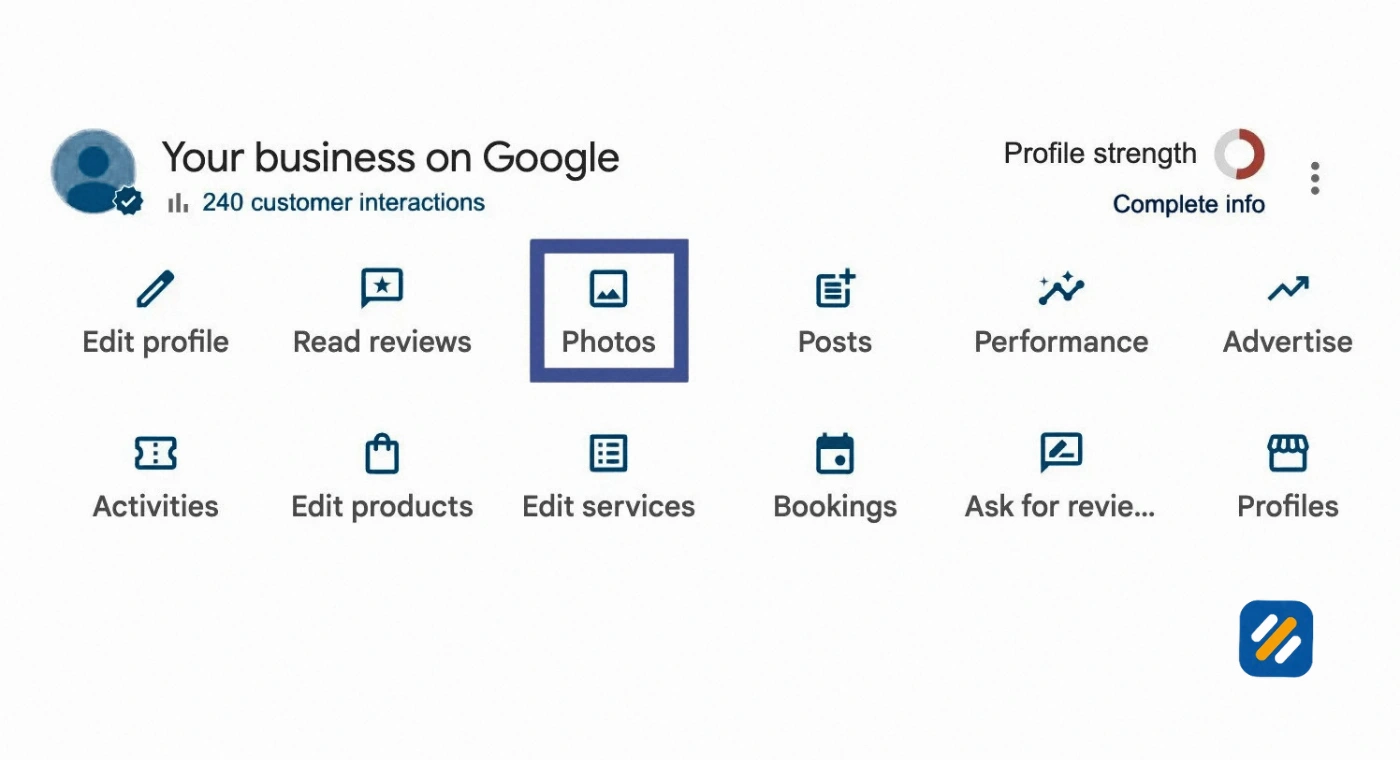
5 Google My Business SEO | How GBP and Your Website Work Together
One of the biggest misunderstandings in local SEO is treating Google Business Profile and website SEO as separate strategies. They are not. They are two parts of the same system and they actively reinforce each other when aligned correctly.
Here is how the connection works in practice
Your website’s domain authority contributes to your GBP prominence score. A business with a well-optimised website that ranks for local keywords signals to Google that the business is legitimate, established, and relevant. This directly improves GBP visibility in competitive Map Pack searches.
Your GBP drives traffic to your website, which improves your website’s engagement metrics. When someone clicks through from your GBP to your website, that session counts as direct or referral traffic. A healthy pattern of GBP-driven website visits improves your site’s overall performance signals in Google’s eyes.
Consistency between your GBP and your website builds Google’s confidence in your business data. If your GBP says your phone number is one thing and your website says another, Google cannot confidently verify which is correct and may suppress your profile from competitive results.
Your website’s local landing pages can feed keyword signals back into your GBP ranking. Creating dedicated pages on your website for each service area you serve, with proper local keyword optimisation, strengthens the geographic relevance of your GBP in those areas beyond your immediate physical location.
The practical implication of this for local business SEO is straightforward. Treat your GBP and your website as a single interconnected system. What you say in one should be reflected in the other. The keywords you target on your website should appear naturally in your GBP description and services. The service areas you define in GBP should have corresponding pages on your website.
6 Google Reviews | The Most Powerful and Most Neglected GBP Ranking Signal
If I had to identify the one GBP optimisation factor that makes the biggest difference between a business that dominates the Map Pack and one that barely appears in it, it would be reviews. Not just the number of reviews, but the strategy around earning them consistently.
Research from local SEO expert Joy Hawkins at Sterling Sky has shown that review velocity, the rate at which new reviews arrive, matters more than total review count. A business that receives five new reviews every month will consistently outrank a competitor who received fifty reviews two years ago but has been getting none recently. Google interprets fresh reviews as a signal that the business is currently active, currently serving customers, and currently maintaining quality.
Here is the review strategy I implement for every local SEO client:
Build a review request process into your business operations. The best moment to ask for a review is immediately after a positive customer interaction while the experience is fresh. For service businesses this might be right after completing a job. For retail businesses it might be in the post-purchase follow-up email.
Make it effortless. Create a short custom link that takes customers directly to your Google review form. You can generate this link from your GBP dashboard. Include it in follow-up emails, on your receipts, and in your email signature.
Respond to every review without exception. Responding to positive reviews shows appreciation and builds community. Responding to negative reviews shows professionalism and gives potential customers confidence that you handle problems seriously. Google also views active review responses as an engagement signal.
Never buy reviews or offer incentives for reviews. This violates Google’s policies and the consequences are severe. Google can suspend your entire GBP, removing your business from Maps and local search results completely. No shortcut is worth that risk.
7 GBP Posts, Q and A, and the Features Most Businesses Completely Ignore
After many years of auditing Google Business Profiles for clients across multiple industries, I consistently find that most businesses use less than half of the available GBP features. The ones they ignore are often the ones that separate average profiles from dominant ones.
Google Business Profile posts are updates that appear directly on your profile in search results. There are three types available: Updates for general news and announcements, Offers for promotions and deals, and Events for upcoming dates. Each post can include an image, text, and a call to action button.
Posting two to three times per week consistently does two things. It signals to Google that your profile is actively managed, which positively influences prominence. And it gives searchers more reasons to engage with your profile directly in search results rather than clicking to a competitor.
The Questions and Answers section is almost universally ignored but highly valuable. Anyone can add a question to your Q and A section and anyone can answer it, including you. I recommend proactively adding your own frequently asked questions and answering them yourself. This populates your profile with keyword-rich content and prevents incorrect answers from other users appearing on your listing.
The Products and Services sections are the most under-utilised features on the average GBP. Every service or product you add creates a new relevance signal. Each one has a name, a description, and optionally a price. Write these descriptions the same way you would write on-page SEO content: naturally, helpfully, and with the keywords your customers search for included where they fit.
8 What Is the 80/20 Rule in SEO and How It Applies to GBP Optimization
The 80/20 rule, also known as the Pareto Principle, states that 80% of your results come from 20% of your efforts. In SEO this principle is particularly useful because the range of possible optimisation activities is enormous and not all of them deliver equal results.
Applied to Google Business Profile optimization, the 80/20 rule looks like this:
The 20% of GBP activities that drive 80% of your results are: choosing the correct primary category, maintaining a consistent review acquisition strategy, keeping your NAP information accurate and consistent across the web, and uploading fresh photos regularly.
Everything else, adding secondary categories, writing post updates, filling in Q and A sections, and listing every service, is valuable but it falls into the remaining 20% of impact that follows from getting the foundational 20% right first.
For a business with limited time, this means: get your primary category right, your NAP consistent, your photos active, and your reviews coming in every month. Do those four things consistently and your GBP will outperform most competitors who are doing everything inconsistently or not at all.
Applied to broader SEO strategy, the 80/20 rule means focusing your content creation on the 20% of keywords that drive 80% of your valuable traffic. Fixing the 20% of technical issues that cause 80% of your crawl problems. Building relationships with the 20% of referring domains that pass 80% of your link equity.
Knowing what to focus on is not glamorous SEO advice. But it is the advice that actually determines whether a small business or a solo blogger builds something that works versus spending years busy without results.
9 Is SEO Dead or Evolving in 2026 | The Honest Answer
This question comes up every year without fail. And every year the answer is the same, though the evidence changes.
SEO is not dead. It has never been more important. But what SEO means has expanded significantly, and the businesses and blogs that treat it as the same practice it was in 2019 are the ones falling behind.
Here is what has genuinely changed in 2026
Google AI Overviews now appear at the top of results for a large percentage of informational searches. For many queries, users get an AI-generated answer without clicking any organic results. This has reduced click-through rates on certain types of content. The response is not to abandon SEO but to optimise for inclusion in AI Overviews by writing clear, authoritative, well-structured content that answers questions directly and completely.
Google Business Profile results, including AI-powered local packs, now appear for a wider range of searches than ever before. This makes GBP optimization more important in 2026 than it was in 2022, not less. Businesses investing in local SEO Google My Business strategies are capturing traffic that is bypassing traditional organic results entirely.
Voice search and conversational queries have grown. More people search in complete natural language sentences rather than keyword fragments. This shifts keyword strategy toward question-based and long-tail keywords, which is exactly the kind of content a well-structured personal brand blog is positioned to capture.
E-E-A-T signals matter more than they did five years ago. Google is investing more in verifying that the content it ranks comes from people with real expertise and real experience. This is not a threat to quality content creators. It is a barrier to low-quality AI-generated content farms, which benefits anyone publishing genuine expertise.
SEO in 2026 is an ecosystem, not a single channel. It includes your website’s organic rankings, your Google Business Profile visibility, your appearance in AI-generated answers, your presence in featured snippets, and your authority across the web. The businesses and blogs that understand this and build a strategy across all of these touchpoints are the ones growing, not the ones panicking about whether SEO is dead.
10 Google Business Profile Optimization Checklist | Everything in One Place
| Optimization Task | Priority | Impact on Rankings | Frequency |
|---|---|---|---|
| Claim and verify profile | Essential | Foundational, nothing works without this | One time |
| Choose accurate primary category | Essential | Very high, strongest relevance signal | Review annually |
| Add up to 9 secondary categories | High | Medium, expands search coverage | Update when services change |
| Write keyword-rich business description | Essential | High, direct relevance signal | Review every 6 months |
| Add accurate NAP details | Essential | High, consistency signal across web | Update immediately on any change |
| Upload minimum 10 high-quality photos | High | High, engagement and completeness signal | Add new photos twice monthly |
| List all services with descriptions | High | High, relevance signal for service searches | Update when services change |
| Set accurate business hours | Essential | Medium, trust signal | Update for holidays and changes |
| Enable messaging | Medium | Medium, engagement signal | One time setup |
| Post updates 2 to 3 times per week | High | Medium, activity and freshness signal | Weekly ongoing |
| Actively request reviews from customers | Essential | Very high, prominence signal | Daily habit |
| Respond to every review | High | High, engagement and trust signal | Within 24 hours |
| Add Q and A content proactively | Medium | Medium, keyword and relevance signal | Monthly |
| Verify NAP consistency across all directories | High | High, local citation signal | Quarterly audit |
| Monitor profile insights monthly | Medium | Indirect, informs strategy | Monthly |
11 3 Expert Tips for Google Business Profile Optimization in 2026
Tip 1: Use Your Reviews as a Keyword Research Tool
Read through your existing customer reviews and note the specific words and phrases customers use to describe your business and services. These are real search terms your customers actually use. Incorporate the most common ones naturally into your business description and service listings. This creates a direct alignment between how customers describe you and how Google matches you to new searchers.
Tip 2: Post GBP Updates That Mirror Your Website Content
When you publish a new blog post or service page on your website, create a corresponding GBP post linking to it. This drives traffic from your GBP to your website, signals to Google that both assets are actively maintained and topically aligned, and reinforces the same keyword themes across two different Google properties simultaneously.
Tip 3: Monitor Your Competitor Profiles Monthly
Search for your primary service keyword in your target area and study the top three profiles in the Map Pack. Note how many reviews they have, when their last post was, what categories they use, and what photos they have uploaded. This gives you a clear picture of what the benchmark looks like in your market and shows you exactly where you need to invest more effort to surpass them.
12 Conclusion
Google Business Profile optimization is one of the most direct, highest-impact, and genuinely free SEO strategies available to any local business or service provider in 2026. And it is still being ignored or executed poorly by the majority of businesses it could help.
The businesses appearing at the top of the Map Pack for competitive local searches are not there by accident. They have complete profiles, active review strategies, consistent posting habits, and NAP information that matches perfectly across the web. Those things take time to build but they do not require a large budget.
Start with the checklist in this article. Work through it section by section. Then build the habits, posting weekly, requesting reviews after every job, responding to every review within 24 hours, that keep your profile active and competitive over time.
Your Google Business Profile is working for you around the clock whether you have optimised it or not. The only question is whether it is working for you or for your competitors.
Have a question about Google Business Profile optimization? Drop it in the comments below and I will answer it personally.
Join 1,000+ business owners and bloggers who get one actionable SEO tip every week — straight to their inbox. Free forever.
Get Free Weekly Tips →