- Localization SEO is the process of adapting your website content, keywords, and technical setup to rank in specific countries or regions, not just translating text
- Direct translation of keywords almost never works because search behaviour varies dramatically between markets even within the same language
- Hreflang tags, localized URL structures, and market-specific sitemaps are the three technical pillars every localization SEO strategy must have
- The four types of SEO are on-page, off-page, technical, and local SEO, and localization touches all four simultaneously
- A US company targeting the UK market still needs SEO localization because “sneakers” and “trainers” are completely different keywords with different search volumes
1 What Is Localization SEO and Why Translating Your Website Is Not Enough
Most businesses expanding into new markets make the same expensive mistake. They translate their existing content into the target language, upload it, and wait for traffic to arrive. The traffic never comes. Not because the translation was bad. Because translation and localization SEO are fundamentally different things.
Localization SEO is the process of adapting your entire online presence, including your keywords, content structure, metadata, URL architecture, and cultural tone, so that it ranks in search engines and feels natural to real people in a specific market.
Translation converts words from one language to another. SEO localization converts your entire digital strategy from one market to another.
Here is a real example that makes this distinction immediately clear. A US-based shoe retailer optimises their website for the keyword “sneakers.” This keyword gets 450,000 monthly searches in the United States. When they translate their site for the UK market, they use the same keyword translated directly. The problem is that British consumers do not search for “sneakers.” They search for “trainers.” Same product. Same intent. Completely different keyword. Without localized SEO, the UK version of the site ranks for nobody.
This is exactly the gap that localization SEO closes. It is not about language. It is about how real people in each specific market actually search for what you offer.
2 What Is an Example of Localization in SEO | Real Cases That Show How It Works
Understanding localization SEO through real examples is far more useful than reading abstract definitions. Here are four concrete examples across different industries that show exactly how localized SEO works in practice.
Example 1: US vs UK English keyword differences
A food delivery platform targeting both the US and UK markets cannot use the same keywords across both sites. American users search for “takeout food near me.” British users search for “takeaway food near me.” The word is different. The intent is identical. Without localized keyword research, the platform either ranks in one market and not the other, or it splits its authority between two different pages competing against each other.
Example 2: Date formats and local trust signals
A US software company expanding into Germany needs to do more than translate its website into German. German users expect dates in DD.MM.YYYY format, prices in euros with German comma notation, and references to GDPR compliance displayed prominently. A site that reads like an American site written in German converts poorly regardless of how well it ranks. True localization SEO adapts the entire user experience, not just the language.
Example 3: Currency and measurement units
A UK retailer targeting the Australian market needs to adapt prices to AUD, use metric measurements, and reference Australian consumer protection standards on checkout pages. Google also evaluates trust signals on ecommerce pages. Pages that show mismatched currency or country codes confuse both users and search engines about which market the page actually serves.
Example 4: Search engine differences by country
Google dominates search in most Western markets but is not the dominant search engine everywhere. In Russia, Yandex holds significant market share. In China, Baidu is the primary search engine. In South Korea, Naver processes more local searches than Google. A localization SEO strategy that only optimises for Google will miss entire national search ecosystems completely.
3 What Are the Four Types of SEO and How Localization Touches All of Them
One of the most common questions beginners ask when they start learning about localization SEO is how it fits into the broader SEO landscape. The answer is that localized SEO is not a separate discipline. It is the international application of the four core types of SEO working together simultaneously.
On-Page SEO in Localization
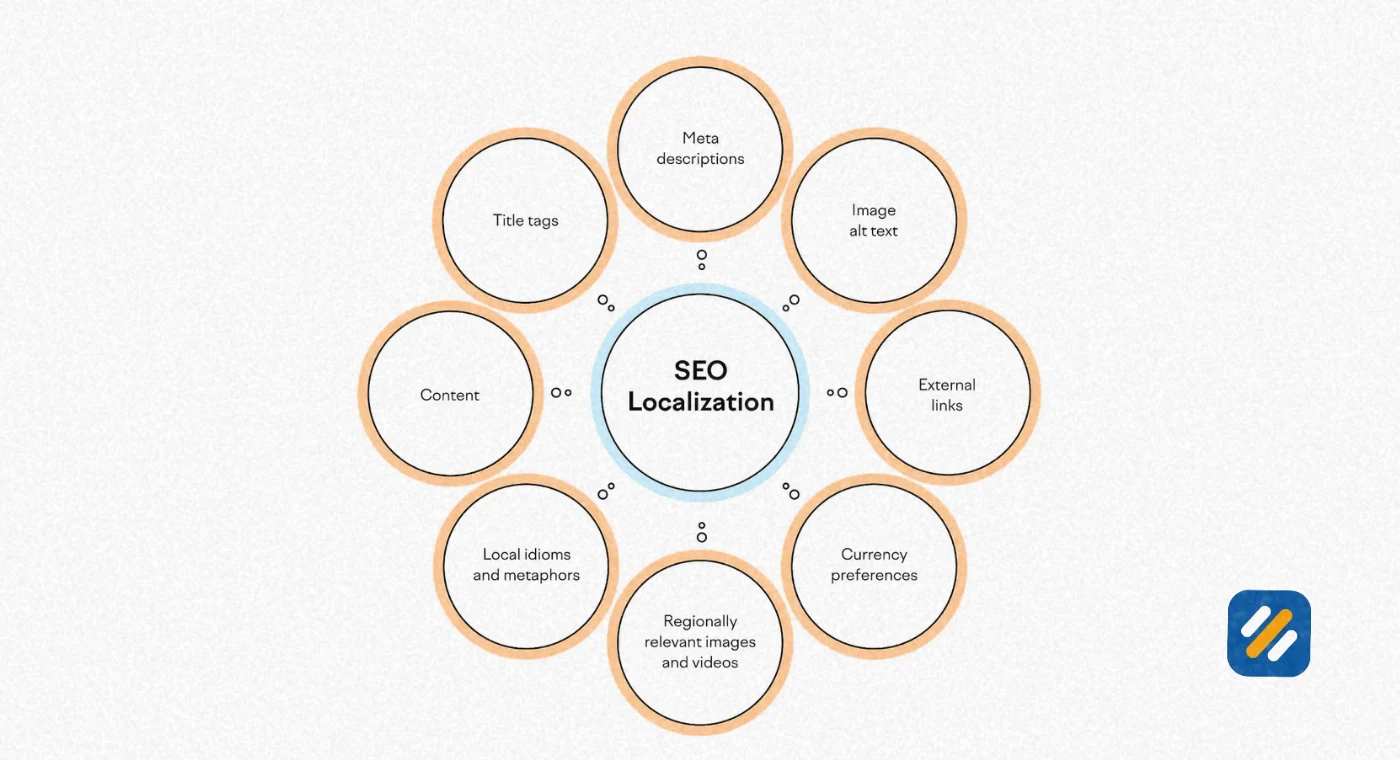
On-page SEO covers everything on the page itself: title tags, meta descriptions, heading structure, keyword usage, and content depth. In a localization context, on-page SEO means researching and using keywords that real users in each target market actually search for, not direct translations of your English keywords. It also means adapting your content tone, examples, and cultural references so the page feels written for local readers rather than translated for them.
Off-Page SEO in Localization
Off-page SEO in a localised context means building backlinks from websites in your target market. A backlink from a respected German publication carries far more authority for your German content than a backlink from a US website. Local link building requires outreach to local bloggers, journalists, and industry publications in each market, which is more resource-intensive than domestic link building but produces significantly stronger localised rankings.
Technical SEO in Localization
Technical localization SEO is where most businesses make critical mistakes. It includes implementing hreflang tags correctly, choosing the right URL structure for each market, creating and submitting localized sitemaps, and ensuring Google knows which version of your site to serve in which country. Get the technical setup wrong and all your content and link work produces nothing in the target market.
Local SEO in Localization
Local SEO applies specifically to businesses with a physical presence or service area in a target country. This means claiming and optimising a Google Business Profile in each market, building local citations in country-specific directories, and earning reviews from customers in that specific region.
| SEO Type | Domestic Application | Localization Application |
|---|---|---|
| On-Page SEO | English keywords, US cultural references | Market-specific keywords, local cultural tone and examples |
| Off-Page SEO | Backlinks from US websites | Backlinks from local market websites and publications |
| Technical SEO | Site speed, sitemaps, crawlability | Hreflang tags, localized URL structures, market-specific sitemaps |
| Local SEO | Google Business Profile for US location | Separate GBP entries per country, local directory citations |
4 Localization SEO vs Standard Translation | The Difference That Determines Whether You Rank or Not
This distinction is worth spending real time on because the confusion between translation and localization SEO costs businesses significant money every year.
Standard translation converts your text from one language to another. A human or machine translator reads your English page and produces a German, French, or Spanish version. The words are accurate. The grammar is correct. But search engines do not rank pages for accuracy. They rank pages for relevance to how real people search.
SEO localization starts with research, not translation. Before a single word of content is written for a new market, a proper localization SEO strategy begins by answering three questions. What do people in this market actually search for? How does the search intent for this topic differ from the home market? What content format does Google in this market reward for these queries?
Only after those questions are answered does content creation begin. The resulting content may look completely different from the original English version, not because the translation was bad but because the original content was built around different search behaviour.
| Factor | Standard Translation | Localization SEO |
|---|---|---|
| Starting point | Existing content in source language | Market research and local keyword data |
| Keyword approach | Direct translation of existing keywords | Independent keyword research in target language |
| Cultural adaptation | Minimal, focuses on linguistic accuracy | Deep, adapts tone, examples, references, and format |
| Technical elements | No change to URL structure or hreflang | Full technical setup for each market |
| Search visibility | Often low because local search intent is missed | Designed specifically to match local search behaviour |
| Content format | Mirrors source content structure | Adapts to what Google in that market rewards |
5 How to Build a Localization SEO Strategy Step by Step
This is the section that separates businesses that understand localization SEO in theory from those that actually execute it and see results. Here is the complete process I use when building a localised SEO strategy for a new market.
Step 1: Choose your target markets based on data, not assumptions
Do not expand into markets because they seem like good opportunities. Expand into markets where evidence shows demand for your product or service already exists. Use Google Analytics to identify which countries are already sending you organic traffic without any localised effort. These markets have existing demand that localisation can amplify rather than create from scratch.
Step 2: Conduct independent keyword research in each target market
Open Ahrefs or SEMrush and switch both the database and the target country to your market. Do not start with your English keyword list. Start fresh with your core topic and see what terms real users in that market search for. Build a keyword list that reflects local search behaviour, not translated assumptions.
Step 3: Decide on your URL structure before publishing anything
You have three options. Country code top-level domains like brand.de give the strongest geo-targeting signal but require separate hosting and authority building. Subdomains like de.brand.com are easier to manage but share authority more loosely. Subfolders like brand.com/de/ are the easiest to implement and benefit directly from your main domain authority. For most small and medium businesses, subfolders are the recommended starting point.
Step 4: Implement hreflang tags on every localised page
Hreflang tags are HTML attributes that tell Google which language and regional version of a page to serve to which users. Without them, Google may serve the wrong language version of your page in the wrong country, or identify your localised pages as duplicate content and penalise both versions. Every localised page must have a hreflang tag pointing to all alternate language versions of that page including the original.
Step 5: Adapt on-page content for local search intent and cultural expectations
Rewrite titles, meta descriptions, headings, and body content using your locally researched keywords. Adapt examples, case studies, pricing references, and cultural touchpoints to reflect the target market. Have a native speaker review the content before publishing. Tools cannot catch the subtleties of tone and phrasing that determine whether content feels local or foreign.
Step 6: Build localised backlinks in each market
Identify the top industry publications, blogs, and directories in your target market. Conduct outreach in the local language. Aim to earn at least 10 to 15 quality backlinks from local domains in each market before expecting strong rankings. Local backlinks carry far more weight for localised pages than backlinks from international or English-language sites.
Step 7: Submit localised sitemaps in Google Search Console
Create a separate sitemap for each language or regional version of your site and submit it to Google Search Console under the appropriate property. This ensures Google can discover and index all your localised pages rather than relying on finding them through crawling alone.
6 Localization Keywords | How to Find and Use Them Correctly
Localization keywords are the specific search terms that real users in your target market type into Google when looking for what you offer. They are almost never a direct translation of your English keywords and identifying them correctly is the single most important step in any localization SEO strategy.
Here is the process for finding localization keywords that actually drive traffic
Start with market-specific Google autocomplete. Open Google in the target country or use a VPN to simulate that market. Type your core topic and note every autocomplete suggestion. These suggestions are pulled from real search activity in that specific market and often surface keyword variations that no keyword tool would show you.
Use Ahrefs or SEMrush with the target country database. Switch both the keyword database and the location filter to your target country. Enter your core topic and analyse the results. Pay attention to keywords that have significant local search volume but low difficulty, these are your fastest ranking opportunities in the new market.
Study what your local competitors rank for. Find three to five websites that rank well in your target market for your topic. Enter their URLs into the organic keywords report in Ahrefs or SEMrush and filter for your target country. The keywords sending them traffic are proven local search terms that real users are already finding valuable.
Validate search intent before creating content. Google any localization keyword you plan to target and study the top three results. Are they guides, product pages, comparison articles, or definitions? The format Google is already rewarding in that market tells you exactly what format your localised content needs to take.
7 Can I Do Local SEO and Localization SEO Myself
Yes, absolutely. Both local SEO and localization SEO are skills you can learn and execute yourself without hiring an agency. The key is understanding what each one requires in terms of time, tools, and knowledge.
Local SEO for a single market is highly manageable as a solo effort. Setting up and optimising a Google Business Profile, building local citations, earning local reviews, and creating location-specific content are all tasks a determined small business owner can handle within a few hours per week.
Localization SEO across multiple markets requires more resources but is still achievable without an agency for businesses targeting one or two additional markets. Here is an honest assessment of what you can do yourself versus where professional help adds the most value:
| Task | Can You Do It Yourself | Tools Needed |
|---|---|---|
| Local keyword research per market | Yes | Ahrefs free, Google Keyword Planner, Google Trends |
| Hreflang tag implementation on WordPress | Yes, with a plugin | WPML, Polylang, or Rank Math |
| Content adaptation and localisation | Yes, with native reviewer | Claude AI for drafts, native speaker for review |
| Localized sitemap creation | Yes | Rank Math or Yoast SEO |
| Google Search Console setup per market | Yes | Free, just requires property verification |
| Local link building outreach | Yes but time-intensive | Hunter.io for email finding, manual outreach |
| Technical hreflang audit | Challenging without experience | Screaming Frog free version |
| Building content hubs per market | Yes | WordPress with WPML or Polylang |
The honest limitation of doing it yourself is time. Localization SEO done well is research-intensive. Keyword research, content creation, and outreach all multiply by the number of markets you are targeting. For businesses targeting three or more markets simultaneously, professional help becomes cost-effective simply because of the volume of work involved.
8 Common Localization SEO Mistakes That Waste Budget and Kill Rankings
After working on international SEO campaigns across B2B, ecommerce, and service businesses, the same mistakes appear repeatedly when companies attempt localization SEO without a proper strategy.
Translating keywords directly without local research: This is the most common and most damaging mistake. A keyword that drives thousands of searches in one language may be searched by nobody in the translated form. Always research keywords independently in each market rather than translating your existing list.
Ignoring hreflang tags entirely: Without hreflang, Google cannot reliably serve the correct language version of your pages to the right users. You end up with English pages ranking in Germany and German pages ranking in the US, both performing below their potential and potentially cannibalising each other.
Using machine translation without human review: Machine translation tools have improved dramatically but they still miss cultural nuance, local idioms, and industry-specific terminology. Content that reads like it came out of a translation tool damages brand trust in ways that are very difficult to measure but very real in their impact on conversion rates.
Building localised content without building local backlinks: Many businesses invest heavily in translating and localising their on-page content but then do nothing to build authority in the new market. A localised page with no local backlinks will almost always lose to a local competitor’s page with even moderate on-page optimisation and strong local link authority.
Treating localisation as a one-time project: Search behaviour evolves. New competitors enter markets. Algorithm updates change what Google rewards. Localisation SEO is an ongoing process of monitoring, updating, and improving, not a one-time content translation project.
9 3 Expert Tips for Localization SEO That Most Guides Never Tell You
Tip 1: Research local search intent before researching local keywords
Most guides tell you to start with keyword research. The smarter approach is to start with search intent research. Google your core topic in the target market and study what type of content currently ranks. Are they long guides, short definitions, product comparisons, or how-to videos? This tells you what Google in that specific market considers the best answer for your topic before you write a single word. Matching that intent saves months of ranking time.
Tip 2: Build one localised content hub before expanding to multiple markets
Trying to localise for five markets simultaneously almost always produces mediocre results across all five. A better approach is to build a complete, authoritative content hub for one market first, earn local backlinks, achieve real rankings, and then use that proven structure as your template for the next market. One market done excellently beats five markets done poorly every time.
Tip 3: Monitor your localised pages in Google Search Console separately for each market
Set up a separate Google Search Console property for each language version of your site. This gives you clean performance data per market without mixing signals from different regions. When a localised page starts ranking between positions 5 and 15 in its target market, that is your signal to update it with additional depth, better local examples, and stronger localised internal links. This targeted improvement process is where the fastest ranking gains in localization SEO come from.
10 Conclusion
Localization SEO is what separates businesses that have a global presence from businesses that have a global website. The difference is measurable in traffic, in revenue, and in the long-term authority you build in each market you enter.
The process is not complicated but it requires doing things in the right order. Research the market before creating content. Find local keywords independently rather than translating existing ones. Set up the technical foundation correctly before publishing anything. Build local authority through local links. Then monitor, update, and improve consistently over time.
Every market you localise correctly becomes a compounding traffic source that works for you in that country around the clock without ongoing ad spend.
Start with one market. Do it properly. Then take what you learned and apply it to the next one.
Have a question about localization SEO for your specific situation? Leave a comment below and I will answer it personally.
Join 1,000+ business owners and bloggers who get one actionable SEO tip every week — straight to their inbox. Free forever.
Get Free Weekly Tips →