- Choosing the right SEO keywords is the single most important decision you make before writing any piece of content
- Search intent matters more than search volume when selecting keywords for SEO
- A new website should only target keywords with a difficulty score under 20 to 30
- Long-tail keywords consistently outperform broad keywords for new and growing websites
- AI tools like Claude AI and ChatGPT are now genuinely useful for discovering keyword angles traditional tools miss
- Primary keyword density should stay between 1% and 1.2% across your article to avoid keyword stuffing
1 What Does It Actually Mean to Choose the Right SEO Keywords
Most beginners think keyword selection is just about finding popular search terms and adding them to their content. After many years of doing SEO for clients across B2b, healthcare, ecommerce, and SaaS industries, I can tell you that mindset is exactly why most new websites never rank.
Choosing the right SEO keywords means finding the specific phrases your target audience actually types into Google, confirming those phrases have realistic ranking potential for your website, and understanding the intent behind each search before writing a single word.
A keyword is not just a word. It is a window into what a real person wants at a specific moment. When someone searches “how to choose SEO keywords,” they want a step by step process, not a definition. When someone searches “best SEO keyword tool,” they want a comparison, not a tutorial. The keyword tells you what to write. The intent tells you how to write it.
Get the keyword right and every hour you spend writing content pays off for years. Get it wrong and your content sits invisible on page five no matter how well it is written.
2 Is SEO Still Relevant in 2026 | And Why Keyword Selection Matters More Than Ever
Before investing time in keyword research, this is the question every small business owner and blogger asks. The honest answer is yes, SEO is not just relevant in 2026, it is more competitive and more valuable than it has ever been.
Here is why keyword selection has become even more critical in 2026 specifically. Google’s AI Overviews now appear at the top of search results for a significant percentage of informational queries. This means if your content is not structured around the precise keyword and intent a searcher uses, you will not just miss the top organic result. You will miss the AI Overview entirely.
At the same time, Google’s E-E-A-T updates have made it harder for generic content to rank. Keyword selection now needs to account not just for what people search, but for whether your website has the authority to answer that specific question credibly.
The websites winning in 2026 are the ones choosing keywords strategically, publishing genuinely expert content around those keywords, and building topical authority across a focused niche. Keyword selection is the foundation that everything else sits on.

3 The 4 Types of Search Intent You Must Understand Before Choosing Any Keyword
Search intent is the reason behind a search query. It is the single most important factor in keyword selection and the one most beginners completely ignore.
Google does not just match keywords to pages. It matches intent to pages. If your content format does not match what the searcher actually wants, you will not rank, even if every other SEO element is perfect.
There are four types of search intent:
Informational intent means the searcher wants to learn something. Keywords like “what is keyword difficulty” or “how to do keyword research” are informational. The best content format here is a guide, tutorial, or explanation.
Navigational intent means the searcher wants to find a specific website or page. Keywords like “Ahrefs login” or “Google Search Console” are navigational. Creating content targeting these keywords rarely makes sense unless you are the brand being searched.
Commercial intent means the searcher is researching before making a decision. Keywords like “best free SEO tools” or “Ahrefs vs SEMrush” are commercial. Comparison articles and roundups work best here.
Transactional intent means the searcher is ready to take action right now. Keywords like “buy SEO course” or “hire SEO specialist” are transactional. These keywords convert the highest but have the most competition.
Before selecting any keyword, ask yourself which intent category it falls into. Then make sure your content format matches that intent. A blog post trying to rank for a transactional keyword will almost always lose to a landing page. A landing page trying to rank for an informational keyword will almost always lose to a guide.
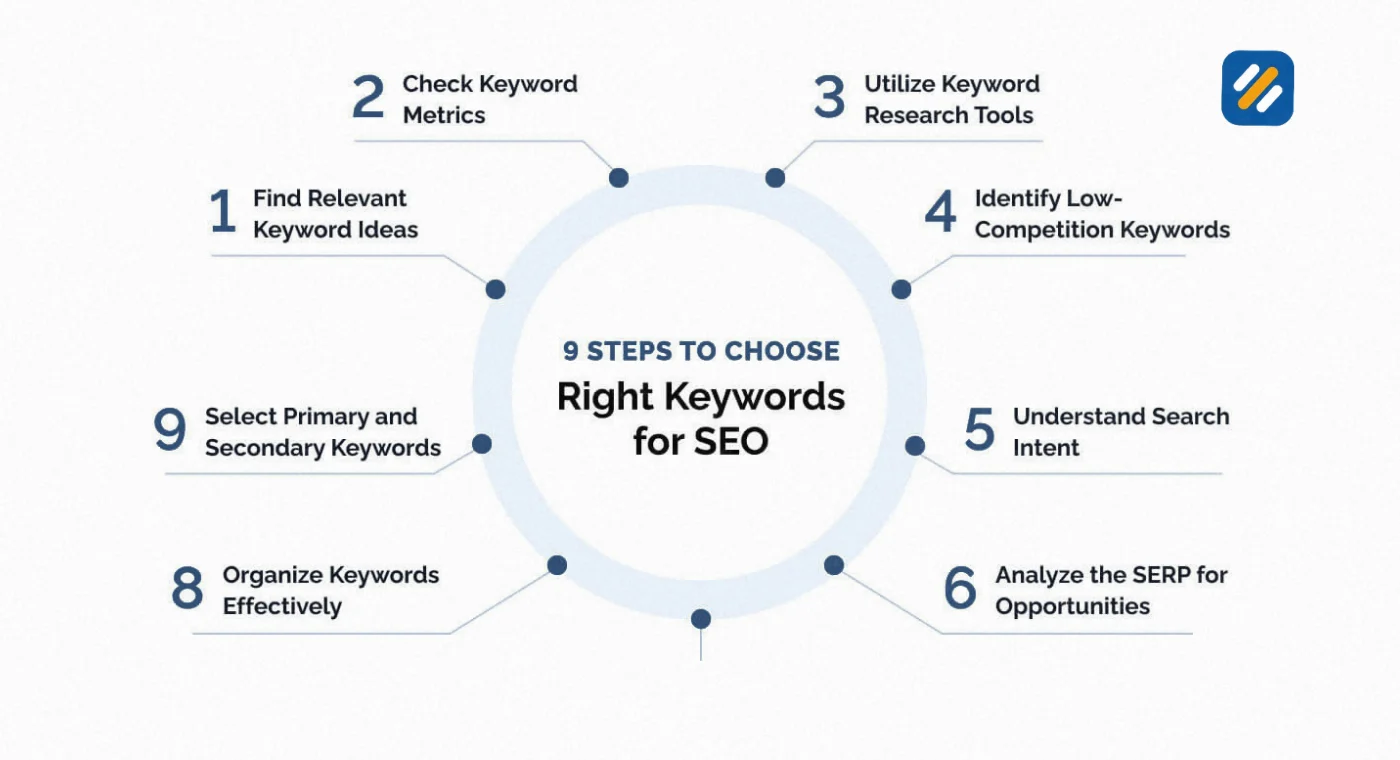
4 How to Choose SEO Keywords Step by Step
Here is the exact keyword selection process I use for every new piece of content on client websites and my own blog:
Step 1: Start with a seed topic. Write down the broad subject your content will cover. This is not your final keyword. It is your starting point for research. For example, “keyword research” or “on-page SEO.”
Step 2: Expand into real search phrases. Type your seed topic into Google and study the autocomplete suggestions. Every suggestion is a real search being made right now. The People Also Ask box on each results page gives you question-based keyword variations that often have lower competition than the main keyword.
Step 3: Check search volume and keyword difficulty. Use Google Keyword Planner for free volume data or Ahrefs free keyword generator for difficulty scores. For a new website with no domain authority, only pursue keywords with a difficulty score under 20. For websites with 6 to 12 months of consistent publishing, difficulty up to 30 is reasonable.
Step 4: Analyse the search intent. Google your shortlisted keyword and study what the top three results look like. Are they listicles, guides, definitions, or comparison articles? The format Google is already rewarding tells you exactly what format your content needs to take.
Step 5: Check the competition realistically. Open the top three ranking pages for your target keyword. How many backlinks do they have? How long is the content? How deep does the topic go? If the top results are from Semrush, Ahrefs, or HubSpot with thousands of backlinks, that keyword is not realistic for a new website regardless of the difficulty score.
Step 6: Confirm trend direction in Google Trends. Enter your final keyword into Google Trends and confirm the interest line is stable or rising. A keyword with declining interest is a shrinking opportunity even if the current volume looks acceptable.
Step 7: Assign one primary keyword and two to three secondary keywords. Your primary keyword goes in the title, first paragraph, one H2 heading, and meta description. Secondary keywords are planted naturally in supporting sections without forcing them.
5 What Makes a Good SEO Keyword | The 5 Criteria That Actually Matter
Not every keyword with decent search volume is worth targeting. Here is the framework I use to evaluate whether a keyword deserves a full article:
| Criteria | What to Look For | Why It Matters |
|---|---|---|
| Search Volume | Minimum 100 monthly searches in target country | Below this, traffic is too thin even if you rank number one |
| Keyword Difficulty | Under 20 for new sites, under 40 for established sites | Realistic ranking potential based on your domain authority |
| Search Intent Match | Does your content format match what ranks | Google rewards intent match above almost everything else |
| Commercial or Informational Value | Does ranking for this keyword serve a business goal | Traffic that never converts or builds authority is wasted effort |
| Trend Direction | Stable or rising in Google Trends | Declining keywords shrink your return over time |
A keyword that scores well across all five criteria is worth a full article. A keyword that fails even one of these criteria needs to be reconsidered or replaced with a better variation.
6 How Many SEO Keywords Should You Use Per Article
This is one of the most common questions beginners ask and it has a clear answer.
Each article should target one primary keyword. That primary keyword should appear at a density of 1% to 1.2% across the article. For a 1,500 word article this means the primary keyword appears 15 to 18 times naturally throughout the content.
Beyond the primary keyword, each article should include two to four secondary keywords. These are closely related phrases that support the main topic and help the page rank for a wider range of related searches.
Here is how to place them correctly:
Primary keyword placement:
- In the article title, as close to the beginning as possible
- In the first 100 words of the introduction
- In at least one H2 heading
- In the meta description
- Naturally throughout the body at 1% to 1.2% density
Secondary keyword placement:
- In supporting H2 or H3 headings where they fit naturally
- Once or twice in body paragraphs where they read without friction
- In image alt text where relevant
What you are never doing is repeating any keyword in every paragraph. If a sentence sounds forced, the keyword does not belong there. Google’s natural language processing in 2026 is sophisticated enough to identify keyword stuffing and it actively reduces rankings for pages that do it.
7 Long-Tail vs Short-Tail Keywords | Which Should You Choose
This decision determines whether your content has any realistic chance of ranking in the first 12 months.
Short-tail keywords are broad, one to two word phrases like “SEO” or “keyword research.” They have massive search volume but equally massive competition. The pages ranking for these terms have years of authority and thousands of backlinks behind them. A new or growing website cannot compete here.
Long-tail keywords are specific, three to six word phrases like “how to choose SEO keywords for a new website” or “free keyword research tools for beginners.” They have lower search volume individually but significantly lower competition and much higher conversion rates because they attract searchers who know exactly what they want.
| Keyword Type | Example | Monthly Volume | Difficulty | Best For |
|---|---|---|---|---|
| Short-tail | keyword research | 40,000+ | 85+ | Established authority sites only |
| Medium-tail | how to do keyword research | 8,000 | 55 | Sites with 12+ months authority |
| Long-tail | how to do keyword research for free | 1,200 | 18 | New and growing websites |
| Ultra long-tail | how to do keyword research for free step by step for beginners | 300 | 8 | Brand new websites, fastest to rank |
The strategy for a personal brand blog in its first year is straightforward. Start with ultra long-tail and long-tail keywords exclusively. Build topical authority by publishing consistently across your niche. As your domain authority grows between months six and twelve, begin targeting medium-tail keywords. Short-tail keywords become realistic after 18 to 24 months of consistent publishing with a strong backlink profile.
8 How to Use AI Tools for Smarter Keyword Selection in 2026
Traditional keyword tools show you search volume data from last month. AI tools show you how real people think and ask questions, which opens up keyword opportunities that volume data alone will never surface.
Here is how to use AI tools specifically for choosing SEO keywords:
ChatGPT: Ask it to generate 20 questions a small business owner with no SEO knowledge would type into Google about your topic. The output surfaces natural language keyword variations that match how real people search rather than how industry professionals phrase things.
Claude AI: Ask Claude to identify the most common misconceptions beginners have about your topic, then turn those misconceptions into search queries. This technique consistently surfaces keywords with informational intent that have low competition because most content creators are too advanced to think about what beginners actually do not know.
Perplexity AI: Search your main topic and study the related questions that appear at the bottom of each answer. These are drawn from real search patterns and represent exactly the type of conversational queries that now appear in Google AI Overviews.
Google People Also Ask: Not an AI tool in the traditional sense but powered by machine learning. Every PAA question on a search results page is a validated keyword with clear intent already defined for you. Expanding all PAA boxes on a results page gives you five to fifteen additional keyword opportunities from a single search.
The combination of AI-generated question angles and traditional volume data from Keyword Planner or Ahrefs gives you a keyword list that is both searchable and genuinely useful to real readers.
9 Is an SEO Score of 92 Good | What Keyword Scores Actually Tell You
If you use Rank Math or Yoast SEO on WordPress, you have seen a content score displayed after optimising your page. A score of 92 out of 100 in Rank Math is genuinely good. It means your keyword is placed correctly across the page elements that matter most.
However, this is what every beginner needs to understand. A high SEO score does not guarantee rankings. It guarantees that your on-page optimisation is technically sound. Rankings still depend on your domain authority, your backlink profile, the quality of your content relative to competitors, and how well your page matches search intent.
Here is what an SEO score of 92 in Rank Math typically means you have done correctly:
- Primary keyword in title tag and meta description
- Primary keyword in the first paragraph
- Keyword used in at least one heading
- Content length meets the minimum threshold for the topic
- Images have alt text containing relevant keywords
- Internal links are present
- No major technical SEO issues flagged
An SEO score above 80 is the target for every article you publish. Chasing 100 is unnecessary and can lead to forced keyword placement that reads unnaturally. Aim for 80 to 95 and focus the remaining energy on making the content genuinely better than what currently ranks.
10 What to Consider When Selecting Keywords to Guide Your Content Strategy
Keyword selection is not just about individual articles. When done correctly, it builds a content strategy that creates topical authority across your entire website.
Here is what to consider when building a keyword-driven content strategy:
Topical coverage: Every keyword you target should fit within one of your defined content categories. Publishing articles that cover every angle of a topic signals to Google that your website is an authority on that subject, which lifts rankings for all related pages simultaneously.
Keyword clustering: Group related keywords into clusters and write one comprehensive article targeting the primary keyword with supporting articles targeting secondary variations. This internal linking structure distributes authority across your site and helps Google understand the relationship between your pages.
Content gaps: Use Ahrefs or SEMrush free tools to find keywords your competitors rank for that you do not yet have content for. These gaps represent direct opportunities to capture traffic your competitor is already proving exists.
Publishing cadence: Choose keywords at a pace you can consistently publish around. It is far better to publish two deeply researched articles per week than five thin articles. Quality of keyword targeting matters more than publishing volume.
Revenue alignment: Prioritise keywords that connect to your monetisation goals. For a personal brand blog, keywords that attract potential freelance clients, readers who may purchase affiliate products, or audiences that generate strong AdSense RPM should be weighted higher than keywords with volume but no commercial connection.
11 3 Expert Tips for Choosing SEO Keywords Like a Specialist
Tip 1: Always check who is ranking before you decide to target a keyword
Search volume and difficulty scores are estimates. The real competition check is opening the actual pages ranking in the top three. If they are all from industry giants with domain ratings above 70, skip that keyword regardless of what any tool tells you.
Tip 2: Target the same topic from multiple angles using keyword clusters
Instead of writing one article on “keyword research,” write one article targeting “how to do keyword research for free,” another targeting “what is keyword difficulty,” and a third targeting “long-tail keywords for beginners.” Each article reinforces the others through internal links and together they build topical authority faster than a single article ever could.
Tip 3: Revisit your keyword list every three months using Google Search Console data
GSC shows you which keywords your pages are already appearing for but not fully optimised around. These are your highest value opportunities because Google is already trying to rank you for them. Update the article to target that keyword more deliberately and rankings often improve within weeks.
12 Conclusion
Choosing the right SEO keywords is not a one-time task. It is a continuous process of researching what your audience is searching for, evaluating whether ranking is realistic for your website right now, and publishing content that fully matches what searchers actually want to find.
Start with long-tail keywords your domain can realistically rank for. Build topical authority by covering your niche consistently. Use AI tools to surface the natural language angles traditional tools miss. Check intent before writing a single word.
The websites that build real, lasting organic traffic are not the ones chasing the highest volume keywords. They are the ones choosing the right keywords for where they are right now and publishing content good enough to earn and hold those rankings permanently.
Have a question about keyword selection for your specific website? Drop a comment below and I will give you a personalised answer.
Join 1,000+ business owners and bloggers who get one actionable SEO tip every week — straight to their inbox. Free forever.
Get Free Weekly Tips →