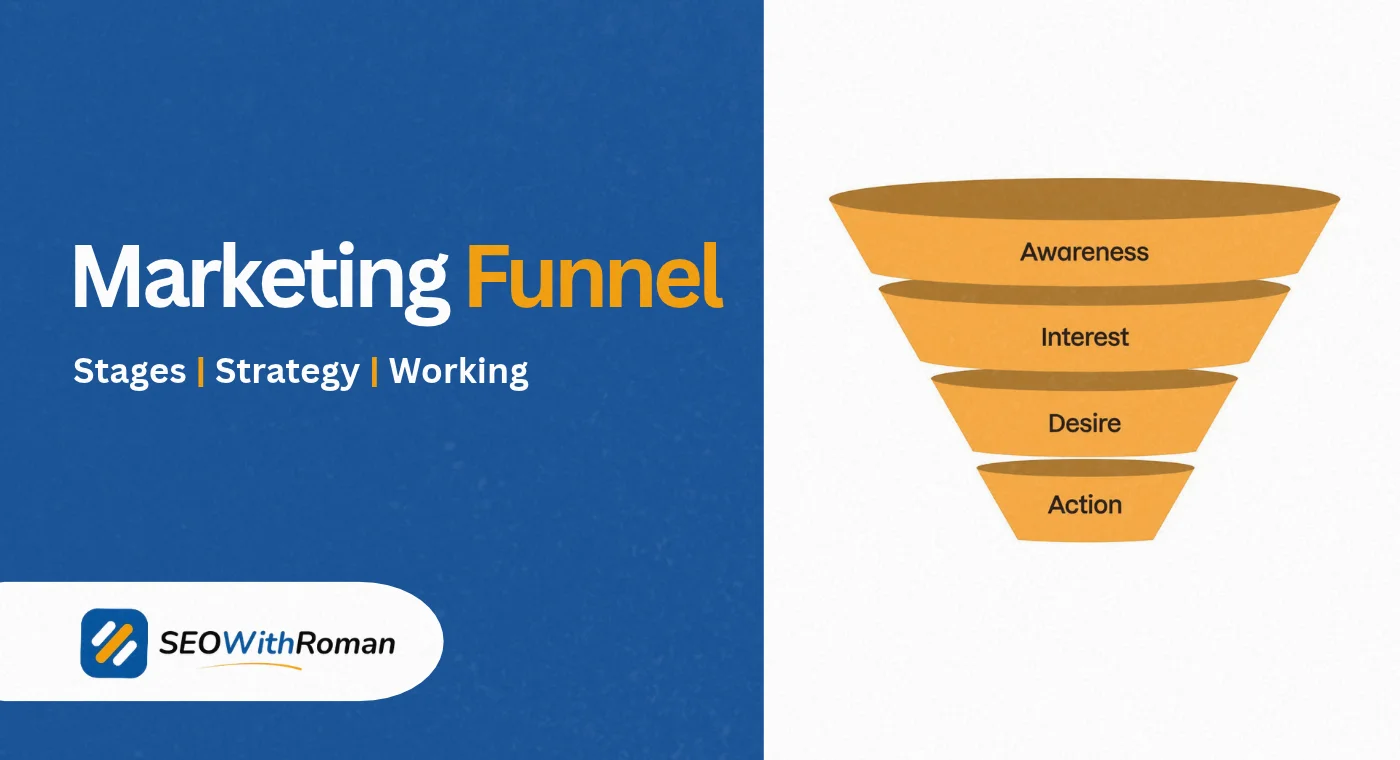
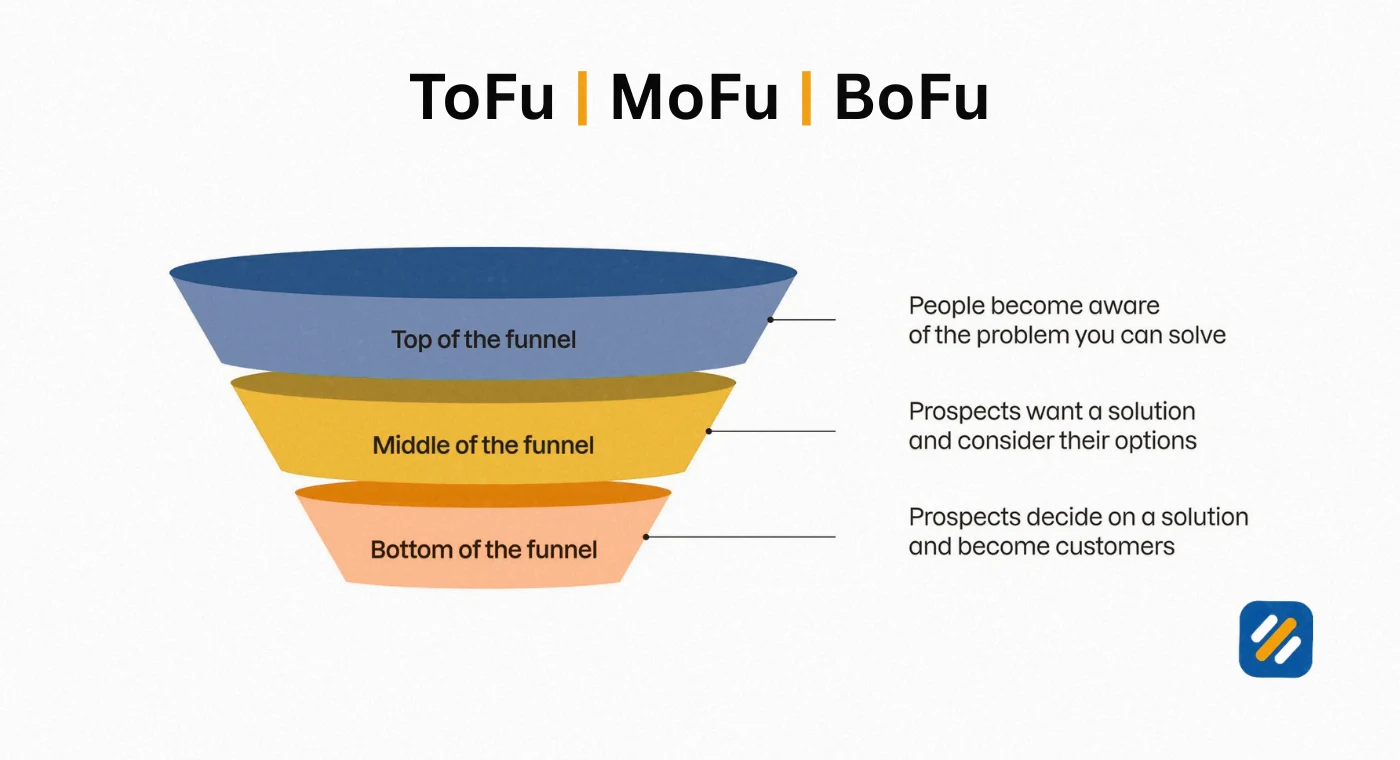
- A marketing funnel maps the journey a customer takes from first hearing about your brand to making a purchase and becoming a loyal advocate
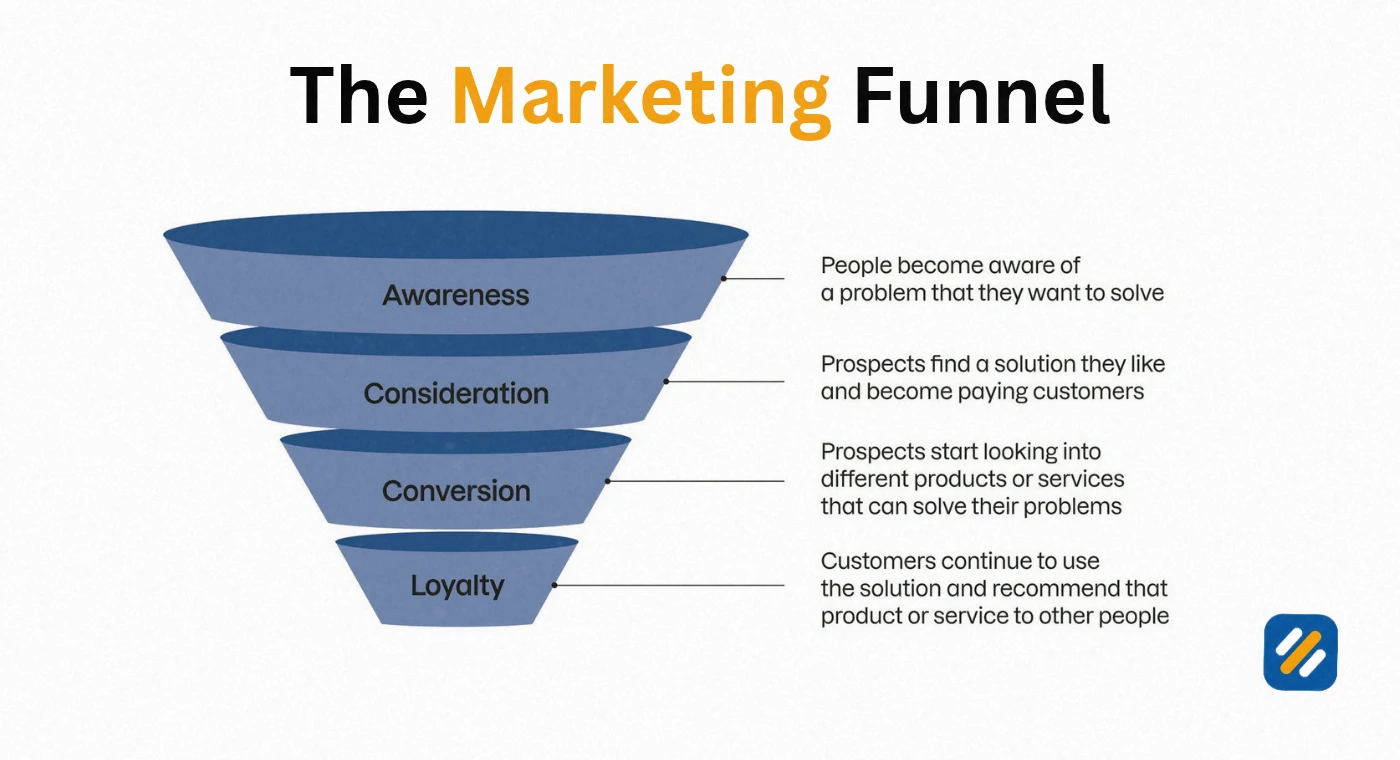
- The 5 stages of the marketing funnel are Awareness, Interest, Consideration, Conversion, and Loyalty
- Every stage of the funnel requires a different type of content, message, and marketing channel
- SEO plays a critical role at every funnel stage, from blog content at the top to optimised landing pages at the bottom
- Gen Z has disrupted the linear funnel model by entering and exiting at unpredictable points driven by social media, peer reviews, and creator content
1 What Is a Marketing Funnel and Why Every Business Needs One
Most businesses lose customers not because their product is bad but because they have no structured way of guiding a stranger toward a purchase. That is exactly what a marketing funnel fixes.
A marketing funnel is a framework that maps the journey a potential customer takes from the moment they first become aware of your brand to the moment they buy from you and beyond. It is called a funnel because a large number of people enter at the top through awareness, and a smaller, more qualified group makes it through to conversion at the bottom.
The funnel meaning in marketing is not just theoretical. It is a practical planning tool. It tells you what content to create, which channels to focus on, what messages to send, and when to send them. Without it, marketing becomes guesswork.
Here is what makes the marketing funnel especially powerful for small businesses and personal brands. It forces you to think about the customer’s perspective at every stage, not just what you want to sell. A person who has never heard of you needs completely different content than someone who visited your pricing page three times this week.
I have worked on marketing funnels across B2B, CXM, ecommerce, and service businesses. The ones that convert consistently are always the ones where each funnel stage has a deliberate strategy behind it, not just a homepage and a contact form.
2 The 5 Stages of the Marketing Funnel Explained
Different models divide the funnel into three, four, or five stages. The five-stage model is the most complete for businesses that want to build long-term customer relationships rather than just chase one-time sales.
Stage 1: Awareness
This is the top of the funnel. The potential customer does not know who you are yet. They have a problem or a question and they are searching for answers. Your job at this stage is to show up where they are looking, with content that is genuinely helpful and not promotional.
The best awareness-stage channels are SEO-driven blog content, social media, YouTube, digital PR, and paid reach campaigns. The goal is not to sell. The goal is to get seen by the right people.
Stage 2: Interest
The person now knows you exist. They are starting to pay attention. They might follow you on social media, subscribe to your newsletter, or read a second article on your blog. This is the stage where your content needs to build a connection and demonstrate that you understand their specific situation.
Useful content at this stage includes educational guides, comparison articles, newsletters, and social media posts that show your expertise without being a hard sell.
Stage 3: Consideration
This is the middle of the funnel. The prospect is actively evaluating their options. They are comparing you to competitors, reading reviews, and asking specific questions about whether your product or service is right for them.
Your content here needs to be direct about what you offer, why it is better, and what results real customers have experienced. Case studies, testimonials, product comparison pages, and detailed service pages all belong here.
Stage 4: Conversion
This is the bottom of the funnel. The prospect is ready to make a decision. They are looking at your pricing page, your checkout, your contact form, or your booking system. The smallest friction at this stage can cost you the sale.
Landing page optimisation, clear calls to action, trust signals like reviews and guarantees, and fast load speeds are what determine whether someone who reached this stage actually converts.
Stage 5: Loyalty and Advocacy
Most marketing funnel guides stop at conversion. That is a mistake that costs businesses significant revenue. A customer who buys once and returns is worth five to seven times more than acquiring a new customer from scratch, according to research from Bain and Company.
The loyalty stage focuses on post-purchase experience, follow-up emails, loyalty programmes, and creating conditions where satisfied customers refer others and become brand advocates without being asked.
3 The Complete Marketing Funnel Stages at a Glance
| Funnel Stage | Customer Mindset | Content That Works | Key Metric to Track |
|---|---|---|---|
| Awareness (ToFu) | I have a problem, what are my options | Blog posts, social media, YouTube, SEO articles | Impressions, page views, organic reach |
| Interest (ToFu to MoFu) | This brand seems relevant, tell me more | Email newsletters, educational guides, social posts | Email open rates, time on page, followers |
| Consideration (MoFu) | I am comparing options, help me decide | Case studies, comparison pages, reviews, testimonials | Bounce rate, pages per session, return visits |
| Conversion (BoFu) | I am ready to buy, make it easy | Landing pages, pricing pages, free trials, demos | Conversion rate, cost per acquisition |
| Loyalty and Advocacy | I bought, now keep me happy | Onboarding emails, support, loyalty rewards, referral programmes | Repeat purchase rate, NPS score, referrals |
4 What Is a Marketing Funnel in Digital Marketing Specifically
The digital marketing funnel works on the same principles as the traditional model but the channels and tools are entirely online. This is where SEO, paid advertising, email marketing, social media, and content marketing all come together in a coordinated system.
In a digital marketing funnel, a typical customer journey might look like this. Someone searches “how to do keyword research for free” on Google and finds your blog post. That is the awareness stage. They read the post, find it useful, and subscribe to your newsletter. That is the interest stage. A week later they receive an email about your freelance SEO services and visit your Hire Me page. That is the consideration stage. They fill out your contact form. That is conversion.
The digital funnel has one major advantage over traditional advertising. Every stage is measurable. You can track exactly how many people enter at the top, where they drop off, what content moves them to the next stage, and what finally converts them.
Google Analytics 4 tracks this journey across sessions. Google Search Console shows you which queries are bringing people into the top of your funnel. Your email platform shows open rates and click through rates in the middle of the funnel. And your CRM or booking system shows conversions at the bottom.
This is what makes the digital marketing funnel so powerful for small businesses with limited budgets. You can see exactly where your money and time are delivering results and where they are not.
5 How the Marketing Funnel Connects Directly to SEO Strategy
This is the connection that most marketing funnel guides completely miss, and it is the most valuable insight for anyone building an SEO-driven content strategy.
Every stage of the marketing funnel maps to a specific type of search intent. When you understand this, keyword research stops being a list of words and becomes a strategic content plan.
Top of funnel SEO targets informational intent. These are searches like “what is SEO,” “how does Google rank websites,” and “what is a marketing funnel.” The person is learning. Your blog content meets them here.
Middle of funnel SEO targets commercial investigation intent. These are searches like “best SEO tools for beginners,” “Rank Math vs Yoast,” and “SEO specialist vs SEO agency.” The person is comparing. Your comparison articles, case studies, and in-depth guides meet them here.
Bottom of funnel SEO targets transactional intent. These are searches like “hire SEO specialist UK,” “SEO audit service,” and “buy Ahrefs subscription.” The person is ready to act. Your service pages, landing pages, and pricing pages meet them here.
| Funnel Stage | Search Intent Type | Keyword Examples | Content Type |
|---|---|---|---|
| Awareness | Informational | What is a marketing funnel, how SEO works | Blog posts, guides, explainers |
| Consideration | Commercial investigation | Best SEO tools, Ahrefs vs SEMrush | Comparison articles, reviews |
| Conversion | Transactional | Hire SEO specialist, buy SEO course | Service pages, landing pages |
| Loyalty | Navigational | SEOWithRoman login, my account | Support pages, onboarding content |
When your content strategy covers all four intent types across all funnel stages, you are building a complete SEO-driven marketing funnel. Each article you publish is not just content. It is a funnel entry point pulling qualified readers toward the bottom where they convert.
6 How to Build a Marketing Funnel for Your Business Step by Step
Building a marketing funnel does not require a large team or an expensive agency. Here is the exact process I follow when building funnels for client websites and my own brand.
Step 1: Define your target audience with precision. A funnel built for everyone converts no one. Write down the specific person you are trying to reach, their problem, their current level of knowledge, and what they want to achieve. The more specific this profile is, the more effective every piece of content you create will be.
Step 2: Map your content to each funnel stage. For every stage from awareness to loyalty, identify two to three content pieces that serve that stage. A personal brand blog needs top-of-funnel SEO articles, middle-of-funnel comparison guides, and a bottom-of-funnel Hire Me page at minimum.
Step 3: Choose your primary traffic channel for each stage. Social media and SEO work well for awareness. Email works well for interest and consideration. Paid ads work well for conversion-stage retargeting. Pick one primary channel per stage and execute it properly before adding more.
Step 4: Create clear pathways between stages. This is where most funnels break down. A person who reads your blog post needs a clear next step. A newsletter signup form, a related article link, or a content upgrade offer keeps them moving toward the next stage rather than leaving your site entirely.
Step 5: Set up measurement for each stage. You cannot improve what you cannot measure. Set up Google Analytics 4 goals for key conversion actions. Track email open rates and click through rates for the middle of the funnel. Monitor your contact form submissions and enquiry rates at the bottom.
Step 6: Review and optimise monthly. Look at where people are dropping out of your funnel. If a lot of people read your blog but never subscribe to your email list, the bridge between those two stages needs work. If people visit your pricing page but never contact you, your conversion stage content needs stronger trust signals.
7 How Did Gen Z Break the Marketing Funnel
This is the question that has been debated in marketing circles since around 2022 and the honest answer is that Gen Z did not break the marketing funnel. They exposed the fact that it was always a simplified model of a messy reality.
The traditional marketing funnel assumes a linear journey. Person sees ad, person becomes interested, person compares options, person buys. Gen Z’s buying behaviour does not follow this path at all.
A Gen Z consumer might discover a product through a TikTok video from a creator they trust. They skip the awareness and interest stages entirely because the creator’s recommendation collapses them into a single moment. They might then search for reviews on Reddit, check the brand’s Instagram, ask friends in a Discord server, and only then visit the product page, all within twenty minutes.
The funnel is not dead for Gen Z. It is compressed, nonlinear, and heavily social-proof driven.
Here is what actually changed
Trust has shifted from brands to creators and peers. Gen Z trusts a recommendation from a micro-influencer with fifty thousand followers more than a full-page magazine ad. This means awareness and consideration now happen simultaneously through creator content rather than sequentially through traditional advertising.
Social media is now a search engine for Gen Z. According to a 2023 Google report, nearly 40% of Gen Z use TikTok and Instagram as their primary search tools. This means your top-of-funnel content strategy needs to account for discoverability on social platforms, not just Google.
The purchase decision happens faster but the trust requirement is higher. Gen Z will buy quickly when they trust the source but they will not buy at all if something feels inauthentic. A polished brand ad triggers scepticism. A creator genuinely using your product triggers purchase intent.
What this means for your marketing funnel strategy in 2026 is that the stages still exist but the pathways through them are no longer predictable or linear. Building a funnel that works today means creating trust signals at every stage, being present on the platforms where your audience actually searches, and making every touchpoint feel genuinely helpful rather than promotional.
8 Marketing Funnel Metrics You Must Track at Every Stage
Setting up a marketing funnel without tracking its performance is like driving with your eyes closed. These are the metrics that matter at each stage and what they tell you about where your funnel needs work.
| Stage | Metric | What It Tells You | Where to Track It |
|---|---|---|---|
| Awareness | Organic impressions, page views | How many people your content is reaching | Google Search Console, GA4 |
| Interest | Email subscribers, newsletter open rate | Whether people find enough value to stay connected | Email platform, GA4 |
| Consideration | Pages per session, return visits, time on page | Whether people are researching your brand seriously | Google Analytics 4 |
| Conversion | Contact form submissions, conversion rate | How many qualified prospects are taking action | GA4 goals, CRM |
| Loyalty | Repeat purchase rate, referral rate | Whether customers are satisfied enough to return and refer | CRM, email platform |
A healthy funnel shows gradual, predictable drop-off at each stage. If you have a massive drop between awareness and interest, your content is attracting the wrong audience. If you have strong traffic to your pricing page but zero conversions, your offer, trust signals, or pricing structure needs attention.
9 3 Expert Tips to Build a Marketing Funnel That Actually Converts
Tip 1: Match your content format to the funnel stage, not just the topic
A beginner searching “what is a marketing funnel” wants a clear explanation, not a 3,000-word deep dive with technical strategy. Giving the wrong format at the wrong stage causes people to leave before they ever see the value you offer.
Tip 2: Never send top-of-funnel traffic directly to a sales page
Sending someone who just read their first blog post about marketing to a pricing page is the fastest way to lose them. Build a bridge, offer something valuable like a newsletter, a free checklist, or a related article, and let trust develop before asking for the sale.
Tip 3: Treat your existing customers as the most valuable part of your funnel
Most businesses spend 80% of their marketing budget trying to acquire new customers and almost nothing on retaining existing ones. A single follow-up email sequence, a loyalty offer, or a referral incentive can generate more revenue from people who already trust you than months of top-of-funnel content creation.
10 Conclusion
A marketing funnel is not a complicated concept. It is a simple but powerful way of thinking about your customer’s journey and making sure you have the right message waiting for them at every step.
The businesses that win with content marketing and SEO in 2026 are not necessarily the ones with the biggest budgets or the most articles. They are the ones who understand where their audience is in the buying journey and serve them exactly what they need at exactly the right moment.
Build your funnel stage by stage. Start with awareness content that gets found on Google. Create a clear path to your email list. Develop consideration content that answers the real questions your prospects are asking. Optimise your conversion pages until they remove every barrier to action. And then invest in the loyalty stage that most of your competitors are completely ignoring.
Do that consistently and your marketing funnel becomes the most valuable asset your business has.
Have a question about building your own marketing funnel? Leave a comment below and I will answer it personally.
Join 1,000+ business owners and bloggers who get one actionable SEO tip every week — straight to their inbox. Free forever.
Get Free Weekly Tips →