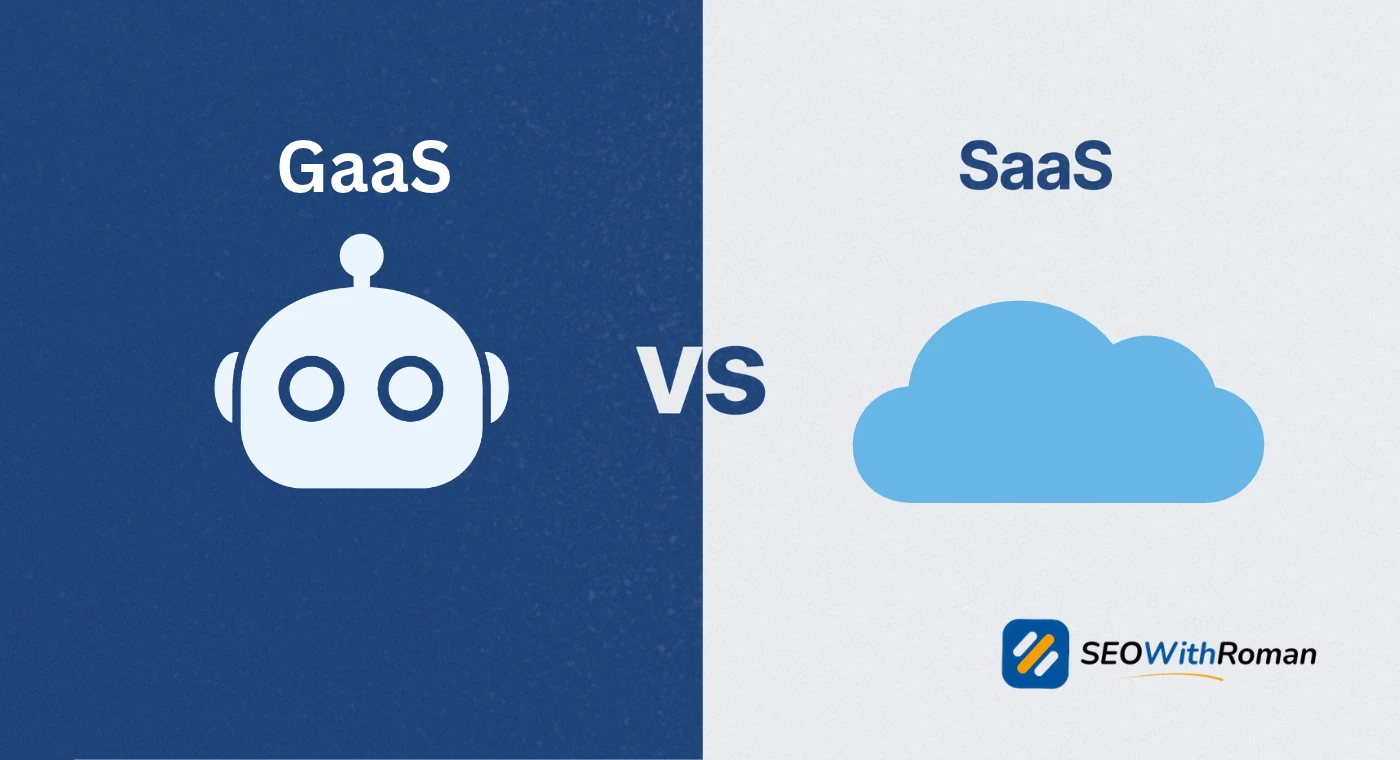
- SaaS gives users hosted software to operate. GaaS gives users managed AI agents that operate software on their behalf
- GaaS is not just SaaS with an AI chatbot added. It is a fundamentally different service model built around outcomes, not features
- The GaaS business model shifts pricing from per seat subscriptions to per task, per outcome, or per agent execution
- AI agents as a service are already replacing entire categories of human-operated SaaS workflows in customer support, data processing, and project management
- Generative Agent as a Service is changing how SEO works by shifting search behaviour from keyword queries to goal-based AI prompts, making brand authority and cited expertise more important than ever
1 What Is SaaS and Why It Dominated the Last Two Decades
If you have used Gmail, Salesforce, Slack, or Zoom, you have used a SaaS product. You probably just called it “software.”
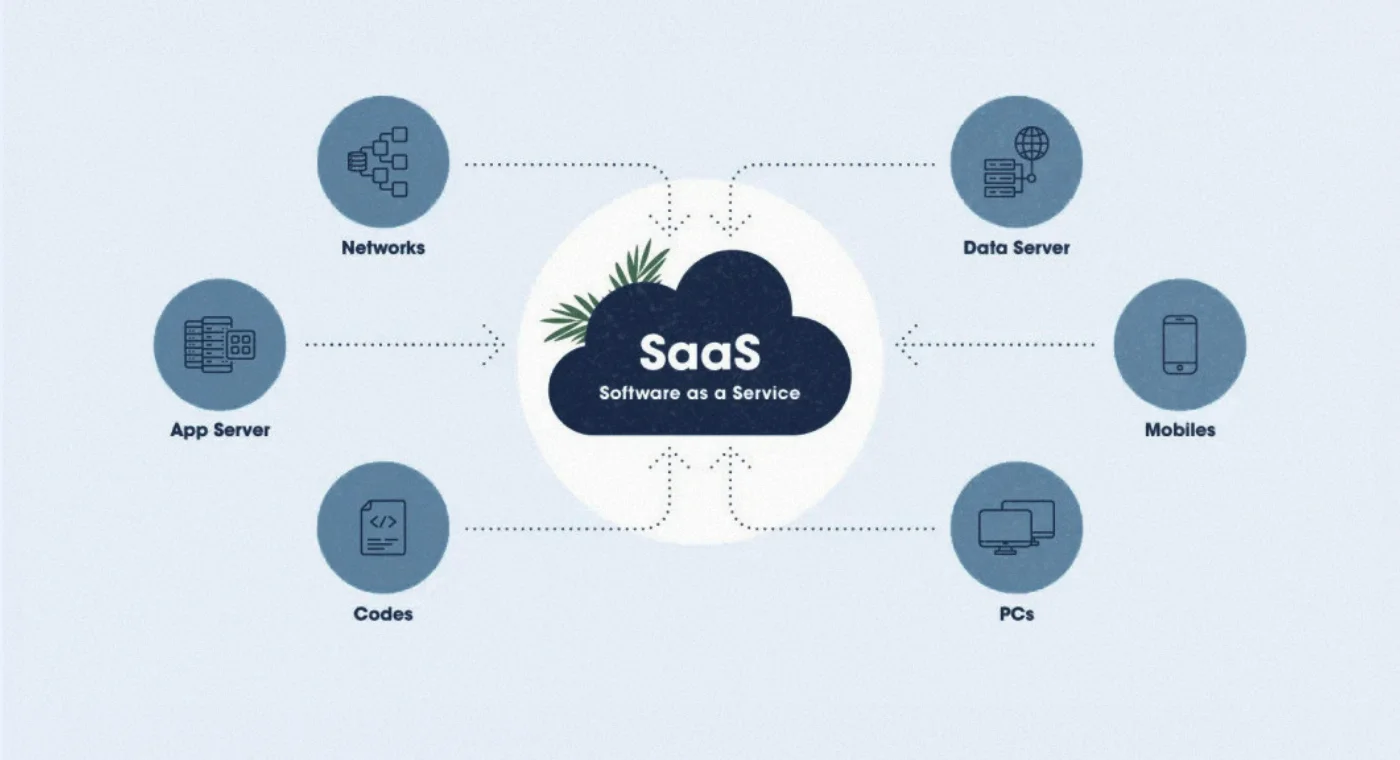
SaaS stands for Software as a Service. It is a cloud delivery model where a provider hosts an application on their servers and gives customers access over the internet. No installation. No local maintenance. No infrastructure headaches. You pay a monthly or annual subscription and you get access to the features.
This model transformed business technology from 2005 onwards because it removed the two biggest barriers to software adoption: cost and complexity. Small businesses could suddenly access the same tools as enterprise companies without paying for servers or hiring IT teams.
Here is what a SaaS provider manages on your behalf
- Application hosting and infrastructure
- Software updates and new features
- Security patching and maintenance
- Uptime and availability
- Data backups
And here is what the customer still controls entirely
- How the software is configured
- Which users have access
- What data goes in
- How workflows are designed
- Every action taken inside the platform
That last point is the critical one. In every traditional SaaS model, a human being is still doing the work. The software makes the work easier and faster. But someone still has to open the application, read the screen, make decisions, click the buttons, and move the process forward.
That is what is changing right now
2 What Is GaaS | The New Model That Goes Further Than Software
GaaS stands for Generative Agent as a Service, though you will also see it described simply as Agentic as a Service. The name varies slightly depending on who is using it, but the concept is consistent.
Generative Agent as a Service is a service model where managed AI agents perform bounded work on behalf of users and businesses. Instead of giving you software to operate, a GaaS provider gives you an AI agent that can operate software for you.
This is not the same as an AI feature inside a SaaS product. A spell checker, a content suggestion engine, or a chatbot that answers questions are all AI features. They are still operated by a human. The human asks, the AI responds, and the human decides what to do with the response.
A true generative agent as a service system works differently. You describe the outcome you need. The agent determines the steps required, accesses the approved tools and data sources, executes the workflow, and returns either the completed result or an exception that requires your review.
Here is a real-world example. Consider a customer support workflow
In a traditional SaaS model an employee opens the support ticket, reads the customer query, searches the knowledge base, finds the relevant policy, drafts a response, updates the ticket, and assigns any follow-up tasks. Every step is done by the human using the software as a tool.
In a GaaS model the system receives the ticket, the agent reads the query, searches approved sources, drafts a response based on verified policy, and either sends the response automatically or routes it to a human reviewer for approval before sending. The human reviews outcomes and exceptions rather than performing every step.
The SaaS product did not disappear. The agent uses it. But the operating layer between the human and the software has been replaced by an autonomous AI workflow.
3 The Real Difference Between SaaS and GaaS Explained Simply
Most explanations of this topic make it more complicated than it needs to be. Here is the simplest version.
SaaS changes how software is delivered. GaaS changes who does the work.
| Factor | Software as a Service | Generative Agent as a Service |
|---|---|---|
| What you get | Hosted software application | Managed AI agents that use software |
| Who operates it | The human user | The AI agent within approved limits |
| What you pay for | Access to features | Completed tasks or outcomes |
| Pricing model | Per seat, per month subscription | Per task, per run, or outcome-based pricing |
| Workflow design | Fixed screens and features | Adaptive steps within approved boundaries |
| User’s role | Operates every step | Sets goals and reviews exceptions |
| Failure type | Feature error or downtime | Incorrect reasoning or wrong tool selection |
| Governance focus | User access and permissions | Agent identity, tool permissions, action limits |
| Best suited for | Direct control, simple processes | Repeatable multi-step outcomes across systems |
| AI involvement | Optional feature layer | Core operating mechanism |
SaaS remains the system where your data lives and your business processes are recorded. Generative agent as a service becomes the execution layer that coordinates work across those systems on your behalf.
They are not competitors. They are different layers of the same technology stack. Most businesses in 2026 will run both simultaneously without even fully realising it.
4 Is SaaS Growing or Dying in the Age of AI Agents
This question is getting asked more frequently as GaaS gains attention. The honest answer is more nuanced than either extreme suggests.
SaaS is not dying. The global SaaS market was valued at over $315 billion in 2025 and continues to grow. But the nature of how SaaS is used and valued is changing significantly.
The shift happening right now is not from SaaS to GaaS as a replacement. It is from human-operated SaaS to agent-operated SaaS. The underlying platforms, databases, and business applications are still SaaS products. What is being replaced is the human labour that previously connected all those platforms together.
Think about what a typical SaaS stack looks like for a mid-sized business. A CRM, a project management tool, a customer support platform, an analytics dashboard, an email marketing tool, and a document management system. In the traditional model, human employees spend significant portions of their working day moving data between these systems, extracting reports, drafting responses, and updating records across platforms.
Agentic as a Service does not eliminate the SaaS products. It eliminates the manual work of operating them.
Where SaaS is genuinely under pressure is in the feature-based pricing model. When an AI agent can complete an entire workflow that previously required five software licences and three employees, the per-seat subscription model starts to look economically undefendable. Vendors who sell access to features will feel this pressure. Vendors who sell measurable outcomes will capture the value that shifts.
5 What Is AI and How Is It Different From Both SaaS and GaaS
This question comes up because the terms overlap and vendors use them interchangeably when they should not.
AI refers to the underlying technology. Machine learning models, large language models, computer vision systems, and predictive algorithms are all forms of AI. AI is the engine, not the vehicle.
SaaS is a delivery model. It is a way of hosting and distributing software over the internet. A SaaS product may or may not use AI inside it.
GaaS is a service model that uses AI as its core operating mechanism. It is specifically about autonomous agents that can pursue goals through multi-step actions using AI reasoning.
Here is the simplest way to think about the relationship
AI is the technology. SaaS is the delivery method. Generative Agent as a Service is the operating model that combines both to replace human-executed workflows with agent-executed ones.
A company that adds a ChatGPT-powered writing assistant to their SaaS product has added an AI feature. That is not GaaS.
A company that deploys an AI agent that monitors your sales pipeline, identifies at-risk deals, drafts personalised outreach emails, schedules follow-up tasks, and updates your CRM automatically within approved permissions is delivering agentic as a service. The agent is doing the work, not just assisting with part of it.
6 The GaaS Business Model | How Pricing and Value Delivery Is Changing
The shift from SaaS to GaaS is not just a technical change. It is a fundamental restructuring of how software companies charge for value.
Traditional SaaS pricing is based on access. You pay per user, per month, per tier, or per feature bundle. The provider earns money regardless of whether you actually use the software effectively. A company that pays for 50 Salesforce seats but only actively uses 30 of them still pays for all 50.
GaaS pricing is moving toward outcomes. You pay for completed tasks, successful agent runs, or verified results. This is called outcome-based pricing and it changes the entire commercial relationship between provider and customer.
Outcome-based pricing requires both parties to define precisely
- What counts as a completed task
- When an outcome is considered successful
- How exceptions and failed runs are handled
- Whether human corrections are included in the cost
- How quality is measured and disputed
This pricing model is genuinely more aligned with business value but it introduces complexity that per-seat subscriptions avoid entirely. Both models will coexist for the foreseeable future with most GaaS products combining a base subscription with execution-based charges on top.
The businesses that understand this pricing shift early will have significant negotiating advantages when procuring AI workflow automation services in 2026 and beyond.
7 How Generative Agent as a Service Is Changing the Direction of SEO After the Rise of AI
This is the section that matters most for anyone building an SEO-focused website or managing organic search for a business in 2026.
GaaS and AI agents are not just changing how businesses operate internally. They are changing how people search for information and how search engines respond to those searches.
Here is what is shifting at a fundamental level.
Traditional SEO was built around the assumption that humans type keyword queries into Google and then choose from a list of blue links. Every strategy from keyword research to title tag optimisation was built to serve that behaviour.
AI-powered search is changing that assumption. A significant and growing percentage of searches now happen through AI interfaces where users describe a goal or problem in natural language and an AI system returns a synthesised answer rather than a list of links. Google’s AI Overviews, ChatGPT Search, Perplexity, and similar tools are all part of this shift.
This creates a new SEO challenge. To appear in AI-generated answers, your content needs to be cited as a trusted source rather than simply ranked by keyword match. The signals that drive citation in AI systems are different from the signals that drive traditional rankings.
Here is what matters most for GEO optimisation in a GaaS-influenced search landscape
| SEO Signal | Traditional Importance | GEO and AIO Importance in 2026 |
|---|---|---|
| Keyword density | High | Moderate, intent matters more than density |
| Backlink volume | High | Still important but brand authority now matters equally |
| Content depth | Medium | Very high, AI systems cite comprehensive sources |
| Author credentials | Low | Very high, E-E-A-T is a citation signal |
| Factual accuracy | Medium | Critical, AI systems avoid citing unreliable sources |
| Structured data | Medium | High, helps AI systems parse and attribute content |
| Brand mentions | Low | High, unlinked brand mentions are now a trust signal |
| Response format | Low | High, direct answers rank in AI Overviews |
The businesses and content creators who adapt their SEO strategy to serve both human readers and AI citation systems will maintain and grow their organic visibility. Those who optimise purely for traditional keyword rankings will find their traffic increasingly bypassed by AI-generated answers that cite competitors with stronger authority signals.
8 How to Do SEO for a GaaS or SaaS Business in 2026
If you run or work for a SaaS or GaaS company, your SEO strategy needs to account for how your product category is being searched and how AI systems are interpreting those searches.
Here is the framework that works for both categories
For SaaS SEO:
Focus on bottom of funnel keywords that reflect buying intent. “Best project management software for remote teams” and “Salesforce alternative for small business” are examples of high-intent search queries where someone is actively evaluating options. Publish detailed comparison pages, feature breakdowns, and case studies with specific measurable results. These formats are both well-ranked by Google and frequently cited by AI systems.
For GaaS SEO:
The keyword landscape is newer and less competitive. Terms like “AI agents as a service,” “autonomous AI workflow,” “managed AI services,” and “agentic as a service” have lower difficulty scores in 2026 because the category is still emerging. Publishing authoritative explanatory content now builds topical authority before the space becomes crowded. First-mover advantage in emerging SEO categories is a genuine strategic opportunity.
For both categories:
Build E-E-A-T signals aggressively. AI citation systems prioritise named experts over anonymous organisations. Author bios with credentials, case studies with named clients and verified results, and original research data all contribute to the authority signals that drive both traditional rankings and AI citations.
9 3 Expert Tips for Navigating the SaaS to GaaS Transition
Tip 1: Do not confuse AI features with agentic capability
Before describing your product or a vendor’s product as GaaS, check whether the AI can actually pursue goals through multi-step actions. A summarisation tool or a chatbot assistant is an AI feature inside SaaS, not GaaS. Real agentic as a service involves an agent that takes actions, uses tools, observes results, and adapts within approved boundaries.
Tip 2: Start with one bounded outcome before automating entire departments
The biggest implementation mistake businesses make with Generative Agent as a Service is trying to automate too much too quickly. Pick one repeatable workflow with a measurable output, clear tool permissions, and a human review step. Prove the model works at small scale before expanding. GaaS fails loudly when deployed without proper governance.
Tip 3: Optimise your content for AI citation now, not after your rankings drop
The shift from keyword-based search to AI-generated answers is already happening. Update your most important pages to include direct definitional answers in the first paragraph, add structured FAQ sections, and ensure every article has a credible named author with visible credentials. These changes improve both traditional SEO and AI Overview citations simultaneously.
10 Conclusion
SaaS gave the world access to software without the burden of infrastructure. GaaS is doing something more profound. It is giving businesses access to work getting done without the burden of manual execution.
The two models are not in competition. SaaS remains the foundation where business data lives and business processes are recorded. GaaS is the intelligent layer that coordinates those processes automatically, escalating to humans only when genuine judgement is required.
For anyone in SEO, content marketing, or digital strategy, the most important takeaway is this. The audience that used to find your content through Google keyword searches is increasingly finding answers through AI systems that cite trusted sources. Building that trust, through deep expertise, real credentials, accurate information, and comprehensive content, is the SEO strategy that survives every algorithm change and every shift in how people search.
SaaS vs GaaS is not a battle. It is an evolution. The businesses that understand both layers and adapt their strategy accordingly are the ones that will still be growing when the next shift arrives.
Have a question about how GaaS affects your SEO strategy or your business operations? Drop it in the comments below and I will answer it personally.
Join 1,000+ business owners and bloggers who get one actionable SEO tip every week — straight to their inbox. Free forever.
Get Free Weekly Tips →