- Competitive PPC analysis means studying what your paid search competitors are doing so you can outperform them with smarter strategy and better targeting
- The five core steps are identifying true PPC competitors, analysing their keywords, studying ad copy, reviewing landing pages, and tracking results over time
- PPC and SEO are not rivals. They serve different purposes and work best when combined as part of one integrated search strategy
- The four Ps of competitive analysis are Product, Price, Place, and Promotion and all four apply directly to how you evaluate competitor PPC campaigns
- Tools like Google Ads Auction Insights, SEMrush, SpyFu, and Ahrefs make competitor PPC research faster and more precise than manual analysis alone
1 What Is Competitive PPC Analysis and Why Most Businesses Get It Wrong
Pay-per-click advertising is one of the fastest ways to get your business in front of the right audience at exactly the right moment. But running PPC campaigns without understanding what your competitors are doing is like playing chess without being able to see half the board.
Competitive PPC analysis is the process of systematically researching your paid search competitors to understand which keywords they are targeting, what their ads say, how they bid, where they send traffic, and what is working for them in your shared market.
Most businesses that run PPC campaigns do one of two things wrong. They either ignore competitor research entirely and make every decision in isolation, or they do surface level research, glance at a few competitor ads, copy the general tone, and move on. Neither approach works.
After many years of running SEO and paid search campaigns for B2B clients across the US and UK markets, I have seen both of these mistakes destroy otherwise solid advertising budgets. The businesses that consistently win with PPC are the ones that treat competitive intelligence as an ongoing discipline, not a one-time task.
Real competitive PPC analysis goes far deeper than keyword lists. It tells you where competitors are spending heavily, where they are not spending at all, what messaging resonates with your shared audience, and where the gaps exist that you can exploit right now.
2 What Is PPC and How Does It Work | The Foundation Every Beginner Needs
Before diving into competitive analysis, you need a clear understanding of how PPC advertising actually works.
PPC stands for pay-per-click. It is a model of digital advertising where you pay a set amount every time someone clicks your ad. The most widely used PPC platform is Google Ads, which places your advertisements at the top and bottom of Google search results pages when someone searches for a keyword you are bidding on.
Here is how the auction works in simple terms. Every time someone searches on Google, an auction happens in milliseconds. Advertisers who have bid on that keyword compete for the available ad positions. Your position in the results is not determined purely by how much you bid. Google uses a metric called Quality Score, which combines your bid amount, your ad relevance to the search query, and the expected experience on your landing page.
This means a competitor with a lower bid but a more relevant, better-optimised ad can outrank you even if your budget is larger. Understanding this is fundamental to competitive PPC analysis because it explains why copying a competitor’s keywords alone never gives you the full picture.
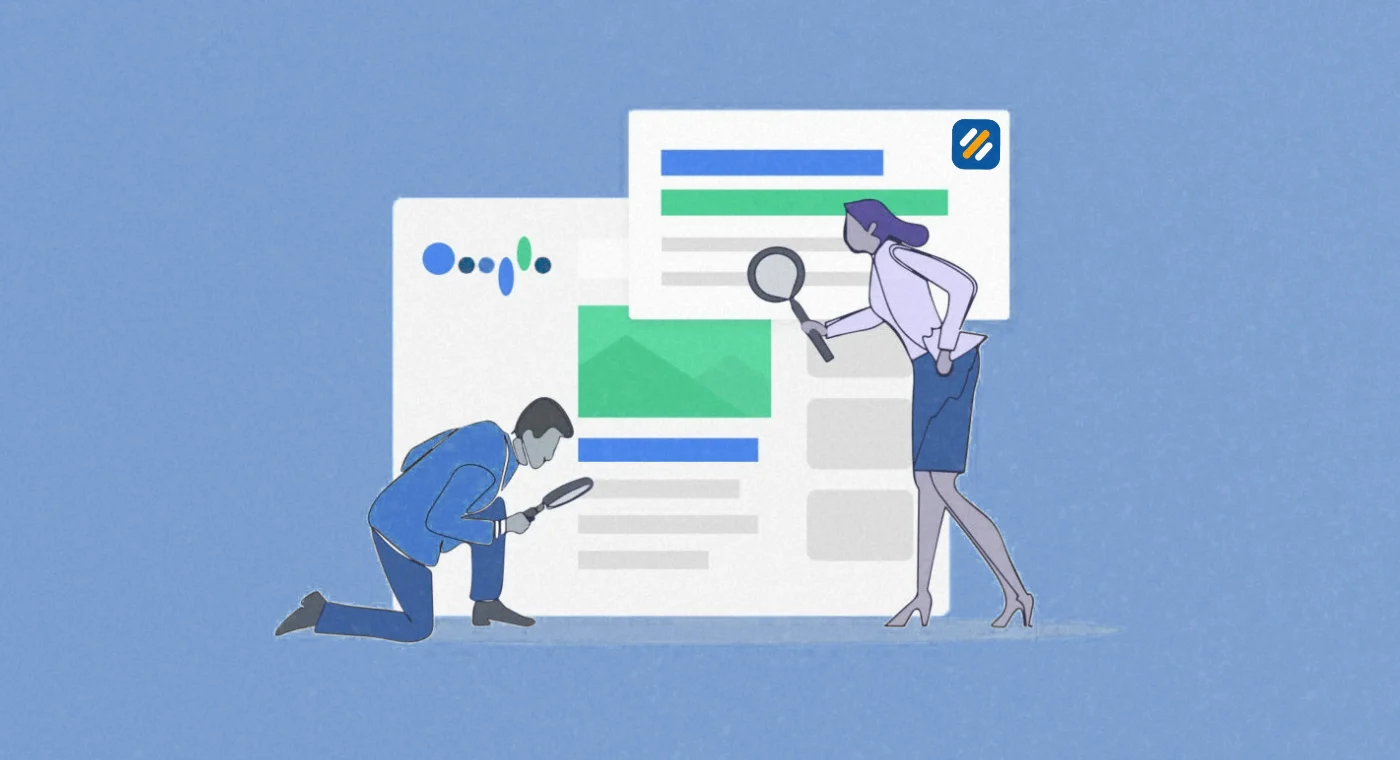
3 Is PPC Better Than SEO? The Honest Answer Every Business Needs to Hear
This is one of the most common questions I get from small business owners and marketing managers who are trying to decide where to invest their budget. The honest answer is that it is the wrong question.
PPC and SEO are not competing strategies. They are complementary channels that serve different purposes in your overall search marketing strategy.
| Factor | PPC | SEO |
|---|---|---|
| Time to results | Immediate, ads appear same day | 3 to 6 months minimum for new sites |
| Cost model | You pay per click, stops when budget runs out | Upfront effort, traffic continues without ongoing cost |
| Visibility control | Full control over when and where ads appear | Google decides ranking position |
| Click trust | Lower, users know it is an ad | Higher, organic results carry more inherent trust |
| Best use case | Product launches, promotions, time-sensitive offers | Long term brand authority and sustainable traffic |
| Keyword flexibility | Can target any keyword immediately regardless of domain authority | Restricted by competition and domain authority on new sites |
| Data for learning | Immediate keyword performance data | Slower feedback loop |
PPC is better than SEO when you need results fast, when you are entering a new market, or when you are testing which keywords actually convert before investing in long term content. SEO is better than PPC when you are building a long term sustainable traffic source that does not stop the moment your budget runs out.
The businesses with the strongest search presence use both. PPC data informs SEO keyword strategy. SEO authority reduces the cost-per-click on branded terms. Together they cover every stage of the buyer journey.
4 What Are the 4 Ps of Competitive PPC Analysis
The four Ps framework originally comes from traditional marketing theory: Product, Price, Place, and Promotion. Most PPC guides do not apply this framework to paid search analysis, which is a significant missed opportunity.
Here is how the four Ps apply directly to analysing your PPC competitors
Product refers to understanding what your competitors are actually selling through their ads and how they position it. Are they promoting a specific feature, a bundle, a trial offer, or a service outcome? Studying competitor ads reveals not just their offer but how they believe their audience perceives value. If every competitor is leading with price discounts, there may be a gap for a competitor who leads with quality or speed of delivery instead.
Price in PPC context means understanding competitor bidding behaviour and the cost signals embedded in their strategy. High bids on certain keywords signal that those terms convert well for them and are worth the cost. Tools like SEMrush and SpyFu show estimated competitor cost-per-click data, which reveals where they believe the most valuable clicks are in your market.
Place in paid search means the platforms and placements competitors are using. Are they running only Google Search campaigns or are they also active on Google Display Network, YouTube, and Microsoft Ads? Understanding where competitors advertise helps you identify platforms they may be ignoring, which often means lower competition and lower costs for you.
Promotion covers the actual creative elements of competitive PPC: the ad headlines, descriptions, extensions, offers, and calls to action. This is where most competitor analysis focuses and rightly so, but it should always be analysed in the context of the other three Ps rather than in isolation.
5 What Are the 5 Steps of a Competitive PPC Analysis
Here is the complete process I follow when conducting competitive PPC analysis for client campaigns. These five steps cover everything from identifying who you are actually competing against to turning research into campaigns that consistently outperform rivals.
Step 1: Identify Your True PPC Competitors
Your business competitors are not always your PPC competitors. This distinction is critical and most beginners miss it completely.
A business that sells the same product as you may not be bidding on the same keywords. Meanwhile, a large industry aggregator or comparison platform that you would never consider a direct competitor may be capturing a significant share of your highest value search terms.
Start your PPC competitor research using Google Ads Auction Insights if you are already running campaigns. This report shows exactly which domains are appearing in the same auctions as your ads and how frequently they overlap with your impressions. This is the most accurate source of true PPC competitor data because it comes directly from the same auctions you are participating in.
If you are not yet running campaigns, use SEMrush or SpyFu to search your main product or service keywords and identify which domains consistently appear in the paid results. Pay attention to impression share, which tells you how dominant each competitor is across your shared keyword space.
Step 2: Analyse Competitor Keywords
Once you know who your PPC competitors are, the next step is understanding exactly which keywords they are targeting and how they are prioritising their budget across different keyword types.
Effective keyword analysis for competitive PPC goes beyond a simple list of terms. You need to understand how competitors are targeting keywords at different stages of the buyer journey. Broad awareness keywords like “what is PPC advertising” attract very different audiences than high-intent conversion keywords like “PPC agency London pricing.”
Look at the balance between branded and non-branded keywords. Competitors bidding heavily on their own brand terms are protecting their existing customer base from conquest campaigns. Competitors with weak branded keyword presence are vulnerable to you capturing their branded traffic with well-targeted competitor keyword campaigns.
Identify gaps in their keyword strategy. Keywords with solid search volume that competitors are not bidding on are your lowest-cost, highest-potential opportunities in the market right now.
Step 3: Study Competitor Ad Copy and Messaging
Ad copy analysis is where competitive PPC research gets genuinely interesting. Every word a competitor chooses to put in their headline is a deliberate decision backed by budget and testing. When you see the same message repeated across multiple competitors, it is because that message has proven to resonate with the audience you share.
Study competitor ads for three specific things. First, their value proposition: what single benefit or outcome do they lead with in the headline? Second, their differentiation claim: what do they say that positions them as the better choice? Third, their call to action: what specific next step are they asking the searcher to take?
Do not copy competitor ad copy. Instead, identify the emotional need their best ads are addressing and then find a more specific, more credible, or more relevant way to address that same need from your own brand’s perspective.
Step 4: Review Competitor Landing Pages
Most competitive PPC analysis stops at the ad level. This is a significant mistake. The landing page is where conversions happen, and understanding how competitors convert the traffic their ads bring in is just as important as understanding the ads themselves.
When a competitor ad links to a landing page, note these elements: the headline match between the ad and the landing page, the primary conversion action being requested, the trust signals present including testimonials or certifications, the page load speed on mobile, and how they handle objections in the copy.
If a competitor consistently maintains high ad positions and strong quality scores over time, their landing pages are converting well. Reverse engineer what they are doing right and identify what they are leaving out that you could add to gain an edge.
Step 5: Track, Measure, and Repeat
Competitive PPC analysis is not a one-time project. Your competitors are constantly testing new ads, adjusting bids, adding keywords, and changing landing pages. The marketers who win consistently are the ones who monitor competitor activity on a regular cadence.
Set up a monthly review process that checks your competitors across all five dimensions: who they are, what keywords they target, what their ads say, where they send traffic, and how their overall presence in the auction is changing. Any significant shift in a competitor’s strategy is a signal worth investigating because it usually means something has changed in their performance data.
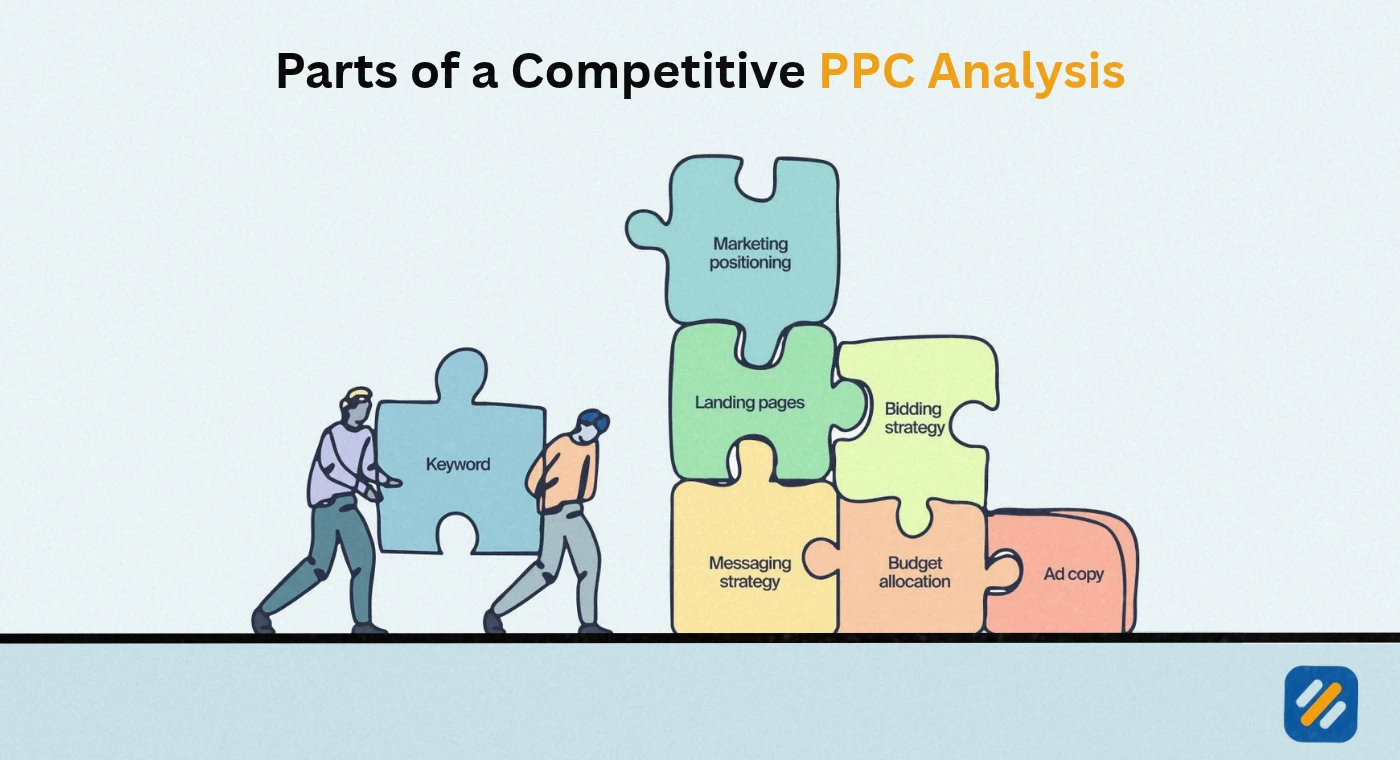
6 Competitive PPC Analysis Example | How a B2B SaaS Company Used Competitor Research
Real examples clarify strategy better than any framework. Here is a real-world competitive PPC analysis scenario that shows exactly how this process creates measurable results.
A B2B SaaS company offering project management software was spending a significant monthly budget on Google Ads with a cost per lead that was too high to scale profitably. Their initial keyword strategy focused on broad terms like “project management software” and “task management tool,” both of which are dominated by enterprise players with much larger budgets.
A competitive PPC analysis revealed three things their team had missed.
First, every major competitor was ignoring a cluster of high-intent long-tail keywords like “project management software for remote marketing teams” and “task tracking tool for agencies under 50 people.” These keywords had lower search volume but dramatically higher buyer intent and almost no competition.
Second, competitor ad copy was almost universally focused on features, specifically the number of integrations and dashboard capabilities. No competitor was speaking directly to the problem the audience actually wanted solved, which was reducing the time spent in status update meetings.
Third, competitor landing pages all required a credit card for trial signup. A landing page offering a no-credit-card free trial with a single prominent CTA created immediate conversion rate differentiation.
The result of applying these three insights was a 40 percent reduction in cost per lead within 90 days, without increasing budget.
| Before Competitor Analysis | After Competitor Analysis |
|---|---|
| Broad keywords with high competition | Specific long-tail keywords with low competition |
| Feature-focused ad copy matching competitors | Problem-focused ad copy addressing the real pain point |
| Standard trial signup with credit card required | No-credit-card trial with single CTA |
| High cost per lead, limited scalability | 40 percent lower cost per lead, scalable structure |
| No differentiation in the auction | Clear positioning gap exploited |
7 Best PPC Competitor Research Tools | Free and Paid Options Compared
The quality of your competitive PPC analysis depends significantly on the tools you use. Here is a complete breakdown of the best options available in 2026:
| Tool | Cost | Best For | Key PPC Feature |
|---|---|---|---|
| Google Ads Auction Insights | Free (requires active campaign) | Identifying true auction competitors | Impression share overlap and outranking share data |
| SEMrush | Paid, free trial available | Full competitor ad intelligence | Competitor ad history, keyword gaps, estimated spend |
| SpyFu | Paid, limited free access | Google Ads competitor research | Full competitor keyword and ad copy history |
| Ahrefs | Paid, free webmaster tools | Keyword gap analysis | Paid keyword data alongside organic data |
| Google Keyword Planner | Free | Keyword volume and competition data | Direct from Google, accurate for volume ranges |
| SimilarWeb | Free tier available | Traffic source and audience analysis | Ad traffic estimates and competitor channel breakdown |
| iSpionage | Paid | Competitor ad copy monitoring | Ad copy alerts and landing page screenshots |
| Microsoft Advertising Intelligence | Free | Bing and Microsoft Ads competitor data | Competitive keyword data for Microsoft ad network |
For a small business starting out, the combination of Google Ads Auction Insights plus the free tier of SEMrush gives you enough data to conduct meaningful competitive analysis without spending anything on tools. As your campaigns grow and the value of marginal gains increases, investing in SpyFu or the full SEMrush suite provides significantly deeper intelligence.
8 How to Build a PPC Competitor Analysis Template That Actually Gets Used
A competitive PPC analysis is only valuable if the insights are recorded, shared, and acted on. The most common reason competitor research does not translate into campaign improvements is that it lives in someone’s head or in a disorganised set of notes rather than in a structured template that guides action.
Here is the core structure of an effective PPC competitor analysis template
Section one covers competitor identification. List each competitor domain, their estimated monthly PPC spend, their impression share overlap with your campaigns, and their primary geographic targeting.
Section two covers keyword intelligence. Record their top ten paid keywords by estimated traffic, note which keywords they are bidding on that you are not, and flag any keywords you are targeting where they have significantly stronger positions.
Section three covers ad copy analysis. Capture their current headline variations, their most common value propositions, their primary calls to action, and any seasonal messaging patterns you have identified.
Section four covers landing page assessment. Note the primary conversion action on their main landing pages, their trust signals, their mobile experience quality, and any obvious gaps in their conversion strategy.
Section five covers action items. Every competitor analysis session should end with a specific list of campaign changes to test based on the intelligence gathered. Without this section, the research never becomes results.
Review and update this template monthly. Any competitor that shows a significant change in their keyword portfolio, ad spend, or messaging is telling you something important about what is working or changing in your market.
9 Why Competitive PPC Analysis Matters for Businesses in Every Industry
One of the most common objections I hear from small business owners about competitive PPC analysis is that it sounds like something only large companies with dedicated marketing teams need to worry about. This belief costs small businesses a significant amount of wasted ad spend every year.
Here is why competitive PPC intelligence matters regardless of your industry or company size
In highly competitive markets like legal services, insurance, and financial services, cost-per-click rates can exceed one hundred dollars for premium keywords. In these markets, competitive analysis is not optional. Understanding which keywords your competitors are avoiding, which ad angles they have not tested, and where they are weak in the auction is the difference between a profitable campaign and a budget that disappears with no return.
In less competitive local markets, competitive analysis reveals an even more important insight: many local businesses are not running PPC at all, or they are running it poorly. This creates opportunities to dominate local search terms at a fraction of the cost you would pay in a national market.
For B2B businesses specifically, competitive PPC analysis reveals the language your shared customers respond to. Because B2B buying decisions involve multiple stakeholders, understanding which decision-maker language competitors use in their ads, whether they speak to the CEO’s revenue concerns or the operations manager’s efficiency goals, informs not just ad copy but your entire content and positioning strategy.
10 3 Expert Tips for Competitive PPC Analysis That Most Guides Miss
Tip 1: Monitor Competitors After Major Events
When a competitor launches a new product, changes pricing, or runs a promotion, their PPC activity changes almost immediately. Set a Google Alert for major competitor brand names and check their ads within 48 hours of any significant news. Competitors reveal their most important strategic priorities through where they shift their ad spend during key moments.
Tip 2: Do Not Just Study the Winners
Most people analyse the competitors ranking in positions one and two. The most useful intelligence often comes from studying the competitors who appear intermittently, bidding in and out of the auction. These companies are testing. When they show up consistently with new ad variations, they have found something that works, and you want to know what it is before they scale it.
Tip 3: Use Competitor Landing Pages to Find Your Content Gaps
Every element a competitor adds to their landing page is a response to a real objection their audience raises. If a competitor’s landing page recently added a detailed FAQ section or a comparison chart against alternatives, they are addressing concerns their traffic is expressing. These additions are a direct signal of what questions you should be answering in your own ads, landing pages, and content strategy.
11 Conclusion
Competitive PPC analysis is not about copying what your competitors do. It is about understanding the market you are operating in deeply enough to make smarter decisions than everyone else competing for the same audience.
The businesses that consistently generate the best return from their PPC budgets are not always the ones with the most money to spend. They are the ones who understand where the gaps are, where competitors are weak, and where the audience is not being properly served by anyone currently in the auction.
Start with Google Ads Auction Insights if you are already running campaigns. If you are not yet running PPC, use the free tier of SEMrush to identify who is bidding on your most important keywords and what they are saying. Build your competitor analysis template and commit to reviewing it monthly.
The competitive landscape in paid search shifts constantly. The marketers who treat analysis as a habit rather than a project are the ones whose campaigns keep improving while their competitors keep wondering why their cost per lead keeps rising.
Have a question about competitive PPC analysis for your specific industry? Leave a comment below and I will answer it directly.
Join 1,000+ business owners and bloggers who get one actionable SEO tip every week — straight to their inbox. Free forever.
Get Free Weekly Tips →