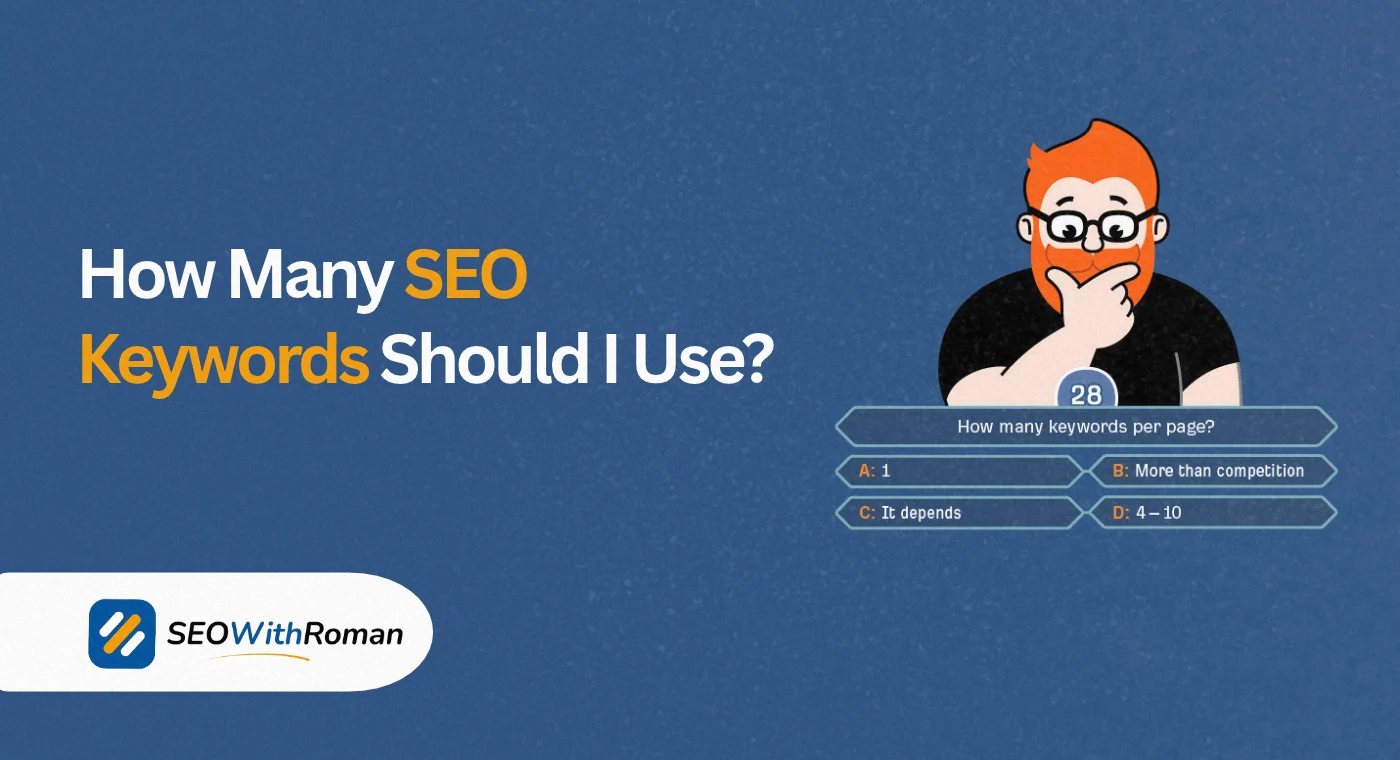
- Use 1 primary keyword and 5 to 7 secondary keywords per page as your starting formula
- Primary keyword density should stay between 1% and 1.2% across your full article
- LSI keywords and semantic keywords are different from secondary keywords and both matter for ranking in 2026
- The 80/20 rule in SEO means 80% of your traffic comes from 20% of your keywords so targeting the right ones matters more than targeting more of them
- There are 16 types of SEO keywords and understanding each one changes how you plan and write content
- An SEO score of 92 in tools like Rank Math is excellent and indicates strong on-page optimisation
- Keyword stuffing is still one of the fastest ways to lose rankings in 2026
1 Why the Question “How Many SEO Keywords Should I Use” Is More Important Than Most Beginners Realise
I get this question from almost every small business owner and blogger who starts working on their own SEO. They have done their keyword research, they have a list of terms, and now they are staring at a blank page wondering which keywords go in, how many, and where.
The reason this question matters so much is not just about following a rule. It is about understanding how Google reads your content. When you plant keywords correctly, Google understands exactly what your page is about and who it should show it to. When you plant them incorrectly, either too few or too many, Google either ignores your page or penalises it.
After many years of doing SEO across B2b, ecommerce, healthcare, and SaaS websites, the keyword placement mistakes I see on small business websites are almost always the same three. Too many primary keywords competing on one page, secondary keywords ignored completely, or keyword density so high the content reads unnaturally.
This guide covers all of it. Not just the number but the strategy behind keyword plantation, the types of keywords you need to know, density rules, semantic SEO, and the frameworks that actually produce rankings in 2026.
2 What Are SEO Keywords and What Role Do They Play in Rankings
Before talking about how many keywords to use, you need to understand what SEO keywords actually are and what job they do.
An SEO keyword is any word or phrase that a person types into Google when they are looking for information, a product, or a service. When you include that keyword in your content, you are signalling to Google that your page is a relevant answer to that search.
Keywords play three specific roles in your content
Relevance signals tell Google what your page is about. If your article targets “keyword density” and uses that phrase in your title, headings, and body naturally, Google knows with confidence what topic your page covers.
Intent matching signals tell Google whether your page matches what the searcher actually wants. A page targeting “how many keywords should I use” needs to answer that question directly. If it drifts into unrelated topics, Google detects the mismatch and ranks other pages instead.
Authority signals build up over time as your website publishes more content covering related keyword topics. This is called topical authority and it is one of the most powerful ranking advantages a personal brand blog can develop in 2026.
3 Primary Keywords vs Secondary Keywords | The Exact Difference and Why Both Matter
Most beginners treat all keywords the same. They find a list of related terms and try to fit as many as possible into one article. This is not how keyword plantation works and it is one of the main reasons well-written articles fail to rank.
Primary keyword is the single main term your page is built around. It is the phrase with the highest search relevance to your topic, it carries the most search volume in most cases, and it is the term you most want to rank for. Everything about the page, from the title tag to the URL to the opening paragraph, is built to signal that this is your primary keyword.
Your primary keyword should appear in
- The title tag
- The H1 heading
- The first 100 words of the article
- At least one H2 subheading
- The meta description
- The URL slug
- Naturally throughout the body at 1% to 1.2% density
Secondary keywords are related terms that support and expand your primary keyword’s topic. They are not competitors to your primary keyword. They are supporting evidence that your page covers the topic in full depth.
If your primary keyword is “how many SEO keywords should I use,” your secondary keywords might include “keyword density,” “primary keywords in SEO,” “how many keywords per 1000 words,” and “LSI keywords.” Each one adds a different dimension to the same core topic.
Secondary keywords should appear naturally in
- H2 and H3 subheadings
- Body paragraphs where they fit contextually
- Image alt text where relevant
- Internal link anchor text
The golden ratio that works across almost every article format: 1 primary keyword plus 5 to 7 secondary keywords per page.

4 The 16 Types of SEO Keywords Every Content Writer Needs to Know
Understanding keyword types is what separates beginner SEO content from expert-level content strategy. Most guides tell you about short-tail and long-tail. That is only two of the sixteen types you should know.
| Keyword Type | Definition | Example | Best Used For |
|---|---|---|---|
| Short-tail keyword | 1 to 2 words, high volume, high competition | “SEO keywords” | Authority pages on broad topics |
| Long-tail keyword | 3 or more words, lower volume, lower competition | “how many keywords per 1000 words” | Blog posts, beginner content |
| Primary keyword | Main target keyword for the page | “how many SEO keywords should I use” | Title, H1, URL, meta description |
| Secondary keyword | Supporting keywords around the primary topic | “keyword density percentage” | H2 headings, body paragraphs |
| LSI keyword | Latent Semantic Indexing terms, conceptually related | “search engine optimization,” “content optimisation” | Natural body content, semantic signals |
| Semantic keyword | Contextually related terms Google associates with your topic | “Google ranking factors,” “on-page optimisation” | Throughout article to build context |
| Geo-targeted keyword | Location-specific keyword | “SEO specialist in London” | Local SEO pages and landing pages |
| Branded keyword | Keywords containing your brand name | “SEOWithRoman keyword guide” | Brand authority content |
| Informational keyword | Searcher wants to learn something | “what is keyword density” | Blog posts, guides, definitions |
| Navigational keyword | Searcher wants to find a specific website | “Ahrefs keyword tool” | Not typically targeted in content SEO |
| Transactional keyword | Searcher ready to take action | “hire SEO specialist” | Service pages, Hire Me pages |
| Commercial keyword | Searcher is comparing options before buying | “best free keyword research tools 2026” | Comparison and review articles |
| Question keyword | Keyword phrased as a direct question | “how many keywords should I use for SEO” | FAQ sections, People Also Ask targeting |
| Negative keyword | Terms you want to exclude from targeting | “free” when targeting paid clients | Paid ads, not content SEO |
| Evergreen keyword | Keyword with consistent search volume year-round | “what is SEO” | Pillar pages, foundational guides |
| Trending keyword | Keyword with sudden or seasonal volume spikes | “Google algorithm update 2026” | Timely articles, news-style content |
For a personal brand SEO blog targeting beginners in the US and UK, the most important types to focus on are long-tail, informational, question-based, and evergreen keywords. These four types together make up the majority of what beginner and small business searchers type into Google every day.
5 Keyword Density | What Percentage Actually Works in 2026
Keyword density is the percentage of times your primary keyword appears compared to the total word count of your page. It is one of the most debated topics in SEO and also one of the most misunderstood.
The old-school recommendation from the early 2010s was to aim for 2% to 3% keyword density. That era is gone. Google’s natural language processing has become sophisticated enough to understand what a page is about without relying on simple keyword counting.
In 2026, the correct approach to keyword density is
Primary keyword density: 1% to 1.2%
This means in a 1,500-word article, your primary keyword should appear naturally 15 to 18 times. Not forced. Not in every paragraph. Placed where it reads naturally.
Secondary keyword density: 0.3% to 0.5% each
Each secondary keyword should appear 4 to 7 times across a 1,500-word article, used where they fit the context of that specific paragraph or section.
How to calculate keyword density manually:
Take the number of times your keyword appears, divide it by your total word count, and multiply by 100.
If “SEO keywords” appears 16 times in a 1,500-word article: 16 divided by 1,500 multiplied by 100 equals 1.06%. That is within the ideal range.
What happens when density is too high:
Google’s spam detection systems identify unnatural keyword repetition patterns. A page with 3% to 5% density on a single keyword reads unnaturally and Google ranks it lower or removes it from results entirely. This is keyword stuffing and it remains one of the fastest ways to lose rankings in 2026.
What happens when density is too low:
Google may not identify your page as sufficiently relevant to your target keyword. If your primary keyword appears only 3 or 4 times in 1,500 words, other pages covering the topic more thoroughly will outrank yours even if your content is otherwise excellent.
6 How Many Keywords Per 1,000 Words | The Numbers Broken Down
This is one of the most practically useful things to know before you sit down to write. Here is the exact keyword count breakdown by article length:
| Article Length | Primary Keyword (1% to 1.2%) | Secondary Keywords (2 to 4 total) | LSI and Semantic Keywords |
|---|---|---|---|
| 500 words | 5 to 6 times | 2 to 3 times each | 8 to 12 total across article |
| 800 words | 8 to 10 times | 3 to 4 times each | 12 to 18 total across article |
| 1,000 words | 10 to 12 times | 4 to 5 times each | 15 to 22 total across article |
| 1,500 words | 15 to 18 times | 5 to 7 times each | 22 to 30 total across article |
| 2,000 words | 20 to 24 times | 6 to 8 times each | 30 to 40 total across article |
| 3,000 words | 30 to 36 times | 8 to 12 times each | 45 to 60 total across article |
The key takeaway from this table is that keyword count scales with length but density stays constant. You are not adding more keywords as your article gets longer. You are maintaining the same percentage across a larger word count.
For most beginner-friendly blog posts targeting US and UK audiences, 1,200 to 1,800 words is the sweet spot. Long enough to cover the topic thoroughly. Short enough to maintain reading engagement without padding.
7 Traditional Keyword Plantation vs Semantic Keyword Plantation
This is where most SEO guides stop and where this guide goes further. There are two fundamentally different approaches to placing keywords in your content and understanding both of them is what separates content that ranks from content that does not.
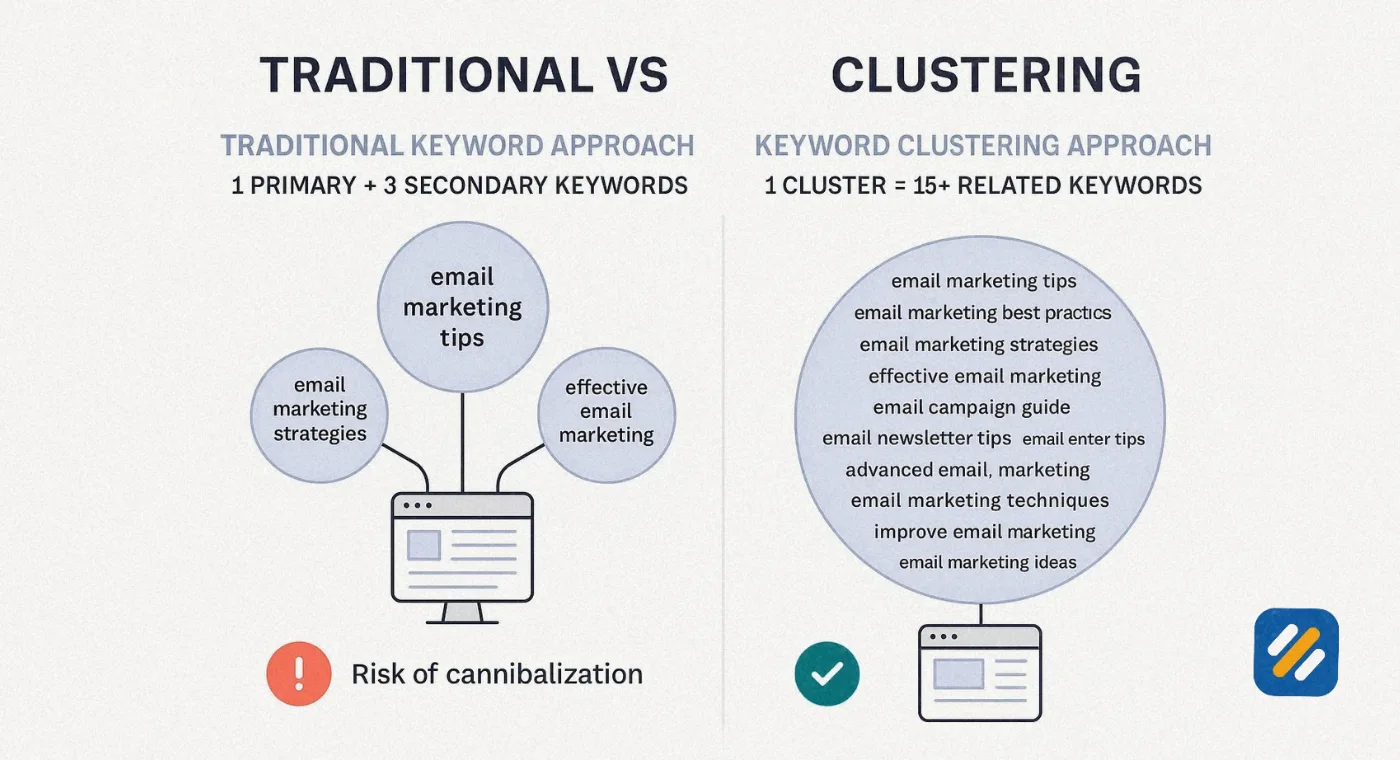
Traditional keyword plantation is the older approach. You target one keyword, place it in your title, repeat it at regular intervals through the body, and call it done. It worked well when Google was simpler and relied more heavily on exact keyword matching.
The problem with traditional plantation is that it creates content that sounds robotic when overdone and misses the semantic context that Google now uses to evaluate page quality.
Semantic keyword plantation is how modern SEO content is built. Instead of repeating the same keyword phrase, you build a network of related terms, concepts, and questions that together paint a complete picture of the topic for Google.
Here is the practical difference
Traditional approach for “keyword density”:
Article repeats “keyword density” 18 times across 1,500 words. Every reference uses that exact phrase. Google sees the repetition but the page lacks depth.
Semantic approach for “keyword density”:
Article uses “keyword density” as the primary keyword 16 times. It also naturally includes “keyword percentage,” “how often to use keywords,” “keyword frequency,” “optimal keyword usage,” “search engine keyword placement,” and “primary keyword ratio.” Each related term adds semantic depth without repetition.
The semantic approach ranks for the primary keyword AND for all the related terms simultaneously. This is why pages using semantic SEO consistently outperform pages using only traditional keyword placement, even when they target the same primary keyword.
How to implement semantic keyword plantation:
Start by asking what related questions, concepts, and terms surround your primary keyword. For “keyword density,” the semantic universe includes keyword stuffing, keyword cannibalization, LSI keywords, on-page SEO, Rank Math optimisation score, and search intent. Weave these naturally throughout your content and you build semantic depth that Google rewards with broader ranking coverage.
8 What Is the 80/20 Rule in SEO and How It Changes Your Keyword Strategy
The 80/20 rule, also known as the Pareto Principle, applied to SEO means this: approximately 80% of your organic traffic comes from just 20% of your keywords.
In practical terms for a blog like SEOWithRoman.com with 80 to 100 articles, this means roughly 16 to 20 articles will drive the majority of your total traffic. The rest will contribute smaller amounts.
What this tells you about your keyword strategy is important.
Picking the right 20% of keywords matters far more than publishing volume alone. A website that publishes 20 highly targeted, well-optimised articles on keywords with real search demand will often outperform a website with 100 poorly targeted articles.
9 How to apply the 80/20 rule to your keyword selection:
Before writing any article, ask these three questions:
Is this keyword searched by real people with a genuine need I can fully address? Does this keyword have search volume above 100 monthly searches in my target region? Is the keyword difficulty low enough for my current domain authority to compete?
If the answer to all three is yes, that keyword is likely in your high-impact 20%. If the answer to any is no, reconsider whether the article is worth the time investment at this stage of your website’s growth.
The 80/20 rule also applies within individual articles. Roughly 80% of your keyword appearances should be your primary keyword and core secondary keywords. The remaining 20% should be LSI terms and semantic variations. This ratio keeps your content natural while maintaining strong optimisation signals.
10 Is an SEO Score of 92 Good | What Rank Math Scores Actually Mean
If you are using Rank Math on WordPress, you have seen the SEO score that appears as you write. Beginners often obsess over this number without understanding what it actually measures.
An SEO score of 92 in Rank Math is excellent. It means your page is strongly optimised across all the on-page factors Rank Math evaluates. These include keyword presence in the title, meta description, H1, first paragraph, subheadings, image alt text, internal links, and content length.
Here is what each score range means in practical terms
| Rank Math Score | What It Means | Action Required |
|---|---|---|
| Below 50 | Poorly optimised, missing basic elements | Fix title, meta description, keyword placement urgently |
| 50 to 69 | Basic optimisation done but gaps remain | Add keyword to headings, improve meta description, add internal links |
| 70 to 79 | Decent optimisation, competitive at lower difficulty levels | Add LSI keywords, check image alt text, improve content depth |
| 80 to 89 | Good optimisation, ready to publish in most niches | Minor improvements optional, check readability score |
| 90 to 100 | Excellent optimisation, strong on-page signals | Publish confidently, focus on off-page and content quality |
The target for every article you publish on SEOWithRoman.com should be 80 or above before hitting publish. A score of 92 means you have covered all the technical on-page elements correctly.
One important clarification. A Rank Math score of 92 tells you that your on-page optimisation is strong. It does not guarantee a first-page ranking. Rankings are also determined by domain authority, backlink profile, content quality, and competition level. On-page optimisation is the foundation. Everything else builds on top of it.
11 LSI Keywords | The Hidden Ranking Multiplier Most Beginners Never Use
LSI stands for Latent Semantic Indexing. It refers to a method Google uses to understand the relationships between words and concepts on a page, rather than just counting keyword repetitions.
In simple terms, LSI keywords are terms that are conceptually related to your primary keyword without being variations of the same phrase.
If your primary keyword is “SEO marketing,” LSI keywords might include “search engine optimisation,” “Google rankings,” “organic traffic,” “content strategy,” “backlinks,” and “meta description.” None of these contain the words “SEO” and “marketing” together, but all of them are concepts that naturally appear in content about SEO marketing.
Why LSI keywords matter for rankings
Google uses LSI signals to verify that your content is genuinely comprehensive and expert-level. A page that covers “keyword density” but never mentions related concepts like “search intent,” “on-page SEO,” or “keyword research” looks incomplete to Google compared to a page that naturally weaves all these concepts together.
How to find LSI keywords for any topic
Type your primary keyword into Google and scroll to the bottom of the page. The “Related Searches” section shows exactly what Google considers semantically connected to your keyword. Every term in that section is a potential LSI keyword for your article.
Additionally, Google’s “People Also Ask” section surfaces question-based LSI terms that you can naturally incorporate as FAQ items or supporting paragraphs in your content.
For a 1,500-word article, including 8 to 12 distinct LSI keywords naturally woven throughout the content significantly improves semantic depth and broadens the range of search queries your page can rank for.
12 3 Expert Tips for Perfect Keyword Plantation Every Time
These three tips go beyond what most SEO guides cover and come directly from real client work across multiple industries.
Expert Tip 1: Use Your Primary Keyword in the First 100 Words Without Making It Obvious
The most natural way to open an article is to answer the reader’s question immediately. If your primary keyword is “how many SEO keywords should I use,” your opening paragraph should answer that question in the first two sentences. The keyword appears naturally because you are directly addressing what the reader came to find. Google rewards this because it matches search intent immediately.
Expert Tip 2: Never Use the Same Secondary Keyword in Back-to-Back Paragraphs
Spacing your secondary keywords across the article is just as important as the total count. If “keyword density” appears in three consecutive paragraphs, it reads as forced and unnatural. Spread each secondary keyword across different sections of the article so the distribution feels organic throughout the full reading experience.
Expert Tip 3: Add LSI Keywords to Your Conclusion Deliberately
Most writers naturally include LSI terms throughout the body but forget them in the conclusion. Your conclusion is read carefully by engaged readers and crawled specifically by Google as a summary of the page’s topic. Including two or three LSI keywords naturally in your final paragraph reinforces your semantic depth signal right where Google is looking for it.
13 Conclusion
The answer to how many SEO keywords to use is not just a number. It is a system.
One primary keyword placed strategically at 1% to 1.2% density. Two to four secondary keywords woven naturally through supporting sections. Eight to twelve LSI and semantic keywords adding depth across the full article. All of them working together to tell Google and the reader exactly what your page is about and why it deserves to rank.
The 80/20 rule reminds you that keyword selection matters as much as keyword placement. Choosing the right primary keyword for your domain authority level is the decision that determines whether all this optimisation work pays off in actual rankings.
The 16 types of keywords remind you that not all keywords serve the same purpose. Matching the right keyword type to the right page type is what builds a coherent content strategy rather than a collection of unconnected articles.
A Rank Math score of 92 tells you the technical foundation is solid. After that, content quality, genuine expertise, and consistent publishing are what carry your rankings to page one and keep them there.
Use this guide as your keyword plantation reference before writing every article. The results compound over time and that compounding is what makes SEO the most valuable marketing channel a small business can invest in.
Found this useful? Drop a comment below and tell me which keyword type you find the most confusing. I answer every comment personally.
Join 1,000+ business owners and bloggers who get one actionable SEO tip every week — straight to their inbox. Free forever.
Get Free Weekly Tips →