- What SEO copywriting means in plain language, and how it differs from content writing and regular copywriting
- What an SEO copywriter does all day, and which skills matter most
- A five stage process for SEO copywriting, from keyword research to the final edit
- How to adapt your copy for Google, AI Overviews, and answer engines
- Whether SEO is hard to learn, with a realistic 90 day plan to get started
- The honest math behind making $5,000 a month, and what SEO copywriters really earn
1 What Is SEO Copywriting (Meaning Explained Simply)
SEO copywriting is the craft of writing web copy that does two jobs at once. It ranks in search engines for the phrases your audience searches, and it persuades the person who lands on the page to act, whether that means buying, booking, or signing up.
That is the SEO copywriting meaning in one sentence. If you want it even shorter, think of it as a sales pitch that Google can find.
People search for this in all sorts of ways, from “what is SEO/ copywriting” to “SEO copywriting meaning”, but they are all asking one thing: how do I write pages that get found and get results? SEO and copywriting were separate skills for years, and the people who learned to combine them became very valuable.
The term confuses people because both halves have a bad reputation. “SEO” makes people picture keyword stuffing. “Copywriting” makes people picture loud ads. Put them together and the real picture is much quieter: clear writing, built around what a real person typed into a search box, shaped so the page earns its ranking and then earns the click.
Here is a small example. Picture a plumber in Leeds. A weak page says, “We offer a wide range of plumbing services for all your needs.” A page written with search engine optimization copywriting says, “Boiler repair in Leeds: same day call outs and a fixed price quote before we start.” The second version matches what people actually search, answers the two questions standing between them and a phone call (how fast, how much), and sounds like a human wrote it.
In my experience, the biggest gains rarely come from adding more keywords. They come from replacing vague claims with the exact words customers already use on sales calls and in reviews. The language you need is usually sitting in your inbox.
Quick answer: What is SEO copywriting? It is writing commercial web pages, such as service pages, product pages, and landing pages, so they rank for the right searches and convert the visitors who arrive.
2 SEO Copywriting vs Content Writing vs Copywriting
These three get mixed up constantly, and the confusion leads to hiring the wrong person or writing the wrong page. Here is the clean split.
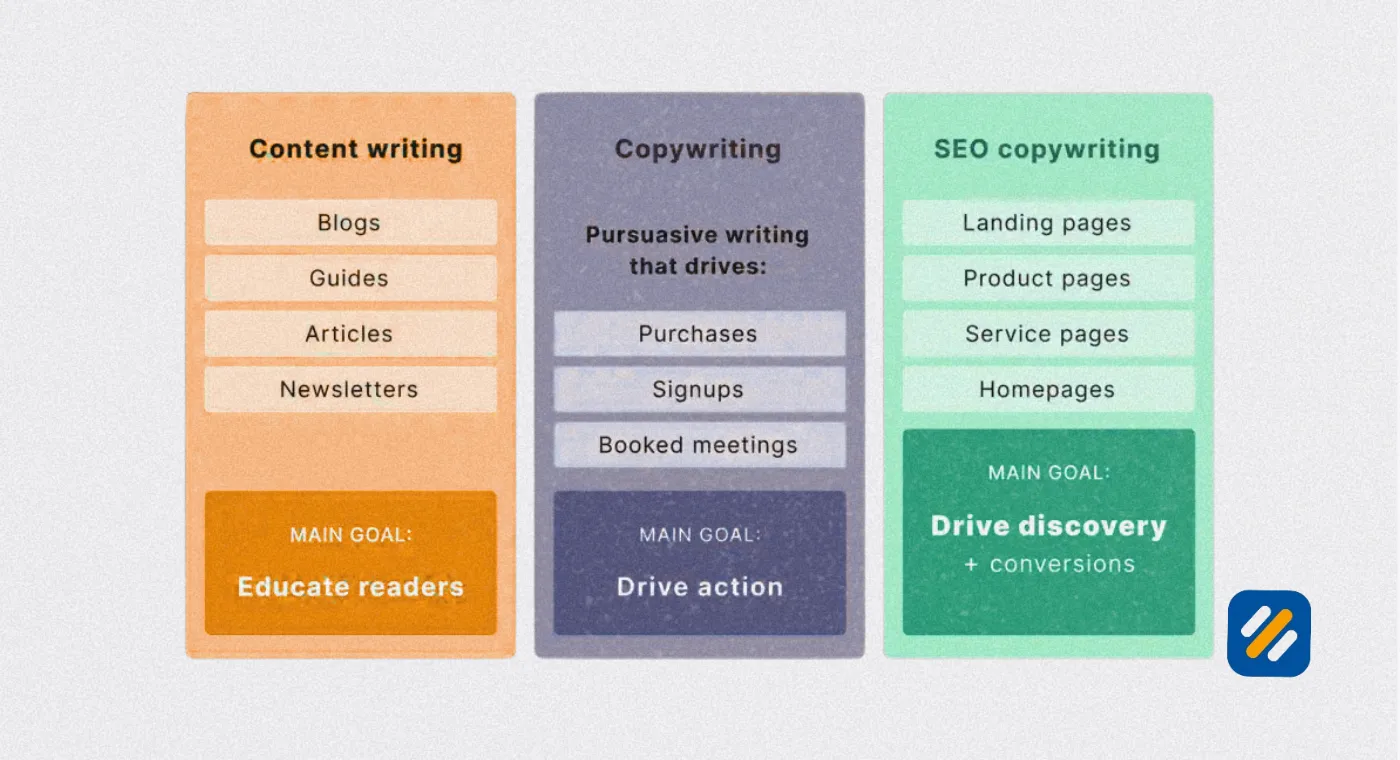
| Content Writing | Copywriting | SEO Copywriting | |
|---|---|---|---|
| Main goal | Inform or educate | Persuade someone to act | Persuade and get found in search |
| Typical formats | Blog posts, guides, newsletters | Ads, sales pages, emails | Service pages, product pages, landing pages, category pages |
| Success measure | Traffic, time on page, shares | Conversions and revenue | Rankings and conversions together |
| Role of keywords | Supporting | Minimal or none | A central input, but never the boss of the page |
| Reader’s mindset | Curious | Being persuaded | Searching, often close to a decision |
Hiring a content writer when you need SEO copywriting, or the other way around, is one of the most common and expensive mix-ups in marketing. One honest caveat. Some teams use “SEO writing” and “SEO copywriting” as the same thing, and others reserve the second term for commercial pages only. Both views are common in the industry. What matters is that the page has a clear job, and that someone decided that job before the first sentence was written.
3 What Is an SEO Copywriter (and What Do They Actually Do)
An SEO copywriter is a writer who combines persuasive writing with search knowledge. If someone asks “what is an SEO copywriter” or “what is seo copywriter” at a dinner party, the simple answer is this: they write pages that people can find and want to act on.
An SEO website copywriter focuses specifically on the pages that make up a business site, such as the homepage, service pages, and product pages, rather than only blog posts.
The job is wider than most people expect. Good SEO copywriting starts long before the writing, and the writing itself is maybe a third of the work.
| Task | What it looks like in practice |
|---|---|
| Keyword and intent research | Checking what already ranks, in what format, and which questions searchers ask |
| Briefing | Talking to sales, support, or the founder, and collecting real customer phrases |
| Writing | Headlines, body copy, calls to action, meta titles and meta descriptions |
| On-page setup | Headings, internal links, image alt text, and suggestions for schema |
| Editing | Reading aloud, cutting filler, fact checking |
| Measuring | Reviewing Search Console queries, rankings, and conversion rate, then updating the page |
The skills that matter most are not the glamorous ones. Research, empathy for the reader, ruthless editing, and enough basic SEO to avoid self-inflicted damage will take you further than a poetic writing style.
4 Why SEO Copywriting Matters Even More in the Age of AI Search
Search results now include AI Overviews and AI Mode answers, and plenty of people ask ChatGPT or Perplexity instead of Google. It would be easy to think SEO copywriting is dying. Copywriting and SEO are both being reshaped, but I think the opposite is true: the bar has simply moved.
AI systems tend to pull from pages that state something clearly, with specifics, and with a point of view. Generic copy that repeats what ten other pages already say gives them no reason to pick you. Here is how to write for both humans and answer engines.
Answer first. Put a direct answer of two or three sentences right under each heading, then expand. This helps featured snippets and AI summaries alike.
Say something the rest of the web doesn’t. Search your topic in an AI tool and notice where its answer gets vague or hedges. Those gaps are where your first hand experience is most valuable.
Keep your facts consistent. Your brand name, pricing, services, and descriptions should match across your site, your social profiles, and third party listings. Systems cross-check.
Add a real FAQ. Use questions people actually ask, with short, specific answers.
Keep product and service data current. Wrong prices and stale details hurt trust with both people and machines.
The sites that do well here are the ones with a genuine perspective. Backlinko’s recent guide on commercial pages makes the same point, that copy built around the buyer’s situation and the seller’s real expertise is what gets surfaced.
5 SEO Copywriting Basics: The Three Phase Process
Before the details, here is the shape of the work. Yoast popularized a split that I find holds up in practice: roughly 40 percent of your time preparing, 20 percent writing, and 40 percent editing. Most beginners do the reverse, which is why their drafts feel thin. Think of SEO copywriting as a loop rather than a straight line, because what you learn in editing and measuring feeds the next round of research.
Phase 1, Research: keywords, search intent, competitors, customer language
Phase 2, Write: headline, structure, body copy, calls to action
Phase 3, Edit and publish: polish, on-page setup, internal links, measurement
The next five sections walk through each stage of writing copy for SEO in order.
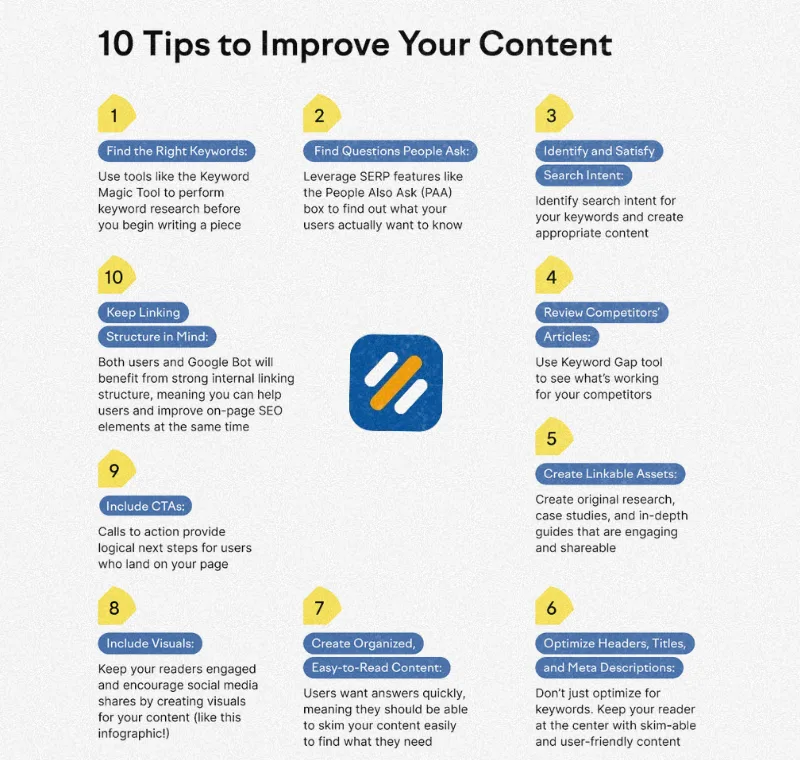
Step 1: Research Keywords and Search Intent
You cannot write good SEO copy for a phrase you have not understood. Keyword research for SEO copywriting also works differently from research for blog traffic, because you want phrases that signal a buyer is close to acting. Start with the keyword, then read the results page the way a detective would.
1: Pick one primary keyword for the page. One page, one main phrase. Support it with three to six related terms.
2: Open the search results. Look at what format ranks (guides, product pages, videos, tools). Google is telling you what it thinks the searcher wants.
3: Classify the intent. Informational, commercial investigation, transactional, or navigational.
4: Collect real questions. Use the People Also Ask box, autocomplete, and your own Search Console data.
5: Check what AI says. Ask an AI tool the same question and note what it gets right, wrong, or vague.
| Search intent | Page type that fits | Copy style that works |
|---|---|---|
| Informational | Guide or blog post | Clear, teaching, answer first |
| Commercial investigation | Comparison, review, category page | Honest, comparative, proof heavy |
| Transactional | Product, service, or landing page | Benefit led, short path to action |
| Navigational | Homepage or brand page | Clear brand message |
A small trap worth knowing. A keyword can look transactional but still have a results page full of videos and how-to articles. In that case Google reads the intent as informational, and a hard-sell page will struggle no matter how well it is written. Match the format first, then optimize.
Step 2: Build a Messaging Brief Before You Write
This is the step most guides skip, and it is the most underrated tool in SEO copywriting. It separates copy that sounds like everyone else from copy that sounds like a person who knows the buyer.
Gather what customers already say. Good places to look are your own reviews, sales call notes, support tickets, and community threads where your audience asks questions. You are hunting for exact phrases, not paraphrases.
Then sort what you find into four buckets
- Pain points: the problem in their words
- Objections: what makes them hesitate
- Desired outcome: what “solved” looks like to them
- Sticky phrases: vivid wording you can use almost verbatim
Then write a one page brief with these fields: page goal, audience, the single core argument (why this brand is right for this person), differentiators, who it is not for, proof you can show, primary keyword, and supporting terms.
That “who it is not for” line feels risky, but it works. Naming the wrong fit builds trust with the right fit, and it quietly filters your traffic toward people more likely to convert.
Step 3: Write the Copy
Now you write. The research should have given you more than enough material, so the blank page problem mostly disappears. Strong SEO copywriting reads like a good conversation with someone who understands the problem.
Lead with the situation, not the feature. Buyers don’t care about specs, they care about what the specs mean for their day.
| Feature led (weak) | Situation led (strong) |
|---|---|
| 5,000mAh battery | Gets through a full day of maps, calls, and music without hunting for a charger |
| 24/7 support | A real person answers at 2 a.m. when your checkout breaks |
| Ergonomic design | Comfortable enough that your wrist doesn’t ache by Friday |
Use the inverted pyramid. Give the most important point in the first paragraph, then add context for the people who want it. This helps readers and also helps your page match featured snippet formats.
Hook with problem, agitate, solve. Name the problem, make the reader feel the cost of leaving it alone, then introduce the fix. It is an old formula because it follows how people actually decide.
Keep readers moving. Short sentences. Short paragraphs. A transitional line like “Here’s the catch” or “But there’s a problem” at the end of a paragraph gives the eye a reason to continue.
Write how you speak. If a sentence would sound strange read aloud to a friend, rewrite it. Plain words beat clever ones almost every time on a commercial page.
Write your calls to action like a promise. “Start my free trial” beats “Submit.” “Get my quote” beats “Click here.” The button should tell the reader what happens next.
Step 4: On-Page Placement and Keyword Density
With the copy drafted, work your keywords in without wrecking it. In SEO copywriting, smart placement matters far more than repetition. Write the persuasive version first, then look for natural homes for the phrase.
| Element | Practical guidance |
|---|---|
| Title tag | Main keyword near the front, around 60 characters, with a reason to click |
| H1 | Matches the promise of the title, one per page |
| First 100 words | State the main point and use the keyword naturally |
| Subheadings | Use the keyword or a close variant in one or two, keep the rest reader friendly |
| URL | Short and readable, includes the main phrase |
| Meta description | A pitch in about 150 to 160 characters, which influences clicks even though it is not a direct ranking factor |
| Image alt text | Describe the image plainly, mention the topic only when it fits |
| Internal links | Descriptive anchor text from related pages |
| FAQ block | Real questions with short, direct answers |
On keyword density, treat 1 percent as a handy reference rather than a rule. Some experienced SEO writers ignore density completely and rely on smart placement and natural language, which is a fair approach. The test that never fails is reading the page out loud. If the phrase ever sounds repetitive, you have used it too often.
Step 5: Edit, Publish, and Measure
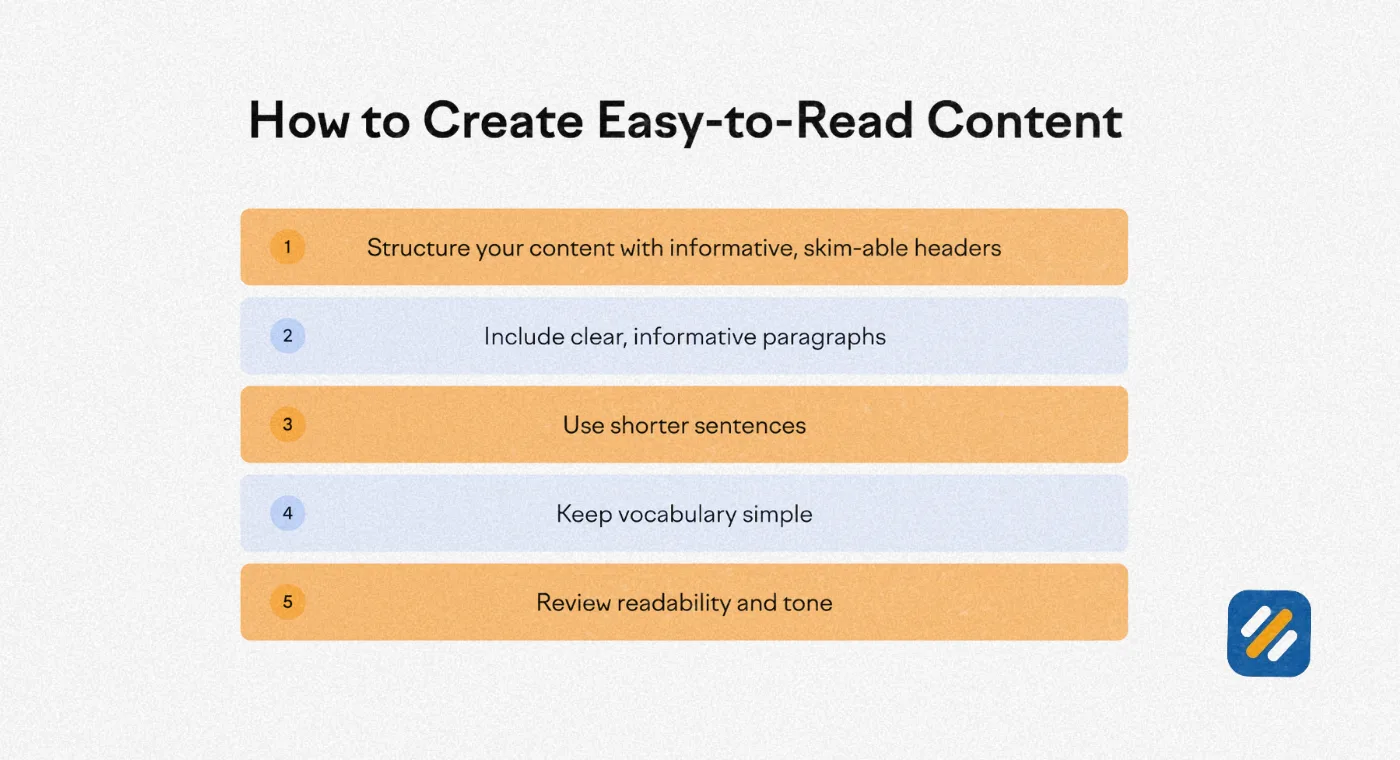
Editing is where average copy becomes good, and where SEO copywriting earns its keep. Plan to spend as long here as you did on research.
1: Read it aloud, slowly. Awkward lines reveal themselves immediately.
2: Cut filler. Delete roughly ten percent of your draft. Almost everything survives the cut better than you expect.
3: Check every claim. Numbers, names, dates, and prices.
4: Fix the structure. If someone read only your headings, would they get the story?
5: Get one outside reader. Ideally someone who matches your audience.
6: Check on a phone. Most visits come from mobile.
After publishing, add internal links from three to five related pages, submit the URL in Google Search Console, and give the page time. Most pages take weeks to settle and months to reach their potential. Check your Search Console queries after about three months, then update the page with the exact phrases you appear for on pages two and three.
6 SEO Website Copywriting: What Each Page Needs
SEO website copywriting is not one skill applied once, it is a different job per page type. Some people call this SEO web copywriting, and the label matters less than the idea: each page type calls for different SEO copywriting priorities. Here is how they shift.
| Page | Its job | What to include | The usual miss |
|---|---|---|---|
| Homepage | Say who you help and what you do | Clear value proposition, proof, paths to key pages | Trying to rank for everything at once |
| Service page | Rank for “service + location” and convert | Process, pricing signals, FAQs, local details | Generic claims anyone could make |
| Product page | Close the sale | Specs translated into benefits, reviews, shipping and returns | Manufacturer text copied word for word |
| Category page | Help people choose and rank for broad terms | A short intro, buying guidance | Thin text with no help |
| Landing page | Drive one action | One call to action, proof | Too many links |
| Blog post | Attract and educate early-stage searchers | Depth, original angle, links to commercial pages | Never linking to services or products |
SEO Copywriting Tips Most Guides Skip
These SEO copywriting tips are the ones I come back to most.
- Write the headline last. After the body is done, you know exactly what the page promises.
- Use numbers that only you have. Turnaround times, customer counts, test results. Specifics read as true.
- Answer the price question. Even a range builds trust and filters out poor-fit leads.
- Put proof next to claims. A testimonial beside the promise it supports beats a testimonial wall at the bottom.
- Use eyebrow lines for clever copy. If your favorite line doesn’t contain the keyword, keep it as small supporting text and let the clear keyword line lead.
- Match the tone of your audience. A page for accountants and a page for skateboarders should not sound alike.
- Read your top three competitors, then say something they don’t. If all of them repeat the same claims, that repetition is your map.
- Update winners, not just new pages. A page already ranking on page two is cheaper to push than a new page is to build.
7 Common SEO Copywriting Mistakes
These show up again and again when SEO copywriting gets reviewed, even on sites with big budgets.
- Keyword stuffing. It is still a thing, and it still reads badly.
- Ignoring search intent. Writing a sales page for an informational search.
- Writing for algorithms. Pages that sound like they were built for a robot get treated accordingly by readers.
- Burying the answer. Three paragraphs of preamble before the point.
- One page for five keywords. Focused pages beat scattered ones.
- Copying competitors. If your page says the same thing as the page above it, there is no reason to rank above it.
- Publishing unedited AI drafts. AI can speed up outlining and first drafts, but unedited output is generic and sometimes wrong, which hurts trust.
- Never refreshing content. Prices change, services change, and search behavior shifts.
8 SEO Copyright: What People Mean and Why It Matters
You will sometimes see people search for “seo copyright” when they mean SEO copywriting. It is an extremely common typo, so if that is what brought you here, you are in the right place.
But copyright genuinely matters in this field, and it is worth a short note
- Never copy another site’s text. It risks takedown requests and gives you nothing unique to rank with.
- Product pages are the usual trap. Pasting manufacturer descriptions across many stores creates duplicate content problems.
- Use images you have the right to use, and keep a record of where they came from.
- If you use AI to draft, edit heavily and add your own experience, then run a plagiarism check.
This is general information, not legal advice. If a project has real legal exposure, ask a qualified professional.
9 How to Learn SEO Copywriting (and Is SEO Hard to Learn?)
Is SEO hard to learn? The honest answer is that it is easy to start and slow to master. The basics, such as how keywords work, what search intent means, and how to structure a page, can be learned in a few weeks. What takes years is judgment, knowing which of ten good ideas will move the needle for a specific page.
The hardest part for most beginners is patience. SEO results arrive on a delay, and it is easy to quit just before they show up. You also don’t need to learn technical SEO to write copy that ranks. It helps, but it is a separate path.
Copywriting for SEO is a learnable skill, not a talent you are born with. Here is a realistic 90 day plan for how to learn SEO copywriting.
| Weeks | Focus | Output |
|---|---|---|
| 1 to 4 | Learn the fundamentals: Google’s SEO starter guide, one free beginner course, and the guides in the sources table below | Notes, plus three existing pages rewritten as practice |
| 5 to 8 | Build something real: a small site or blog, Search Console connected | Four to six published pages, including one commercial page and one guide |
| 9 to 12 | Measure and pitch | Before and after examples, then outreach to ten small businesses or agencies |
Your own site is the best credential you can have. A ranking page is proof, and it takes no one’s permission.
10 Can You Make $5,000 a Month With Copywriting?
Yes, it is realistic for a working freelancer. People who search “copywriting SEO jobs” are usually asking this same question underneath: is there real money in this? There can be, but it is not realistic for most people in their first month. Here is the math, using 2026 rate data. The Editorial Freelancers Association’s 2026 rate chart puts US freelance SEO copywriting at roughly 25 to 45 cents per word, or $74.50 to $87.50 per hour for blog posts. Content platforms pay far less, around 5 to 16 cents per word.
| Pricing model | Rate | Work needed for $5,000 a month |
|---|---|---|
| Entry level per word | $0.10 | About 33 articles of 1,500 words |
| Mid level per word | $0.25 | About 13 articles of 1,500 words |
| EFA range per word | $0.35 | About 10 articles of 1,500 words |
| Per service page | $400 | About 13 pages |
| Hourly | $60 | About 83 billable hours |
| Retainer | $1,250 | Four retainer clients |
Two things to keep in mind. First, billable hours are not the same as working hours. Pitching, invoicing, and revisions take a real share of your week, so plan around billing for perhaps half to two thirds of your time. Second, the fastest route up is not writing more words, it is charging for a better outcome. Writers who bring keyword research, structure, and conversion thinking can charge more per page than writers who only deliver text.
For a sense of the top end, Jacob McMillen reports that he once charged $5,000 per SEO article and that his freelance income peaked at around $20,000 a month after six or seven years. Treat that as one person’s account of a best case, not a promise. Income varies widely and nothing here is guaranteed.
11 Is SEO Copywriting High Paying?
Compared with general writing work, yes, SEO copywriting pays well when your copy is tied to revenue. When you sell words by the pound on a content mill, no. Here is what the 2026 data shows.
| Source | Figure |
|---|---|
| ZipRecruiter (September 2026) | Average US SEO copywriter salary of about $76,400, with most between $58,000 and $86,500 |
| Glassdoor | Median total pay of about $77,000, with top earners near $117,000 (an older snapshot) |
| Payscale | Average US copywriter base salary of about $63,900 |
| EFA 2026 rate chart | 25 to 45 cents per word, or $74.50 to $87.50 per hour, for freelance blog posts |
| ProCopywriters 2026 (UK) | Median freelance day rate of £440 |
The US Bureau of Labor Statistics has no separate job code for SEO copywriters, which is why the figures above come from salary sites and surveys instead of one official number. Treat them as ranges.
The writers at the high end tend to share three things. They specialize in a niche such as software, finance, or healthcare. They combine writing with keyword research and analytics. And they can point to pages that drove leads or sales. This section covers copywriting pay specifically, because pay for the broader SEO field varies so much by role.
12 SEO Copywriting Services: What to Expect and How to Hire
If you are hiring rather than writing, here are typical 2026 price ranges for SEO copywriting services. Quality, niche, and research depth move these a lot.
| Deliverable | Typical range |
|---|---|
| SEO blog post (1,000 to 1,500 words) | $100 to $800 |
| Landing page | $500 to $2,500 |
| Sales page | $1,500 to $6,000 |
| Full website copy | $2,000 to $12,000 |
A good SEO copywriting service should ask you questions before quoting. Who is the customer? What do you sell? Which pages matter most? What does a good result look like? If a provider quotes a price without asking about your audience, treat that as a warning.
Questions worth asking:
- Can you show pages you wrote that rank for commercial terms?
- How do you research search intent and customer language?
- Who owns keyword research, you or me?
- What is your policy on AI drafts and plagiarism checks?
- How will we measure success?
Red flags: a guaranteed number one ranking, extremely low per word pricing, keyword stuffed samples, and bulk text that reads the same for every client.
13 Tools and Trusted Sources for SEO Copywriting
These are the references worth bookmarking, a mix of official Google guidance, pay data, and respected guides.
| Resource | What It Helps With | Link |
|---|---|---|
| Google SEO Starter Guide | Official fundamentals of how search works | developers.google.com/search/docs/fundamentals/seo-starter-guide |
| Google: Creating Helpful Content | Google’s own guidance on people-first content and E-E-A-T | developers.google.com/search/docs/fundamentals/creating-helpful-content |
| Google Search Console | Real queries, rankings, and clicks for your pages | search.google.com/search-console |
| Editorial Freelancers Association Rate Chart | Survey based pay rates for freelance writers | the-efa.org/rates |
| Yoast: SEO Copywriting Guide | A full process from keyword research to editing | yoast.com/complete-guide-seo-copywriting |
| Ahrefs: SEO Copywriting | Practical formulas for hooks and structure | ahrefs.com/blog/seo-copywriting |
| Backlinko: SEO Copywriting | A research-first approach for commercial pages | backlinko.com/seo-copywriting |
| Hemingway Editor | A quick readability check on your draft | hemingwayapp.com |
14 Conclusion
SEO copywriting is not a trick for pleasing algorithms. It is the discipline of understanding what someone searches for, then writing the clearest, most useful, most persuasive page they could land on. The tools and the search results keep evolving, but that core job does not.
Start small. Pick one page that matters, research the search intent properly, build a short messaging brief, write it in plain language, and measure what happens. One page done well will teach you more than any amount of reading.
Have a question about SEO copywriting, or want a second opinion on a page you are writing? Drop a comment below and I will take a look personally.
Join 1,000+ business owners and bloggers who get one actionable SEO tip every week — straight to their inbox. Free forever.
Get Free Weekly Tips →