- A search engine is a software system that crawls, indexes, and ranks web content in response to a user query
- Google processes over 8.5 billion searches per day and holds over 91% of the global search engine market share
- There are six types of search engines including traditional, AI-powered, privacy-focused, regional, social, and specialised
- Optimising for Google does not automatically mean you rank on Bing, Baidu, or AI search engines like Perplexity
- The rise of AI search engines in 2025 and 2026 has fundamentally changed how websites need to approach visibility online
1 What Is a Search Engine and Why It Matters More Than Ever
Most people use a search engine dozens of times a day without ever thinking about what is actually happening behind the scenes. You type a question, results appear in under a second, and you click the link that looks most useful. The whole experience feels effortless. But the system making it work is one of the most sophisticated pieces of technology ever built.
A search engine is a software system designed to carry out web searches. It searches the internet for content matching the words a user enters, then ranks and displays that content in a list of results called a Search Engine Results Page, or SERP.
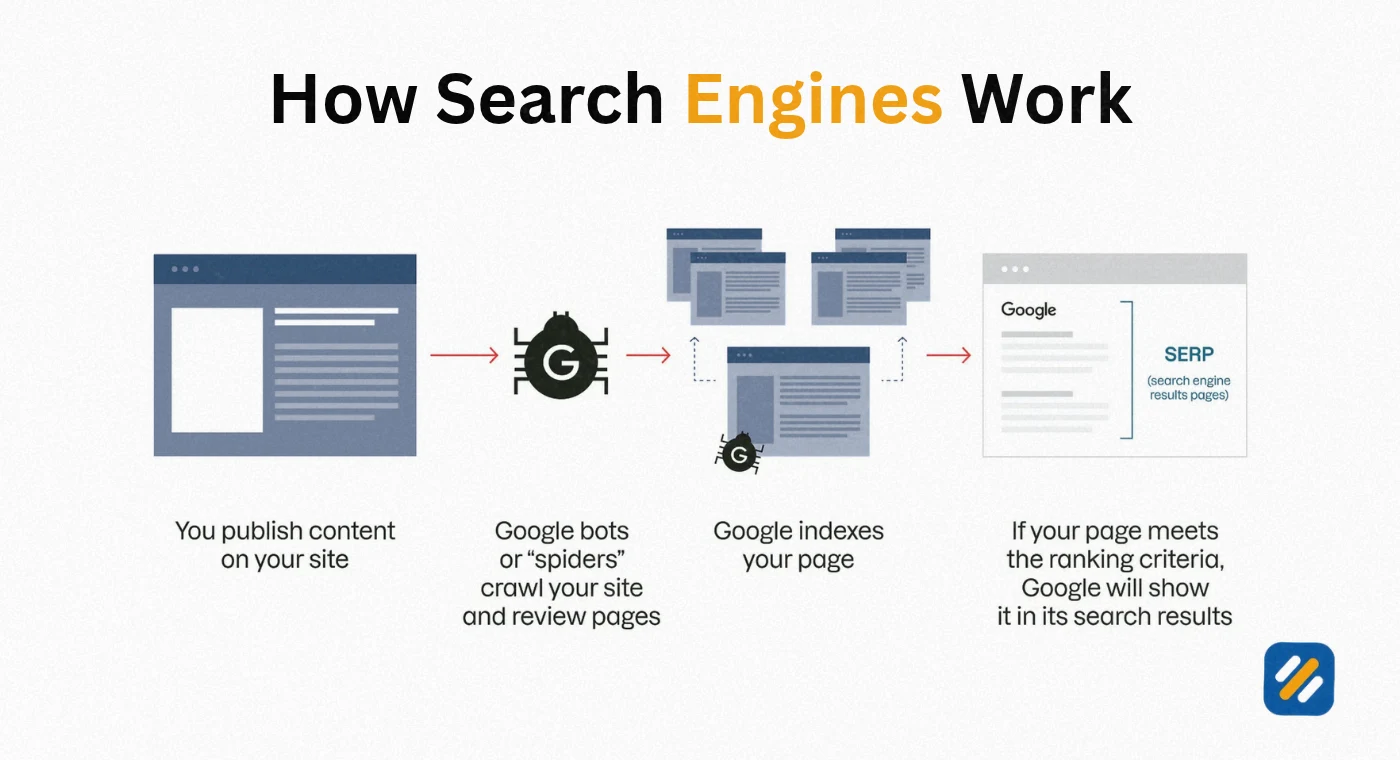
The three core processes that every search engine runs are
Crawling, where automated programs called bots or spiders continuously visit pages across the entire internet, following links from one page to the next and reading the content they find.
Indexing, where all the content discovered during crawling is stored and organised in a massive database so it can be retrieved quickly when a user searches.
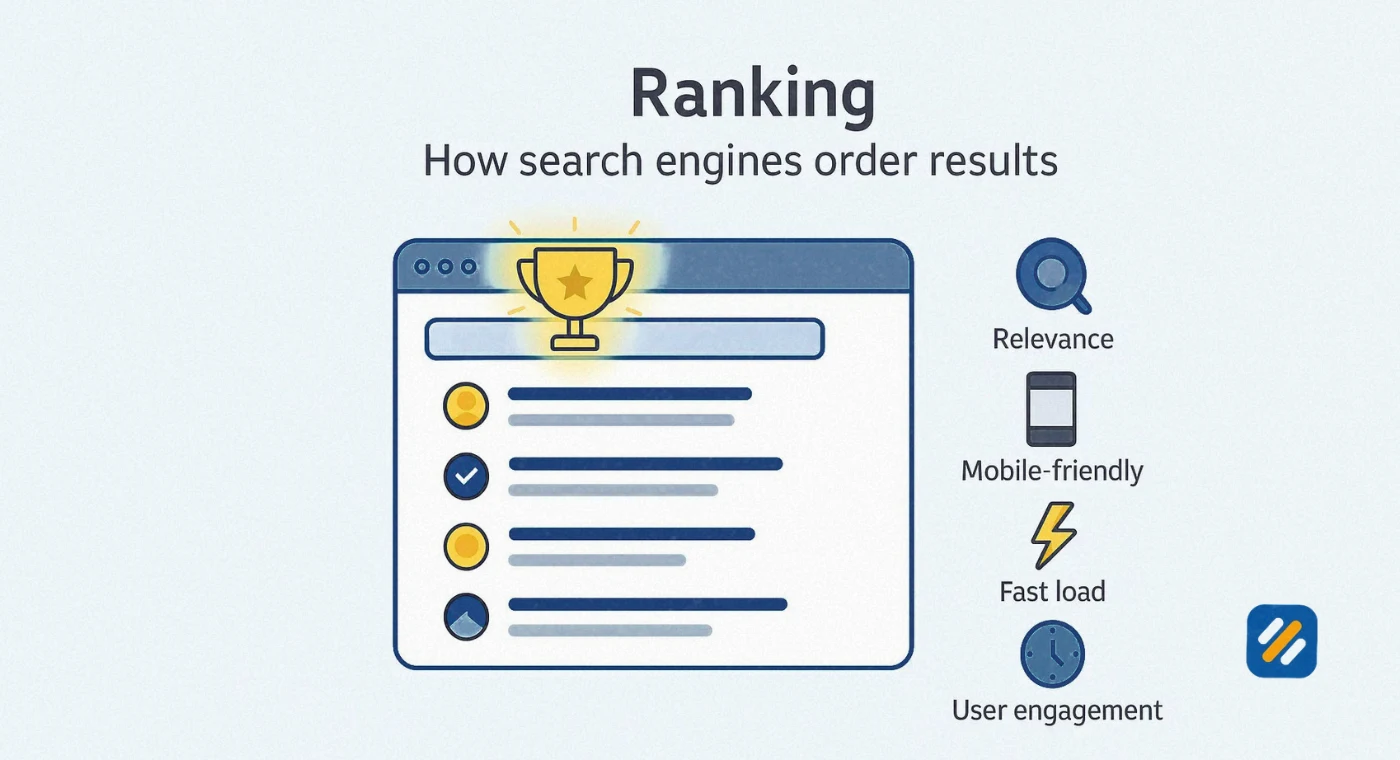
Ranking, where the search engine applies hundreds of algorithms to decide which pages from its index best answer a specific query, then presents them in order from most to least relevant.
Understanding these three processes is not just an academic exercise. Every decision you make about your website, from how you structure your content to which keywords you target, affects how well search engine crawlers can read your pages, how accurately your content gets indexed, and how high the algorithm decides to rank you.
In 2026, the definition of a search engine has expanded beyond traditional web search. AI-powered answer engines, social search platforms, and regional search systems all operate on the same fundamental principles but apply them in very different ways. Knowing the difference shapes your entire SEO and content strategy.
2 How Does a Search Engine Work? The Full Process Explained
Most SEO guides skip straight to tactics without explaining the underlying system those tactics are designed to influence. That gap in understanding is why so many websites produce content that never ranks. Here is the full process, explained in plain language.
Step 1: Crawling
Search engines deploy automated programs called crawlers, spiders, or bots that continuously visit webpages across the internet. Google’s crawler is called Googlebot. Bing’s is called Bingbot. Each crawler starts from a list of known URLs, visits those pages, reads the content, and then follows every link on that page to discover new pages.
The speed and thoroughness of this crawling depends on your website’s crawlability. If your pages are blocked in your robots.txt file, if your site loads slowly, or if your internal linking is weak, crawlers will visit fewer of your pages and visit them less often.
Step 2: Indexing
Once a page is crawled, its content is processed and stored in the search engine’s index. Think of the index as an enormous library where every book is a webpage. When you search, the search engine does not scan the live internet. It searches this pre-built index, which is why results appear in milliseconds.
Not every crawled page gets indexed. Search engines skip pages they consider duplicate, thin, low quality, or technically blocked from indexing. This is why technical SEO matters so much. A page that cannot be indexed cannot rank, regardless of how good the content is.
Step 3: Ranking
Ranking is where the real competition happens. When a user submits a query, the search engine scans its index for pages that match that query, then applies its ranking algorithm to decide which pages to show and in what order.
Google’s algorithm uses over 200 ranking factors. The most significant include content relevance and depth, the number and quality of backlinks pointing to the page, page experience signals like load speed and mobile usability, E-E-A-T signals showing real expertise and trustworthiness, and how well the content matches the searcher’s intent.
Step 4: Displaying Results
The ranked pages are displayed on the SERP. In 2026, SERPs include far more than a simple list of blue links. They contain featured snippets, AI-generated overviews, People Also Ask sections, image packs, local map results, video carousels, and shopping panels. Each of these result types requires a different optimisation approach to appear in.
3 6 Types of Search Engines You Need to Know About
Not all search engines are built the same way or serve the same purpose. Understanding the six main types helps you decide where to focus your optimisation efforts.
| Type | How It Works | Best For | Examples |
|---|---|---|---|
| Traditional Web Search | Crawls and indexes the open web, ranks by algorithm | General information, commercial intent, most SEO work | Google, Bing, Yahoo |
| AI Answer Engines | Uses large language models to generate answers from indexed or live content | Conversational queries, research, complex questions | ChatGPT Search, Perplexity, Google AI Mode |
| Privacy-Focused | Crawls the web but does not track users or personalise results | Users who want anonymity and unbiased results | DuckDuckGo, Brave Search, Startpage |
| Regional and Local | Optimised for specific countries, languages, or cultures | Reaching audiences in China, Russia, Korea, Czech Republic | Baidu, Yandex, Naver, Seznam |
| Social Search | Searches within user-generated content on social platforms | Trending content, product discovery, entertainment | YouTube, TikTok, Reddit, Pinterest |
| Specialised | Searches within a specific content type or domain | Academic research, historical archives, data computation | Google Scholar, Wayback Machine, WolframAlpha |
The reason this categorisation matters for SEO professionals is that each type rewards different signals. Traditional search engines reward backlinks, keyword optimisation, and technical health. AI search engines reward structured, cited, authoritative content. Social search rewards engagement signals like likes, shares, and watch time. Optimising for one category does not automatically optimise for the others.
4 Search Engine Google | Why It Is Still the Number One Search Engine
If you are doing SEO, you are almost certainly doing it primarily for Google. Understanding exactly why Google dominates, and what makes it different from every other search engine, is essential context for every SEO decision you make.
Google was founded in 1998 by Larry Page and Sergey Brin while they were PhD students at Stanford University. The original insight behind Google was that the number and quality of links pointing to a page was a far better signal of its value than the keywords on the page itself. That insight, called PageRank, became the foundation of what is now the most used website on earth.
In 2026, Google processes over 8.5 billion searches per day across more than 150 countries and 50 languages. Its global search engine market share sits above 91% according to StatCounter data.
What keeps Google dominant is not just its index size or algorithm sophistication. It is the feedback loop between user behaviour and ranking quality. Google tracks how users interact with search results. Pages that receive clicks, generate longer dwell times, and result in users not immediately returning to search get rewarded with higher rankings. Pages that fail these behavioural tests get demoted. This self-improving loop makes Google increasingly accurate over time in ways that competitors building fresh indexes struggle to replicate quickly.
Key Google features that no other traditional search engine matches
Google AI Overviews appear at the top of results for many queries and synthesise answers from multiple sources directly on the SERP. Getting your content cited in these overviews requires the same structural clarity and authoritative sourcing that makes content rank well in AIO platforms.
Google Search features like featured snippets, People Also Ask, knowledge panels, and local pack results each represent separate opportunities to capture SERP real estate beyond a standard blue link ranking.
Google’s personalisation engine adjusts results based on a signed-in user’s search history, location, device, and behavioural patterns. This means two people searching the same keyword in different cities or with different search histories will see different results.
5 The 20 Best Search Engines in 2026 | Complete List With Monthly Traffic
Here is the definitive search engines list for 2026, organised by category with real monthly traffic data so you understand the actual scale of each platform:
Traditional Search Engines
1: Google | 92.7 billion monthly visits. The number one search engine in the world by every measure. Strongest for commercial, informational, and local intent searches. Your primary SEO target for any US or UK audience.
2: Bing | 4.2 billion monthly visits. Microsoft’s search engine with strong image search, Microsoft 365 integration, and a rewards programme. Powers Yahoo search results and feeds into several AI tools including Copilot. Worth optimising for separately since it has its own crawling and ranking signals.
3: Yahoo | 2.5 billion monthly visits. Powered by Bing’s index but wrapped in Yahoo’s content ecosystem including news, mail, and finance. Still significant for older US audiences.
AI Search Engines
4: ChatGPT Search | 4.5 billion monthly visits. OpenAI’s conversational search product that delivers cited AI-generated answers rather than a list of links. Growing rapidly and changing how younger audiences research products and topics. Optimising for ChatGPT means writing content that is clearly structured, factually accurate, and citable.
5: Perplexity AI | 125.4 million monthly visits. Research-focused AI search engine with inline citations and multi-turn conversation. Preferred by academics, researchers, and technical audiences. Perplexity prioritises content from authoritative sources, making E-E-A-T signals especially important here.
6: Google AI Mode | Integrated into Google Search. Google’s full AI answer mode that generates comprehensive responses to complex queries by synthesising multiple sources. Reaching this placement requires content that is comprehensive, well-structured, and demonstrates real expertise.
Privacy-Focused Search Engines
7: DuckDuckGo | 1.9 billion monthly visits. The most popular privacy-focused search engine. Does not track users or personalise results. Draws results from Bing and its own crawler. Significant enough that it is worth checking your Bing optimisation, which feeds DuckDuckGo directly.
8: Brave Search | 367.2 million monthly visits. Fully independent search index, no Google or Bing dependency. Prioritises independent content and Reddit community discussions. Growing fastest among tech-savvy privacy-conscious users.
9: Startpage | 49.4 million monthly visits. Serves Google results with all personal tracking stripped away. A good option for users who want Google quality without Google’s data collection.
10: Ecosia | 254 million monthly visits. Uses Bing results and donates search ad revenue to reforestation projects. Popular in Germany and among environmentally conscious audiences.
Regional Search Engines
11: Baidu | 728.2 million monthly visits. The dominant search engine in China with over 70% market share inside China. Operates under different content regulations than Western search engines. Requires separate technical and content considerations for Chinese market SEO.
12: Yandex | 238.3 million monthly visits. Russia’s leading search engine. Strong in natural language processing for Slavic languages. Has its own proprietary ranking algorithm called MatrixNet that weights behavioural signals differently from Google.
13: Naver | 1.1 billion monthly visits. South Korea’s dominant search engine. Prioritises its own content ecosystem including Naver Blog and Knowledge iN. International websites need to adapt their content strategy significantly to rank here.
14: Seznam | 246.1 million monthly visits. Czech Republic’s home search engine with its own crawler and index. Strong for reaching Czech-speaking audiences with locally relevant content.
15: Shenma | Mobile-first Chinese search engine owned by Alibaba. Heavily commercial focus, great for ecommerce targeting Chinese mobile users.
6 Social Search Engines
16: YouTube | 42.8 billion monthly visits. The world’s second largest search engine by query volume. Video SEO on YouTube requires keyword-optimised titles, descriptions, chapters, and transcripts. Embedded YouTube videos on your website can also improve dwell time and page experience signals for Google.
17: TikTok | 1.9 billion monthly visits. Increasingly used as a search engine especially by users under 35. Searches on TikTok favour video content with strong hooks, captions with searchable terms, and high engagement in the first 24 hours.
18: Reddit | One of the most referenced sources in Google AI Overviews. Community discussions on Reddit frequently appear in Google’s featured snippets and People Also Ask sections. Building a presence in relevant subreddits can indirectly support Google visibility.
Specialised Search Engines
19: WolframAlpha | 5.4 million monthly visits. Computational knowledge engine that calculates answers rather than retrieving pages. Used by students, engineers, and data analysts. Not an SEO target but useful context for understanding how specialised search works.
20: Wayback Machine | 23 million monthly visits. Internet Archive’s historical search tool. Essential for SEO audits involving site migrations, deleted content, and historical URL structures.
7 How to Do SEO for Different Search Engines | Not Just Google
Most SEO guides treat Google as the only search engine that matters. In 2026, that approach leaves significant traffic and visibility on the table. Here is how to optimise for the most important search engines beyond Google:
Bing SEO
Bing’s ranking algorithm places significantly more weight on exact match keywords in title tags and body content than Google does. It also values social signals more heavily than Google, meaning pages with strong shares and mentions on Twitter and LinkedIn tend to rank better on Bing. Submit your sitemap directly to Bing Webmaster Tools and ensure your business has a verified Bing Places listing for local visibility.
Baidu SEO
Baidu requires your website to be hosted on a server physically located in China or with a Chinese ICP licence. Content must be in simplified Chinese. Baidu’s spider crawls more slowly than Googlebot so internal linking and a clean sitemap are even more critical. Baidu also places higher weight on meta keywords, a tag that Google completely ignores.
Yandex SEO
Yandex’s MatrixNet algorithm heavily weights user behaviour signals including click-through rate and bounce rate, similar to Google but with even more sensitivity. Yandex also uses its own proprietary metric called TIC (Thematic Index of Citation) to evaluate backlink quality, which differs significantly from Google’s PageRank approach.
AI Search Engine Optimisation (AIO and GEO)
Ranking in AI search engines like ChatGPT, Perplexity, and Google AI Overviews requires a different mindset than traditional SEO. AI systems pull from content that is:
Clearly structured with well-defined headings that match common question formats
Factually accurate with citations from credible sources
Written with genuine expertise that demonstrates first-hand knowledge
Concise enough to extract as a direct answer but comprehensive enough to cover all related angles
This is exactly why E-E-A-T has become the most important long-term SEO framework in 2026. It aligns perfectly with what AI search systems look for when deciding which content to cite.
YouTube SEO
YouTube’s algorithm ranks videos based on watch time, click-through rate from thumbnails, engagement (likes, comments, shares), and keyword relevance in the title, description, and tags. The biggest mistake content creators make is optimising the title but leaving the description empty. A well-written 200-word description with your target keyword in the first two sentences significantly improves YouTube search rankings.
8 How to Change Your Default Search Engine on Any Device
One question that consistently appears in search alongside “search engines list” is how to actually switch from one search engine to another. Here is the quick guide for every major platform:
| Device or Browser | How to Change Search Engine |
|---|---|
| Google Chrome (Desktop) | Settings then Search Engine then Manage Search Engines then set default |
| Microsoft Edge | Settings then Privacy Search and Services then Address Bar and Search then choose engine |
| Safari on iPhone or iPad | Settings then Safari then Search Engine then select from the list |
| Firefox | Settings then Search then Default Search Engine then choose from dropdown |
| Android Chrome | Chrome Settings then Search Engine then choose from available options |
| Samsung Internet | Settings then General then Default Search Engine |
| Mac Safari | Safari then Preferences then Search then Search Engine |
The default options available vary by device and operating system. On most browsers you can add additional search engines manually by visiting the search engine’s website and following the browser’s add search engine prompt.
9 Search Engine Market Share in 2026 | Who Controls What
Understanding market share by region is essential context for any international SEO strategy. Optimising only for Google makes sense if your entire audience is in the US or UK. The moment you target other markets, the picture changes significantly.
| Search Engine | Global Market Share | Dominant Region | Monthly Visits |
|---|---|---|---|
| 91.4% | Worldwide except China, Russia, Korea | 92.7 billion | |
| Bing | 3.9% | US, UK, Western Europe | 4.2 billion |
| Yahoo | 1.1% | US, Japan | 2.5 billion |
| Baidu | 0.6% (global), 70%+ (China) | China | 728.2 million |
| Yandex | 0.5% (global), 60%+ (Russia) | Russia, Eastern Europe | 238.3 million |
| DuckDuckGo | 0.5% | US, Europe, privacy-conscious markets | 1.9 billion |
| Naver | Regional | South Korea | 1.1 billion |
| ChatGPT Search | Growing fast | Global, especially US | 4.5 billion |
The most important trend in this data for SEO professionals is the rapid growth of ChatGPT Search. Going from essentially zero to 4.5 billion monthly visits in under two years is faster growth than any previous search engine in history. This is not a niche product any more. It is a mainstream search behaviour that your content strategy needs to account for.
10 3 Expert Tips for Ranking Across Multiple Search Engines
Tip 1: Optimise One Page for Google First, Then Adapt for Others
Google’s ranking signals are the most well-documented and the most widely applicable. A page that ranks well on Google typically has the technical health, content depth, and authority signals that also help it on Bing and AI search engines. Get your Google optimisation right first. Then adapt specific elements for other platforms rather than trying to build separate strategies from scratch.
Tip 2: Structure Your Content for AI Extraction From Day One
AI search engines and Google’s AI Overviews both prefer content that is easy to extract specific answers from. This means using direct answer sentences at the start of each section, clear H2 and H3 headings that match how people phrase questions, and factual claims supported by links to credible sources. Writing this way does not just help AI search, it also improves your traditional Google rankings because it aligns with how Google evaluates content quality.
Tip 3: Do Not Ignore YouTube as a Search Engine
YouTube is the world’s second largest search engine by query volume and its results frequently appear inside Google’s video carousel on the main SERP. A well-optimised YouTube video on the same topic as your blog article doubles your SERP presence for that keyword without requiring any additional domain authority building. For any tutorial, how-to, or explainer content you publish on your blog, create a companion YouTube video. The compound effect on visibility is one of the most underused strategies in SEO today.
11 Conclusion
A search engine is no longer just a box where you type words and get a list of links. In 2026, it is an ecosystem of traditional web indexes, AI-powered answer engines, social video platforms, regional systems, and specialised databases, each with its own ranking logic and its own audience.
Google remains the dominant force and should be the foundation of any SEO strategy targeting US or UK audiences. But the fastest growing search behaviours in 2026 are happening on ChatGPT, Perplexity, YouTube, and TikTok. The websites and content creators who understand how all of these systems work, and who build content that earns visibility across multiple platforms, are the ones who will dominate organic traffic over the next three to five years.
Start with Google. Build E-E-A-T signals into every piece of content you publish. Structure that content for AI extraction. And never underestimate YouTube.
Have a question about any of the search engines covered in this guide? Drop a comment below and I will answer it personally.
Join 1,000+ business owners and bloggers who get one actionable SEO tip every week — straight to their inbox. Free forever.
Get Free Weekly Tips →